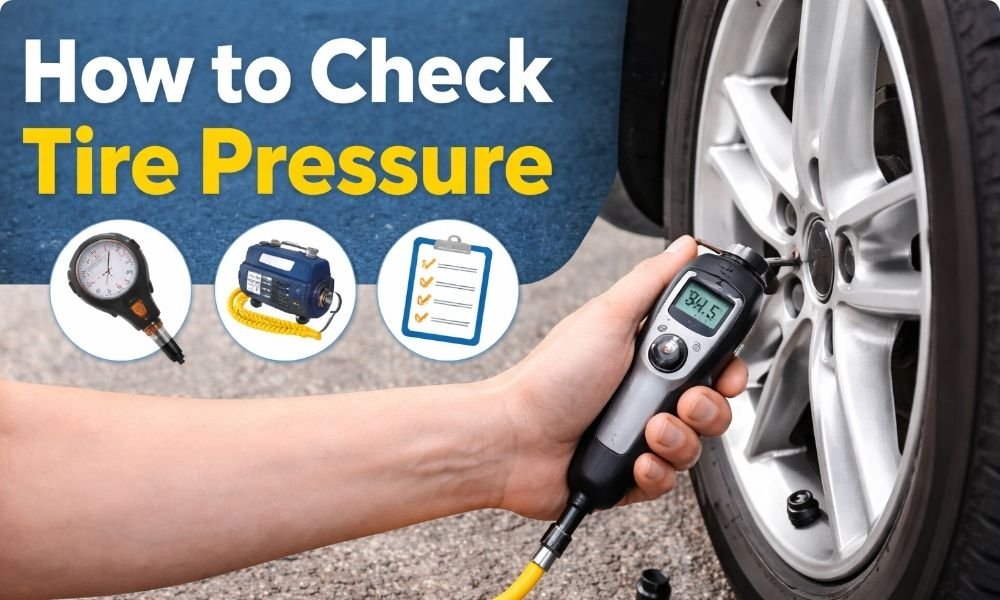
How to Check Tire Pressure (Simple Step-by-Step Guide for Everyday Drivers)
Keeping your tires at the right pressure is one of the easiest ways to stay safe on the road, save money on gas, and make your tires last longer. Yet many drivers don’t check their tire pressure often enough—or rely only on the warning light in their car.
In this guide, you’ll learn how to check tire pressure step by step, what tools you need, and common mistakes to avoid. Even if you’ve never done it before, these simple instructions will help you quickly make sure your tires are properly inflated and ready for safe driving.
By the end of this post, you’ll know exactly how to keep your tires at the right PSI and avoid problems before they start.
Why Tire Pressure Matters (For Real-World Driving)
Tire pressure affects how your car drives every day, even if you don’t notice it right away.
When your tires don’t have enough air, your car can feel less stable. It may take longer to stop, especially in rain or during sudden braking. Low tire pressure also makes your tires wear out faster and causes your car to use more gas.
If your tires have too much air, the ride can feel rough. Your tires may not grip the road as well, which can make steering harder. Over-inflated tires are also more likely to wear unevenly.
The right tire pressure helps your car:
- Stay easier to control
- Stop more safely
- Use less fuel
- Make tires last longer
Checking your tire pressure regularly is a simple habit that helps keep you safe and saves money over time.
Who This Guide Is For
This short section tells readers if this guide is right for them. Keep it simple and helpful.
Who should read this:
- New drivers — if you’re learning the basics and want clear steps.
- Everyday car owners — if you drive to work, run errands, or take the kids to school.
- People with no mechanical experience — you don’t need tools or training to follow this.
- Drivers planning a trip — quick checks before a long drive can prevent problems.
- Anyone who wants to save money — proper tire pressure helps tires last longer and uses less gas.
- People in changing weather — if the seasons or temperature swing a lot, pressure can change and this guide helps you adjust.
Quick note: No prior knowledge needed. The steps are simple and can be done in about five minutes with a basic tire pressure gauge.
What You Need to Check Tire Pressure — simple and practical
Keep this short and useful. Tell readers exactly what to have and what to do before they start.
Essentials (you must have these):
- Tire pressure gauge — digital or stick/analog. This is the only tool you need to read the air pressure.
- Owner’s manual or the PSI sticker — the correct tire pressure for your car is on a sticker inside the driver-side door jamb or in the manual. Use that number, not the number on the tire sidewall.
- A flat, level place to park — park on level ground and set the parking brake so the car won’t roll.
Nice-to-have (makes the job easier):
- Portable air compressor or access to a gas-station air hose — to add air if a tire is low.
- Flashlight — helpful at night or in dim light.
- Pen and paper or phone note — jot down readings if you’re checking all four tires.
- Tire pressure gauge with light — useful for reading the gauge in low light.
Quick alternatives if you don’t have a gauge:
- Many gas stations have air machines with built-in gauges. They work in a pinch but can be less accurate.
- Some auto shops or tire shops will check pressure for free.
Other useful reminders:
- Check when tires are cold (before driving or after the car has been parked for a few hours) for the most accurate reading.
- Don’t forget the spare — check it at least occasionally, especially before a long trip.
- Keep valve caps in place after you finish — they keep dirt and moisture out.
Where to Find the Correct Tire Pressure (PSI)
Keep this simple: use the number your car’s maker gives you, not the number on the tire itself. That number is the right air pressure for your car, tires, and load.
Where to look
- Driver-side door jamb — open the driver door and look on the edge or the frame. Most cars have a sticker there with the correct PSI.
- Owner’s manual — the manual that came with the car lists the correct pressure.
- Fuel filler flap or glove box — some cars put the sticker on the gas door or inside the glove box.
- Trunk area — occasionally the sticker is near the spare tire or in the trunk.
- Manufacturer website or dealer — if you can’t find a sticker or manual, check the car maker’s website or ask a dealer. They can tell you the right PSI for your exact model and year.
Important note: The number stamped on the tire sidewall is the maximum pressure the tire can hold. Do not use that number as your car’s recommended PSI.
Quick tips
- The sticker may show different PSI for the front and rear tires — use the ones that match the tire position.
- If you plan to carry heavy loads or tow, check the owner’s manual for any special tire-pressure recommendations.
- Always record the PSI number (for example, 35 PSI) and use that when you check or add air.
If you can’t find the sticker or manual
- Look up your car’s make, model, and year on the manufacturer’s website.
- Call a local dealer or a trusted tire shop and give them your vehicle details.
Short checklist to keep with you
- Find the sticker or manual → note the PSI for front and rear → use that number when checking your tires.
This makes it fast and clear for readers with no background knowledge. Want a one-sentence version for a sidebar or caption? I can write that next.
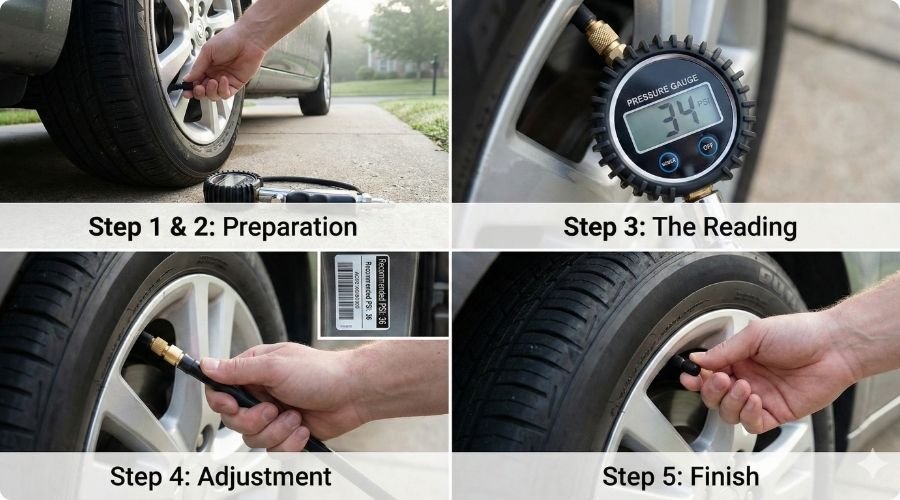
How to Check Tire Pressure (Step by Step)
Check tire pressure when the tires are cold — that means before you’ve driven, or after the car has been parked for at least 3 hours. Hot tires give higher, inaccurate readings.
Step 1: Make sure tires are cold
Park on level ground and set the parking brake. Wait until the tires are cool (or check first thing in the morning).
Step 2: Remove the valve cap
Find the small cap on the tire valve and twist it off. Keep it somewhere safe so you don’t lose it.
Step 3: Press the gauge firmly onto the valve
Place your tire pressure gauge straight onto the valve stem. Push until the hissing stops and the gauge gives a reading.
- For digital gauges: read the number on the screen.
- For stick/analog gauges: pull out the measuring stick or read the dial.
If you hear a loud hiss and can’t get a reading, press harder and hold the gauge steady.
Step 4: Compare the reading to the recommended PSI
Look at the PSI number on your car’s sticker or in the owner’s manual (not the tire sidewall).
- If the reading is lower, add air until it matches the recommended PSI.
- If the reading is higher, press the small pin in the center of the valve briefly to let out a little air, then check again.
After adding or releasing air, always re-check the pressure to be sure it’s correct.
Step 5: Replace the valve caps
Screw the valve caps back on snugly. They keep dirt and moisture out.
Common Mistakes to Avoid
Even though checking tire pressure is simple, a few common mistakes can give you the wrong reading or cause problems later.
Checking tires after driving
Tires heat up when you drive. Warm tires show higher pressure than they really have. Always check tire pressure before driving or after the car has been parked for a few hours.
Using the number on the tire
The number printed on the tire is the maximum air it can hold. It is not the right pressure for your car. Always use the number on the sticker inside the driver’s door or in the owner’s manual.
Relying only on the warning light
The tire pressure warning light usually turns on after pressure is already too low. It does not tell you which tire is low or how much air you need. Use a gauge to check.
Forgetting to check all four tires
One tire can lose air faster than the others. Check every tire, even if only one looks low.
Not putting the valve caps back on
Valve caps keep dirt and moisture out. Leaving them off can lead to slow leaks over time.
Skipping the spare tire
If your car has a spare, check it too. A flat spare won’t help in an emergency.
How Often You Should Check Tire Pressure
Keep it short and easy: check your tire pressure often enough that small problems don’t become big ones. Here’s a simple plan that anyone can follow.
Basic rule
- Check once a month.
That keeps small leaks or slow pressure loss from sneaking up on you.
Also check when any of these happen
- Before a long trip (road trip, long commute).
- When the seasons change or the temperature drops a lot — cold air lowers pressure.
- If the tire pressure warning light comes on.
- After you hit a pothole or curb, or if you notice a bump or vibration while driving.
- After tire work (new tires, patching, rotation, or alignment).
- Check the spare at least a few times a year and before long trips.
Why these checks matter (in plain words)
- Monthly checks catch slow leaks early.
- Temperature changes can lower pressure by about a little each time it gets much colder.
- Checking before trips keeps you safer and avoids breakdowns.
How long it takes
- About 5 minutes to check all four tires once you have a gauge.
Easy ways to remember
- Put a monthly reminder in your phone calendar.
- Check when you fill up with gas.
- Add it to a vehicle maintenance checklist (oil change, filters, etc.).
Does Tire Pressure Affect Fuel Economy?
Yes. Tire pressure affects how much gas your car uses.
When your tires don’t have enough air, they press harder against the road. This makes the engine work harder to move the car. When the engine works harder, it uses more gas.
Low tire pressure can also cause tires to wear out faster, which means you may need to replace them sooner.
When your tires have the right amount of air:
- Your car rolls more easily
- The engine doesn’t have to work as hard
- You use less gas over time
You may not notice the change right away, but over weeks and months, low tire pressure can cost you extra money at the gas pump.
Trusted Safety Guidance
Automotive safety organizations like the National Highway Traffic Safety Administration (NHTSA) and major tire manufacturers emphasize regular tire pressure checks as a key safety habit. Properly inflated tires reduce the risk of tire failure and improve vehicle control.
Conclusion
Checking your tire pressure is quick, easy, and one of the simplest ways to keep your car safe and efficient. By following the steps in this guide—using a gauge, checking when tires are cold, and keeping the pressure at the recommended PSI—you can avoid uneven tire wear, improve fuel economy, and prevent potential safety issues.
Make it a habit to check your tires at least once a month, before long trips, and whenever the temperature changes. A few minutes of attention now can save you money, extend the life of your tires, and give you peace of mind on the road.
Remember: Properly inflated tires aren’t just about performance—they’re about safety, efficiency, and taking good care of your car.
FAQs
How do I know the right PSI for my car?
Look at the sticker on the driver-side door jamb or check your owner’s manual. That number is the correct PSI for your car — not the number on the tire sidewall.
Can I check tire pressure without a gauge?
A gauge is best. If you don’t have one, use the air machine at a gas station (many have built-in gauges) or ask a tire shop to check it. Visual checks (looking at a tire) are not reliable.
When is the best time to check tire pressure?
Check when the tires are cold — before you’ve driven or after the car has sat for at least 3 hours. Cold readings are the most accurate.
How often should I check tire pressure?
At least once a month, before long trips, after big temperature changes, and any time the tire pressure warning light comes on.
What does the tire pressure warning light mean?
It means one or more tires is significantly below the car’s set pressure threshold. It doesn’t tell you which tire or the exact PSI. Use a gauge to find out.
How much does temperature change affect tire pressure?
Tire pressure can fall about 1–2 PSI for every 10°F (≈5–1°C) drop in temperature. Check more often when seasons change.
How do I add or release air?
To add air, push the hose nozzle onto the valve and add air in short bursts, then re-check with a gauge. To release air, press the small pin inside the valve stem briefly, then check again.
My tire keeps losing air — what should I do?
If a tire loses air quickly, don’t drive on it. Have a tire shop inspect it for a puncture, damaged rim, or bad valve. They can repair or replace it safely.
Should I check the spare tire?
Yes. Check the spare a few times a year and before long trips so it’s ready if you need it.
Digital gauge or stick/analog gauge — which is better?
Digital gauges are easy to read and fast. Stick or dial gauges work well too if they’re in good condition. Buy a quality, affordable gauge — accuracy matters more than price.
Can I drive on a slightly underinflated tire?
Avoid driving far on an underinflated tire. Low pressure affects handling and can cause tire damage or a blowout. If it’s only a little low, add air as soon as you can; if it’s losing rapidly, stop and get help.
How long does it take to check all four tires?
About 5 minutes once you have a gauge and know the recommended PSI.
I don’t understand PSI — what is it?
PSI means “pounds per square inch.” It’s the unit used to measure tire air pressure. Just use the number from your car’s sticker and set your tires to that number.
Where can I get professional help or free checks?
Many tire shops, auto parts stores, and some gas stations will check your tire pressure for free or for a small fee.
