Motorcycle Tire Conversion Chart
Last updated on February 26th, 2026
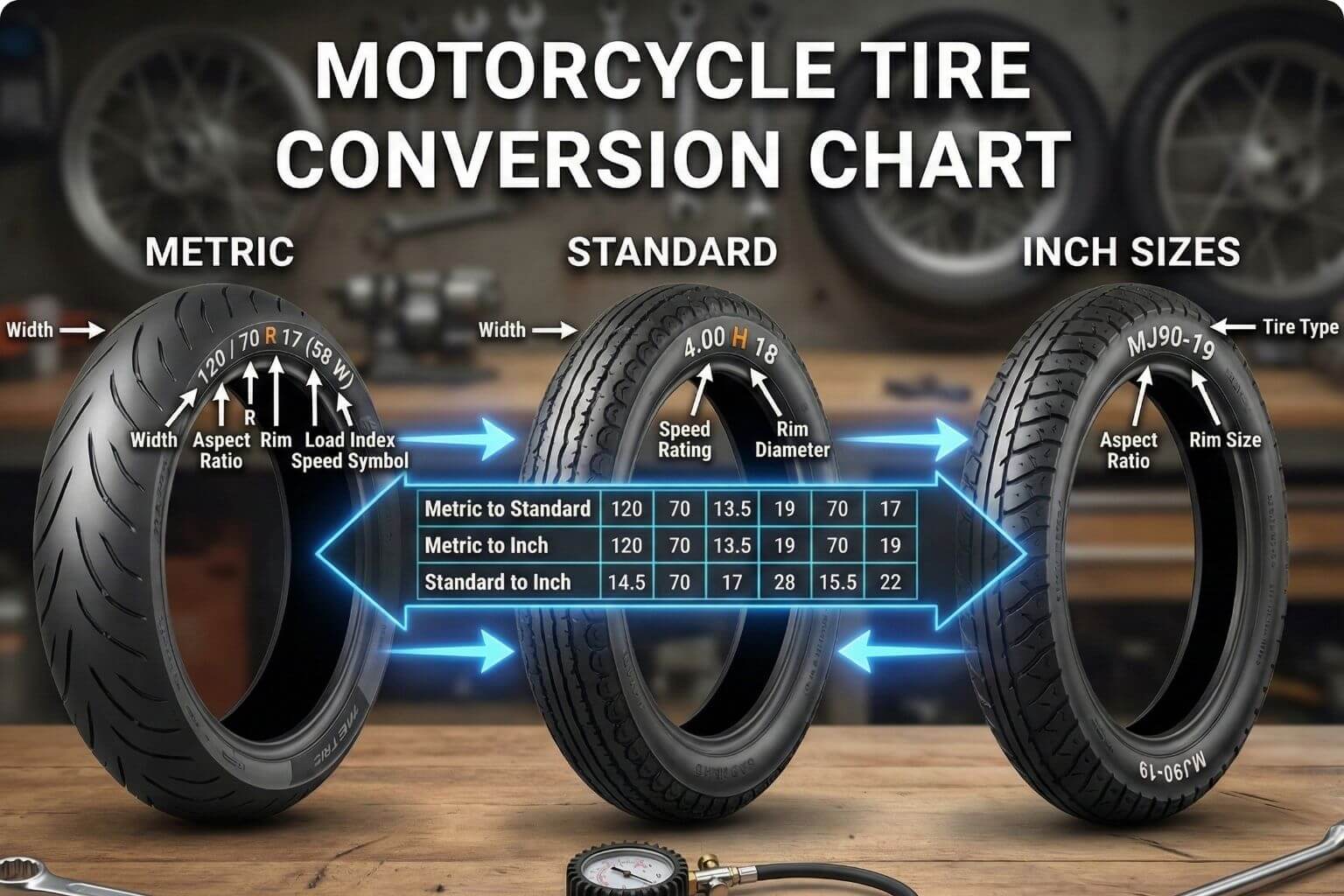
This Motorcycle Tire Conversion Chart provides fast, accurate conversions between Metric, Alpha, and Inch tire sizes for both Street and Off-Road motorcycles. If you’re replacing worn tires, restoring a classic bike, or comparing sizing options, this page gives you clear front and rear tire equivalents in one place.
The chart is organized into dedicated sections for Street Front, Street Rear, Off-Road Front, and Off-Road Rear tires, making it easy to find the exact conversion you need without scrolling through unnecessary information.
Use this as a quick-reference guide to match tire sizes confidently and avoid ordering the wrong fitment.
How to use these charts
- Find your metric size (e.g., 130/90-16 or 120/70-17) in the left column.
- Read across to see the alpha code (older cruiser/std system) and an inch style equivalent.
- These are approximate equivalences — always confirm load index, speed rating, rim width compatibility and clearances before fitting.
Street Motorcycle Tire Conversion Chart
Street motorcycles commonly use metric sizing, while older bikes and many cruisers may use alpha or inch sizing. The following charts help you match equivalent sizes.
Street Front Tire Conversion Chart
| Metric Size | Alpha Size | Inch Size |
| 80/90-21 | — | 2.75-21 |
| 90/90-18 | MH90-18 | 3.00-18 |
| 90/90-19 | MH90-19 | 3.00-19 |
| 100/90-18 | MJ90-18 | 3.25-18 |
| 100/90-19 | MJ90-19 | 3.25-19 |
| 110/90-18 | MM90-18 | 3.50-18 |
| 110/90-19 | MM90-19 | 3.50-19 |
| 120/70-17 | — | 4.50-17 |
| 120/80-18 | — | 4.00-18 |
| 130/70-18 | — | 4.50-18 |
Note: Alpha sizing is most common on cruisers and older street bikes.
Street Rear Tire Conversion Chart
| Metric Size | Alpha Size | Inch Size |
| 120/90-16 | MR90-16 | 4.25-16 |
| 130/90-15 | MT90-15 | 5.00-15 |
| 130/90-16 | MT90-16 | 5.00-16 |
| 140/90-15 | MU90-15 | 5.50-15 |
| 140/90-16 | MU90-16 | 5.50-16 |
| 150/80-16 | MV85-16 | 6.00-16 |
| 150/90-15 | MV85-15 | 6.00-15 |
| 160/80-16 | — | 6.50-16 |
| 170/80-15 | — | 6.70-15 |
| 180/65-16 | — | 7.00-16 |
| 180/70-15 | — | 7.10-15 |
| 200/55-17 | — | 7.90-17 |
Alpha sizes are primarily used for cruiser rear tires.
Off-Road Motorcycle Tire Conversion Chart
Off-road tires (motocross, enduro, dual-sport) are typically shown in metric sizing, but many riders reference them in inches. These conversions are common equivalents.
Off-Road Front Tire Conversion Chart
| Metric Size | Inch Equivalent |
| 70/100-17 | 2.50-17 |
| 80/100-21 | 3.00-21 |
| 90/90-21 | 3.25-21 |
| 90/100-21 | 3.50-21 |
| 80/100-19 | 2.75-19 |
| 90/100-19 | 3.50-19 |
| 100/90-19 | 3.75-19 |
Off-road front tires commonly use 21″ rims.
Off-Road Rear Tire Conversion Chart
| Metric Size | Inch Equivalent |
| 90/100-16 | 3.50-16 |
| 100/100-18 | 4.00-18 |
| 110/90-18 | 4.50-18 |
| 110/100-18 | 4.50-18 |
| 120/80-18 | 4.75-18 |
| 120/90-18 | 4.50-18 |
| 120/100-18 | 5.00-18 |
| 130/80-18 | 5.10-18 |
| 140/80-18 | 5.50-18 |
Off-road rear tires most commonly use 18″ rims.
Understanding Motorcycle Tire Sizes
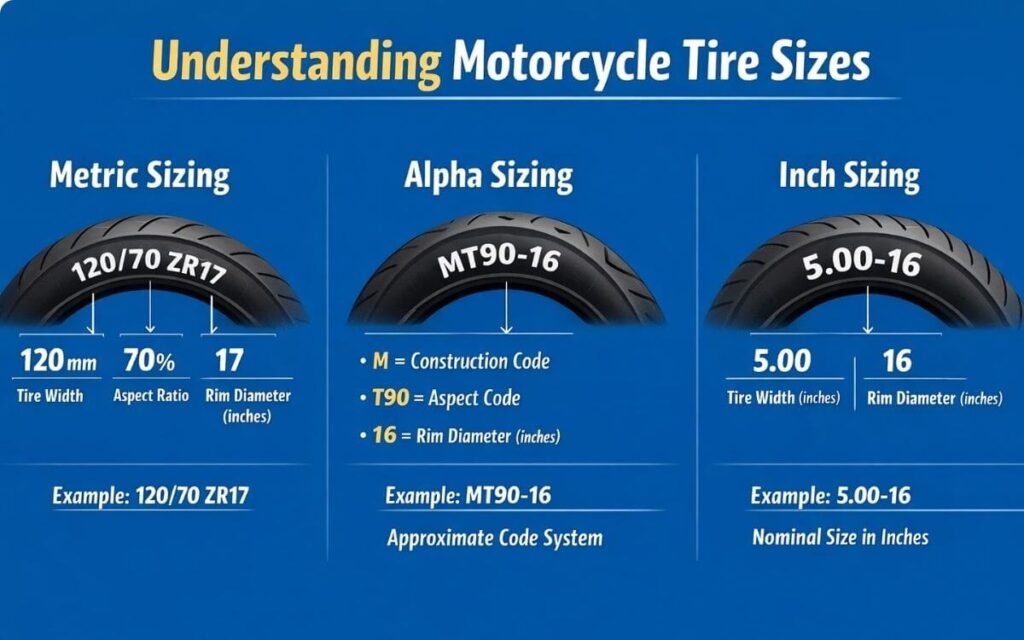
- Metric sizing (e.g., 120/70-17) lists width in mm / aspect ratio / rim diameter in inches. The overall diameter can be calculated from these numbers.
- Alpha sizing (e.g., MT90-16) is an older system used on many cruiser/classic tires — it’s an approximate code, not a strict geometric conversion.
- Inch sizing (e.g., 5.00-16) historically expresses tire nominal width and rim diameter in inches. Modern inch entries are approximations when matching to metric specs.
Important Fitment Warnings Before Converting Tire Sizes
These conversions are approximate. Rolling circumference and real-world fit depend on tread, construction, rim width and manufacturer tolerances. Always confirm with your bike’s manual and the tire manufacturer.
Load index & speed rating matter. Even if a converted size “fits”, the tire must meet or exceed the OEM load index and speed rating for safety.
Overall diameter changes affect instruments. Changing overall tire diameter will change speedometer/odometer readings and — in larger deviations — can affect ABS/traction control behavior; aim to keep overall diameter within a small percentage of OEM (many sources recommend within ~1–3%). If in doubt, consult a dealer or use a size calculator.
Rim width compatibility & clearance. Rim width must be compatible with the tire’s recommended rim range. Also check swingarm/fender/chain clearance before fitting a wider or taller tire.
Tubes vs tubeless: If you’re changing form factor or size, check inner-tube compatibility (if you use tubes). Use tube reference charts (e.g., RevZilla) to match tube sizes.
How to calculate overall diameter (quick formula)
Overall diameter (mm) ≈ 2 × (width × aspect_ratio/100) + rim_diameter_in_inches × 25.4
Example: For 120/70-17: diameter ≈ 2 × (120×0.70) + 17×25.4 = 2×84 + 431.8 = 599.8 mm (≈ 599.8 mm). Use this to compare to OEM specs before swapping.
FAQs
Q: Can I replace a 130/90-16 with a 5.00-16?
A: Generally yes — 130/90-16 commonly maps to MT90-16 / 5.00-16 on many conversion charts — but confirm load/speed rating and rim width first.
Q: Will a different tire size hurt handling?
A: Changing width, profile, or diameter can alter handling, steering effort and ground clearance. Small changes are often tolerable; large changes can be unsafe. Stick close to OEM or consult a pro.
Q: Are alpha sizes still used?
A: Yes — especially on cruisers, classic bikes and some replacement tires. They remain useful when matching older rim/tire combos.
Q: How accurate are conversion charts?
A: They’re a practical guide — not scientifically exact — because tread pattern, manufacturer tolerances and bead construction all change the final circumference. Always verify with manufacturer fitment notes.
Final Thoughts
In conclusion, this Motorcycle Tire Conversion Chart is your go-to reference for quickly and accurately converting between Metric, Alpha, and Inch tire sizes for both Street and Off-Road motorcycles. Whether you’re replacing tires, upgrading rims, or restoring a classic bike, these charts provide the essential information you need to ensure proper fitment.
Always remember to double-check load ratings, speed ratings, rim width, and clearance before installing a replacement tire, as even small differences can affect handling and safety. By using this guide, you can make informed decisions, avoid costly mistakes, and keep your bike performing at its best.
Ride safely and confidently with the right tires every time.
