Can I Replace Just One Tire? (Complete 2026 Guide)
You walk outside and see it — one flat tire. Maybe it picked up a nail. Maybe it blew out on the highway. Now you’re standing there wondering:
Can I replace just one tire, or do I really need to replace two… or even all four?
The honest answer is this:
Yes, sometimes you can replace just one tire. But only if certain conditions are met.
In some situations, replacing just one tire is perfectly safe. In others, it can affect handling, braking, or even damage your drivetrain — especially if you drive an AWD vehicle.
In this guide, I’ll explain when it’s safe, when it’s risky, and how to make the right decision without wasting money.
Can I Replace Just One Tire?
Here’s a short, easy-to-read summary for quick decisions. Read the table, then follow the two short tips below it.
| You can replace one tire if — | You should replace two or four tires if — |
| Your other tires are nearly new | You drive an AWD vehicle |
| Tread depth difference is less than 2/32” | Tread wear difference exceeds 2/32” |
| Your vehicle is FWD or RWD | Other tires are more than 50% worn |
This table gives the fast answer: one tire is usually fine only when the others are almost new and very close in tread depth.
A small drawback: if you guess instead of measuring, you can create uneven handling or wear. Take two minutes to check tread depth before deciding — it’s the simplest way to avoid a costly mistake.
Why This Question Matters
Tires are both a safety item and a major maintenance cost. Replacing a single tire feels like the obvious, wallet-friendly choice after a puncture or sidewall damage. But mismatched tires can cause more than uneven wear — on some vehicles they cause drivetrain strain that can lead to expensive repairs.
Think of it as balancing short-term savings vs long-term risk: a $200 tire today might save you money, or it might trigger a $1,500–$3,000 repair down the road if the vehicle’s system has to constantly compensate for mismatched wheel rotation.
When It’s Safe to Replace Just One Tire
Replacing just one tire can be perfectly fine in certain situations. The key is making sure the new tire closely matches the others in wear and size.
First, let’s quickly understand tread depth.
New tires usually start with about 10/32” to 12/32” of tread depth. That number simply measures how deep the grooves are in the tire. As you drive, those grooves slowly wear down. The smaller the number gets, the more worn the tire is.
If your other three tires are still close to their original depth — and the difference between them and the new tire is less than 2/32 of an inch — replacing just one tire is usually safe. That small difference won’t cause noticeable problems on most vehicles.
Here are the situations where a single tire replacement often makes sense:
- The other tires are almost as new and show very little wear.
- The tread difference between the new and old tires is under 2/32”.
- Your vehicle is front-wheel drive (FWD) or rear-wheel drive (RWD), not all-wheel drive (AWD).
- The damage happened to just one tire, like a sidewall cut or a blowout, and the other tires are still in good shape.
- The current tires have low mileage, usually under 5,000 to 8,000 miles.
Front-wheel and rear-wheel drive vehicles are generally more forgiving when it comes to small tread differences. They don’t rely on all four tires spinning at exactly the same rate the way many AWD systems do.
If your tires are fairly new and one gets damaged by a nail or road hazard, replacing just that one tire is often the most practical and cost-effective choice.
That said, always measure first. Even tires that look similar can have different tread depths. A quick check with a tread gauge can save you from guessing.
When the numbers are close and your vehicle isn’t AWD, replacing one tire is usually a safe and sensible solution.
When You Should Replace Two or Four Tires
There are times when replacing just one tire can create more problems than it solves. In these cases, it’s safer to replace two tires — or sometimes all four.
Here are the main situations where a single tire replacement is not a good idea:
- You drive an AWD (all-wheel-drive) vehicle.
- The tread difference is more than 2/32 of an inch.
- The other tires are already worn below 5/32”.
- Your tires show uneven wear patterns.
Let’s break that down in simple terms.
If your vehicle is AWD, all four tires work together all the time. They are connected through parts under the car that send power to each wheel. Those parts expect all four tires to spin at nearly the same speed.
When one tire is much newer and has deeper tread, it’s slightly taller. That small height difference means it rotates at a different speed compared to the worn tires.
The car’s system tries to correct this constantly. Over time, that extra effort can cause strain on parts like the differential or transfer case. Repairs for those parts are expensive.
Some manufacturers are very clear about this. For example, Subaru recommends keeping tread depth differences very small on their AWD vehicles. Ignoring this advice can lead to drivetrain damage.
Industry groups such as the Tire Industry Association also support matching tires closely to prevent mechanical stress.
Another warning sign is low overall tread. If your tires are already below 5/32”, they’re getting close to the end of their useful life. Adding one brand-new tire next to three worn ones creates a big difference in height and grip.
Uneven wear is another reason to replace more than one tire. If your tires show cupping, one-sided wear, or bald spots, simply adding one new tire won’t fix the underlying issue. In some cases, it can even make handling feel unbalanced.
Yes, replacing two or four tires costs more upfront. But in these situations, it’s often the smarter choice long-term. It protects your vehicle, keeps handling stable, and helps you avoid much larger repair bills later.
How Uneven Tread Can Damage Your Vehicle
Tire wear changes the size of the tire a little bit. As the tread wears down, the tire’s circumference — the distance around the tire — gets smaller. That means a worn tire turns slightly faster at the same speed than a newer, taller tire.
All-wheel-drive systems and other drivetrain designs assume the tires will spin at nearly the same speed. When one tire is taller, the car’s control systems and mechanical parts try to make up for the difference all the time. That constant correcting — whether it’s hydraulic, electronic, or mechanical — puts extra stress on parts like the differential or transfer case.
Over months of driving, that extra stress adds up. Bearings, gears, or clutches in the drivetrain can wear faster, and small problems become big, expensive repairs. In short: a small mismatch that feels minor in the driveway can cause real mechanical wear over time.
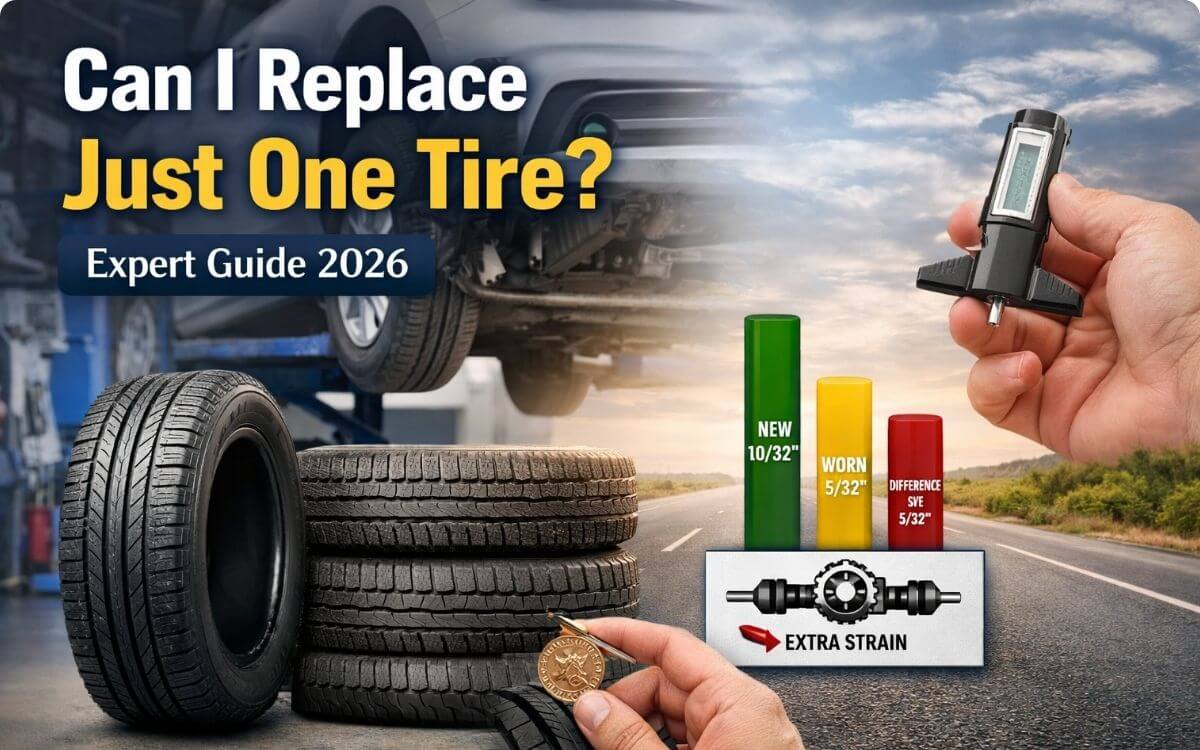
A simple real-world example helps make this clear. Imagine one brand-new tire with about 10/32” of tread next to three worn tires at 5/32”. That single new tire is noticeably taller. Even though the difference sounds tiny, the taller tire forces the drivetrain to compensate continuously. The result is imbalance, extra heat, and added wear where parts are trying to correct the mismatch.
Visual idea you can use in the article: show a small comparison chart with three vertical bars labeled “New (10/32)”, “Worn (5/32)”, and “Difference (5/32)”. Add a second row showing the relative rotation speed or a simple icon of a drivetrain with an arrow labeled “extra strain”. A clear caption like “Small tread differences cause continuous drivetrain compensation” makes the point at a glance.
That visual plus a short explanation helps readers see why even a few 32nds of an inch matter — and why matching tires isn’t just about grip, it’s about protecting expensive drivetrain parts.
Can I Replace Just One Tire on an AWD Vehicle?
The short answer is usually no — unless the tread difference is very small and within the limit set by your vehicle manufacturer.
All-wheel-drive (AWD) vehicles send power to all four wheels. That system works best when all four tires are the same size and wear level. Even a small height difference between tires can cause the system to work harder than it should.
Many AWD systems allow a maximum tread difference of about 2/32 of an inch. Anything more than that can increase the risk of drivetrain wear over time. That may not cause an immediate problem, but it can shorten the life of expensive parts.
The National Highway Traffic Safety Administration emphasizes proper tire maintenance because uneven or mismatched tires can affect both safety and vehicle performance. Keeping tires closely matched is part of that responsibility.
Some AWD systems work differently depending on the brand. For example, vehicles from Audi often use advanced full-time AWD systems that constantly send power to all four wheels. Many models from Toyota use systems that switch power between front and rear wheels when needed.
Even though the systems are designed differently, the basic rule stays the same: they perform best when the tires match closely.
If you drive an AWD vehicle and one tire is damaged, measure the remaining tread carefully. If the difference is more than 2/32”, replacing two or all four tires is usually the safer choice. It costs more upfront, but it protects the parts that are much more expensive to fix later.
Can You Shave a New Tire to Match the Others?
Yes, in some cases you can.
Tire shaving is a process where a shop carefully removes a small amount of tread from a brand-new tire so it matches the tread depth of your other tires. The goal is simple: make all four tires the same height.
This is most commonly used on AWD vehicles. Instead of replacing all four tires, you buy one new tire and have it trimmed down to match the others. That way, the tires rotate evenly and the drivetrain isn’t stressed.
It usually costs more than a standard tire installation, but far less than buying three extra tires. For many drivers, it’s a smart middle-ground option.
There are a few things to keep in mind.
Not every tire shop offers shaving. It requires special equipment, and many general repair shops don’t have it. You may need to call around or visit a performance tire shop.
Also, shaving slightly reduces the usable life of the new tire because you’re removing some tread right away. That means it won’t last as long as a full-depth new tire. Still, for many people, that trade-off is worth it to avoid buying a complete set.
If you drive an AWD vehicle and your other tires still have good tread left, tire shaving can be a practical and cost-effective solution. It’s not widely discussed, but in the right situation, it can save you a significant amount of money while keeping your vehicle protected.
Cost Comparison: One Tire vs Two vs Four
Cost is a big part of the decision. Here’s a simple comparison to put the trade-offs into perspective.
| Option | Typical Cost (per tire) | Typical Total Cost | Risk |
| Replace 1 tire | $150–$250 | $150–$250 | Low–Moderate (depends on tread match and vehicle type) |
| Replace 2 tires | $150–$250 | $300–$500 | Moderate |
| Replace 4 tires | $150–$300 | $600–$1,200 | Lowest risk long-term |
Keep in mind: drivetrain repairs from mismatched tires — such as a differential or transfer case — can range from roughly $1,500 to $3,000 or more. That potential cost is the main reason some vehicle owners choose the safer, higher-upfront option.
If you’re on a budget and your vehicle and tire condition allow it, replacing one tire can be perfectly reasonable. If you drive an AWD vehicle or the existing tires are worn, think of the extra cost of 2–4 tires as insurance against much larger repairs.
– Do not use bullet points everywhere, only use where helpful. – Be honest and balanced (mention small drawbacks if relevant). – Do NOT repeat content from other sections. – Do not use sub heading (H3, H4) everywhere, only use where helpful.
How to Check If You Can Replace Just One Tire
Start with a simple tool: a tread depth gauge. It’s cheap, easy to use, and gives a clear number in 32nds of an inch. Press the gauge into the deepest groove, read the number, and write it down. Do this in the inside, center, and outside of each tire and use the lowest reading for that tire — that’s the safe measure of how worn it is.
If you don’t have a gauge, the penny test is a quick alternative. Put a penny head-first into a tread groove. If you can see the top of Lincoln’s head, the tread is very low (about 2/32″ or less) and the tire needs replacing. The penny test is rough — it’s fine for a fast check, but it can’t replace a gauge for precise decisions.
Measure all four tires and compare the lowest readings. Look for the biggest gap between any two tires. Also check for uneven wear across each tire; if one tire is much lower on the inside or outside, that can cause handling issues even if overall numbers seem close.
Decision rule to use: if the largest difference between tires is 2/32″ or less, replacing a single tire is often acceptable for most FWD or RWD cars. For AWD vehicles or if you see uneven wear, treat that rule more conservatively — err toward replacing pairs or all four.
If you’re unsure or the numbers are borderline, ask a reputable shop to measure in front of you. A quick, accurate check can save you money and prevent bigger problems later.
Is the Tire Shop Upselling You?
Tire shops sometimes recommend replacing two or four tires — and sometimes that’s exactly the right advice. It helps to know which is which.
Legitimate reasons to replace more than one tire:
- Your vehicle is AWD.
- Tires show uneven wear patterns (cupping, feathering).
- The existing tires are near the end of life (low tread across the board).
Signs the shop might be overselling:
- They push full replacement when your tread measurements are solid and the vehicle is FWD/RWD.
- They don’t show you the tread measurements or explain the drivetrain risks.
Tip: Ask the shop to measure tread depth in front of you, and request the reason they recommend 2–4 tires. A reliable shop will explain the drivetrain logic and show the readings — a high-trust approach you should expect.
For broader testing and buyer guidance on tires and repairs, independent organizations and review groups provide useful testing data and recommendations. Consumer Reports and major tire makers have published practical guidance on matching tires and replacement strategies. For manufacturer-specific limits and advice, consult official resources produced by major tire manufacturers or the vehicle maker.
Quick Decision Checklist
Use this simple checklist to decide quickly:
- Is your vehicle AWD? → If yes, avoid replacing only one tire unless explicitly allowed.
- Are the other tires within 2/32” of difference compared to a new tire? → If yes and the vehicle is FWD/RWD, replacing one may be fine.
- Are the other tires less than ~5/32” tread remaining? → If yes, consider replacing pairs or all four.
- Can your local shop shave a new tire to match the others? → If yes and you want to save money, shaving can be a good option.
- Do you see uneven wear patterns? → If yes, replacing more than one is likely needed.
If you answered “yes” to AWD, large tread difference, or uneven wear, plan on replacing at least two tires — often all four.
Frequently Asked Questions
Can I replace just one tire on a front-wheel-drive car?
Yes, if the other tires are in good shape and tread difference is very small. Measure and compare before you decide.
How much tread difference is too much?
A common practical threshold is around 2/32 of an inch. Larger differences increase risk, especially for AWD vehicles.
Will insurance cover multiple tires?
Insurance coverage depends on your policy and the cause (e.g., road hazard coverage vs comprehensive). Check your policy or call your insurer.
Can I mix tire brands?
Mixing brands is possible, but it can affect handling. Matching tire type and size is more important than brand alone.
How long can I drive with uneven tires?
Driving with small tread differences for a short time is okay, but avoid long-term use — the risk is higher for AWD cars or when differences grow.
Final Verdict: Should You Replace Just One Tire?
Replacing one tire can be a safe, cost-effective choice when the rest of your tires are in good shape and the tread difference is small, especially on FWD or RWD vehicles. For AWD vehicles, or when the existing tires are moderately or heavily worn, replacing two or all four is the safer choice. Consider tire shaving as a middle option if you want to save money but keep your drivetrain protected.
Practical next steps: measure all four tires, check your vehicle manual for any manufacturer limits, and ask a trusted shop to demonstrate their measurements. That combination — data, manufacturer guidance, and a clear cost comparison — is the easiest way to make the right decision for safety and your wallet.
