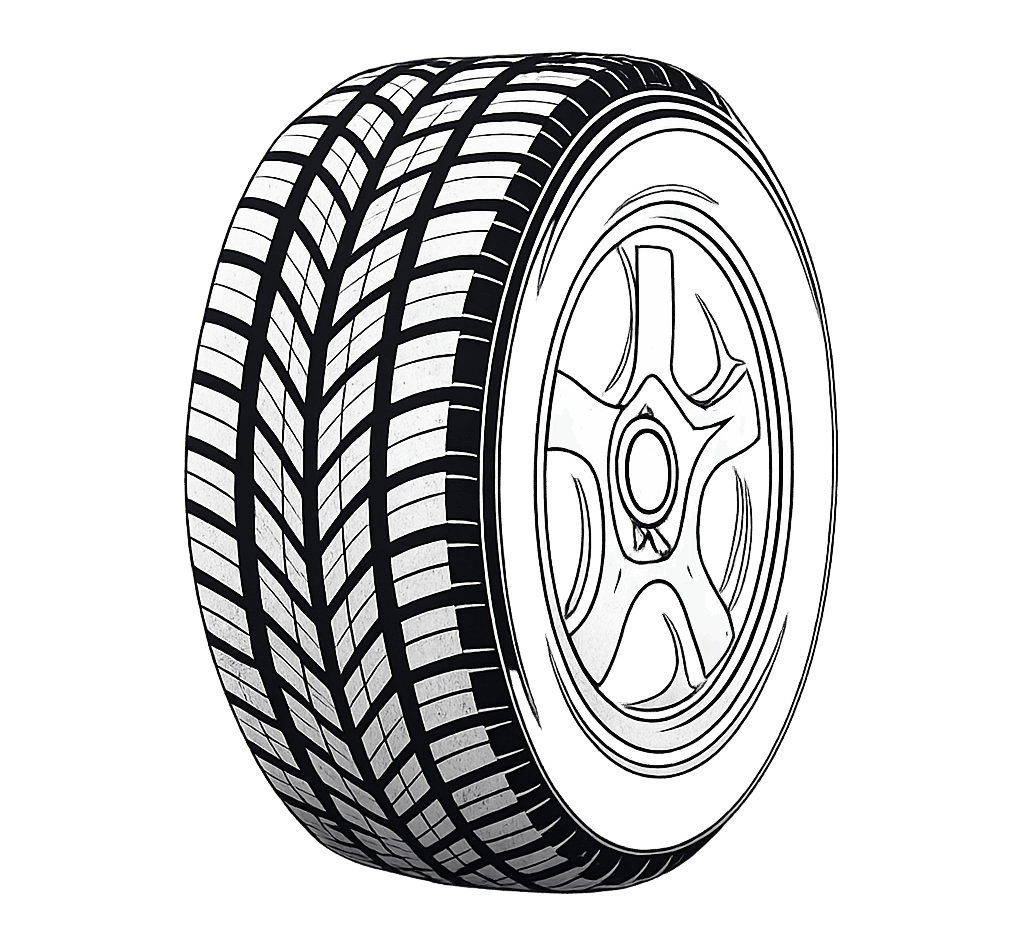

Tire Tread Depth Chart – Know When It’s Time to Replace Your Tires
Most drivers don’t know when their tires are still safe or when they need replacement. Driving on worn tires can drastically increase stopping distances, reduce traction, and even put you at legal risk.
This post includes a complete tire tread depth chart, explains how to measure tread depth at home, covers legal limits, and gives seasonal safety recommendations. By the end of this article, you’ll know exactly when to replace your tires for maximum safety.
Quick Decision Box:
- 🔴 3/32 or less → Replace immediately (dangerous in wet conditions)
- 🟡 4–5/32 → Caution — plan replacement soon
- 🟢 6/32+ → Safe for general use, monitor wear
What Is Tire Tread Depth?

Tire tread depth is simply the distance between the top of the tire’s tread (the raised rubber you see) and the bottom of the grooves (the low parts between the tread blocks). Think of it as how much “meat” is left on the tire that can grab the road.
Tread depth vs. tread pattern
- Tread depth = a measurement (how deep the grooves are).
- Tread pattern = the shape and arrangement of the grooves and blocks (what the tire looks like and how it channels water or bites into snow).
Both matter, but depth tells you how much life the tire has left.
Why those grooves exist
- Move water away — grooves channel water so the tire keeps contact with the road, which reduces hydroplaning.
- Give traction — the edges of the grooves “bite” into surfaces (wet roads, mud, snow) to help the car grip.
- Help braking and turning — deeper grooves generally help the tire stop and turn more reliably, especially in bad weather.
How tread depth is measured (units you’ll see)
Tread depth is usually shown in 32nds of an inch in the U.S. — written like 8/32, 6/32, 4/32, etc. Many places also use millimeters.
Helpful quick conversions (common values):
- 1/32 inch ≈ 0.79 mm
- 2/32 ≈ 1.59 mm
- 3/32 ≈ 2.38 mm
- 4/32 ≈ 3.18 mm
- 6/32 ≈ 4.76 mm
- 8/32 ≈ 6.35 mm
- 10/32 ≈ 7.94 mm
So if your tire measures 4/32, that’s about 3.2 mm of tread left.
Quick takeaway: tread depth tells you how much useful rubber is left for safety; tread pattern tells you how that rubber works. Both are important, but when you’re deciding whether to replace a tire, the tread depth number is the clearest, easiest measurement to use.
Tire Tread Depth Chart
Here’s the core chart showing safe, caution, and unsafe tread depths:
Tread Depth | mm approx. | Condition | Safety Impact | Action |
10/32”–8/32” | 8.0–6.0 | New | Excellent traction | No action |
7/32″–6/32″ | 5.6–4.8 | Slightly worn | Good | Monitor |
5/32″–4/32″ | 4.0–3.2 | Mid-life | Reduced wet/snow performance | Plan replacement |
3/32″ | 2.4 | Worn | High risk in rain | Replace soon |
2/32″ | 1.6 | Legal limit | Very dangerous | Replace immediately |
1/32″ | 0.8 | Bald | Extreme danger | Do not drive |
Color Coding:
- Green → Safe (10–6/32)
- Yellow → Caution (5–4/32)
- Orange → High risk (3/32)
- Red → Dangerous (≤2/32)
Tip: Always consider real driving conditions. Rain, snow, or off-road use may require earlier replacement.
Legal Tire Tread Depth Requirements (By Region)
Different countries set legal minimums for tread depth. Legal limits tell you when a tire can get a ticket or fail inspection — but remember: legal ≠ safe. Below are the common rules in several major regions and quick tips for what you should actually do.
USA — 2/32 inch is the legal minimum
Most U.S. rules and safety standards use 2/32″ (two thirty-seconds of an inch) as the threshold where tires are considered worn out and will fail inspection. That’s why many tires have built-in wear bars at that level.
What to do: Don’t wait until 2/32″. Replace earlier for better safety in wet weather (see replacement tips below).
UK & EU — 1.6 mm is the legal minimum
In the UK and most EU countries the legal limit for passenger car tyres is 1.6 millimetres across the central three-quarters of the tread. If you drive below that, you can be fined and fail safety checks.
What to do: Consider replacing at a higher depth (3 mm or more) if you do a lot of wet-weather driving.
Canada — Safety guidance: avoid under 4 mm (especially for winter)
Canada’s national safety advice recommends not using tires with less than about 4 mm of tread for winter driving; winter-safety guidance emphasizes stronger minimums than the bare legal minimums used for inspections. Provinces may have specific rules or inspection limits.
What to do: For winter use, treat 4 mm as the practical minimum; for year-round driving aim for higher.
Australia — 1.6 mm is the legal minimum; change earlier for safety
Australian road safety guidance lists 1.6 mm as the legal minimum, but tyre experts recommend replacing tyres around 3 mm to keep good wet-weather performance.
What to do: Replace at ~3 mm if you want safer wet-weather braking and lower hydroplaning risk.
Asia & Other Countries — rules vary (check local authority)
Laws differ across Asian countries — some follow 1.6 mm or 2/32″ equivalents, others set local limits. Because rules vary, check your country’s transport or road-safety website for the exact legal limit.
What to do: If you can’t find a clear law, use the practical safety thresholds below (4/32–5/32) as your guide.
Important: Legal ≠ Safe — what that means for you
- Legal minimums are the absolute floor — be aware that tires at the legal limit perform much worse in rain and snow. Studies and safety agencies often advise replacing tires well before they hit the legal minimum.
- Practical replacement guidelines:
- Rainy / monsoon areas → replace at 4/32″ (≈3.2 mm) or earlier.
- Snow / winter driving → replace at 5/32″ or more.
- Dry-only driving → don’t go below 3/32″ if you must, but aim for higher.
- Rainy / monsoon areas → replace at 4/32″ (≈3.2 mm) or earlier.
What Happens at Each Tread Depth Level (Real-World Effects)
Picture this: you’re on your way to work, running errands, or driving the kids to school. The number that tells you how safe your tires are isn’t how they look — it’s how deep those grooves are. Below are simple stories showing what driving feels like at each tread depth, plus clear actions to take.
8/32 – 6/32 (≈ 6.35 mm – 4.76 mm) — “Fresh and confident”
You’ve just put newish tires on your car. On a rainy morning the water slips away under the tires and the car feels planted. Braking is predictable and turns are steady. This is the comfortable, “I trust these tires” zone.
What you’ll notice:
- Strong grip on wet and dry roads.
- Good light-snow performance.
- Normal stopping distances.
What to do:
- Keep driving normally.
- Keep up with regular maintenance (rotate tires, check pressure).
- No rush to replace — you still have plenty of life left.
5/32 – 4/32 (≈ 3.97 mm – 3.18 mm) — “Caution begins”
Your tires are past their freshest stage. On a sunny day you’ll hardly notice, but a sudden rain shows the difference: stopping takes a bit longer, and the car doesn’t feel as sure when turning.
Real-world scene:
- You hit a rain shower after leaving the supermarket. You brake and feel a small increase in stopping distance compared with new tires.
What you’ll notice:
- Wet braking is slower than before.
- Snow traction drops noticeably.
- Hydroplaning risk starts to rise on deeper puddles.
What to do:
- Plan to replace it soon if you drive in rain or snow.
- Drive more carefully in wet weather: reduce speed and increase following distance.
- Check tread often — move to replacement at the first sign of more wear.
3/32 (≈ 2.38 mm) — “Warning light: not safe for bad weather”
This is where things get risky. On a rainy highway your car can start to slide more easily. In heavy rain you may hydroplane — which means the tires ride on top of the water and lose road contact.
Real-world scene:
- Driving on a highway after a storm you feel the car drift slightly when hitting standing water.
What you’ll notice:
- Significant increase in hydroplaning risk.
- Wet braking becomes unreliable.
- Not safe for highway speeds in wet conditions.
What to do immediately:
- Avoid high-speed driving in rain.
- Replace tires ASAP — don’t wait.
- If you must drive, go slow and leave extra distance from other vehicles.
2/32 (≈ 1.59 mm) — “Danger: legal minimum, performance collapsed”
At this depth, tires are at the common legal failure point in many places. They simply can’t move water away effectively anymore.
Real-world scene:
- You get pulled into a safety check or fail an inspection. In the rain, stopping distance is much longer and steering control is poor.
What you’ll notice:
- Tires fail to disperse water well → strong hydroplaning risk.
- Braking distances increase a lot.
- Many inspection systems flag this as unacceptable.
What to do now:
- Replace your tires immediately.
- Do not drive at high speeds or in heavy rain.
- If you get a warning or failure on inspection, do not delay replacement.
1/32 – 0 (≈ 0.79 mm – 0 mm) — “Bald: unsafe and unreliable”
This is the worst case: almost no tread left. Tires here are dangerous — they can blow out, lose control in wet conditions, and are basically unreliable.
Real-world scene:
- A puddle hits and the car feels like it’s floating. At highway speeds a blowout becomes likely.
What you’ll notice:
- Little to no grip in wet or slick conditions.
- Very high chance of accident or blowout.
- It is illegal to drive in most places.
What to do now:
- Stop driving if you can—get the car to a safe place.
- Replace tires immediately before driving again.
- Consider spare/roadside assistance if you can’t replace it right away.
Quick takeaway (what you should act on)
- 6/32+ (≈ 4.76 mm and above) — Comfortable and safe for most conditions.
- 4/32–5/32 (≈ 3.18–3.97 mm) — Start planning replacement, especially for rain/snow.
- 3/32 (≈ 2.38 mm) — Replace as soon as possible; avoid bad weather.
- 2/32 (≈ 1.59 mm) and below — Replace immediately. Don’t risk driving in wet conditions.
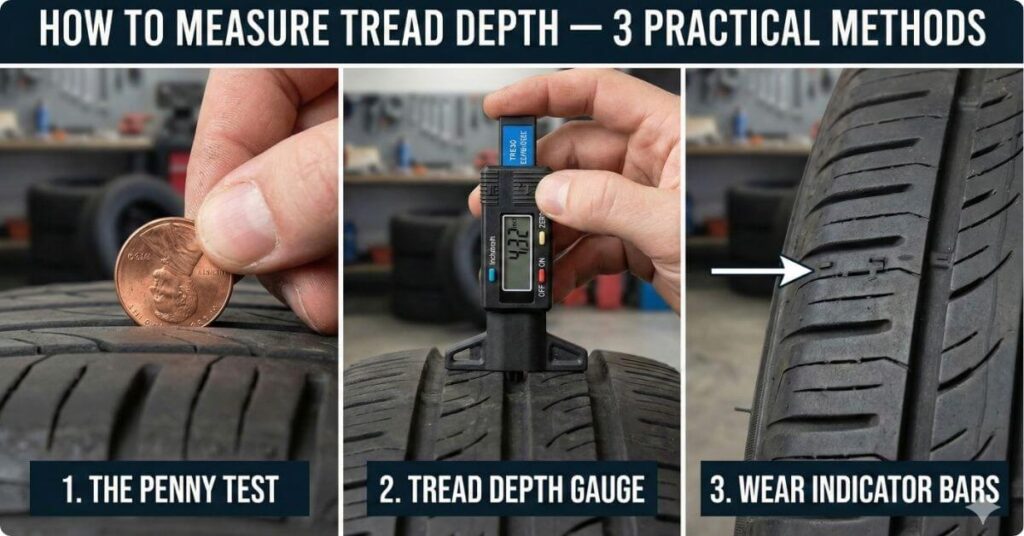
How to measure tread depth — 3 practical methods
Measuring tread depth is quick and easy. Do it on every tire in three places across the tread — inner, middle, outer — because tires often wear unevenly. Check all four tires and any spares.
Method 1 — Tread depth gauge (best, most accurate)
What it is: a small tool with a probe and ruler. Cost: about $5–$25.
How to use (step-by-step):
- Clean a groove so dirt won’t block the probe.
- Press the probe into the deepest part of the groove until the gauge’s base sits flat on the tread.
- Read the number (most gauges give 32nds and mm).
Example: the gauge reads 4/32 — that means the tire is getting worn and you should plan to replace it soon for wet driving.
Tip: measure inner, middle, outer and repeat on each tire.
Method 2 — Penny / coin test (quick and free)
US penny test: Insert a penny into the tread groove with Lincoln’s head facing down. If you can see the top of Lincoln’s head, the tread is around 2/32 — time to replace.
Other countries: use a commonly available coin with a raised portrait or rim. The exact “stop” point varies by coin, so recommend readers use a local coin test or a gauge if unsure.
Method 3 — Built-in tread wear indicators (TWI)
What to look for: small raised bars running across the grooves at several spots. If the tread is level with these bars, the tire has reached its wear limit.
Reliability note: TWIs are handy but check multiple grooves — TWIs can miss uneven wear.
Troubleshooting common mistakes
- Don’t measure on the shoulder (outer edge); measure in the groove.
- Clean the groove before measuring.
- If readings vary across the tire, the tire has uneven wear — get alignment or rotation checked.
Tire Tread vs Driving Conditions (Rain, Snow, Heat, Off-road)
Different roads and weather need different amounts of tread. A tire that feels “okay” on a dry day can be very dangerous in rain, snow, or heat. Here’s an easy way to know what tread depth is safe for your situation.
Rainy areas (monsoon / wet regions)
If you often drive in rain, shallow tread is a big risk. When the grooves are worn down, water stays between the tire and the road. The car can start to float and lose control — this is called hydroplaning.
Action: Replace your tires at 4/32 or earlier in rainy climates.
Why it matters: Deep tread channels push water away so the tire can grip the road and stop safely.
Snow and ice
Snow and ice need even more grip than rain. Shallow tread can’t hold snow or bite into ice, so the car slides more easily.
Action: Use tires with 5/32 or more in winter conditions.
Extra safety: Winter tires are made with softer rubber and special grooves that stay flexible in cold temperatures. They grip much better than normal tires.
Hot climates
In very hot weather, worn tires become dangerous faster. Thin rubber heats up quickly as you drive. This can weaken the tire’s structure.
Risk: Bald or nearly bald tires in heat are more likely to blow out on the road.
Action: Don’t wait until 2/32. Replace early, around 4/32, in hot regions.
Off-road and muddy terrain
Driving on dirt, mud, sand, or gravel needs deeper and more aggressive tread. Smooth or worn tires get stuck easily because they can’t dig into the ground for grip.
Action: Choose tires with deep, chunky tread made for off-road or all-terrain driving.
Why Some Tires Wear Faster Than Others
Tires don’t wear out evenly by accident — most of the time something specific is causing it. Below is a simple explanation of the common causes, what the wear looks like, and exactly what to do to fix or prevent it.
Common causes and quick fixes
Bad alignment
What happens: Wheels point slightly the wrong way, so the tire scrubs as you drive.
How it looks: One-sided wear (tread worn on the inside or outside).
Fix: Get a wheel alignment at a shop. If you feel the car pulling to one side or the steering wheel is off-center, check alignment sooner.
Under- or over-inflation
What happens: Wrong tire pressure changes how the tire’s contact patch touches the road.
How it looks:
- Underinflated → outer edges wear faster (edge wear).
- Overinflated → center wears faster (center wear).
Fix: Check tire pressure monthly and before long trips. Inflate to the vehicle manufacturer’s recommended pressure (found on the door jamb or owner’s manual).
Aggressive driving
What happens: Hard braking, fast cornering, and quick starts grind the tread down faster.
How it looks: Faster, uneven wear across the tread and shorter tire life.
Fix: Smooth driving, gradual braking, and avoiding sudden acceleration extend tire life.
Heavy loads
What happens: More weight presses tires harder into the road, increasing wear.
How it looks: Faster overall wear and possible sidewall damage.
Fix: Don’t overload the vehicle; check tire pressure when carrying heavy loads (increase ressure to the recommended load level).
Poor quality tire compounds
What happens: Cheaper rubber can wear faster, especially at high speeds or hot roads.
How it looks: Quick overall tread loss even with normal driving.
Fix: Buy tires from reputable brands and match the tire type to your driving (all-season, summer, all-terrain, etc.).
Wear-pattern chart
| Wear pattern | What it looks like | Likely cause | What to do |
| Center wear | Middle of tread is lower than edges | Overinflation | Lower pressure to recommended level; check monthly |
| Edge wear | Both outer edges worn more than center | Underinflation or aggressive cornering | Inflate correctly; check driving style; rotate tires |
| One-sided wear | Inside or outside edge worn on one side only | Wheel alignment (camber/toe) | Get alignment check and correct steering/suspension issues |
Final tips
- Rotate tires every 5,000–8,000 miles to even out wear.
- If readings differ across a single tire, see a mechanic — it often signals alignment or suspension problems.
- Take photos of unusual wear and show them to a shop; it helps diagnosis.
This keeps the explanation simple and gives readers clear, actionable steps to find and fix the real cause of fast tire wear.
When Should You Replace Your Tires?
Knowing when to replace your tires can save your life. Worn tires reduce grip, increase stopping distance, and raise the risk of accidents. Here’s a simple, easy-to-follow guide.
1. Rainy climates
If you drive in wet or rainy areas, replace tires when tread reaches 4/32 or less. Shallow tread cannot push water away properly, increasing the risk of slipping or hydroplaning.
2. Winter or snowy regions
For icy or snowy roads, you need more grip. Replace tires at 5/32 or sooner. Winter tires with deeper tread perform much better in cold and slippery conditions.
3. Normal dry use
If you mostly drive in dry weather, you can wait a little longer, but don’t go below 3/32. Even in dry conditions, worn tires are less safe for braking and cornering.
4. Uneven wear, bulges, or cracks
If your tire shows uneven wear, bulges, cuts, or cracks, replace it immediately — regardless of tread depth. These defects can cause blowouts and accidents.
5. Tire age rule
Even if the tread looks okay, tires older than 6 years can become brittle and unsafe. Check the manufacturing date on the tire sidewall (look for the last four digits of the DOT code). Replace old tires to avoid failures.
Quick summary box (easy to remember):
| Condition | When to Replace |
| Rainy / wet roads | 4/32 or less |
| Winter / snow | 5/32 or less |
| Dry conditions | 3/32 or less |
| Uneven wear / cracks / bulges | Immediately |
| Tire age | 6 years max |
Tip: Always check all four tires and your spare. Replacing in time keeps you safe, improves braking, and ensures better control on the road.
Common Causes of Uneven Tread Wear & Fixes
Uneven tire wear shortens tire life and hurts safety. Here are the usual causes, how to spot them, a quick fix, and a prevention tip.
- Improper inflation
- Spot it: Center worn more than edges = overinflation. Edges worn more than center = underinflation.
- Fix: Inflate to the car maker’s recommended pressure.
- Prevent: Check tire pressure monthly and before long trips.
- Spot it: Center worn more than edges = overinflation. Edges worn more than center = underinflation.
- Misalignment
- Spot it: One-sided wear (inside OR outside edge) or the car pulls to one side.
- Fix: Get a wheel alignment at a shop.
- Prevent: Have alignment checked yearly or after hitting a big pothole.
- Spot it: One-sided wear (inside OR outside edge) or the car pulls to one side.
- Worn suspension parts
- Spot it: Irregular or patchy wear, bouncy ride, or unusual vibrations.
- Fix: Replace worn shocks, struts, or bushings.
- Prevent: Inspect suspension during regular service intervals.
- Spot it: Irregular or patchy wear, bouncy ride, or unusual vibrations.
- Lack of rotation
- Spot it: Front tires wear faster than rear (common on FWD cars).
- Fix: Rotate tires to even out wear.
- Prevent: Rotate every 5,000–8,000 miles (or follow vehicle manual).
- Spot it: Front tires wear faster than rear (common on FWD cars).
- Aggressive driving
- Spot it: Rapid, uneven wear and flattened tread blocks.
- Fix: Drive more gently—avoid hard starts and sharp turns.
- Prevent: Smooth acceleration and braking.
- Spot it: Rapid, uneven wear and flattened tread blocks.
Quick maintenance checklist
- Rotate tires every 5,000–8,000 miles.
- Check tire pressure monthly.
- Get alignment checked annually or after impacts.
Conclusion
Knowing your tire tread depth is one of the easiest ways to stay safe on the road. Worn tires reduce grip, increase stopping distance, and can put you at serious risk, especially in rain, snow, or hot conditions. Regular checks and timely replacements keep your car handling properly and prevent accidents.
Quick Summary – When to Replace Tires:
| Tread Depth | Safety Status | Action |
| ✅ 6/32+ | Safe | Keep using |
| ⚠️ 4/32–5/32 | Worn | Replace soon |
| ❌ 3/32 or less | Dangerous | Replace immediately |
Tip: Always check all four tires and your spare. Rotate them regularly, maintain proper inflation, and replace tires based on tread, age, or visible damage — whichever comes first. This simple routine ensures safer driving and longer-lasting tires.
FAQs About Tire Tread Depth
1. Is 3/32 safe for highway driving?
No. At 3/32, your tires are very close to worn out. On dry roads, you might manage, but in rain or wet conditions, stopping distance increases and the risk of hydroplaning is high. Replace tires before they reach this depth for highway safety.
2. Can I just replace two tires instead of four?
You can replace only two tires, but it’s not ideal. The new tires should go on the rear axle, even if your car is front-wheel drive, to maintain stability and prevent oversteering. For the best safety and performance, replacing all four tires is recommended.
3. How long does 1/32 last?
1/32 is basically bald. Tires at this depth are extremely unsafe and could fail at any time. Don’t try to drive on them — they should be replaced immediately.
4. Can bald tires survive rain?
No. Bald tires have almost no grooves to push water away. On wet roads, they can easily hydroplane, which means your car slides uncontrollably. Driving on bald tires in rain is very dangerous.
5. How often should I check the tread?
Check your tread at least once a month and before long trips. Also check after hitting potholes or curbs, as impacts can damage tires. For an easy reminder, use a tread gauge, coin test, or built-in wear indicators.
