Toyota Corolla Lug Nut Torque: Specs by Year
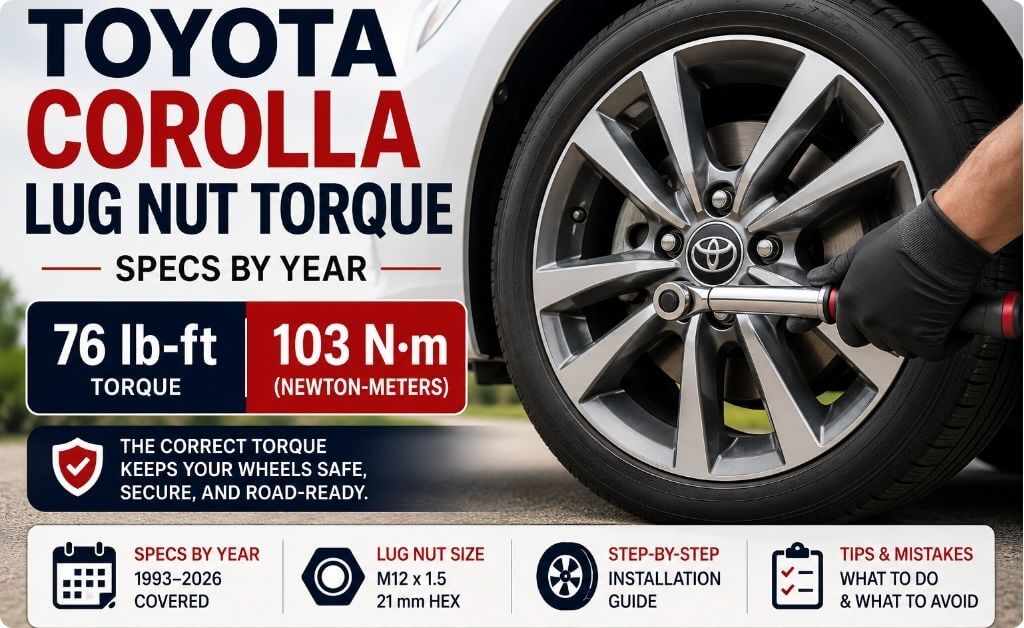
The correct Toyota Corolla lug nut torque is important whenever you install a wheel, change a flat tire, or rotate your tires. For the factory Corolla configurations covered by the Toyota documentation reviewed for this guide, the specified wheel-nut torque is 76 lb-ft (103 N·m).
However, it is important to verify the specification for your exact Corolla before tightening the wheels, especially if the vehicle has aftermarket wheels or lug nuts. This guide provides the Corolla lug nut torque specifications by year and explains how to tighten the wheel nuts correctly with a torque wrench.
Toyota Corolla Lug Nut Torque: Quick Answer
Toyota Corolla lug nut torque: 76 lb-ft (103 N·m) for the factory configurations covered by the Toyota documentation reviewed for this guide. Toyota lists this specification in its Corolla maintenance information and wheel-changing instructions.
Use a properly set torque wrench for the final tightening rather than relying on an impact wrench’s torque setting. If your Corolla has aftermarket wheels or lug nuts, check the wheel and lug-nut manufacturer’s instructions as well as the vehicle-specific Toyota specification.
Toyota Corolla Lug Nut Torque Chart by Year
Toyota specifies a 76 lb-ft (103 N·m) wheel-nut torque for the Corolla configurations covered by the owner’s manuals and Toyota technical documentation reviewed for this guide. The same specification appears across multiple Corolla generations and continues into the current Corolla lineup. Toyota’s documentation also applies the 76 lb-ft (103 N·m) specification across different factory wheel and tire configurations within applicable model years.
Toyota Corolla Lug Nut Torque Specifications
| Model Year | Corolla Generation / Model | Lug Nut Torque | Torque in Nm |
| 1998 | 8th Gen (E110) | 76 lb-ft | 103 N·m |
| 1999 | 8th Gen (E110) | 76 lb-ft | 103 N·m |
| 2000 | 8th Gen (E110) | 76 lb-ft | 103 N·m |
| 2001 | 8th Gen (E110) | 76 lb-ft | 103 N·m |
| 2002 | 9th Gen (E120) | 76 lb-ft | 103 N·m |
| 2003 | 9th Gen (E120) | 76 lb-ft | 103 N·m |
| 2004 | 9th Gen (E120) | 76 lb-ft | 103 N·m |
| 2005 | 9th Gen (E120) | 76 lb-ft | 103 N·m |
| 2006 | 9th Gen (E120) | 76 lb-ft | 103 N·m |
| 2007 | 10th Gen (E140/E150) | 76 lb-ft | 103 N·m |
| 2008 | 10th Gen (E140/E150) | 76 lb-ft | 103 N·m |
| 2009 | 10th Gen (E140/E150) | 76 lb-ft | 103 N·m |
| 2010 | 10th Gen (E140/E150) | 76 lb-ft | 103 N·m |
| 2011 | 10th Gen (E140/E150) | 76 lb-ft | 103 N·m |
| 2012 | 10th Gen (E140/E150) | 76 lb-ft | 103 N·m |
| 2013 | 10th Gen (E140/E150) | 76 lb-ft | 103 N·m |
| 2014 | 11th Gen (E170) | 76 lb-ft | 103 N·m |
| 2015 | 11th Gen (E170) | 76 lb-ft | 103 N·m |
| 2016 | 11th Gen (E170) | 76 lb-ft | 103 N·m |
| 2017 | 11th Gen (E170) | 76 lb-ft | 103 N·m |
| 2018 | 11th Gen (E170) | 76 lb-ft | 103 N·m |
| 2019 | 12th Gen (E210) | 76 lb-ft | 103 N·m |
| 2020 | 12th Gen (E210) | 76 lb-ft | 103 N·m |
| 2021 | 12th Gen (E210) | 76 lb-ft | 103 N·m |
| 2022 | 12th Gen (E210) | 76 lb-ft | 103 N·m |
| 2023 | 12th Gen (E210) | 76 lb-ft | 103 N·m |
| 2024 | 12th Gen (E210) | 76 lb-ft | 103 N·m |
| 2025 | 12th Gen (E210) | 76 lb-ft | 103 N·m |
| 2026 | 12th Gen (E210) | 76 lb-ft | 103 N·m |
Toyota’s owner-manual data directly documents the 76 lb-ft (103 N·m) specification for multiple years within these generation ranges, including the 1998–2002 period, 2005–2010 period, 2013, 2018, 2020, 2022–2023 and 2026. Toyota’s current documentation also continues to use 76 lb-ft (103 N·m) for applicable Corolla wheel configurations.
For the 2024 model year, Toyota’s official Corolla Owner’s Manual is available through Toyota Owners, and Toyota technical documentation for the same-generation GR Corolla specifies 103 N·m (76 ft-lbf) for wheel installation.
For 2025 Corolla Hybrid, the owner’s manual specifies 76 ft-lbf (103 N·m) for the wheel-nut torque and provides the same value in its wheel-maintenance instructions.
Important Note
The torque specification is vehicle-specific, so the owner’s manual or Toyota service information for your exact Corolla should remain the final reference. If you find a different number on a third-party website, verify it against Toyota documentation before using it.
If your Corolla has aftermarket wheels or lug nuts, also follow the applicable wheel and lug-nut manufacturer’s installation instructions. The wheel’s lug-nut seat and the correct lug-nut design must match the wheel.
For factory Corolla applications covered by the documentation reviewed here, 76 lb-ft (103 N·m) is the consistently documented wheel-nut torque specification.
Toyota Corolla Lug Nut Size and Thread Specification
Many Toyota Corolla applications use an M12 × 1.5 wheel-stud thread. This means the stud has a nominal 12 mm diameter and a 1.5 mm thread pitch.
The lug-nut thread specification is different from the socket size used to install the nut. Fitment references for Corolla applications commonly list M12 × 1.5 threads and a 21 mm hex, but the exact lug-nut design can vary by wheel application.
| Specification | Common Corolla Application |
| Thread size | M12 × 1.5 |
| Common hex/socket size | 21 mm |
| Thread direction | Right-hand |
| Lug-nut seat | Must match the wheel |
| Factory wheel-nut torque | 76 lb-ft (103 N·m) |
The M12 × 1.5 measurement describes the internal thread, while 21 mm describes the external hex that the socket grips. They are not interchangeable specifications.
The wheel’s lug-nut seat is also important. Toyota instructs owners to use wheel nuts specifically designed for the wheel being installed, and its Corolla instructions show the importance of proper contact between the tapered lug-nut surface and the wheel seat.
If you are replacing the factory lug nuts, do not select them based only on thread size or socket size. Confirm that the lug-nut seat matches the wheel.
How to Torque Toyota Corolla Lug Nuts Correctly
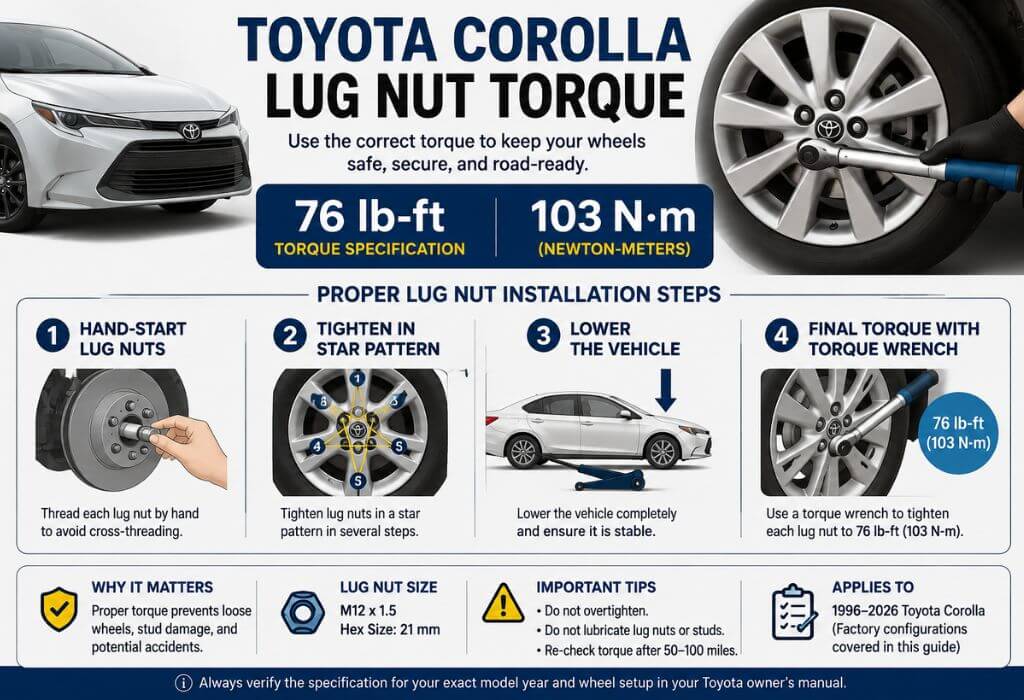
Once the wheel is installed, the lug nuts should be tightened evenly and finished with a properly set torque wrench. Toyota’s Corolla instructions specify 76 lb-ft (103 N·m) and show a gradual tightening sequence before final torque is applied.
1. Make sure the wheel is seated correctly
Make sure the wheel is properly positioned against the hub mounting surface. Remove dirt, rust buildup, or other foreign material that could prevent the wheel from sitting correctly.
Toyota warns that foreign material on the wheel contact surface can contribute to wheel-nut loosening.
2. Start the lug nuts by hand
Thread each lug nut onto the wheel stud by hand. This helps prevent cross-threading and confirms that the threads are engaging correctly.
3. Tighten the nuts gradually
Do not fully tighten one lug nut while the others remain loose. Tighten the nuts gradually in the specified crisscross or star sequence so the wheel seats evenly.
Toyota’s wheel-changing instructions specifically call for tightening each nut a little at a time in the order shown.
4. Lower the vehicle as directed
After the lug nuts have been installed and initially tightened, lower the vehicle according to the applicable wheel-changing procedure.
5. Apply the final torque
Set a properly functioning torque wrench to:
76 lb-ft (103 N·m)
Tighten each lug nut in the specified sequence until the torque wrench reaches the required setting.
Toyota recommends having the wheel nuts tightened with a torque wrench to 103 N·m (76 ft-lbf) after changing a wheel.
6. Confirm all lug nuts
After the first pass, verify each lug nut in the sequence. Toyota’s installation instructions for its five-lug applications also show repeating the sequence to confirm the specified torque.
An impact wrench should not be relied upon for final torque. Its output can vary depending on the tool, setting, power source, and fastener condition.
Common Toyota Corolla Lug Nut Torque Mistakes
Even with the correct torque specification, installation mistakes can affect wheel clamping.
Using an impact wrench for final torque
An impact wrench can be useful for removing lug nuts and for initial installation, but its setting should not be treated as a precise substitute for a torque wrench.
Use a properly set torque wrench for final tightening.
Tightening one lug nut completely first
Fully tightening one lug nut while the others remain loose can prevent the wheel from seating evenly. Tighten the nuts gradually in the specified sequence instead.
Applying oil or grease to the wheel studs
Do not lubricate the wheel studs or lug nuts unless the applicable manufacturer specifically requires it. Toyota warns that oil or grease can cause excessive tightening and potentially damage the wheel fasteners or wheel.
Guessing the torque
Do not rely on how tight a lug nut feels. For the factory Corolla applications covered by the documentation reviewed here, the specified value is 76 lb-ft (103 N·m).
Confusing lb-ft and N·m
76 lb-ft and 103 N·m are approximately equivalent.
Do not confuse 103 N·m with 103 lb-ft. They are different torque values.
Ignoring aftermarket wheel requirements
A lug nut can have the correct thread and still be wrong for a particular wheel if the seating surface is incompatible.
Why Correct Toyota Corolla Lug Nut Torque Matters
The specified lug nut torque helps provide the correct clamping force between the wheel and hub. Using too little or too much torque can create problems, which is why Toyota specifies a particular wheel-nut torque and recommends using a torque wrench after changing a wheel.
Too Little Torque
If a lug nut is not tightened sufficiently, the wheel may not be clamped securely against the hub. Under-tightened wheel nuts can loosen during driving, which can compromise the wheel attachment. Toyota warns that loose wheel nuts can allow a wheel to fall off and cause a serious accident.
Too Much Torque
Over-tightening can place excessive stress on the wheel studs, lug nuts, or related components. It can also make the lug nuts unnecessarily difficult to remove during the next wheel service.
For the factory Corolla configurations covered by the Toyota documentation reviewed for this guide, the specified wheel-nut torque is 76 lb-ft (103 N·m). Use a properly set torque wrench for the final tightening rather than relying on feel or an impact wrench setting.
What If Your Corolla Has Aftermarket Wheels or Lug Nuts?
Aftermarket wheels change an important part of the equation: the lug nut must fit the wheel, not just the Toyota wheel stud.
Before installation, check:
- Thread: The lug nut must correctly match the wheel stud.
- Seat type: The nut’s seating surface must match the wheel.
- Hardware design: The nut must be designed for the particular wheel.
- Torque: Follow the applicable vehicle, wheel, and lug-nut manufacturer’s requirements.
Toyota’s Corolla documentation distinguishes wheel and lug-nut seating requirements, so matching the thread alone is not enough.
If your Corolla has aftermarket wheels, check the wheel manufacturer’s instructions before assuming that the factory lug nuts or factory hardware are suitable.
For a factory Corolla configuration covered by Toyota’s documentation, the commonly specified wheel-nut torque remains 76 lb-ft (103 N·m).
Read More: Toyota Corolla Tire Size
Does the GR Corolla Use the Same Lug Nut Torque?
Yes. Toyota documentation for the GR Corolla specifies 103 N·m (76 ft-lbf) for the wheel lug nuts in the installation procedure reviewed for this guide. Toyota’s GR Corolla suspension-kit instructions call for a 21 mm socket, tightening the lug nuts in a five-lug star pattern, and using a torque wrench set to 103 N·m (76 ft-lbf). The instructions also call for repeating the torque sequence after the initial pass.
That matches the 76 lb-ft (103 N·m) wheel-nut torque specified in Toyota’s standard Corolla documentation for the factory configurations covered by the owner’s manual.
So, for the GR Corolla configuration covered by Toyota’s installation documentation:
GR Corolla lug nut torque: 76 lb-ft (103 N·m)
If the GR Corolla has aftermarket wheels or replacement lug nuts, verify the hardware and installation requirements for that specific wheel and lug-nut combination rather than assuming the factory specification applies to every aftermarket setup.
Read More: Toyota Corolla Tire Pressure
Why You May See Different Toyota Corolla Torque Numbers Online
Searching for Corolla lug nut torque can produce conflicting numbers. One source may show 76 lb-ft, another may show 80 lb-ft, and an incorrect source may even list 103 lb-ft.
One common source of confusion is unit conversion.
Toyota specifies:
103 N·m = approximately 76 lb-ft
It does not mean 103 lb-ft.
Toyota’s 2020 Corolla maintenance data explicitly lists 76 ft-lbf (103 N·m) for its various wheel and tire configurations.
Different online numbers can also result from:
- database errors
- incorrect unit conversion
- information assigned to the wrong vehicle
- mixing different wheel applications
- aftermarket specifications being presented as factory specifications
When sources disagree, use the owner’s manual or Toyota service information for your exact vehicle rather than choosing the number that appears most frequently online.
Read More: Toyota Corolla Bolt Pattern by Year
Frequently Asked Questions
What is the lug nut torque on a Toyota Corolla?
For the factory Corolla configurations covered by the Toyota documentation reviewed for this guide, the wheel-nut torque is 76 lb-ft (103 N·m). Toyota’s maintenance specifications and wheel-changing instructions support this value.
How many Nm is 76 lb-ft?
76 lb-ft is approximately 103 N·m.
These are two different units expressing essentially the same torque specification.
What size are Toyota Corolla lug nuts?
Many Corolla applications use M12 × 1.5 wheel-stud threads, and a 21 mm socket is commonly used. However, the correct lug nut also needs to have the appropriate seat and design for the wheel.
Can I use an impact wrench to tighten Corolla lug nuts?
An impact wrench should not replace a torque wrench for final tightening. Use a properly set torque wrench to apply the specified 76 lb-ft (103 N·m) where that specification applies.
Should I lubricate Toyota Corolla wheel studs or lug nuts?
Do not lubricate the studs or lug nuts unless the applicable manufacturer specifically instructs you to do so. Toyota warns that oil or grease can contribute to overtightening and damage.
Does the GR Corolla use the same lug nut torque?
Toyota’s GR Corolla installation documentation reviewed for this guide specifies 103 N·m (76 ft-lbf) for the wheel lug nuts.
Should I use the factory torque specification with aftermarket wheels?
Do not assume that the factory hardware and specifications automatically apply to every aftermarket wheel setup. Confirm that the lug nuts match the wheel’s seat and follow the wheel and lug-nut manufacturer’s installation requirements.
Final Takeaway
For the factory Toyota Corolla configurations covered by the documentation reviewed for this guide, the wheel lug nut torque is 76 lb-ft (103 N·m). Toyota also recommends using a torque wrench to achieve the specified torque after changing a wheel.
When installing a wheel, use the correct lug nuts, tighten them evenly in the specified sequence, and avoid relying on an impact wrench or hand feel for final torque. If your Corolla has aftermarket wheels or lug nuts, verify that the hardware is compatible with the wheel and follow the applicable manufacturer’s installation requirements.
When in doubt, the owner’s manual or Toyota service information for your exact Corolla should take priority over a generic online torque specification.
