Trailer Wheel Bolt Pattern: Chart for 4, 5, 6 & 8 Lug Wheels
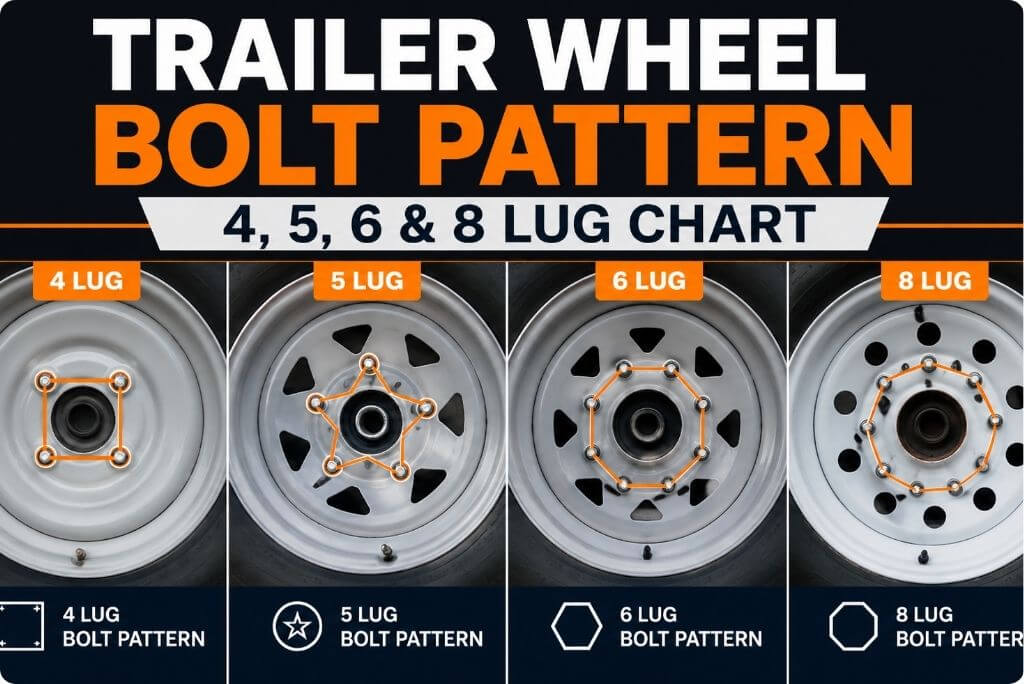
The trailer wheel bolt pattern tells you how many lug holes a wheel has and the diameter of the circle those holes form. For example, a 5×4.5-inch bolt pattern has five lug holes arranged on a 4.5-inch bolt circle.
If you are replacing a trailer wheel, start by counting the lug holes and then measure the bolt pattern using the correct method for that lug count. A matching bolt pattern is essential, but it is not the only wheel-fitment specification you should verify before buying a replacement wheel.
Quick Answer: Common Trailer Wheel Bolt Patterns
Common trailer wheel patterns include 4×4, 5×4.5, 5×5, 6×5.5, and 8×6.5 inches. Some trailer wheels also use less-common or specialty patterns, including 5×4.75, 5×5.5, 4×9.44, and 8×275 mm.
The easiest way to identify yours is:
- Count the lug holes.
- If there are 4, 6, or 8 holes, measure from the center of one hole to the center of the directly opposite hole.
- If there are 5 holes, use a 5-lug measurement method because there is no directly opposite hole.
- Match your measurement to the chart below before ordering a replacement wheel.
Trailer Wheel Bolt Pattern Chart
| Lug Holes | Bolt Pattern | Bolt Circle | Identification / Measurement |
| 4 | 4×4″ | 4.00″ | Measure center-to-center across opposite holes |
| 4 | 4×9.44″ | 9.44″ | Specialty pattern; verify against the existing hub or wheel |
| 5 | 5×4.5″ | 4.50″ | 5-lug measurement; 2-5/8″ between adjacent hole centers |
| 5 | 5×4.75″ | 4.75″ | 5-lug measurement; 2-3/4″ between adjacent hole centers |
| 5 | 5×5″ | 5.00″ | 5-lug measurement; 3″ between adjacent hole centers |
| 5 | 5×5.5″ | 5.50″ | 5-lug measurement; 3-1/4″ between adjacent hole centers |
| 6 | 6×5.5″ | 5.50″ | Measure center-to-center across opposite holes |
| 8 | 8×6.5″ | 6.50″ | Measure center-to-center across opposite holes |
| 8 | 8×275 mm | 275 mm | Specialty metric pattern; verify against wheel and hub specifications |
The 5-lug adjacent-hole measurements above are based on the standard identification method documented by etrailer: 2-5/8 inches corresponds to 5×4.5, 2-3/4 inches to 5×4.75, 3 inches to 5×5, and 3-1/4 inches to 5×5.5.
Current trailer-wheel specifications from Dexter also show 5×4.5, 6×5.5, and 8×6.5 as actual trailer-wheel fitments, with wheel specifications also listing details such as center bore, load rating, offset, and stud size. That is why the bolt pattern should be treated as one part of the complete wheel-fitment check, not the only specification that matters.
Important: Do not identify a trailer wheel bolt pattern by appearance alone. In particular, 5×4.5 and 5×5 can look very similar, so measure the pattern before ordering a replacement wheel.
What Does a Trailer Wheel Bolt Pattern Mean?
A trailer wheel bolt pattern describes two things: the number of lug holes and the diameter of the circle formed by their centers.
For example, a 5×4.5-inch trailer wheel has five lug holes arranged around a 4.5-inch bolt circle. The first number tells you how many lug holes the wheel has; the second number gives the bolt-circle diameter.
So:
- 4×4″ = 4 lug holes on a 4-inch bolt circle
- 5×4.5″ = 5 lug holes on a 4.5-inch bolt circle
- 5×5″ = 5 lug holes on a 5-inch bolt circle
- 6×5.5″ = 6 lug holes on a 5.5-inch bolt circle
- 8×6.5″ = 8 lug holes on a 6.5-inch bolt circle
The bolt pattern is also called the lug pattern or bolt circle. It is a critical measurement when replacing a trailer wheel because the wheel’s lug holes must match the trailer hub or studs correctly.
Why the Bolt Pattern Matters
A wheel can look like it has the right number of lug holes but still have the wrong bolt-circle diameter. For example, 5×4.5″ and 5×5″ wheels both have five lug holes, but their bolt circles are different, so they are not interchangeable. AAA Trailer specifically warns that these two patterns can look nearly identical and should be measured rather than identified by appearance.
The bolt pattern is only one part of complete trailer-wheel fitment. Before buying a replacement wheel, also verify the wheel size, width, load capacity, center bore, offset or backspacing where applicable, and compatibility with the trailer hub and studs.
Common Trailer Wheel Bolt Patterns Explained
Trailer wheels commonly use 4-, 5-, 6-, or 8-lug patterns, but the number of lug holes alone does not identify the wheel. The bolt-circle diameter also has to match. For example, two wheels can both have five lug holes but use different patterns, such as 5×4.5 or 5×5.
Here are the main trailer wheel bolt patterns you are most likely to encounter.
4-Lug Trailer Wheel Patterns
4×4 inches is a common small-trailer bolt pattern. It has four lug holes arranged on a 4-inch bolt circle. To measure a 4-lug wheel, measure from the center of one lug hole straight across to the center of the opposite hole.
etrailer also lists 4×9.44 inches as a trailer wheel pattern. Because this is much less typical than 4×4, do not assume a 4-lug wheel is automatically 4×4. Measure the existing wheel or verify the hub specifications when replacing it.
5-Lug Trailer Wheel Patterns
Five-lug wheels are especially important because several different bolt-circle diameters are used. Common or documented trailer patterns include 5×4.5, 5×4.75, 5×5, and 5×5.5 inches.
The 5×4.5-inch pattern is one of the most widely encountered trailer patterns. Current trailer-hub listings also show 5×4.5 and 5×5 configurations, demonstrating why the pattern should be measured rather than assumed from the wheel size or appearance.
For a 5-lug wheel, you cannot measure directly from one lug hole to an opposite lug hole because there is no lug directly across from it. Instead, use an appropriate 5-lug measurement method or compare the distance between adjacent lug-hole centers with a verified reference chart.
The adjacent-hole measurements commonly used to identify these patterns are:
- 2-5/8 inches → 5×4.5
- 2-3/4 inches → 5×4.75
- 3 inches → 5×5
- 3-1/4 inches → 5×5.5
Because 5×4.5 and 5×5 can look very similar, measure carefully before ordering a replacement wheel. A wheel with the wrong bolt-circle diameter should not be forced onto the trailer hub.
6-Lug Trailer Wheel Patterns
6×5.5 inches is a common trailer wheel pattern, particularly among heavier trailer applications. It uses six lug holes arranged around a 5.5-inch bolt circle. Current trailer-wheel and hub specifications also document 6×5.5 applications.
Because six is an even number, measuring the pattern is straightforward: measure from the center of one lug hole to the center of the directly opposite hole. If the measurement is 5.5 inches, the pattern is 6×5.5.
Do not select a 6-lug wheel based only on the number of holes. The bolt-circle diameter, wheel dimensions, load rating, and other fitment specifications still need to match the trailer.
8-Lug Trailer Wheel Patterns
8×6.5 inches is a well-established trailer wheel pattern used on heavier trailer applications. It has eight lug holes on a 6.5-inch bolt circle.
With eight lug holes, you can measure the bolt circle directly across the wheel: measure from the center of one lug hole to the center of the directly opposite hole.
etrailer also lists 8×275 mm as a trailer wheel pattern. This is a specialty metric pattern, so if your measurement does not correspond to a common inch-based pattern, verify the wheel and hub specifications rather than assuming the closest-looking pattern will fit.
Why the Number of Lug Holes Is Not Enough
Counting the lug holes is only the first step in identifying a trailer wheel. The second number in the bolt pattern—the bolt-circle diameter—is equally important.
For example:
- 5×4.5 and 5×5 both have five lug holes.
- 6×5.5 and another six-lug pattern would both have six holes.
- 8×6.5 and another eight-lug pattern would both have eight holes.
The wheels are not interchangeable simply because they have the same number of lug holes. Always measure or verify the exact bolt pattern before purchasing a replacement wheel.
How to Measure a Trailer Wheel Bolt Pattern
Measuring a trailer wheel bolt pattern is straightforward once you know whether the wheel has an even or odd number of lug holes. For 4-, 6-, and 8-lug wheels, you can measure directly across the wheel. A 5-lug wheel requires a different method because no lug hole sits directly opposite another.
You can measure the pattern on the wheel itself or, when accessible, on the trailer hub. For the most reliable result, use a clean wheel or hub and measure carefully from the correct reference points.
What You Need
You do not need specialized equipment for most trailer wheel bolt-pattern measurements. Have these items available:
- A tape measure or ruler that shows inches
- A straightedge, if needed to help align the measurement
- A flashlight for inspecting the lug holes or studs
- A calculator or this chart to compare your measurement
- A bolt-pattern template if you want an additional way to verify the result
etrailer also recommends using a bolt-pattern template as an alternative to measuring manually.
Step 1: Count the Lug Holes
Start by counting the wheel’s lug holes or the hub’s wheel studs.
You will commonly encounter:
- 4 lugs
- 5 lugs
- 6 lugs
- 8 lugs
Counting the lugs gives you the first part of the bolt pattern, but it does not tell you the complete pattern. For example, both 5×4.5 and 5×5 wheels have five lug holes, but their bolt-circle diameters are different.
Step 2: Choose the Correct Measurement Method
The measurement method depends on the number of lug holes.
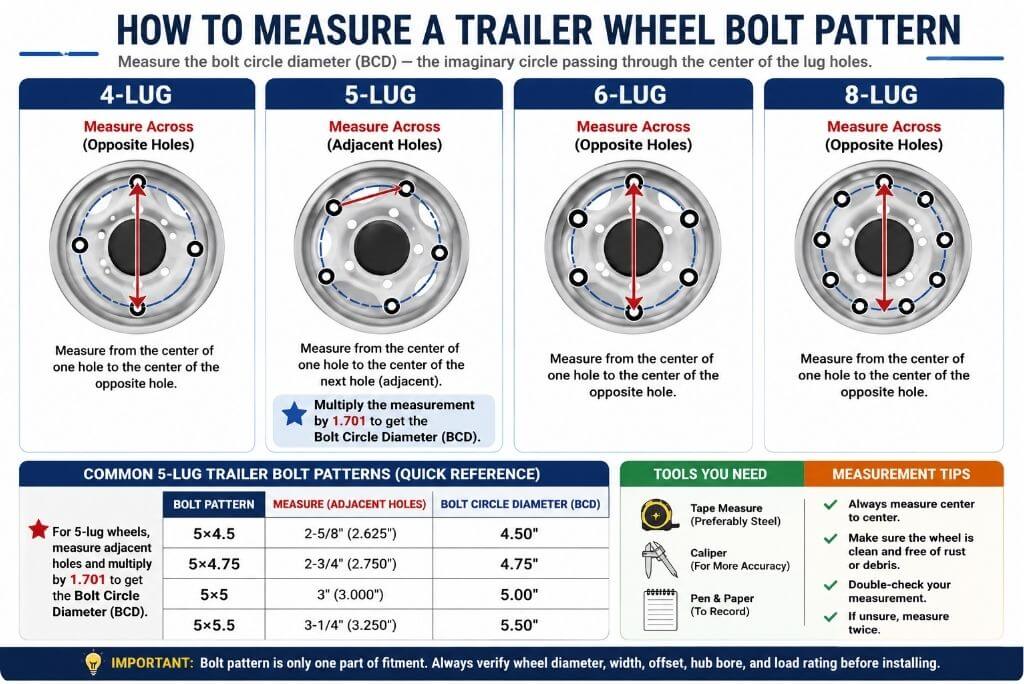
4, 6, or 8 lugs: Measure from the center of one lug hole straight across to the center of the directly opposite lug hole. The measurement is the bolt-circle diameter.
5 lugs: There is no directly opposite hole, so you cannot simply measure straight across from center to center. Instead, use a 5-lug measurement method or measure between adjacent holes and match the result to a verified chart.
How to Measure a 4-Lug Trailer Wheel
A 4-lug wheel has an even number of holes, so measuring the bolt circle is simple.
- Place the ruler or tape measure across the center of the wheel.
- Select one lug hole and locate the hole directly opposite it.
- Measure from the center of the first hole to the center of the opposite hole.
- Record the measurement in inches.
- Match it to the bolt-pattern chart.
For example, a measurement of 4 inches across opposite lug-hole centers indicates a 4×4-inch bolt pattern. etrailer identifies 4×4 and 4×9.44 as trailer wheel patterns, so do not automatically assume every 4-lug wheel is 4×4.
How to Measure a 6-Lug Trailer Wheel
The process is the same for a 6-lug wheel.
- Choose any lug hole.
- Find the hole directly opposite it.
- Measure from center to center.
- Record the measurement.
- Match it to the number of lugs.
For example, 6 holes with a 5.5-inch center-to-center measurement gives you a 6×5.5-inch bolt pattern. Because a 6-lug pattern has directly opposite holes, you do not need to use the special 5-lug measurement method.
How to Measure an 8-Lug Trailer Wheel
An 8-lug wheel is also measured directly across the bolt circle.
- Select one lug hole.
- Find the hole directly opposite it.
- Measure center to center.
- Record the result in inches or millimeters if applicable.
- Compare the measurement with the bolt-pattern chart.
For example, eight lug holes arranged on a 6.5-inch bolt circle give you an 8×6.5-inch pattern. Dexter uses this same center-to-center method when explaining how to identify an 8×6.5 wheel pattern.
How to Measure a 5-Lug Trailer Wheel
A 5-lug wheel is the one that causes the most measurement mistakes because there is no lug directly opposite another lug.
There are several accepted ways to identify the pattern. The easiest for many people is to measure between adjacent lug holes and compare the result with a known 5-lug chart. etrailer documents this method as an option, while Dexter and Lippert also describe the center-to-edge method for determining the bolt circle.
Method A: Adjacent-Hole Measurement
Measure from the center of one lug hole to the center of the next lug hole.
Then compare your measurement:
| Adjacent Hole Measurement | Trailer Bolt Pattern |
| 2-5/8″ | 5×4.5″ |
| 2-3/4″ | 5×4.75″ |
| About 3″ | 5×5″ |
| 3-1/4″ | 5×5.5″ |
etrailer and other trailer-industry references use these adjacent-hole measurements to identify common 5-lug patterns.
Important: You may see 2-7/8″ or 2-15/16″ listed for some 5×5 measurement references instead of exactly 3 inches. That difference comes from the measurement method and rounding. For a final fitment decision, verify the actual bolt circle rather than relying on a borderline tape-measure reading.
Method B: Center-to-Edge Measurement
You can also measure a 5-lug pattern from the center of one lug hole to the outer edge of the lug hole two positions away, skipping one hole.
For example, a measurement of 2-5/8 inches corresponds to a 5×4.5-inch pattern using this 5-lug method. Lippert and AAA Trailer describe this center-to-edge approach, while etrailer provides the same pattern identification through its adjacent-hole method.
The key is to use the correct reference points. Measuring from edge to edge or center to center at the wrong locations can give you a number that does not correspond to the actual bolt circle.
The Original Trailer Wheel Bolt-Pattern Workflow
If you are unsure which method to use, follow this simple workflow:
Count → Classify → Measure → Match → Verify
1. Count
Count the lug holes: 4, 5, 6, or 8.
2. Classify
If the number is even, use the direct center-to-center method. If it is 5, use a 5-lug method.
3. Measure
Take the measurement carefully from the correct reference points.
4. Match
Compare the result with the Trailer Wheel Bolt Pattern Chart.
5. Verify
Before ordering a replacement wheel, confirm the pattern against the trailer hub, existing wheel specifications, or the manufacturer’s fitment information.
This final verification step matters because the bolt pattern is only one part of wheel fitment. Dexter notes that proper wheel selection also depends on matching the wheel to the hub and considering the wheel’s other specifications and load requirements.
If Your Measurement Does Not Match the Chart
Do not round a questionable measurement to the nearest bolt pattern and assume it will fit.
Instead:
- Clean the lug holes or studs and measure again.
- Make sure you are measuring from the correct center or edge point.
- Check that your tape measure is reading inches correctly.
- Use a second measurement method for confirmation.
- Compare the result with the existing hub or wheel specifications.
- Use a bolt-pattern template if the measurement remains uncertain.
This is especially important with 5×4.5 and 5×5 patterns, which can look nearly identical but have different bolt-circle diameters. Never force a wheel onto a hub simply because the number of lug holes matches.
5×4.5 vs 5×5 Trailer Wheel Bolt Pattern
5×4.5 and 5×5 are not the same bolt pattern.
Both have five lug holes, but the bolt-circle diameters are different:
| Specification | 5×4.5″ | 5×5″ |
| Lug holes | 5 | 5 |
| Bolt-circle diameter | 4.5″ | 5″ |
| Adjacent-hole reference | Approx. 2-5/8″ | Approx. 3″ |
| Interchangeable? | No | No |
The difference may appear small, but the lug holes are positioned on different bolt circles.
This is one of the main reasons you should not identify a trailer wheel pattern by appearance alone. AAA Trailer specifically highlights the difficulty of distinguishing five-lug patterns visually, while etrailer provides the measurement conversions needed to distinguish them.
Can a 5×4.5 Wheel Fit a 5×5 Hub?
No—not simply because both wheels have five lug holes.
The bolt-circle diameters are different, so the wheel should not be treated as a direct replacement.
If the lug holes do not align correctly with the trailer studs, do not force the wheel into place.
Does a Matching Bolt Pattern Guarantee Trailer Wheel Fitment?
No.
A matching bolt pattern confirms one important part of wheel compatibility, but it does not confirm the complete fitment.
Dexter’s current wheel specifications separately list bolt pattern, wheel size, center bore, load rating, offset, rim contour, stud size, and pilot type. Dexter’s service documentation also specifically advises matching the replacement wheel to the axle hub and checking capacity and offset.
Before purchasing a replacement trailer wheel, check:
| Specification | What to Verify |
| Bolt pattern | Lug count and bolt-circle diameter |
| Wheel diameter | Correct diameter for the tire and trailer |
| Wheel width | Compatible with the tire and application |
| Load capacity | Adequate for the required trailer/axle load |
| Center bore / pilot | Compatible with the trailer hub |
| Offset / backspacing | Correct wheel position and clearance |
| Stud and lug-nut specifications | Correct thread and seat compatibility |
| Clearance | Fender, frame, suspension, and brake clearance |
For example, Dexter lists a 14×5.5 wheel with a 5×4.5 bolt pattern, 3.19-inch center bore, 2,040-lb load rating, zero offset, and 1/2-inch stud specification. Another Dexter wheel with the same 5×4.5 pattern has different wheel dimensions and load rating.
That is why “the bolt pattern matches” should be the beginning of your fitment check, not the end.
Trailer Wheel Fitment Checklist
Before ordering a replacement trailer wheel, work through this checklist:
- Count the lug holes.
- Confirm the exact bolt pattern.
- Verify the pattern against the trailer hub or axle specifications.
- Check wheel diameter.
- Check wheel width.
- Confirm wheel load capacity.
- Check center bore/pilot diameter where applicable.
- Check offset or backspacing where applicable.
- Confirm stud and lug-nut compatibility.
- Check tire clearance.
- Check fender clearance.
- Check suspension and brake clearance.
- Compare the replacement wheel with the original specifications.
- Verify any unusual measurement with the manufacturer before ordering.
A Simple Rule
Think of trailer-wheel fitment as:
Bolt Pattern → Wheel Dimensions → Load Capacity → Hub/Stud Compatibility → Clearance → Final Verification
A correct bolt pattern gets you to the next step. It does not finish the fitment check.
Common Trailer Wheel Bolt Pattern Measurement Mistakes
A bolt-pattern measurement can be wrong even when the wheel looks easy to measure.
1. Counting the Lug Holes but Not Measuring the Pattern
Five lug holes do not automatically mean 5×4.5.
Measure the bolt pattern.
2. Measuring a 5-Lug Wheel Straight Across
A five-lug wheel has no directly opposite lug hole.
Use a recognized five-lug method instead.
3. Using the Wrong Reference Point
For center-to-center measurements, measure between the centers of the specified lug holes.
Do not accidentally measure outside edge to outside edge.
However, remember that some recognized 5-lug methods intentionally use a hole’s outer edge. The important point is to follow one complete method correctly rather than mixing reference points.
4. Guessing Between 5×4.5 and 5×5
These patterns can look similar.
Measure them.
5. Rounding a Bad Measurement
If the result does not make sense, remeasure.
A measurement error can come from:
- Incorrect reference points
- Ruler positioned at an angle
- Measuring the wrong holes
- Poor visibility
- Measuring the wheel while it is difficult to access
etrailer recommends rechecking measurements when the result does not correspond to a known pattern.
6. Assuming the Existing Wheel Is Correct
If you are replacing a damaged wheel, do not blindly assume that the old wheel is the correct specification.
When possible, compare the wheel measurement with the trailer hub, axle documentation, or manufacturer’s specifications.
7. Assuming Bolt Pattern Is the Only Fitment Specification
A matching bolt pattern does not automatically make every wheel suitable.
You also need to check the wheel’s dimensions, load capacity, center bore, offset or backspacing where applicable, and stud/lug-nut compatibility.
Frequently Asked Questions
What is the most common trailer wheel bolt pattern?
There is no single bolt pattern used on every trailer, but 5×4.5 inches is the most commonly encountered five-lug trailer-wheel pattern. Other widely documented configurations include 4×4, 6×5.5, and 8×6.5.
How do I know what bolt pattern my trailer wheel has?
Count the lug holes first, then measure the bolt circle using the correct method for that lug count. For 4-, 6-, and 8-lug wheels, measure between directly opposite lug-hole centers. For a 5-lug wheel, use a recognized 5-lug method and compare the measurement with a verified chart.
What is the bolt pattern on a 6-lug trailer wheel?
6×5.5 inches is the common documented six-lug trailer-wheel pattern. Measure center-to-center between directly opposite lug holes to verify it.
What is the bolt pattern on an 8-lug trailer wheel?
8×6.5 inches is a common eight-lug trailer-wheel pattern. However, etrailer also documents an 8×275 mm pattern, so an eight-lug wheel should still be measured or verified by its specifications.
Is 4×4 a trailer wheel bolt pattern?
Yes. 4×4 inches is a documented trailer-wheel bolt pattern. Measure center-to-center across opposite lug holes to verify it.
Can I use any wheel with the same trailer bolt pattern?
No. The wheel also needs to meet the required diameter, width, load capacity, center bore, offset or backspacing, stud/lug-nut compatibility, and clearance requirements. Dexter’s current wheel specifications illustrate how these characteristics vary even among wheels sharing a bolt pattern.
Can I tell a trailer wheel bolt pattern by looking at it?
You can count the lug holes visually, but you should not rely on appearance to determine the bolt-circle diameter. This is especially important with five-lug patterns such as 5×4.5 and 5×5. Measure the wheel instead.
What should I do if my measurement does not match the chart?
Measure again and confirm that you are using the correct method and reference points. If the measurement still does not match a documented pattern, check the wheel, hub, or axle manufacturer’s specifications instead of guessing.
Does trailer wheel size determine the bolt pattern?
No. Wheel diameter or tire size does not automatically determine the bolt pattern. The actual lug configuration needs to be measured or verified separately.
Final Takeaway
Finding the right trailer wheel bolt pattern starts with two simple things: count the lug holes and measure the bolt circle correctly.
Use the correct measurement method for your wheel:
- 4-, 6-, and 8-lug wheels: measure between the centers of directly opposite lug holes.
- 5-lug wheels: use a proper 5-lug measurement method and compare the result with a verified chart.
- Never assume that wheels with the same number of lug holes have the same bolt pattern.
For example, 5×4.5 and 5×5 are both five-lug patterns, but they are different and should not be treated as interchangeable.
Once you identify the bolt pattern, complete the fitment check. Verify the wheel diameter, width, load capacity, center bore, offset or backspacing where applicable, stud and lug-nut compatibility, and available tire and suspension clearance before buying a replacement wheel.
The safest approach is simple: measure the existing wheel, verify the trailer hub or axle specifications, match the replacement wheel’s complete specifications, and never guess when a measurement is uncertain.
If you are replacing a trailer wheel, use the Trailer Wheel Bolt Pattern Chart above as your starting point, then follow the measurement and fitment steps to confirm the exact wheel you need.
