Truck Tire Size Chart: Pickup, Commercial and Semi-Truck Sizes
Choosing a truck tire requires more than matching the number printed on the sidewall. The correct tire must also fit the wheel, carry the vehicle’s load, provide adequate clearance and meet the required single- or dual-tire specification.
This truck tire size chart covers common pickup, light-truck, flotation, 17.5-inch, 19.5-inch, 22.5-inch and 24.5-inch tire sizes. It also explains how to compare dimensions without treating calculated or nominal measurements as guaranteed fitment data.
Quick answer: Start with the size on the vehicle placard or fleet specification. Use this chart to compare dimensions, then verify the exact tire model’s approved wheel width, load capacity, inflation table, loaded radius, revolutions per mile and minimum dual spacing before installation.
Truck Tire Size Chart Overview
| Truck or application | Common wheel sizes | Example tire sizes | Chart type |
|---|---|---|---|
| Light-duty pickup or van | 15-20 inches | LT235/75R15, LT265/70R17, LT275/65R20 | LT metric |
| Heavy-duty pickup | 16-20 inches | LT235/85R16, LT275/70R18, LT295/60R20 | LT metric |
| Oversized or off-road pickup | 15-20 inches | 33×12.50R17LT, 35×12.50R20LT, 37×12.50R17LT | Flotation |
| Commercial light or medium truck | 17.5 inches | 215/75R17.5, 225/75R17.5, 245/70R17.5 | Commercial |
| Box truck, delivery truck or motorhome | 19.5 inches | 225/70R19.5, 245/70R19.5, 265/70R19.5 | Commercial |
| Heavy truck or semi-truck | 22.5 inches | 11R22.5, 275/70R22.5, 295/75R22.5 | Conventional/metric |
| Heavy truck or semi-truck | 24.5 inches | 11R24.5, 285/75R24.5 | Conventional/metric |
| Wide-base commercial application | Primarily 22.5 inches | 385/65R22.5, 425/65R22.5, 445/50R22.5 | Wide-base |
What Counts as a Common Size?
A common size appears across current manufacturer catalogues or is regularly specified within a vehicle or commercial-service category. It does not mean the size fits every truck in that category.
The final selection must match the vehicle specification, wheel bead-seat diameter, approved rim width, load requirement and available clearance. Dual assemblies also require correct tire matching and minimum dual spacing.
How to Read Truck Tire Sizes
Truck tires commonly use three designation systems.
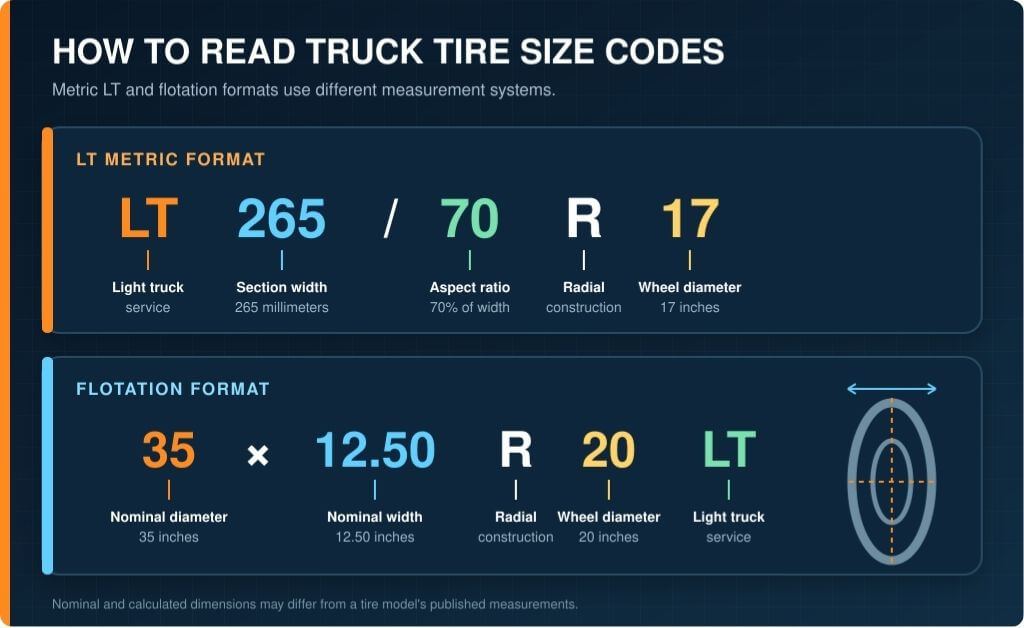
LT Metric: LT265/70R17
- LT: light-truck service
- 265: nominal section width in millimetres
- 70: sidewall height is 70% of the section width
- R: radial construction
- 17: wheel bead-seat diameter in inches
Flotation: 35×12.50R20LT
- 35: nominal overall diameter in inches
- 12.50: nominal width in inches
- R: radial construction
- 20: wheel diameter in inches
- LT: light-truck service
Conventional Commercial: 11R22.5
- 11: nominal section-width designation
- R: radial construction
- 22.5: wheel bead-seat diameter in inches
A conventional commercial code does not state a modern metric aspect ratio. Use the exact manufacturer’s specifications when comparing it with a metric commercial size.
Pickup and Light-Truck Tire Size Chart
The following LT metric dimensions are formula-derived estimates. Actual measurements vary with the tire model, tread depth, measuring rim, inflation and load.
15- and 16-Inch LT Sizes
| Tire size | Width | Sidewall | Overall diameter | Circumference | Revs/mile |
|---|---|---|---|---|---|
| LT215/75R15 | 8.46 in | 6.35 in | 27.70 in | 87.01 in | 728.2 |
| LT235/75R15 | 9.25 in | 6.94 in | 28.88 in | 90.72 in | 698.4 |
| LT225/75R16 | 8.86 in | 6.64 in | 29.29 in | 92.01 in | 688.6 |
| LT235/85R16 | 9.25 in | 7.86 in | 31.73 in | 99.68 in | 635.6 |
| LT245/75R16 | 9.65 in | 7.23 in | 30.47 in | 95.72 in | 661.9 |
| LT265/70R16 | 10.43 in | 7.30 in | 30.61 in | 96.15 in | 659.0 |
| LT265/75R16 | 10.43 in | 7.82 in | 31.65 in | 99.43 in | 637.2 |
| LT285/75R16 | 11.22 in | 8.42 in | 32.83 in | 103.14 in | 614.3 |
| LT305/70R16 | 12.01 in | 8.41 in | 32.81 in | 103.08 in | 614.7 |
| LT315/75R16 | 12.40 in | 9.30 in | 34.60 in | 108.71 in | 582.9 |
17-Inch LT Sizes
| Tire size | Width | Sidewall | Overall diameter | Circumference | Revs/mile |
|---|---|---|---|---|---|
| LT235/80R17 | 9.25 in | 7.40 in | 31.80 in | 99.91 in | 634.2 |
| LT245/70R17 | 9.65 in | 6.75 in | 30.50 in | 95.83 in | 661.2 |
| LT245/75R17 | 9.65 in | 7.23 in | 31.47 in | 98.86 in | 640.9 |
| LT265/70R17 | 10.43 in | 7.30 in | 31.61 in | 99.29 in | 638.1 |
| LT275/70R17 | 10.83 in | 7.58 in | 32.16 in | 101.03 in | 627.2 |
| LT285/70R17 | 11.22 in | 7.85 in | 32.71 in | 102.76 in | 616.6 |
| LT315/70R17 | 12.40 in | 8.68 in | 34.36 in | 107.95 in | 586.9 |
| LT325/70R17 | 12.80 in | 8.96 in | 34.91 in | 109.68 in | 577.7 |
18- and 20-Inch LT Sizes
| Tire size | Width | Sidewall | Overall diameter | Circumference | Revs/mile |
|---|---|---|---|---|---|
| LT275/65R18 | 10.83 in | 7.04 in | 32.07 in | 100.77 in | 628.8 |
| LT275/70R18 | 10.83 in | 7.58 in | 33.16 in | 104.17 in | 608.3 |
| LT285/65R18 | 11.22 in | 7.29 in | 32.59 in | 102.37 in | 618.9 |
| LT285/70R18 | 11.22 in | 7.85 in | 33.71 in | 105.90 in | 598.3 |
| LT295/70R18 | 11.61 in | 8.13 in | 34.26 in | 107.63 in | 588.7 |
| LT275/65R20 | 10.83 in | 7.04 in | 34.07 in | 107.05 in | 591.9 |
| LT285/55R20 | 11.22 in | 6.17 in | 32.34 in | 101.61 in | 623.6 |
| LT285/60R20 | 11.22 in | 6.73 in | 33.46 in | 105.13 in | 602.7 |
| LT295/60R20 | 11.61 in | 6.97 in | 33.94 in | 106.62 in | 594.3 |
| LT305/55R20 | 12.01 in | 6.60 in | 33.21 in | 104.33 in | 607.3 |
| LT325/60R20 | 12.80 in | 7.68 in | 35.35 in | 111.07 in | 570.5 |
LT Metric Calculation Example
For LT265/70R17:
- Width: 265 / 25.4 = 10.43 inches
- Sidewall: 265 x 0.70 / 25.4 = 7.30 inches
- Diameter: 17 + (2 x 7.30) = 31.61 inches
- Circumference: 31.61 x pi = 99.29 inches
- Geometric revs/mile: 63,360 / 99.29 = 638.1
Manufacturer-published rolling figures may differ because a tire deflects under load.
Flotation Truck Tire Size Chart
The measurements below are nominal values derived from the size code, not guaranteed physical measurements.
| Tire size | Nominal diameter | Nominal width | Wheel | Nominal sidewall | Nominal revs/mile |
|---|---|---|---|---|---|
| 30×9.50R15LT | 30.00 in | 9.50 in | 15 in | 7.50 in | 672.3 |
| 31×10.50R15LT | 31.00 in | 10.50 in | 15 in | 8.00 in | 650.6 |
| 32×11.50R15LT | 32.00 in | 11.50 in | 15 in | 8.50 in | 630.3 |
| 33×10.50R15LT | 33.00 in | 10.50 in | 15 in | 9.00 in | 611.2 |
| 33×12.50R15LT | 33.00 in | 12.50 in | 15 in | 9.00 in | 611.2 |
| 33×12.50R17LT | 33.00 in | 12.50 in | 17 in | 8.00 in | 611.2 |
| 35×12.50R17LT | 35.00 in | 12.50 in | 17 in | 9.00 in | 576.2 |
| 35×12.50R18LT | 35.00 in | 12.50 in | 18 in | 8.50 in | 576.2 |
| 35×12.50R20LT | 35.00 in | 12.50 in | 20 in | 7.50 in | 576.2 |
| 37×12.50R17LT | 37.00 in | 12.50 in | 17 in | 10.00 in | 545.1 |
| 37×12.50R20LT | 37.00 in | 12.50 in | 20 in | 8.50 in | 545.1 |
| 38×13.50R20LT | 38.00 in | 13.50 in | 20 in | 9.00 in | 530.7 |
| 40×13.50R17LT | 40.00 in | 13.50 in | 17 in | 11.50 in | 504.2 |
| 40×15.50R20LT | 40.00 in | 15.50 in | 20 in | 10.00 in | 504.2 |
Two tires with the same flotation designation may have different measured diameter, section width, tread width, approved rim range and revolutions per mile. Check the exact model before evaluating clearance or speedometer effects.
Commercial Truck Tire Size Charts
Commercial light- and medium-duty trucks commonly use 17.5- or 19.5-inch wheels. These sizes appear on delivery trucks, box trucks, buses, motorhomes and chassis-cab applications.
Common 17.5-Inch Size Families
| Size family | Typical context |
|---|---|
| 215/75R17.5 | Light/medium commercial service |
| 225/75R17.5 | Commercial delivery and vocational applications |
| 235/75R17.5 | Medium-duty commercial applications |
| 245/70R17.5 | Low-profile commercial applications |
| 245/75R17.5 | Medium-duty commercial applications |
| 265/70R17.5 | Higher-capacity commercial applications |
Common 19.5-Inch Size Families
| Size family | Typical context |
|---|---|
| 225/70R19.5 | Delivery truck, motorhome and medium-duty chassis |
| 245/70R19.5 | Medium-duty and higher-capacity applications |
| 265/70R19.5 | Wider medium-duty applications |
These are size families, not universal dimensional or load specifications. For commercial fitment, obtain the exact model’s overall diameter, loaded radius, approved wheels, minimum dual spacing, load table and speed restriction.
Semi-Truck Tire Size Charts
Common 22.5-Inch Sizes
| Tire size | Format | Typical size context |
|---|---|---|
| 9R22.5 | Conventional numeric | Smaller commercial applications |
| 10R22.5 | Conventional numeric | Commercial truck/bus applications |
| 11R22.5 | Conventional numeric | Common heavy-truck size family |
| 12R22.5 | Conventional numeric | Larger conventional commercial size |
| 255/70R22.5 | Metric low-profile | Low-profile commercial application |
| 275/70R22.5 | Metric low-profile | Commercial steer/all-position applications |
| 295/75R22.5 | Metric low-profile | Common North American heavy-truck size |
| 305/70R22.5 | Metric low-profile | Wider low-profile application |
| 315/80R22.5 | Metric | Heavy commercial/vocational application |
Verified Same-Family Example
The following manufacturer-published examples show why exact-model data matter.
| Specification | Michelin X Multi Energy Z2 11R22.5 | Michelin X Multi Energy Z2 295/75R22.5 |
|---|---|---|
| Load Range | H | H |
| Overall diameter | 41.4 in | 40.2 in |
| Overall width | 11.2 in | 11.1 in |
| Loaded radius | 19.4 in | 18.8 in |
| Revs/mile | 499 | 515 |
| Approved wheel widths | 7.50, 8.25 in | 8.25, 9.00 in |
| Minimum dual spacing | 12.5 in | 13.2 in |
| Maximum speed | 75 mph | 75 mph |
The values belong to the named products. Another tire carrying either nominal size may differ.
Common 24.5-Inch Sizes
| Tire size | Format | Typical context |
|---|---|---|
| 11R24.5 | Conventional numeric | Heavy-truck and trailer applications |
| 285/75R24.5 | Metric low-profile | Lower-profile 24.5-inch application |
Do not assume that 11R24.5 and 285/75R24.5 are direct replacements. Compare their exact loaded radius, revolutions per mile, wheel requirements, load capacity and dual-spacing specifications.
Wide-Base Truck Tire Size Chart
Wide-base tires require their own category because their wheel requirements and intended applications differ from conventional dual-fitment tires.
| Size family | General context |
|---|---|
| 385/65R22.5 | Wide commercial, steer or application-specific fitment |
| 425/65R22.5 | Wide commercial and vocational applications |
| 445/50R22.5 | Wide-base single drive or trailer application, model dependent |
| 445/65R22.5 | Heavy vocational or specialized wide-base application |
A wide section width does not automatically identify an approved dual replacement. Confirm the exact model’s axle-position approval, wheel and offset requirement, load capacity, inflation table and vehicle clearance.
11R22.5 vs 295/75R22.5
The 11R22.5 and 295/75R22.5 fit the same nominal wheel diameter, but they are not universally equivalent.
Using the same Michelin product family shown above, the 295/75R22.5 is 1.2 inches shorter, has a 0.6-inch lower loaded radius and makes 16 more revolutions per mile. Its approved wheel range and minimum dual spacing also differ.
If a vehicle calibrated for the example 11R22.5 changed to the example 295/75R22.5 without recalibration, the actual speed would be approximately 3% lower than the indicated speed. At an indicated 60 mph, that is roughly 58.1 mph.
A replacement may be possible only after confirming wheel approval, load capacity, required pressure, dual spacing, ride height, electronic calibration and manufacturer approval. Never mix these sizes within the same dual assembly.
Truck Tire Size Conversion
Conversions provide comparison estimates, not approved replacement sizes.
| LT metric size | Calculated diameter | Calculated width | Approximate flotation class |
|---|---|---|---|
| LT265/70R17 | 31.61 in | 10.43 in | About 32×10.5R17 |
| LT285/70R17 | 32.71 in | 11.22 in | About 33×11.5R17 |
| LT315/70R17 | 34.36 in | 12.40 in | About 35×12.5R17 |
| LT275/70R18 | 33.16 in | 10.83 in | About 33x11R18 |
| LT285/70R18 | 33.71 in | 11.22 in | About 34×11.5R18 |
| LT295/70R18 | 34.26 in | 11.61 in | About 34-35x12R18 |
| LT275/65R20 | 34.07 in | 10.83 in | About 34x11R20 |
| LT325/60R20 | 35.35 in | 12.80 in | About 35x13R20 |
The final column identifies only the nearest nominal class; it does not confirm that a corresponding flotation size exists or fits the same vehicle.
How to Choose the Right Truck Tire Size
1. Start With the Vehicle Specification
Check the tire placard, owner’s manual, chassis documentation or fleet specification for the original size, load requirement, pressure, wheel and single/dual configuration.
2. Establish the Operating Load
For commercial service, weigh the truck in its normal loaded condition. Use individual wheel-position weights when side-to-side loading is uneven; otherwise use the measured axle load as directed by the tire manufacturer’s load table.
3. Match the Load Requirement
Confirm the load index or single/dual load rating, required cold inflation pressure and intended service. A tire’s maximum capacity does not increase the axle, wheel or vehicle rating.
4. Verify the Wheel
The wheel must have the correct bead-seat diameter, an approved width and sufficient load and pressure ratings. Sharing the same wheel diameter does not guarantee compatibility.
5. Compare Rolling Dimensions
Check overall diameter, loaded radius and manufacturer-published revolutions per mile. Changes can affect ride height, engine rpm, gearing, speedometer readings, ABS and stability-control operation.
6. Check Dual Compatibility
Dual tires need adequate spacing and closely matched diameter, loaded radius, tread depth and inflation. Do not pair different nominal sizes within one dual assembly.
7. Check Physical Clearance
On pickups and modified trucks, inspect fender, liner, suspension, steering, brake and body-mount clearance through full steering and suspension travel. A tire that clears while parked may rub under load or compression.
Truck Tire Load Range and Ply Rating
Load Range replaced the older ply-rating system. The equivalent ply rating describes a strength category, not the number of physical plies in a modern tire.
| Load Range | Historical equivalent | Typical context, not a fitment rule |
|---|---|---|
| C | 6-ply rated | Light-duty pickups and vans |
| D | 8-ply rated | Pickups, vans and some trailers |
| E | 10-ply rated | Heavy-duty pickups and towing |
| F | 12-ply rated | Heavy pickups and medium-duty use |
| G | 14-ply rated | Commercial truck applications |
| H | 16-ply rated | Heavy commercial applications |
| J | 18-ply rated | Higher-capacity commercial applications |
| L | 20-ply rated | Heavy-duty and wide-base applications |
Load Range alone does not establish one universal capacity or operating pressure. Use the complete service description and the exact manufacturer’s load-and-inflation table.
In a commercial service description such as 144/141L, 144 is the load index for single service, 141 is the load index for dual service and L is the speed symbol.
Frequently Asked Questions
What is the most common pickup truck tire size?
There is no single universal size. LT265/70R17, LT275/65R18, LT275/70R18 and LT275/65R20 are common families, but the correct size depends on the truck’s year, trim, axle rating and wheel package.
What are common semi-truck tire sizes?
Common North American families include 11R22.5, 295/75R22.5, 275/70R22.5, 11R24.5 and 285/75R24.5. Their exact applications and load ratings are model-specific.
Are 33-inch and 285 tires the same size?
Not necessarily. 285 identifies metric width, while 33-inch describes a nominal diameter class. For example, LT285/70R17 calculates to about 32.71 inches tall and 11.22 inches wide; 33×12.50R17LT is nominally 33 inches tall and 12.50 inches wide.
Are 35-inch and 315 tires the same size?
Some 315-width sizes are close to 35 inches, but the aspect ratio and wheel diameter determine the result. LT315/70R17 calculates to 34.36 inches, while LT315/75R16 calculates to 34.60 inches.
Can larger tires fit the original wheels?
Only if the tire is approved for the wheel’s diameter and width and the vehicle has adequate clearance. Also verify wheel offset, pressure/load ratings, speedometer effect and manufacturer approval.
Should truck tires use the maximum sidewall pressure?
Not automatically. For original pickup fitment, begin with the vehicle placard unless the manufacturer directs otherwise. For commercial service, use the actual load and the applicable manufacturer load-and-inflation table. Never exceed the tire or wheel limit.
Why can tires with the same size have different dimensions?
Tread depth, casing design, measuring rim and intended service can change measured diameter, width and revolutions per mile. Use the exact model’s technical specification when clearance or dual matching matters.
Can different sizes be mixed in a dual assembly?
No. Dual tires must be closely matched for size, construction, circumference, loaded radius, tread depth and pressure. Mismatch can cause unequal load sharing, scrubbing and heat buildup.
Data and Calculation Methodology
This article uses three clearly separated data types:
- Calculated dimensions: LT metric width, sidewall, diameter, circumference and geometric revolutions per mile derived from the size code.
- Nominal dimensions: flotation measurements stated by the size designation.
- Manufacturer-published specifications: measurements tied to the exact named tire model.
Calculated values are rounded to two decimals for dimensions and one decimal for revolutions per mile. They do not account for loaded deflection. Nominal values describe a size class rather than guaranteed installed measurements.
Commercial product specifications should be checked against the manufacturer’s current technical page or data book before purchase because model availability and specifications can change. The Michelin X Multi Energy Z2 example was checked against Michelin’s official commercial tire information.
Final Takeaway
A truck tire chart is a starting point, not a fitment approval. Begin with the vehicle placard or fleet specification, compare the exact tire model’s dimensions and rolling data, match the load and wheel requirements, and verify clearance before changing sizes.
The safest choice is not simply the largest tire or the highest Load Range. It is the tire whose complete size, load, pressure, wheel and service specifications match the truck’s actual requirements.
