
Tractor Tire Size Chart: Standard, Metric & Agricultural Tire Conversion
Last updated on September 6th, 2026
Choosing the right tractor tire starts with understanding the numbers on the sidewall. Traditional agricultural sizes such as 13.6-28 and modern metric sizes such as 340/85R28 describe related tire dimensions, but they are not always interchangeable without checking the actual tire specifications.
This tractor tire size chart covers common agricultural tire conversions, traditional and metric markings, flotation sizes, tire profiles, and the measurements that matter when replacing a tire.
Quick answer: A common reference for 13.6-28 is 340/85R28, while 18.4-38 is commonly referenced as 460/85R38. These are size-family references, not automatic fitment approvals. Actual dimensions, approved rim width, load capacity, rolling circumference, clearance, and tractor requirements must still be verified.
Tractor Tire Size Conversion Chart
The table below focuses on common traditional agricultural sizes and their commonly referenced metric equivalents. Where more than one metric reference exists, both may be shown because the same traditional size can correspond to different modern profile options.
| Traditional Size | Common Metric Reference | Rim Diameter |
| 6.00-16 | 210/80R16 | 16 in |
| 7.50-16 | 250/80R16 | 16 in |
| 7.50-18 | 250/80R18 | 18 in |
| 9.5-20 | 260/80R20 | 20 in |
| 11.2-20 | 280/85R20 | 20 in |
| 12.4-20 | 320/85R20 | 20 in |
| 9.5-24 | 240/85R24 or 250/85R24 | 24 in |
| 11.2-24 | 280/85R24 | 24 in |
| 12.4-24 | 320/85R24 | 24 in |
| 13.6-24 | 340/85R24 | 24 in |
| 14.9-24 | 380/85R24 | 24 in |
| 16.9-24 | 420/85R24 | 24 in |
| 9.5-28 | 240/85R28 or 250/85R28 | 28 in |
| 11.2-28 | 280/85R28 | 28 in |
| 12.4-28 | 320/85R28 | 28 in |
| 13.6-28 | 340/85R28 | 28 in |
| 14.9-28 | 380/85R28 | 28 in |
| 16.9-28 | 420/85R28 | 28 in |
| 18.4-28 | 460/85R28 | 28 in |
| 14.9-30 | 380/85R30 | 30 in |
| 16.9-30 | 420/85R30 | 30 in |
| 18.4-30 | 460/85R30 | 30 in |
| 12.4-34 | 320/85R34 | 34 in |
| 14.9-34 | 380/85R34 | 34 in |
| 16.9-34 | 420/85R34 | 34 in |
| 18.4-34 | 460/85R34 | 34 in |
| 12.4-36 | 320/85R36 | 36 in |
| 13.6-36 | 340/85R36 | 36 in |
| 13.6-38 | 340/85R38 | 38 in |
| 16.9-38 | 420/85R38 | 38 in |
| 18.4-38 | 460/85R38 | 38 in |
| 20.8-38 | 520/85R38 | 38 in |
| 18.4-42 | 460/85R42 | 42 in |
| 20.8-42 | 520/85R42 | 42 in |
Important: These are common dimensional references, not guaranteed one-for-one replacement approvals. Manufacturer data should be used to verify actual tire dimensions, approved rims, load capacity, and application. Bridgestone’s published equivalency tables also show that some traditional sizes can have more than one modern profile reference.
How to Read Tractor Tire Sizes
Tractor tires commonly use three basic marking systems: traditional inch-based sizes, metric sizes, and flotation sizes.
Traditional Inch-Based Sizes
A marking such as 13.6-28 uses inches.
- 13.6 = nominal section width in inches
- 28 = rim diameter in inches
- – = traditionally indicates a bias construction
- R in a marking such as 13.6R28 indicates radial construction
So 13.6R28 and 13.6-28 are not identical construction markings even though their nominal size numbers are similar.
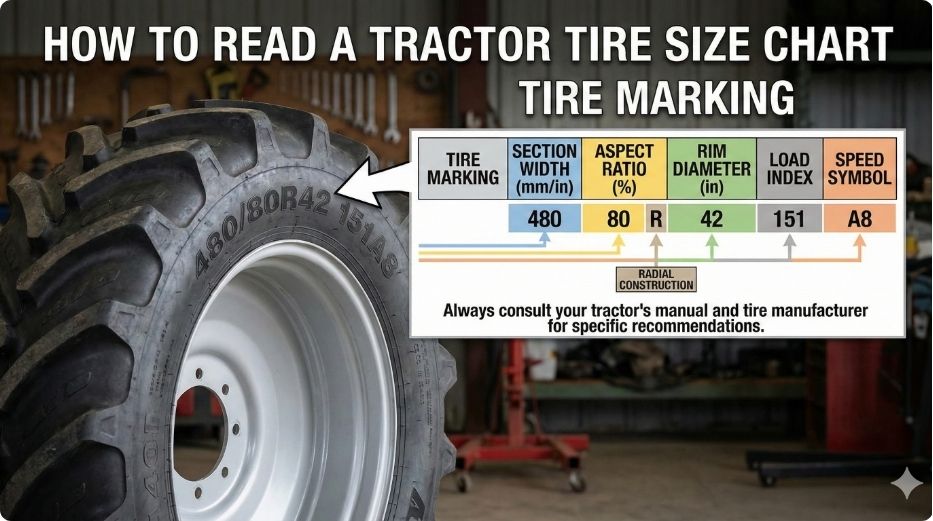
Modern Metric Sizes
A marking such as 340/85R28 contains more information:
- 340 = nominal section width in millimeters
- 85 = aspect ratio
- R = radial construction
- 28 = rim diameter in inches
The 85-series means the nominal sidewall height is approximately 85% of the section width.
Flotation Sizes
A flotation marking such as 29×12.50-15 uses approximate overall diameter, section width, and rim diameter:
- 29 = nominal overall diameter in inches
- 12.50 = nominal section width in inches
- 15 = rim diameter in inches
Flotation sizes should not automatically be converted into a metric agricultural size because their format and dimensional reference are different.
For passenger-car and light-truck sizing formats, see our general tire size chart for broader tire-size references.
Rear Tractor Tire Size Chart
Rear tires typically carry much of the tractor’s working load and are available in a wide range of agricultural sizes. The table below is intended as a reference for common rear-tire size families rather than a universal fitment list.
| Traditional Size | Common Metric Reference | Rim |
| 9.5-24 | 240/85R24 or 250/85R24 | 24 |
| 11.2-24 | 280/85R24 | 24 |
| 12.4-24 | 320/85R24 | 24 |
| 13.6-24 | 340/85R24 | 24 |
| 14.9-24 | 380/85R24 | 24 |
| 16.9-24 | 420/85R24 | 24 |
| 11.2-28 | 280/85R28 | 28 |
| 12.4-28 | 320/85R28 | 28 |
| 13.6-28 | 340/85R28 | 28 |
| 14.9-28 | 380/85R28 | 28 |
| 16.9-28 | 420/85R28 | 28 |
| 18.4-28 | 460/85R28 | 28 |
| 14.9-30 | 380/85R30 | 30 |
| 16.9-30 | 420/85R30 | 30 |
| 18.4-30 | 460/85R30 | 30 |
| 12.4-34 | 320/85R34 | 34 |
| 14.9-34 | 380/85R34 | 34 |
| 16.9-34 | 420/85R34 | 34 |
| 18.4-34 | 460/85R34 | 34 |
| 16.9-38 | 420/85R38 | 38 |
| 18.4-38 | 460/85R38 | 38 |
| 20.8-38 | 520/85R38 | 38 |
| 18.4-42 | 460/85R42 | 42 |
| 20.8-42 | 520/85R42 | 42 |
The same nominal size can have different actual dimensions between tire models, so this chart should be used to identify a size family rather than approve a specific replacement.
Front Tractor Tire Size Chart
Front tractor tires vary considerably depending on whether the tractor uses 2WD, MFWD, or another front-axle configuration. For that reason, the table below provides dimensional references rather than declaring a particular size suitable for every tractor.
| Traditional Size | Common Metric Reference | Rim | Front-Axle Context |
| 6.00-16 | 210/80R16 | 16 | Narrow conventional front size |
| 7.50-16 | 250/80R16 | 16 | Common narrow front-size family |
| 7.50-18 | 250/80R18 | 18 | Narrow front-size family |
| 9.5-20 | 260/80R20 | 20 | Front/utility size family |
| 9.5-24 | 240/85R24 or 250/85R24 | 24 | Front/MFWD size family |
| 11.2-24 | 280/85R24 | 24 | Front/MFWD size family |
| 12.4-24 | 320/85R24 | 24 | Front/MFWD size family |
| 13.6-24 | 340/85R24 | 24 | Wider front/MFWD family |
| 11.2-28 | 280/85R28 | 28 | MFWD size family |
| 12.4-28 | 320/85R28 | 28 | MFWD size family |
| 13.6-28 | 340/85R28 | 28 | MFWD size family |
| 14.9-28 | 380/85R28 | 28 | MFWD size family |
| 16.9-28 | 420/85R28 | 28 | Larger MFWD family |
A size appearing in a front-tire reference chart does not mean it is approved for every front axle. MFWD tractors require particular front/rear relationships, so the tractor manufacturer’s specifications take priority.
Compact Tractor Tire Size Chart
Compact tractors frequently use flotation-style markings rather than traditional agricultural inch or metric markings. These sizes are best treated as their own reference system.
| Flotation Size | Nominal Diameter | Nominal Width | Rim |
| 22×8.50-12 | 22 in | 8.50 in | 12 |
| 23×8.50-12 | 23 in | 8.50 in | 12 |
| 23×10.50-12 | 23 in | 10.50 in | 12 |
| 24×8.50-12 | 24 in | 8.50 in | 12 |
| 24×8.50-14 | 24 in | 8.50 in | 14 |
| 25×8.50-14 | 25 in | 8.50 in | 14 |
| 25×12.00-9 | 25 in | 12.00 in | 9 |
| 26×10.00-12 | 26 in | 10.00 in | 12 |
| 26×12.00-12 | 26 in | 12.00 in | 12 |
| 26×14.00-12 | 26 in | 14.00 in | 12 |
| 27×8.50-15 | 27 in | 8.50 in | 15 |
| 27×10.50-15 | 27 in | 10.50 in | 15 |
| 28×9.00-15 | 28 in | 9.00 in | 15 |
| 29×12.00-15 | 29 in | 12.00 in | 15 |
| 29×12.50-15 | 29 in | 12.50 in | 15 |
| 29×13.50-15 | 29 in | 13.50 in | 15 |
| 31×11.50-15 | 31 in | 11.50 in | 15 |
| 31×12.50-15 | 31 in | 12.50 in | 15 |
| 31×13.50-15 | 31 in | 13.50 in | 15 |
| 31×15.50-15 | 31 in | 15.50 in | 15 |
| 33×12.50-15 | 33 in | 12.50 in | 15 |
| 33×15.50-15 | 33 in | 15.50 in | 15 |
| 33×15.50-16.5 | 33 in | 15.50 in | 16.5 |
| 36×13.50-15 | 36 in | 13.50 in | 15 |
| 38×14.00-20 | 38 in | 14.00 in | 20 |
| 41×14.00-20 | 41 in | 14.00 in | 20 |
| 48×20.00-24 | 48 in | 20.00 in | 24 |
| 54×31.00-26 | 54 in | 31.00 in | 26 |
These are nominal flotation dimensions. Actual section width, overall diameter, rolling circumference, and approved rim combinations vary by tire model.
Agricultural Tire Size Equivalency by Profile
Traditional tractor tire sizes do not always convert to a single modern metric size. The profile—or series—also matters.
85-Series Tractor Tires
The 85-series is one of the clearest traditional-to-metric relationships in agricultural tires.
| Traditional | 85-Series Metric |
| 9.5-24 | 240/85R24 or 250/85R24 |
| 11.2-24 | 280/85R24 |
| 12.4-24 | 320/85R24 |
| 13.6-24 | 340/85R24 |
| 14.9-24 | 380/85R24 |
| 16.9-24 | 420/85R24 |
| 11.2-28 | 280/85R28 |
| 12.4-28 | 320/85R28 |
| 13.6-28 | 340/85R28 |
| 14.9-28 | 380/85R28 |
| 16.9-28 | 420/85R28 |
| 18.4-28 | 460/85R28 |
| 14.9-30 | 380/85R30 |
| 16.9-30 | 420/85R30 |
| 18.4-30 | 460/85R30 |
| 12.4-34 | 320/85R34 |
| 14.9-34 | 380/85R34 |
| 16.9-34 | 420/85R34 |
| 18.4-34 | 460/85R34 |
| 12.4-36 | 320/85R36 |
| 13.6-36 | 340/85R36 |
| 13.6-38 | 340/85R38 |
| 16.9-38 | 420/85R38 |
| 18.4-38 | 460/85R38 |
| 20.8-38 | 520/85R38 |
| 18.4-42 | 460/85R42 |
| 20.8-42 | 520/85R42 |
These relationships are supported by published agricultural tire equivalency data. Some traditional sizes have more than one modern profile option, so a conversion chart should not be interpreted as an exact replacement specification.
70-Series Examples
The 70-series provides a lower-profile alternative for several traditional sizes. Examples include:
| Traditional | 70-Series Reference |
| 9.5-20 | 300/70R20 |
| 11.2-20 | 320/70R20 |
| 12.4-24 | 360/70R24 |
| 13.6-24 | 380/70R24 or 400/70R24 |
| 13.6-28 | 380/70R28 |
| 14.9-28 | 420/70R28 |
| 16.9-28 | 480/70R28 |
| 16.9-30 | 480/70R30 |
| 16.9-34 | 480/70R34 |
| 18.4-38 | 520/70R38 |
65-Series Examples
Examples include:
| Traditional | 65-Series Reference |
| 12.4-24 | 420/65R24 |
| 13.6-24 | 440/65R24 |
| 14.9-28 | 480/65R28 |
| 16.9-28 | 540/65R28 |
| 18.4-34 | 600/65R34 |
| 16.9-38 | 540/65R38 |
| 18.4-38 | 600/65R38 |
A lower-profile tire can change width, sidewall height, overall diameter, and rolling circumference. It therefore needs to be evaluated as a complete tire specification rather than chosen from the width number alone. Bridgestone’s equivalency data illustrates that multiple series can correspond to similar traditional sizes.
60-Series Examples
The 60-series is another lower-profile family used on some agricultural tractors.
Examples include:
- 13.6-28 → 480/60R28
- 14.9-28 → 520/60R28
- 16.9-28 → 600/60R28
- 16.9-30 → 600/60R30
- 16.9-38 → 600/60R38
- 18.4-38 → 650/60R38
- 20.8-38 → 710/60R38
These should be treated as dimensional references rather than universal substitutions.
Narrow 95-Series Examples
Narrow agricultural applications can use high-aspect-ratio 95-series tires.
Examples include:
- 8.3-32 → 210/95R32
- 9.5-32 → 230/95R32
- 9.5-36 → 230/95R36
- 11.2-36 → 270/95R36
- 9.5-38 → 230/95R38
- 11.2-42 → 270/95R42
The higher aspect ratio helps maintain a tall, narrow tire profile, but exact dimensions and fitment still depend on the tire model and rim.
How to Compare Tractor Tire Dimensions
A tire conversion should compare more than width and rim diameter. Four measurements are particularly useful: section width, sidewall height, overall diameter, and rolling circumference.
Section width is the nominal width of the inflated tire from sidewall to sidewall. It is not the same as tread width or the exact footprint on the ground.
For a metric tire, nominal sidewall height can be estimated as:
Section width × aspect ratio
For example, a 340/85R28 tire has a nominal sidewall height of about:
340 × 0.85 = 289 mm
A simple theoretical diameter estimate is:
Rim diameter + 2 × sidewall height
But this is only a calculation. Actual tire dimensions vary by manufacturer, tire model, load, inflation pressure, and construction.
Rolling circumference is particularly important on MFWD tractors because it determines how far a tire travels per revolution.
Bottom line: use calculations to understand a size change, but use the exact tire manufacturer’s published dimensions and the tractor manufacturer’s requirements to approve the replacement.
For broader wheel-size and overall-diameter conversions outside agricultural tractor sizing, see our tire size conversion chart.
Can You Replace a Tractor Tire With a Different Size?
Yes, in some applications—but a different size should never be selected from a conversion chart alone.
Before changing size, verify:
- Rim diameter
- Approved rim width
- Load capacity
- Overall diameter
- Section width
- Rolling circumference
- Wheel-well and steering clearance
- Inflation requirements
- Tire construction
- Tread/application
- MFWD compatibility
A different profile may provide useful changes in width, footprint, or load capacity, but it can also change the tractor’s gearing relationship and physical clearance.
For a 2WD tractor, the drivetrain concerns may be simpler, but clearance, rim compatibility, load, and steering still matter.
For an MFWD tractor, the front and rear tires must also work correctly with the tractor’s mechanical axle ratio.
If you are comparing two specific tire dimensions, use our tire size comparison calculator to compare diameter, width, and other calculated differences before making a change.
The key rule: a tire described as “equivalent” by size is not automatically an approved replacement.
MFWD and 4WD Tractor Tire Matching
MFWD tractors require special attention because the front and rear axles are mechanically connected.
The front and rear tires do not normally need to have the same diameter. Instead, their rolling circumferences must work with the tractor’s mechanical front/rear axle ratio.
A simplified preponderance calculation is:
Preponderance (%) = [(Front Rolling Circumference ÷ Rear Rolling Circumference) × Axle Ratio − 1] × 100
The exact ratio convention and acceptable range can vary by tractor manufacturer, so the manufacturer’s calculation method should take priority. Firestone provides the same basic relationship for evaluating tire-size changes on four-wheel-drive tractors.
Before changing an MFWD tire, record:
- Tractor model and drivetrain
- Existing front and rear tire sizes
- Existing rolling circumferences
- Mechanical front/rear axle ratio
- Replacement tire rolling circumferences
- Required lead/preponderance
- Load and clearance requirements
Do not assume that two tires with the same nominal size have the same rolling circumference. Tire model, pressure, load, and wear can affect the actual result.
Bias vs. Radial Tractor Tires
Bias and radial tires use different internal constructions, so changing between them involves more than matching the sidewall numbers.
A bias tire generally has its casing cords arranged diagonally across the tire. A radial tire uses radial casing construction with the sidewall and tread structure working differently.
This can affect:
- Ride quality
- Sidewall flex
- Footprint
- Traction behavior
- Soil interaction
- Load carrying characteristics
- Rolling circumference
For example, 13.6-28 and 340/85R28 are commonly related size-family references, but the latter specifically identifies a radial construction. That does not mean every 13.6-28 tire can be replaced with any 340/85R28 tire.
When changing construction, verify the approved rim, actual dimensions, load capacity, inflation requirements, and operating application. On MFWD tractors, also verify the complete front/rear rolling-circumference relationship.
Tractor Tire Types and Applications
The tread pattern should match the tractor’s primary working environment.
| Tread | Typical Application |
| R1 | General agricultural field work |
| R1W | Deeper agricultural traction |
| R2 | Very wet, muddy, or paddy conditions |
| R3 | Turf and grounds maintenance |
| R4 | Industrial, loader, utility, and mixed hard-surface work |
R1 is the conventional starting point for general field traction. R1W offers deeper agricultural tread for more demanding traction conditions.
R2 is intended for particularly wet environments where aggressive traction and self-cleaning are important.
R3 prioritizes reduced surface disturbance for turf-related applications.
R4 is commonly chosen when the tractor spends substantial time on hard surfaces or performs loader and utility work.
The tread category should not be selected independently of the tractor, tire size, load, inflation pressure, soil conditions, and road use.
How to Measure an Existing Tractor Tire
Start with the sidewall marking because it provides more useful identification than physical measurement alone.
Record the complete marking, such as:
- 13.6-28
- 18.4R38
- 340/85R28
- 29×12.50-15
Then measure the tire if you need a physical comparison:
- Section width: measure sidewall-to-sidewall.
- Overall diameter: measure from the ground-contact surface to the top of the tire.
- Rim diameter: verify the wheel size rather than estimating it from the tire.
- Rolling circumference: important when comparing MFWD tire combinations.
Also record the tire manufacturer, model, construction, load information, and inflation specifications where available.
Physical measurements can differ from nominal size markings because tire dimensions depend on the specific model, rim, load, and inflation condition.
For final replacement decisions, compare the measurements with the manufacturer’s technical data rather than relying only on a tape-measure result.
Tractor Tire Replacement Checklist
Before ordering a replacement tire, check the following:
| Check | What to Verify |
| Size | Traditional, metric, or flotation marking |
| Rim | Correct diameter and approved rim width |
| Load | Tire can carry the required tractor/load combination |
| Dimensions | Section width and overall diameter |
| Clearance | Steering, fender, chassis, and drivetrain clearance |
| Tread | Correct R1/R1W/R2/R3/R4 application |
| Construction | Bias or radial |
| Inflation | Required pressure range and load rating |
| MFWD | Front/rear rolling circumference and lead |
| Manufacturer | Approved specifications for tractor and tire |
| Operating conditions | Field, road, wet soil, turf, loader, etc. |
If the replacement involves a different size, profile, or construction, verify the complete tire combination before purchase.
For MFWD tractors, do not stop after checking the front tire alone. The front and rear tires must be evaluated together.
Common Tractor Tire Size Mistakes
The most common mistake is treating a size conversion as an exact replacement specification.
Avoid these errors:
- Assuming one traditional size always has one metric equivalent
- Ignoring approved rim width
- Comparing only section width
- Ignoring rolling circumference
- Using the same nominal size from a different brand without checking specifications
- Assuming R1 and R4 are interchangeable
- Choosing R1W simply because it has deeper tread
- Changing MFWD tire size without checking lead/preponderance
- Ignoring load capacity
- Forgetting steering or fender clearance
- Treating physical measurement as a manufacturer’s approved dimension
- Assuming front and rear tires must have identical diameters
The safest approach is to use the chart for identification and comparison, then use the exact tire and tractor specifications for final fitment.
Frequently Asked Questions
What does 13.6-28 mean?
A 13.6-28 tire uses a traditional inch-based agricultural size. The 13.6 represents nominal section width in inches, while 28 represents the rim diameter in inches.
A common modern metric reference is 340/85R28, but that relationship does not automatically approve one tire as a replacement for another.
What is the equivalent of 18.4-38?
A common modern metric reference for 18.4-38 is 460/85R38.
However, the exact tire’s overall dimensions, rolling circumference, approved rim, load capacity, and application should still be checked before replacement.
Can I put a different size tire on my tractor?
Sometimes. The new tire must be compatible with the rim, load, clearance, inflation requirements, and tractor specifications.
On MFWD tractors, the replacement must also maintain the required front/rear rolling-circumference relationship.
What is the difference between R1 and R4?
R1 is primarily an agricultural traction tread, while R4 is commonly used for industrial, loader, utility, and mixed hard-surface work.
Neither is universally better. Choose based on the tractor’s actual operating environment.
How do I know what size tractor tire I need?
Read the complete sidewall marking on the existing tire first. Then verify rim diameter, approved rim width, load capacity, dimensions, clearance, tread type, construction, and—on MFWD tractors—rolling circumference and drivetrain compatibility.
Are 13.6-28 and 340/85R28 the same size?
They are commonly treated as related size-family markings, and 340/85R28 is a published metric reference for 13.6-28.
They should not be assumed to have identical actual dimensions or identical fitment characteristics across every tire model.
Can I change from bias to radial tires?
Yes, in some applications, but it requires more than matching nominal size.
Check rim compatibility, actual dimensions, load, inflation, rolling circumference, clearance, and tractor requirements. MFWD tractors require additional front/rear compatibility checks.
Do front and rear MFWD tires need to be the same size?
No. MFWD tractors commonly use different front and rear tire sizes.
What matters is whether the rolling circumferences work correctly with the tractor’s mechanical front/rear axle ratio and specified lead/preponderance.
Can I use a tractor tire conversion chart to approve a replacement?
No. A conversion chart is a reference tool.
Use it to identify possible size relationships, then verify the exact tire manufacturer’s technical specifications and the tractor manufacturer’s approved fitment requirements.
Does tractor tire size affect traction?
Yes, but size is only one factor. Tread design, inflation pressure, load, soil conditions, construction, and tire slip also affect traction.
A larger tire is not automatically a better-traction tire.
Final Takeaway
A tractor tire size chart is most useful when it helps you understand the relationship between traditional, metric, and flotation markings.
For example, 13.6-28 → 340/85R28 and 18.4-38 → 460/85R38 are useful common references. But the safest replacement decision goes beyond the numbers printed on the sidewall.
Before installing a different tire, verify the rim, load capacity, actual dimensions, clearance, inflation requirements, tread type, construction, and manufacturer specifications.
For MFWD tractors, add one more critical check: rolling circumference and front/rear drivetrain compatibility.
In short, use the chart to find the right size family—then use manufacturer data to determine whether the tire is actually the right fitment.
