V vs H Speed Rating
If you are comparing V vs H speed rating, the real question is usually not about driving 130 or 149 mph. It is about choosing the tire that fits your car, your driving style, and your budget without giving up safety or comfort.
A tire speed rating tells you how much heat and speed a tire was designed to handle under controlled testing. In everyday driving, that rating also tends to reflect how the tire feels on the road, how it handles in corners, and sometimes how long it lasts. That is why the choice between H and V matters more than many drivers first think.
Quick Answer: V vs H Speed Rating
The biggest difference between H and V speed rating tires is how the tire is designed to handle heat, stability, and responsiveness at higher speeds.
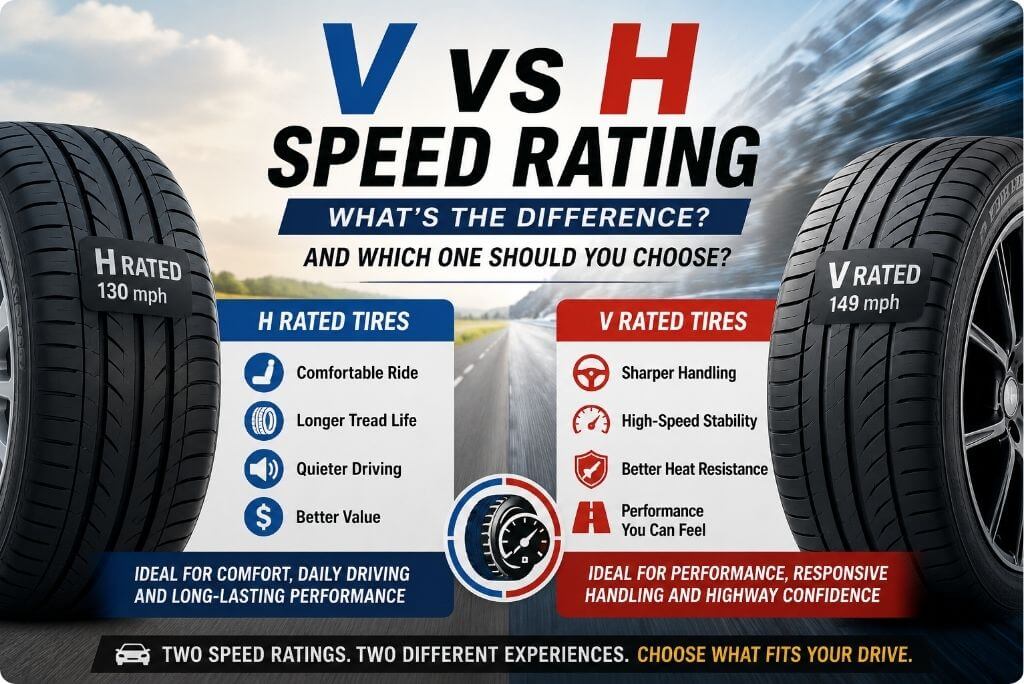
An H-rated tire is approved for speeds up to 130 mph, while a V-rated tire is approved for speeds up to 149 mph.
But for everyday drivers, the real-world difference is usually this:
- H-rated tires often focus more on comfort, smooth ride quality, and longer tread life.
- V-rated tires usually offer sharper handling, firmer steering response, and better high-speed stability.
If you mainly commute, take road trips, and want a softer ride, H-rated tires are often a great choice.
If you drive a sportier sedan, spend lots of time on highways, or enjoy more responsive handling, V-rated tires may feel better behind the wheel.
For most drivers, this decision is less about top speed and more about how the car feels during normal driving.
What Tire Speed Ratings Actually Mean
A tire speed rating tells you the maximum speed a tire can safely support under controlled test conditions when it is properly inflated, carrying the correct load, and in good condition. It is not a target speed for normal driving, and it is not the same thing as how fast your car should be driven.
You will usually find the speed rating in the tire size code on the sidewall. It appears as a letter at the end of the tire size. For example, if a tire size ends in H or V, that letter is the speed rating.
Automakers choose speed ratings during vehicle development for several reasons. Yes, the tire must meet speed capability requirements, but the speed rating also affects other things, such as steering feel, heat resistance, stability, and the way the car responds in everyday driving.
H Speed Rating Explained
H-rated tires are rated for speeds up to 130 mph under test conditions. That is far above normal legal driving speeds in most places, which is why H-rated tires are more than enough for many family cars, crossovers, and touring setups.
In everyday use, H-rated tires are often chosen because they usually strike a nice balance between comfort, durability, and dependable handling. They are common on sedans, minivans, crossovers, and touring-focused vehicles.
V Speed Rating Explained
V-rated tires are rated for speeds up to 149 mph under test conditions. Like H-rated tires, they are still perfectly suitable for normal road use. The real difference is that V-rated tires are often built with a stronger focus on handling precision, heat resistance, and stability.
You will often see V-rated tires on sport sedans, performance trims, and some higher-trim crossovers or EVs. In many cases, the speed rating is part of a broader performance package, not just a top-speed requirement.
H vs V speed rating comparison
H-rated tires are built for sustained speeds up to 130 mph, while V-rated tires are built for 149 mph. In day-to-day driving, that number is not the main difference. What usually changes is the tire’s construction: V-rated tires often feel a little more tied down in fast lane changes and highway sweepers, while H-rated tires often lean a bit more toward comfort and tread life.
Maximum speed rating comparison
The speed rating tells you how much heat and stress a tire is designed to handle at speed. That matters even if you never go anywhere near the limit, because a tire that runs cooler under load is usually more stable during long highway trips, hard braking, and repeated high-speed runs.
For most drivers, both H and V are more than enough. The real question is not “How fast do I drive?” but “What kind of feel do I want from the tire, and what did the vehicle maker specify?”
Steering response and handling feel
V-rated tires usually feel a little sharper when you turn the wheel. On a sporty sedan or a heavy crossover on a winding freeway, that extra stiffness can make the vehicle feel more precise and less floaty. H-rated tires usually give up a bit of that crispness, but many drivers will prefer the more relaxed, less busy feel in normal commuting.
On wet roads, that sharper response can inspire more confidence if you drive quickly and make frequent lane changes. But if your driving is mostly city traffic and straight highway miles, the difference is often small enough that comfort matters more than the last bit of turn-in response.
Ride comfort and road noise
H-rated tires often have the edge here. Their slightly more flexible construction can take the edge off broken pavement, expansion joints, and rough city streets. That makes them a better fit for drivers who care more about calm, easy daily driving than sporty response.
In real life, a V-rated tire may feel a touch firmer and sometimes a little noisier as it wears. On a smooth road, the difference can be minor. On coarse asphalt or patched roads, H-rated tires are often the more comfortable choice.
Heat resistance and high-speed stability
This is where V-rated tires earn their place. If you do long highway runs, drive in hot weather, carry passengers and luggage, or just like a more planted feel at speed, a V-rated tire usually has an advantage in stability and heat management.
A good example is a loaded SUV on a summer road trip. In that situation, the tire is dealing with heat from speed, vehicle weight, and long hours on the road. A V-rated tire is generally better suited to that kind of sustained stress, while an H-rated tire is still fine for normal use but may not feel quite as composed when pushed harder.
Tread life and wear expectations
All else being equal, H-rated tires often last a bit longer. That is not a guarantee, because tread life depends heavily on the tire model, compound, alignment, rotation, and driving style. But in the same tire family, the lower-speed-rated version often uses a slightly softer, more comfort-focused setup, while the higher-rated version may trade some wear life for better response.
If you put a lot of miles on the car and care most about mileage per set, H-rated tires are often the better value. If you care more about feel and stability, V-rated tires can justify the trade.
Price and value trade-off
H-rated tires are usually cheaper, and that matters if you are replacing a full set on a sedan or crossover. For many drivers, they offer the best balance of comfort, price, and long-term wear.
V-rated tires cost more because they are usually engineered with a more performance-oriented structure. That extra cost makes sense when the car is capable, the chassis is tuned for it, or the driver actually wants the firmer road feel. If none of that applies, paying extra for V may not deliver enough real-world benefit.
Typical tire categories where each rating appears
H-rated tires are commonly found in touring, grand touring, and many all-season or all-weather designs. They are a natural fit for family sedans, crossovers, and drivers who want an easygoing ride with good durability.
V-rated tires show up more often in sport touring, performance all-season, and some ultra-high-performance tires. They are more common on sporty sedans, performance trims, and vehicles where the factory tuned the suspension and steering around a firmer tire.
Best for: drivers who want a practical, OEM-friendly tire with a strong comfort-and-value balance.
Avoid if: your car is tuned for sharper handling and you do a lot of fast highway driving, heavy loads, or spirited cornering where the extra stability of V-rated tires is worth paying for.
What drivers actually notice in real-world driving
Daily commuting
In normal commuting, most drivers will notice that H-rated tires usually feel a little softer and calmer, while V-rated tires feel a bit more controlled. Around town, that difference is not dramatic, but it shows up over broken pavement, speed bumps, and stop-and-go traffic. If your daily drive is mostly low-speed city use, H-rated tires often feel easier to live with.
Highway travel and long road trips
On the highway, the gap becomes easier to feel. V-rated tires usually stay more settled at higher speeds and during long sweeping lane changes, especially on a loaded car or SUV. H-rated tires are still perfectly capable for normal highway driving, but they tend to feel a little more relaxed than sharp. On a long summer trip with passengers and luggage, V-rated tires often give a more planted feel.
Wet braking and emergency maneuvers
In heavy rain, the difference is less about the letter on the sidewall and more about how the tire was built. Still, V-rated tires often give a slightly more confident response when you brake hard or swerve suddenly because the sidewall is usually stiffer and the tire feels more immediate. H-rated tires can still brake well, but in a quick emergency maneuver they may feel a touch less tied down.
Cornering, lane changes, and steering precision
This is where the driver feels the biggest difference. V-rated tires usually respond faster to steering input, so the car feels more accurate in fast lane changes and on winding roads. H-rated tires are more forgiving and less nervous, which many drivers actually prefer in everyday use. If you enjoy a tighter steering feel, V makes sense; if you value easy, relaxed driving, H is often enough.
Comfort on rough roads and potholes
On rough pavement, H-rated tires usually have the advantage. They tend to absorb sharp edges a little better and can make an everyday car feel less harsh. That matters if your commute includes patched roads, potholes, or broken city streets. V-rated tires can feel firmer and sometimes transmit more impact into the cabin, especially as they age.
Noise levels over time
New tires can be quiet in either rating, but as they wear, the difference often becomes clearer. H-rated tires typically stay more forgiving and can be less noticeable on coarse pavement. V-rated tires may start off quiet but can pick up more road texture as tread wears down. For drivers who spend hours on rough highways, that matters more than a few tenths of a second in steering response.
Best for: drivers who want to understand the trade-off in real use, not just on paper.
Avoid if: you are expecting the speed rating alone to transform grip, braking, or comfort; tire design and category matter just as much.
Does V or H Speed Rating Affect Tire Life?
In many cases, yes, but not always in the way people expect.
H-rated tires often last longer because they are commonly built for touring and everyday comfort. They may use tread compounds and designs that focus on even wear and longer mileage. Many drivers like this because they want to go farther between tire replacements.
V-rated tires can wear faster if they are part of a performance-oriented tire line. Those tires are often designed for more grip and sharper response, which can sometimes mean a softer compound and shorter tread life.
But again, the tire category matters. A V-rated grand touring tire may last quite well, while an H-rated ultra-cheap tire may wear out sooner than expected. The speed rating is only one piece of the puzzle.
The best way to think about it is this: if long tread life is your top priority, many H-rated tires are a strong fit. If handling feels matters more, you may be willing to give up a little tread life for the sharper response of a V-rated tire.
Can You Replace V-Rated Tires With H-Rated Tires?
This is the question most people really want answered. The honest answer is: sometimes yes, sometimes no.
If your car came with V-rated tires from the factory, replacing them with H-rated tires may be acceptable in some cases, but it depends on the vehicle and how you drive it. The safest rule is to check your owner’s manual, the tire placard on the door jamb, and the recommendation from a trusted tire professional.
The main thing to remember is that changing speed ratings can change how the car feels. It may also affect whether the tire matches the original engineering intent of the vehicle.
When Switching to H-Rated Tires Usually Makes Sense
H-rated tires can be a smart choice when your driving is mostly calm and routine. They often fit well if you want:
- a smoother ride
- lower noise
- longer tread life
- better value
- everyday commuting comfort
If you rarely drive aggressively and your car is used mainly for errands, commuting, and highway cruising, H-rated tires may be perfectly practical.
When You Should Keep V-Rated Tires
Sticking with V-rated tires is usually the better choice if you drive a sportier car, spend a lot of time on fast highways, or simply prefer crisp handling.
V-rated tires are often the safer bet when you want:
- sharper steering response
- firmer cornering feel
- better high-speed stability
- a tire that matches the factory setup
- more confidence in quick lane changes and emergency maneuvers
If your vehicle was tuned around V-rated tires, keeping that rating helps preserve the driving feel the automaker intended.
Possible Risks of Downgrading
Downgrading from V to H is not always a problem, but there can be trade-offs. The car may feel less precise, less stable at speed, or softer in turns. That may be fine for some drivers, but it can be frustrating for others.
There can also be concerns around manufacturer recommendations, tire warranties, and vehicle-specific requirements. That is why it is smart to look at the full tire specification, not just the speed letter.
V vs H Speed Rating for Different Vehicle Types
The best speed rating depends a lot on what you drive.
Family Sedans
For many family sedans, H-rated tires are often a great match. They can give you a comfortable ride, decent handling, and long tread life without pushing the cost too high.
V-rated tires may still be a good choice if you want a little more steering precision or your sedan is a sportier trim. Some drivers like the tighter, more controlled feel, especially on highways.
Crossovers and SUVs
Crossovers and SUVs often benefit from stable, comfortable tires. H-rated tires are common here because many owners want ride comfort and long wear more than sporty handling.
That said, some crossovers and SUVs, especially higher-trim models, may be happier on V-rated tires if the vehicle is tuned for a firmer, more responsive feel. Weight also matters. Heavier vehicles may benefit from the stronger handling character of a V-rated option.
Sports Sedans
Sports sedans usually lean toward V-rated tires for a reason. These cars are built to feel more precise and energetic, so a V-rated tire often supports that personality better.
In this category, changing to an H-rated tire may soften the car too much and reduce the sharpness that owners expect.
Electric Vehicles
EVs often place extra demands on tires because they are heavier than many gas-powered cars and deliver instant torque. Some EVs use higher-rated tires to help with stability, wear control, and handling under that extra load.
That does not mean every EV needs V-rated tires, but it does mean the tire choice should be taken seriously. EV drivers should pay close attention to the original equipment recommendation.
Related topic: Motorcycle Tire Speed Rating Chart
Common Myths About Tire Speed Ratings
There is a lot of confusion around tire speed ratings, so it helps to clear up a few common myths.
“V-Rated Tires Are Only for High-Speed Driving”
Not true. Most drivers never come close to the tire’s speed limit. V-rated tires are often chosen for their handling and stability benefits, not because the driver plans to go extremely fast.
“H-Rated Tires Are Unsafe”
Also not true. H-rated tires are perfectly safe when they match the vehicle and driving conditions. They are used on many cars for ordinary road use every day.
“Higher Speed Rating Always Means Better Tire”
Not necessarily. A higher rating does not automatically mean better comfort, longer life, or better wet grip. It simply means the tire is designed to handle higher speeds under test conditions. The best tire is the one that fits your needs.
“All V-Rated Tires Wear Out Faster”
Not always. Some do, especially performance-focused models. But a V-rated grand touring tire may wear very well. Tire design matters just as much as the letter on the sidewall.
How to Choose Between V and H Speed Ratings
The best choice starts with your real driving habits.
If you want comfort, value, and long tread life, H-rated tires are often a strong choice. They make sense for drivers who spend most of their time commuting, running errands, or taking relaxed highway trips.
If you care more about steering feel, stability, and a more precise road feel, V-rated tires are usually the better fit. They are often a better match for drivers who enjoy a more connected driving experience or who drive a vehicle designed with sportier handling in mind.
It also helps to ask yourself a few simple questions:
- Do I want the softest, quietest ride possible?
- Do I care more about handling and steering response?
- Did my car come with a specific speed rating from the factory?
- Does tread life or driving feel more important to me?
Your answer to those questions will often point you in the right direction.
Related Topic: Trailer Tire Speed Rating Chart
FAQ
Is V speed rating better than H?
Not always. V-rated tires are usually better for handling and stability, while H-rated tires often do better for comfort and tread life.
Can I mix H and V-rated tires?
It is best to avoid mixing tire ratings unless a tire professional confirms it is safe for your specific setup. Matching tires is usually the smarter choice.
Is it safe to downgrade from V to H?
Sometimes yes, but only if the tire still matches your vehicle’s load and size requirements and the change does not conflict with the manufacturer’s recommendation.
Will H-rated tires improve ride comfort?
Often, yes. Many H-rated tires are designed with comfort and everyday use in mind.
Do V-rated tires improve braking?
They can improve braking feel and control in some situations, but braking performance depends on the full tire design, not just the speed rating.
Final verdict: How to choose confidently
Choosing between H and V speed ratings depends on your driving style and priorities.
If you want a smoother ride, strong value, and longer tread life, H-rated tires are often the smarter choice for everyday driving. If you want sharper steering, firmer road feel, and more confidence at higher speeds, V-rated tires are usually the better fit.
Don’t choose just by the letter. Check your vehicle’s recommendation, tire category, load index, and driving habits. That’s how you find the tire that fits your needs and delivers long-term value.
