Wheel Bolt Pattern Chart & Fitment Guide
A wheel bolt pattern chart is one of the easiest ways to check wheel fitment before you buy. If you are shopping for new wheels, replacing damaged wheels, or trying to match a set of used wheels to your vehicle, the bolt pattern is one of the first things you need to know.
A wrong bolt pattern means the wheel will not mount correctly. A correct bolt pattern is the starting point, but it is not the only fitment detail that matters. This guide will help you understand the numbers, measure them correctly, and use a wheel bolt pattern chart with confidence.
What Is a Wheel Bolt Pattern?
A wheel bolt pattern is the arrangement of the holes on a wheel that match the bolts (or studs) on your vehicle’s hub. It decides whether a wheel can physically mount onto your car or truck. If the pattern does not match, the wheel simply will not fit, even if everything else looks similar.
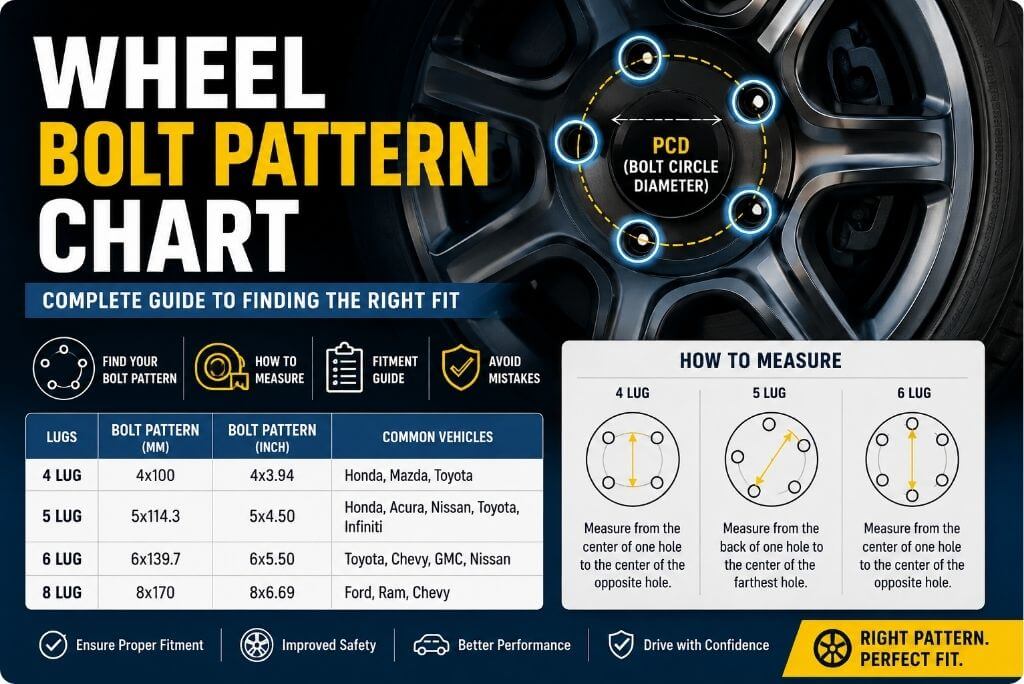
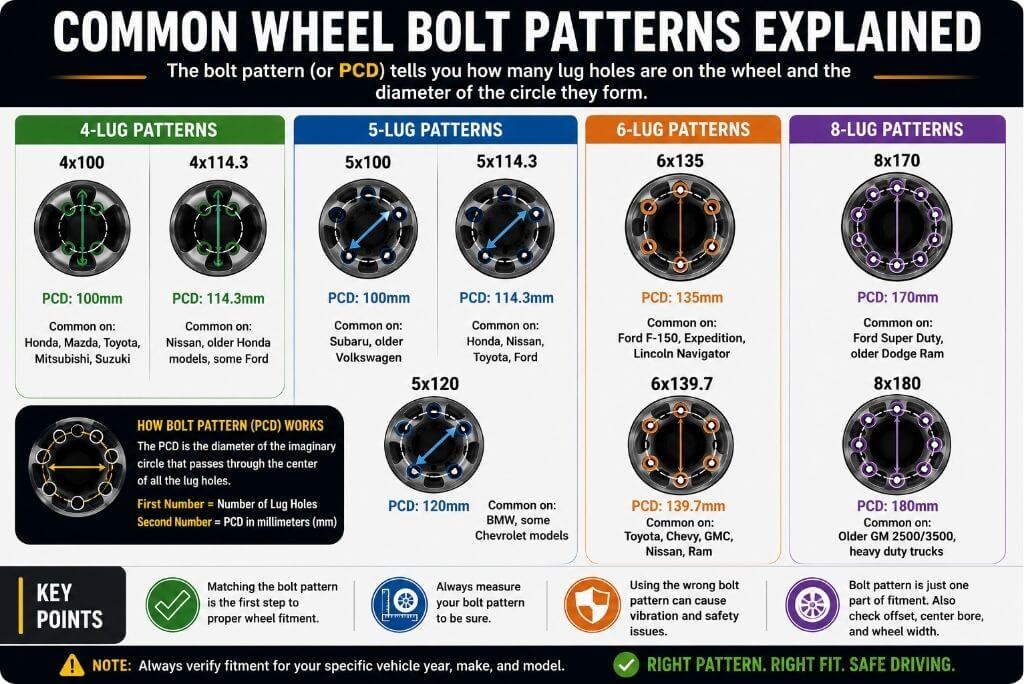
The pattern is shown using two numbers, like 5×114.3 or 6×139.7. The first number tells you how many bolt holes the wheel has. So, 5×114.3 means the wheel has 5 bolt holes. The second number is the diameter of an imaginary circle that passes through those holes, measured in millimeters. This is called the pitch circle diameter (PCD).
So, 5×114.3 means 5 bolts arranged in a circle that is 114.3 mm wide. A 6×139.7 pattern means 6 bolts arranged on a 139.7 mm circle. Even a small difference in that second number can make the wheel incompatible.
People often mix up a few terms here. “Bolt pattern,” “lug pattern,” and “PCD” all basically refer to the same idea, but they are used in slightly different ways. In most everyday situations, they mean the same thing: the layout of the wheel’s bolt holes.
PCD is the more technical term and is commonly used in specifications. Lug pattern is more casual and often used in shops or online listings. Bolt pattern is the most common term you will see in guides and charts. The important thing is not the wording, but making sure the numbers match your vehicle exactly.
How to Read a Wheel Bolt Pattern Chart
A wheel bolt pattern chart looks simple at first, but it becomes easy once you know what to look for. Most of the confusion comes from not understanding the two numbers shown in each pattern.
The first number is the lug count. This tells you how many bolt holes the wheel has. For example, in 5×114.3, the “5” means there are five bolts. This part is easy to check because you can count the holes on the wheel.
The second number is the bolt circle diameter (PCD). This is the size of an imaginary circle that passes through the center of all bolt holes. It is usually measured in millimeters, like 114.3 mm or 139.7 mm. This number is what decides if the wheel will actually fit your vehicle.
Some charts also show measurements in inches. For example, 5×114.3 mm is often written as 5×4.5 inches. Both mean the same thing, just in different units. This can be confusing because the numbers look slightly different, but they refer to the same fitment size.
A simple way to use a chart is to first find your lug count, then match the second number exactly. Even a small difference in PCD can stop the wheel from fitting properly, so it needs to be exact, not close.
For example, 5×114.3 and 5×115 look almost the same, but they are not interchangeable. The small difference is enough to cause fitting issues or unsafe installation.
How to Measure a Wheel Bolt Pattern
If you are unsure about your pattern, measuring it yourself is a smart move. It is especially helpful when wheels are already installed or when the vehicle has aftermarket parts.
Tools Needed
You do not need special equipment for a basic check. A tape measure, a ruler, or a caliper can work. A bolt pattern gauge makes the job easier, but it is not required.
Measuring 4-Lug Wheels
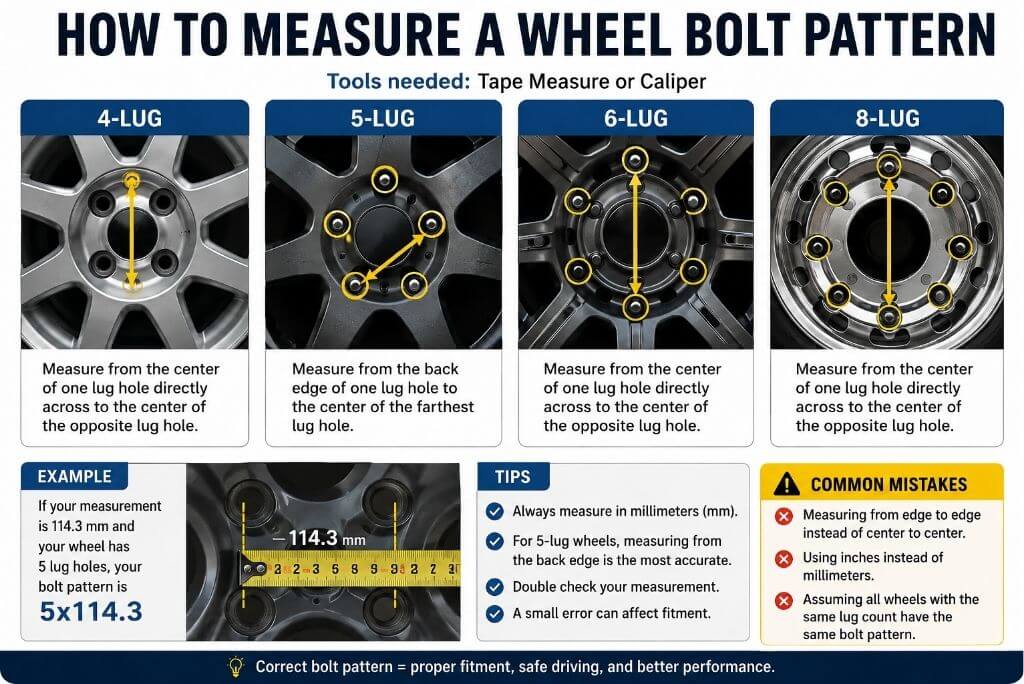
For a 4-lug wheel, measure from the center of one lug hole to the center of the opposite lug hole. That gives you the bolt circle diameter.
This is one of the easiest patterns to measure because the opposite holes line up directly across from each other.
Measuring 5-Lug Wheels
A 5-lug wheel is a little trickier because there is no hole directly opposite the one you are measuring from. In this case, measure from the center of one hole to the outer edge of the hole two positions away, or use a bolt pattern gauge for a more accurate result.
If you are not sure, it is better to confirm with the vehicle’s fitment specs rather than guessing.
Measuring 6-Lug Wheels
For a 6-lug wheel, measure from the center of one hole to the center of the hole directly across from it. Since the holes are evenly spaced, this is simpler than a 5-lug pattern.
Measuring 8-Lug Wheels
An 8-lug wheel is also easier to measure because the holes are opposite each other. Measure from the center of one hole to the center of the hole across from it.
Common Measurement Mistakes
A lot of fitment problems come from simple measuring errors. The most common mistakes are:
- Measuring from edge to edge instead of center to center
- Mixing millimeters and inches
- Counting the holes correctly but reading the wrong diameter
- Assuming all wheels with the same lug count share the same pattern
A small mistake here can lead to a bad purchase, so take your time.
Wheel Bolt Pattern Chart by Lug Count
4 Lug Bolt Pattern Chart
| Metric bolt pattern | Inch equivalent | Vehicle examples | Notes |
| 4×98 | 4×3.86″ | Abarth, Alfa Romeo, Alpine, Citroën, Datsun, Dodge, Fiat. | Common on many smaller European cars and classic-fitment applications. |
| 4×100 | 4×3.94″ | Abarth, Acura, Alpine, Aston Martin, Audi, BMW. | One of the most common 4-lug patterns in passenger cars. |
| 4×10⁸ | 4×4.25″ | Mazda, Ford, Mercury, Alfa Romeo, Audi, Citroën. | Very common in European and some older compact car fitments. |
| 4×110 | 4×4.33″ | Daihatsu, Mazda, Perodua, Toyota. | Seen more often in compact Japanese and Asian-market vehicles. |
| 4×114.3 | 4×4.50″ | Acura, BAIC, BAIC BJEV, BYD, Baojun, Buick, Changan. | A widely used 4-lug pattern across many makes and generations. |
| 4×115 | 4×4.53″ | Aixam, Micro. | A niche pattern, mostly seen on smaller specialty vehicles. |
| 4×130 | 4×5.12″ | Lancia, Skoda, Volkswagen. | More common on older European and classic fitments. |
| 4×140 | 4×5.51″ | Alpine, Peugeot, Subaru. | A rarer pattern, often associated with niche or older applications. |
| 4×156 | 4×6.14″ | Polaris. | Specialty off-road/UTV pattern rather than a typical passenger-car fitment. |
| 4×160 | 4×6.30″ | Opel, Renault, TATA. | Uncommon compared with the main 4-lug passenger-car patterns. |
5 Lug Bolt Pattern Chart
| Metric bolt pattern | Inch equivalent | Vehicle examples | Notes |
| 5×98 | 5×3.86″ | Fiat Egea, Fiat Tipo, Fiat 500L, Alfa Romeo GT. | A common smaller European pattern, especially on Fiat and Alfa Romeo applications. |
| 5×100 | 5×3.94″ | Subaru Impreza, Toyota Premio, Skoda Rapid, MG VS. | One of the most common 5-lug passenger-car patterns. |
| 5×10⁸ | 5×4.25″ | Ford Focus, Ford Escape, Ford S-MAX, Ford C-MAX. | Very common on Ford and several European-market vehicles. |
| 5×110 | 5×4.33″ | Opel Astra, Opel Corsa, Saturn Ion. | Common on Opel and some GM-platform vehicles. |
| 5×112 | 5×4.41″ | BMW 1 Series, Volkswagen Touran, Porsche Macan, MINI One. | A major European fitment pattern used across BMW, VW, Porsche, MINI, and others. |
| 5×114.3 | 5×4.50″ | Kia Forte, Kia K5, Tesla Model 3, Mercedes-Benz T-Class. | One of the most widely used 5-lug patterns worldwide. |
| 5×115 | 5×4.53″ | GMC Terrain, Chevrolet Malibu, Buick Encore, Saturn Vue. | Common in several GM applications and some Opel-based fitments. |
| 5×120 | 5×4.72″ | BMW 1 Series, BMW X1, BMW 5 Series, Rolls-Royce Wraith. | A core BMW-group pattern, with many luxury and performance applications. |
| 5×127 | 5×5.00″ | Jeep Wrangler, Jeep Grand Cherokee, Dodge Charger. | Often seen on Jeep and Dodge applications; not interchangeable with 5×120.65 without the right fitment solution. |
| 5×130 | 5×5.12″ | Porsche 911, Porsche Cayenne, Audi Q7, Volkswagen Touareg. | A classic Porsche/VW-group performance and SUV fitment pattern. |
| 5×139.7 | 5×5.50″ | Ram 1500 Classic, Ram 1500, Ford F-100, Mahindra XUV500, UAZ Hunter. | A common truck and SUV pattern, especially in older and global utility applications. |
| 5×150 | 5×5.91″ | Toyota Tundra, Toyota Sequoia, Toyota Land Cruiser, Lexus LX. | Common on Toyota full-size trucks and SUVs. |
6 Lug Bolt Pattern Chart
| Metric bolt pattern | Inch equivalent | Vehicle examples | Notes |
| 6×114.3 | 6×4.50″ | Nissan Frontier (some trims), Isuzu D-Max, Holden Colorado (select markets) | Less common than 6×139.7, mostly used in midsize truck platforms. |
| 6×115 | 6×4.53″ | Cadillac CTS, Cadillac SRX, Chevrolet Malibu (some years) | GM-related passenger car and crossover applications. |
| 6×120 | 6×4.72″ | Chevrolet Colorado (newer models), GMC Canyon, Cadillac XT5 | Modern GM midsize truck/SUV platform pattern. |
| 6×127 | 6×5.00″ | Jeep Gladiator (JT), Jeep Wagoneer, Chevrolet/GMC full-size SUV (some models) | Strong truck/SUV fitment used in modern utility platforms. |
| 6×130 | 6×5.12″ | Mercedes-Benz Sprinter, Volkswagen Crafter | Common on European vans and commercial vehicles. |
| 6×135 | 6×5.31″ | Ford F-150 (2004–2020), Ford Expedition | One of the most recognized Ford truck patterns. |
| 6×139.7 | 6×5.50″ | Toyota Tacoma, Toyota 4Runner, Toyota Hilux, Chevy Silverado 1500, GMC Sierra 1500, Nissan Titan | One of the most widely used truck/SUV bolt patterns globally. |
| 6×170 | 6×6.69″ | Ford F-250, Ford F-350 Super Duty | Heavy-duty Ford truck platform pattern. |
| 6×180 | 6×7.09″ | Chevrolet Silverado 2500HD/3500HD, GMC Sierra HD | Heavy-duty GM truck applications. |
8 Lug Bolt Pattern Chart
| Metric bolt pattern | Inch equivalent | Vehicle examples | Notes |
| 8×165.1 | 8×6.50″ | Chevrolet Kodiak, GMC TopKick, some heavy-duty commercial trucks | Older medium-duty truck platforms and commercial applications. |
| 8×170 | 8×6.69″ | Ford F-250 Super Duty, Ford F-350 Super Duty | One of the most common modern Ford heavy-duty truck bolt patterns. |
| 8×180 | 8×7.09″ | Chevrolet Silverado 2500HD (newer models), GMC Sierra 2500HD/3500HD | GM heavy-duty platform used on modern HD trucks. |
| 8×200 | 8×7.87″ | RAM 2500, RAM 3500 (newer heavy-duty models) | Heavy-duty RAM truck platform used in modern HD applications. |
| 8×210 | 8×8.27″ | Ford F-450, F-550 Super Duty | Extra-heavy-duty Ford commercial truck platform. |
| 8×275 | 8×10.83″ | International CV Series, some vocational trucks | Used in specialized vocational and commercial fleet applications. |
| 8×285.75 | 8×11.25 | Heavy commercial trucks, older Ford/International medium-duty platforms | Rare in light-duty markets; mostly commercial/heavy equipment use. |
Vehicle Bolt Pattern Chart by Manufacturer
Important: Bolt patterns can vary by model year, trim level, and generation. Always verify your specific vehicle before purchasing wheels.
Ford Bolt Pattern Chart
| Ford Model | Common Bolt Pattern |
| F-150 (2004-Present) | 6×135 |
| F-150 (1997-2003) | 5×135 |
| Super Duty F-250/F-350 (1999-Present) | 8×170 |
| Ranger (2019-Present) | 6×139.7 |
| Ranger (1998-2011) | 5×114.3 |
| Explorer (2020-Present) | 5×114.3 |
| Explorer (2011-2019) | 5×114.3 |
| Mustang (2015-Present) | 5×114.3 |
| Mustang (1994-2014) | 5×114.3 |
| Escape | 5×10⁸ |
| Edge | 5×10⁸ |
| Bronco | 6×139.7 |
| Expedition | 6×135 |
| Maverick | 5×10⁸ |
Chevrolet Bolt Pattern Chart
| Chevrolet Model | Common Bolt Pattern |
| Silverado 1500 (1999-2018) | 6×139.7 |
| Silverado 1500 (2019-Present) | 6×139.7 |
| Silverado 2500HD/3500HD | 8×180 |
| Colorado (2015-Present) | 6×120 |
| Tahoe | 6×139.7 |
| Suburban | 6×139.7 |
| Traverse | 6×120 |
| Blazer | 6×120 |
| Camaro (2010-Present) | 5×120 |
| Corvette (1988-2025) | 5×120.65 |
| Malibu | 5×115 |
| Impala | 5×115 |
| Equinox | 5×115 |
Toyota Bolt Pattern Chart
| Toyota Model | Common Bolt Pattern |
| Tacoma | 6×139.7 |
| Tundra (2007-Present) | 5×150 |
| Tundra (2000-2006) | 6×139.7 |
| 4Runner | 6×139.7 |
| Land Cruiser | 5×150 |
| Sequoia (2008-Present) | 5×150 |
| Sequoia (2001-2007) | 6×139.7 |
| Camry | 5×114.3 |
| Corolla | 5×100 |
| Prius | 5×100 |
| RAV4 | 5×114.3 |
| Highlander | 5×114.3 |
| Avalon | 5×114.3 |
Honda Bolt Pattern Chart
| Honda Model | Common Bolt Pattern |
| Civic (2006-Present) | 5×114.3 |
| Civic (2005 and Older) | 4×100 |
| Accord (2003-Present) | 5×114.3 |
| Accord (1998-2002) | 4×114.3 |
| CR-V | 5×114.3 |
| Pilot | 5×120 |
| Passport | 5×120 |
| Ridgeline | 5×120 |
| Odyssey | 5×120 |
| HR-V | 5×114.3 |
| Fit | 4×100 |
Nissan Bolt Pattern Chart
| Nissan Model | Common Bolt Pattern |
| Frontier (2022-Present) | 6×139.7 |
| Frontier (2005-2021) | 6×114.3 |
| Titan | 6×139.7 |
| Armada | 6×139.7 |
| Pathfinder | 6×114.3 |
| Xterra | 6×114.3 |
| Rogue | 5×114.3 |
| Murano | 5×114.3 |
| Altima | 5×114.3 |
| Maxima | 5×114.3 |
| Sentra | 5×114.3 |
| Versa | 4×100 |
| 350Z / 370Z / Z | 5×114.3 |
Jeep Bolt Pattern Chart
| Jeep Model | Common Bolt Pattern |
| Wrangler JK (2007-2018) | 5×127 |
| Wrangler JL (2018-Present) | 5×127 |
| Gladiator | 5×127 |
| Grand Cherokee (2022-Present) | 5×127 |
| Grand Cherokee (2011-2021) | 5×127 |
| Cherokee | 5×110 |
| Compass | 5×110 |
| Renegade | 5×110 |
| Patriot | 5×114.3 |
| Liberty | 5×114.3 |
Ram Bolt Pattern Chart
| Ram Model | Common Bolt Pattern |
| Ram 1500 (2019-Present) | 6×139.7 |
| Ram 1500 (2012-2018) | 5×139.7 |
| Ram 2500 | 8×165.1 |
| Ram 3500 SRW | 8×165.1 |
| Ram 3500 DRW | 8×200 |
| Dakota | 6×114.3 |
| ProMaster | 5×118 |
GMC Bolt Pattern Chart
| GMC Model | Common Bolt Pattern |
| Sierra 1500 | 6×139.7 |
| Sierra 2500HD | 8×180 |
| Sierra 3500HD | 8×180 |
| Canyon (2015-Present) | 6×120 |
| Yukon | 6×139.7 |
| Yukon XL | 6×139.7 |
| Acadia | 6×120 |
| Terrain | 5×115 |
Subaru Bolt Pattern Chart
| Subaru Model | Common Bolt Pattern |
| WRX (2015-Present) | 5×114.3 |
| WRX STI (2005-Present) | 5×114.3 |
| Impreza | 5×100 |
| Legacy | 5×114.3 |
| Outback | 5×114.3 |
| Forester | 5×114.3 |
| Crosstrek | 5×114.3 |
| BRZ | 5×100 |
BMW Bolt Pattern Chart
| BMW Model | Common Bolt Pattern |
| 3 Series | 5×112 |
| 4 Series | 5×112 |
| 5 Series | 5×112 |
| 7 Series | 5×112 |
| X1 | 5×112 |
| X3 | 5×112 |
| X5 | 5×112 |
| X7 | 5×112 |
| Z4 | 5×112 |
Mercedes-Benz Bolt Pattern Chart
| Mercedes Model | Common Bolt Pattern |
| C-Class | 5×112 |
| E-Class | 5×112 |
| S-Class | 5×112 |
| GLC | 5×112 |
| GLE | 5×112 |
| GLS | 5×112 |
| G-Class | 5×130 |
| Sprinter | 6×130 |
Volkswagen & Audi Bolt Pattern Chart
| Model | Common Bolt Pattern |
| VW Golf | 5×112 |
| VW Jetta | 5×112 |
| VW Passat | 5×112 |
| VW Tiguan | 5×112 |
| Audi A3 | 5×112 |
| Audi A4 | 5×112 |
| Audi A6 | 5×112 |
| Audi Q5 | 5×112 |
| Audi Q7 | 5×112 |
Most Common Wheel Bolt Patterns
Some bolt patterns show up again and again in wheel shopping because they are used on many popular vehicles.
| Bolt Pattern | Common Vehicles |
| 5×114.3 | Honda, Nissan, Toyota, Ford, Hyundai, Mazda |
| 5×120 | BMW, GM, some performance models |
| 5×112 | Many European cars |
| 5×100 | Toyota, Subaru, compact cars |
| 6×139.7 | Toyota trucks, Chevy trucks, GMC trucks, Nissan trucks |
| 6×135 | Ford trucks and SUVs |
| 8×170 | Ford Super Duty |
This section is useful when someone is comparing a vehicle to a wheel listing and wants to know whether the match is even possible.
Wheel Bolt Pattern Conversion Chart
| Bolt Pattern (Metric) | Bolt Pattern (Inches) | Bolt Pattern (mm) | Common Applications |
| 4×98 | 4×3.86 | 98 mm | Fiat, older European compact cars |
| 4×100 | 4×3.94 | 100 mm | Honda Civic, Toyota Corolla, Mazda 3 |
| 4×10⁸ | 4×4.25 | 108 mm | Ford Focus, Peugeot, Volvo |
| 4×110 | 4×4.33 | 110 mm | ATVs, UTVs, select compact vehicles |
| 4×114.3 | 4×4.5 | 114.3 mm | Nissan Sentra, Toyota older models |
| 5×100 | 5×3.94 | 100 mm | Subaru Impreza, Toyota Celica, VW Golf |
| 5×10⁵ | 5×4.13 | 105 mm | Chevrolet Cruze, Buick models |
| 5×10⁸ | 5×4.25 | 108 mm | Ford Fusion, Volvo, Jaguar |
| 5×110 | 5×4.33 | 110 mm | GM vehicles, Saab, Opel |
| 5×112 | 5×4.41 | 112 mm | Audi, Mercedes-Benz, Volkswagen |
| 5×114.3 | 5×4.5 | 114.3 mm | Honda Accord, Toyota Camry, Nissan Altima |
| 5×115 | 5×4.53 | 115 mm | Dodge Charger, Chrysler 300 |
| 5×118 | 5×4.65 | 118 mm | Fiat Ducato, Ram ProMaster |
| 5×120 | 5×4.72 | 120 mm | BMW, Cadillac, Chevrolet Camaro |
| 5×127 | 5×5.0 | 127 mm | Jeep Wrangler, Dodge Durango |
| 5×139.7 | 5×5.5 | 139.7 mm | Toyota Tacoma, Chevy Silverado (older) |
| 6×114.3 | 6×4.5 | 114.3 mm | Nissan Frontier, Mitsubishi trucks |
| 6×115 | 6×4.53 | 115 mm | GM SUVs, select trucks |
| 6×120 | 6×4.72 | 120 mm | Chevy Colorado, GMC Canyon |
| 6×135 | 6×5.31 | 135 mm | Ford F-150, Expedition |
| 6×139.7 | 6×5.5 | 139.7 mm | Toyota Tacoma, Toyota Tundra, GMC Sierra |
| 8×165.1 | 8×6.5 | 165.1 mm | Older Ford/Chevy heavy-duty trucks |
| 8×170 | 8×6.69 | 170 mm | Ford Super Duty (F-250, F-350) |
| 8×180 | 8×7.09 | 180 mm | GM HD trucks (Silverado HD, Sierra HD) |
| 8×200 | 8×7.87 | 200 mm | Ram 2500 / 3500 heavy-duty trucks |
Similar Bolt Patterns That Are Not Interchangeable
This is where many buyers make mistakes.
A wheel may look close in size, but still not fit.
For example:
- 5×112 is not the same as 5×114.3
- 6×135 is not the same as 6×139.7
- 5×120 is not the same as 5×127
Even small differences matter. A wheel should match the bolt pattern exactly unless you are using a properly designed adapter and you fully understand the fitment risks.
Wheel PCD Chart
PCD stands for Pitch Circle Diameter. It is the diameter of the imaginary circle that passes through the center of all the wheel’s lug holes.
If that sounds technical, don’t worry. In simple terms, PCD is just the second number in a wheel bolt pattern. For example, in a 5×114.3 bolt pattern, the 114.3 is the PCD measurement in millimeters.
Some of the most common PCD sizes include:
| PCD Size | Commonly Found On |
| 100 mm | Small cars and compact vehicles |
| 108 mm | Many Ford and European models |
| 112 mm | Audi, Mercedes-Benz, Volkswagen |
| 114.3 mm | Honda, Nissan, Toyota, Ford |
| 120 mm | BMW and some GM vehicles |
| 139.7 mm | Many trucks and SUVs |
A wheel’s PCD must match your vehicle’s bolt pattern. Even a small difference can prevent the wheel from fitting correctly.
When looking at a wheel fitment chart, you can think of the bolt pattern and PCD as two parts of the same measurement. The bolt pattern tells you how many lug holes the wheel has, while the PCD tells you how far apart those holes are arranged.
Checking both numbers before buying wheels is one of the easiest ways to avoid fitment problems.
Bolt Pattern vs Full Wheel Fitment
Bolt pattern is important, but it is only one part of wheel fitment. A wheel can have the correct bolt pattern and still not fit your vehicle properly.
One major factor is center bore. This is the hole in the center of the wheel that fits over the hub. If the center bore is too small, the wheel will not go on. If it is too large, you may need hub-centric rings to help center it correctly.
Another important factor is offset. Offset affects how far the wheel sits in or out from the vehicle. The wrong offset can cause rubbing, poor handling, or clearance problems.
Wheel width also matters. A wheel that is too wide may not clear the suspension or body. A wheel that is too narrow may not support the tire correctly.
You should also check the lug nut seat type. Some wheels use conical seats, while others use ball seats or flat seats. Using the wrong lug nut type can damage the wheel or create unsafe fitment.
Finally, do not forget brake clearance. Some wheels fit the bolt pattern but do not clear the brake calipers. This is especially common on larger brake setups or performance vehicles.
In short, bolt pattern gets you started, but full fitment is what makes the wheel truly work.
Can You Change a Wheel Bolt Pattern?
Sometimes people want to use a wheel with a different bolt pattern. In those cases, they may look at wheel adapters.
Wheel adapters are parts that help mount a wheel with one bolt pattern onto a vehicle with another bolt pattern. They can be useful in some cases, but they should be used carefully.
Adapters can change the wheel position and may affect offset, steering feel, and load handling. They also add another part to the setup, which means more things need to be checked.
Wheel spacers and bolt pattern adapters are not the same thing. Spacers only move the wheel outward, while adapters change the pattern itself. That difference matters a lot.
In general, it is better to use wheels that match your vehicle’s bolt pattern directly. Adapters may be a solution in special situations, but they are not the first choice for a clean, simple fit.
Common Bolt Pattern Mistakes
A lot of wheel-buying problems happen because people focus on one number and ignore the rest.
One common mistake is assuming that all 5-lug wheels are interchangeable. They are not. Another is reading the pattern too quickly and confusing 114.3 with 112 or 120. Some buyers also forget that the bolt pattern is only one part of the fitment.
The biggest mistakes are usually these:
- Choosing a wheel by looks before checking fitment
- Confusing metric and inch measurements
- Ignoring the exact year, make, and model
- Assuming a close pattern is close enough
- Buying used wheels without confirming the bolt pattern first
Taking a few extra minutes to verify the pattern can save time, money, and frustration.
Quick Wheel Fitment Checklist
Before buying wheels, it helps to run through a simple checklist. This can save time, money, and frustration.
Make sure you confirm:
- The correct bolt pattern
- The center bore size
- The wheel offset
- The wheel width
- Brake clearance
- The correct lug nut seat type
If all of these match, your chances of getting the right fit are much better. This is the kind of step that can prevent a costly return or an unsafe setup.
Frequently Asked Questions
Is 5×114.3 the Same as 5×4.5?
Yes. These are two ways of writing the same bolt pattern. One uses millimeters, and the other uses inches.
What Does PCD Mean?
PCD means Pitch Circle Diameter. It is the diameter of the circle made by the lug holes.
How Do I Find My Vehicle’s Bolt Pattern?
You can check the owner’s manual, the factory wheel specs, a reliable fitment chart, or measure the wheel yourself. If the vehicle has aftermarket wheels, measure carefully before buying replacements.
Are All 5-Lug Patterns the Same?
No. A 5-lug wheel can be 5×100, 5×10⁸, 5×112, 5×114.3, 5×120, or another size. The lug count alone does not tell you the full pattern.
Can I Change a Wheel Bolt Pattern?
Sometimes, but it should be done carefully. Some drivers use wheel adapters, but they are not the right choice for every setup. Always check safety, clearance, and torque requirements before using them.
How Do I Measure a 5-Lug Wheel?
A 5-lug wheel is harder to measure by hand than a 4-lug or 6-lug wheel. The easiest option is to use a bolt pattern gauge or match your wheel to a trusted chart.
Conclusion
A wheel bolt pattern chart is one of the most useful tools for finding the right wheels for your vehicle. It helps you identify the correct lug pattern, compare common sizes, and avoid fitment mistakes before you spend money.
The main thing to remember is simple: the bolt pattern must match exactly. Once you know the pattern, you can move on to the rest of the fitment details with much more confidence.
If you are still unsure, measure carefully, check the exact model year, and confirm the fit with a trusted reference before ordering. That small step can save you from a costly mistake later.
