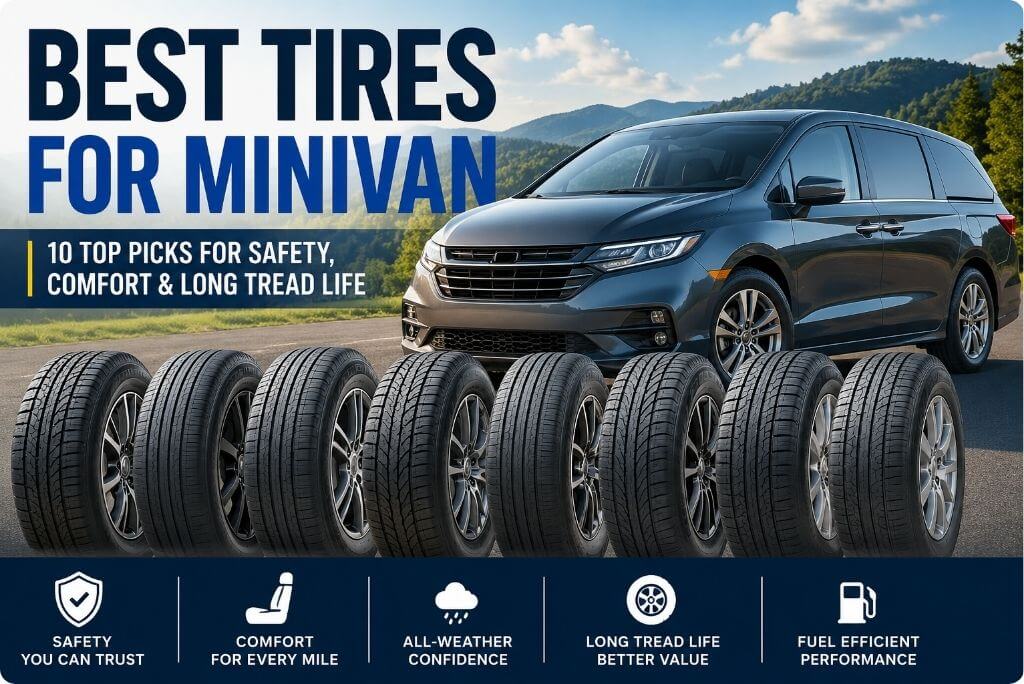
Best Tires for Minivan: Top 10 Picks
Choosing the best tires for minivan is not just about price or brand name. Minivans usually carry families, luggage, groceries, and plenty of highway miles, so the right tire should feel safe in rain, stable under load, quiet on long trips, and durable enough to make the purchase worthwhile. The safest starting point is always your vehicle’s tire placard and owner’s manual, because the correct size and load rating matter as much as the tread pattern itself.
How We Chose These Tires
Not every tire works well on a minivan. Family vehicles are often heavier than sedans, carry more passengers, and spend a lot of time on highways, so we focused on the qualities that matter most to everyday drivers.
First, we looked at wet and dry traction. A good minivan tire should provide confident braking and stable handling, especially during sudden stops or heavy rain.
Ride comfort was another priority. Since many minivans are used for family trips and daily commuting, we favored tires that absorb bumps well and stay quiet on the highway.
We also considered tread life and warranty coverage. Replacing tires is expensive, so longer-lasting options that offer good value over time received higher marks.
For drivers who face changing weather, we paid close attention to snow and all-weather performance. Tires that maintain grip in rain, slush, and light snow earned extra consideration.
Value matters too. A higher price doesn’t always mean a better tire, so we compared performance, durability, and warranty to find the best overall value at different budget levels.
Finally, we considered how well each tire fits the needs of a family minivan. Safety, comfort, stability, and long-term reliability were all key factors in our recommendations.
Quick Comparison Table: Best Tires for Minivan
| Tire | Best For | Type | Warranty |
| Michelin CrossClimate2 | Best overall | All-season / 3PMSF | 60,000 miles |
| Cooper ProControl | Everyday commuting | All-season | 70,000 miles |
| Goodyear Assurance WeatherReady 2 | Rain and snow | All-season / 3PMSF | 60,000 miles |
| Continental CrossContact LX25 | Highway comfort | Touring all-season | Up to 70,000 miles |
| General AltiMAX RT45 | Best value | All-season | Up to 75,000 miles |
| Firestone WeatherGrip | Budget all-weather choice | All-weather style touring tire | 65,000 miles |
| Bridgestone Ecopia EP422 Plus | Fuel economy | Touring all-season | 70,000 miles |
| Pirelli Scorpion Verde All Season Plus II | Legacy option, if still available | Touring all-season | Limited availability; current catalog says unavailable |
| Yokohama AVID Touring-S | Comfortable daily driving | Touring all-season | 65,000 miles |
| Falken Sincera SN250 A/S | Long-life budget tire | Touring all-season | 80,000/75,000 miles |
The 10 Best Tires for Minivan
Specs vary by size and production run, so the figures below use current representative listings and manufacturer data rather than pretending one number fits every size. That matters on minivans, because load index and speed rating can change a lot from one fitment to another.
1. Michelin CrossClimate2
Key specs
- Tread-life warranty: 60,000 miles
- Tread depth: about 10/32″ in common sizes
- Load range / load index: varies by size; example fitments include SL, 92
- Speed rating: H or V, depending on size
- UTQG: example 640 B A in one common size
- Severe snow rating: Yes
- Country of origin: varies by size and plant

This is the safest all-weather pick in the group. Michelin positions the CrossClimate2 as an all-season, 3PMSF-rated van tire with strong wet and dry braking, and that is exactly why it works so well on a family hauler. In real driving, it feels calm and secure on wet highways, and it keeps its composure when the temperature drops and the road turns slushy.
On a long interstate drive in heavy rain, this is the tire you notice for the right reasons: steady braking, less drama under lane changes, and more confidence when traffic stops suddenly. The trade-off is price and a slightly firmer feel than some comfort-first touring tires. It is best for drivers who want one tire that can handle rain, cold weather, and occasional snow without needing a second winter set; drivers who mostly want the softest ride and lowest purchase price should look elsewhere.
Pros
- Excellent wet and dry stopping power for a family vehicle.
- 3PMSF snow certification gives it real winter credibility.
- Designed for cars, SUVs, CUVs, and vans.
- Good tread-life reputation with a 60,000-mile warranty.
Cons
- Usually costs more than mainstream touring tires.
- Ride feel is not as plush as the softest comfort-focused options.
2. Cooper ProControl
Key specs
- Tread-life warranty: 70,000 miles
- Tread depth: 10/32″ in many sizes
- Load range / load index: varies by size; example sizes include SL, 95
- Speed rating: H or V, depending on size
- UTQG: 740 A A
- Severe snow rating: No
- Country of origin: varies by size and plant

The ProControl is a smart choice when ride quality matters more than hype. Cooper says it fits cars, minivans, and SUVs, and the design focus is even wear, wet grip, and a quiet commute. On a minivan, that usually translates to a smoother daily drive over broken city pavement and less tire drone on the highway.
In stop-and-go traffic, it feels composed rather than sporty, which is exactly what most minivan drivers want. Its weakness is that it is more of a comfort-and-control tire than an all-weather specialist, so it is not the first pick for drivers who need real snow capability. It is best for families who spend most of their time in the city or on dry highways and want a calm, balanced ride; avoid it if winter traction is your top priority.
Pros
- Smooth, quiet, easygoing daily driving manners.
- Built to wear evenly for crisp handling.
- Strong wet-road focus for rain-heavy climates.
- Backed by a 70,000-mile warranty.
Cons
- Not an all-weather tire, so snow performance is limited compared with 3PMSF options.
- More comfort-oriented than sharp or sporty.
3. Goodyear Assurance WeatherReady 2
Key specs
- Tread-life warranty: 60,000 miles
- Tread depth: varies by size; commonly around 11/32″
- Load range / load index: varies by size
- Speed rating: H or V depending on size
- UTQG: varies by size
- Severe snow rating: Yes
- Country of origin: varies by size and plant

This is the rain-and-light-snow specialist in the group. Goodyear gives it a 60,000-mile warranty, and current listings show 3PMSF winter certification, so it belongs in the conversation for drivers who live where weather changes fast. On cold, wet roads, it feels more confident than a standard all-season tire when you brake hard or merge into fast traffic.
In the real world, this is the tire for the family that still drives through winter but does not want to run dedicated snow tires. It works best in mixed rain-and-cold climates and performs well on damp highway ramps and slushy neighborhood streets. It is not the best choice for drivers who only want maximum tread life or the softest ride, but it is one of the better all-weather options for confidence.
Pros
- 3PMSF certification for severe snow service.
- Strong wet-road and dry-road all-weather reputation.
- 60,000-mile treadwear warranty.
- Good fit for drivers who want one tire for changing weather.
Cons
- Not a true winter tire for deep snow or ice.
- Usually a little noisier than a pure touring all-season tire at highway speed.
4. Continental CrossContact LX25
Key specs
- Tread-life warranty: up to 70,000 miles in many fitments
- Tread depth: 10/32″ to 12/32″, depending on size
- Load range / load index: varies by size; example fitments include SL and XL
- Speed rating: H or V, depending on size
- UTQG: 740 A A in common examples
- Severe snow rating: not the main selling point
- Country of origin: varies by size and plant

This is the premium comfort-and-longevity choice. Continental describes the CrossContact LX25 as a premium all-season touring tire for crossovers and SUVs, and current spec pages show long-wear figures and a deep tread design. On a minivan, that usually means a quiet highway ride, stable lane tracking, and a tire that feels calm when the vehicle is loaded with passengers and luggage.
The real-world strength here is long-haul refinement. If your minivan spends a lot of time on the interstate, this tire tends to disappear into the background and just do its job. The trade-off is that it is not as winter-forward as the best all-weather options, so drivers in harsher climates may prefer CrossClimate2 or WeatherReady 2. It is best for drivers who value comfort, tread life, and a premium feel; avoid it if you want built-in severe-snow certification.
Pros
- Quiet, premium-feeling highway manners.
- Deep tread and strong wear numbers in current specs.
- Good load capacity for larger vehicles in XL fitments.
- Backed by a 70,000-mile warranty through current retail listings.
Cons
- More SUV/crossover-oriented than snow-focused.
- Not the cheapest tire in the group.
5. General AltiMAX RT45
Key specs
- Tread-life warranty: varies by size and market
- Tread depth: varies by size
- Load range / load index: varies by size
- Speed rating: varies by size
- UTQG: varies by size
- Severe snow rating: not typically the focus
- Country of origin: varies by size and plant

This is the value pick that still feels grown-up on the road. General backs it with a 75,000-mile warranty, and current listings show a 215/65R16 example with 98H rating, 11/32 tread depth, and 700 A A UTQG. In everyday use, it is the kind of tire that quietly handles commuting, school runs, and highway miles without drawing attention.
On rough city pavement, the RT45’s appeal is the lack of fuss. It is not trying to be sporty; it is trying to be honest, comfortable, and affordable. The trade-off is that it is less sophisticated than Michelin or Continental, and winter confidence is only light-snow level. It is best for budget-minded drivers who want a sensible all-season tire for normal family use; avoid it if you regularly drive in serious winter weather.
Pros
- Strong price-to-performance value.
- Quiet enough for family driving.
- Long 75,000-mile warranty.
- Reliable wet-road braking and light-snow traction for the class.
Cons
- Not a premium tire in ride refinement or steering feel.
- Light snow only; not a winter solution.
6. Firestone WeatherGrip
Key specs
- Tread-life warranty: 65,000 miles
- Tread depth: 10/32″ in common sizes
- Load range / load index: varies by size
- Speed rating: varies by size
- UTQG: varies by size
- Severe snow rating: Yes
- Country of origin: varies by size and plant

WeatherGrip is the budget all-weather tire that makes sense for drivers who actually need winter capability. Firestone markets it as an all-weather touring tire for cars, minivans, and CUVs, with a 65,000-mile warranty and 3PMSF certification. In real winter driving, that matters when you pull out of a slushy parking lot or brake on a cold, wet morning.
Compared with a standard all-season tire, it gives you more confidence once the temperature stays low and the roads stay dirty. It is not the quietest or most refined tire in the segment, but it does a better job than most budget all-seasons when weather turns ugly. It is best for drivers who want one tire that can handle rain and winter better than the average all-season; avoid it if your main goal is the softest ride or the longest tread-life number on paper.
Pros
- True all-weather capability with 3PMSF winter rating.
- Good wet and light-snow traction focus.
- 65,000-mile warranty.
- A practical fit for cars, minivans, and CUVs.
Cons
- Ride and noise refinement are not class-leading.
- Tread-life warranty is shorter than some premium touring rivals.
7. Bridgestone Ecopia EP422 Plus
Key specs
- Tread-life warranty: 70,000 miles
- Tread depth: varies by size
- Load range / load index: varies by size; example 94V
- Speed rating: V in common listings
- UTQG: 640 A A in example sizes
- Severe snow rating: No
- Country of origin: varies by size and plant

This is the fuel-economy choice. Bridgestone says the Ecopia EP422 Plus is built for sedans and minivans, with a 70,000-mile warranty and a design focused on rolling efficiency, quiet ride quality, and comfort. On a minivan that spends a lot of time carrying people rather than cargo, the benefit is subtle but real: the tire feels easygoing and does not waste fuel the way a heavy, aggressive tread can.
The best use case is a mostly paved, mostly dry or light-rain commute where comfort and mpg matter more than winter strength. It is not the tire for deep snow or rough-weather bragging rights, but it is one of the better “set it and forget it” touring options for family vans. It is best for drivers who want lower rolling resistance and a quiet ride; avoid it if you regularly face harsh winter roads.
Pros
- Designed specifically with minivans in mind.
- Fuel-efficient feel with a quiet, comfortable ride.
- 70,000-mile warranty.
- Good everyday choice for family commuting.
Cons
- Not the best winter tire in this list.
- Less capable than all-weather rivals in snow and slush.
8. Pirelli Scorpion Verde All Season Plus II
Key specs
- Tread-life warranty: 65,000 miles in common listings
- Tread depth: about 10/32″ to 11/32″ depending on size
- Load range / load index: varies by size
- Speed rating: H or V, depending on size
- UTQG: varies by listing
- Severe snow rating: not the main focus
- Country of origin: varies by size and plant

This one is important more for what it represents than for what you can easily buy today. Pirelli says the Scorpion Verde All Season Plus II was built for crossover, SUV, and pickup drivers, with a focus on wet braking, comfort, low noise, and light-snow performance. On the road, that formula would make sense for a minivan that does a lot of long-distance family duty.
The catch is simple: Pirelli now says the tire is no longer in its catalog. So this is a “good if you can still find it” choice, not a first-choice current recommendation. It is best for shoppers who find remaining stock at a good price and want a quiet, balanced touring feel; drivers who want the newest available model should look at Pirelli’s current Scorpion lineup instead.
Pros
- Balanced wet, dry, and light-snow behavior.
- Low cabin noise and strong comfort focus.
- Good mileage reputation for a touring tire.
Cons
- Discontinued in Pirelli’s current catalog.
- Availability is limited to remaining stock.
9. Yokohama AVID Touring-S
Key specs
- Tread-life warranty: 65,000 miles
- Tread depth: varies by size
- Load range / load index: varies by size; example 105S
- Speed rating: S in some sizes
- UTQG: example 620 A B
- Severe snow rating: No
- Country of origin: varies by size and plant

This is the affordable touring tire that still tries to feel polished. Yokohama says the AVID Touring-S is built around long tread life, quiet ride quality, and competitive wet traction, with a firm sidewall and tread block design that helps stability. On a minivan, that usually shows up as predictable handling on dry roads and less tire roar than many bargain tires.
In real driving, it is a solid commuter tire for the driver who spends a lot of time on pavement and wants a clean, simple, trustworthy setup. It is not the most winter-capable option here, and it is not the plushest tire either, but it does the basics well for the money. It is best for budget buyers who still want decent refinement; avoid it if you need all-weather winter strength.
Pros
- Quiet and comfortable for the price.
- Good wet traction for everyday driving.
- Up to a 65,000-mile warranty.
- Stable, predictable handling feel.
Cons
- Not a severe-winter tire.
- Less premium than Michelin or Continental.
10. Falken Sincera SN250 A/S
Key specs
- Tread-life warranty: 80,000 miles in some sizes; 75,000 in others
- Tread depth: varies by size
- Load range / load index: varies by size; example 100H
- Speed rating: H or V, depending on size
- UTQG: example 720 A A
- Severe snow rating: No
- Country of origin: varies by size and plant

This is the long-life budget tire that punches above its price. Falken says the SN250 A/S is built for class-leading durability, all-season performance, and a quiet ride, with an 80,000-mile warranty and a tread design meant to keep wear even. On a minivan doing family duty, that means a calm commute and a lower chance of shopping for tires again too soon.
It works best for drivers who rack up miles and want a sensible, low-drama tire rather than a premium nameplate. In a steady highway commute or a week of school-run stop-and-go traffic, it should feel unpretentious and easy to live with. The trade-off is that it is still a budget touring tire, so it will not match the wet-braking sharpness of the best premium options or the winter confidence of a true all-weather tire.
Pros
- Excellent warranty length for the money.
- Quiet ride tuning and good everyday comfort.
- Strong dry and wet traction focus.
- Built for long, even wear.
Cons
- Not a premium wet-weather leader.
- Light-snow ability is useful, but it is not a winter substitute.
Best Tires by Driver Need
If you want the safest all-around choice, the Michelin CrossClimate2 is the easiest recommendation because it combines all-weather traction, 3PMSF certification, strong wet and dry braking, and long tread life.
If your main concern is rain and cold weather, the Goodyear Assurance WeatherReady 2 is a very strong fit thanks to its 3PMSF rating and year-round all-season design. For winter-leaning mixed weather, the Firestone WeatherGrip is also a good value pick.
If you want the longest likely tread life, the Falken Sincera SN250 A/S stands out with its 80,000-mile warranty, while the General AltiMAX RT45 is another smart choice thanks to its up to 75,000-mile coverage.
If fuel economy matters most, the Bridgestone Ecopia EP422 Plus is the clearest pick because Bridgestone built it around efficiency for sedans and minivans. If ride comfort and quiet highway miles matter more, the Continental CrossContact LX25 is a premium comfort-focused choice, provided your size is available.
Minivan Tire Buying Guide
What to look for in a minivan tire
The best minivan tire is not always the one with the most aggressive tread or the biggest warranty number. Start with the correct size and load index, then look at wet grip, comfort, tread life, and noise. Cooper’s own ProControl page explains why load index matters: choosing a tire with a lower load index than the original equipment specs means it may not carry the needed load. That matters a lot on a vehicle built to carry people and cargo.
You should also think about your real driving life. If you mostly drive in the city, comfort and low noise may matter most. If you take long road trips, stability and highway comfort become more important. If your area gets frequent rain or winter weather, all-weather traction should move to the top of the list.
All-season vs all-weather tires
All-season tires are the safest choice for many drivers in mild climates because they are designed for broad everyday use, decent wet and dry performance, and long tread life. All-weather tires go a step further. Michelin says the CrossClimate2 is suitable for all weather conditions and carries the 3PMSF marking, while Goodyear gives the WeatherReady 2 the same rating. That 3PMSF symbol is a useful sign that the tire is better prepared for winter conditions than a basic all-season tire.
If you drive often on snow-covered or icy roads at winter temperatures, Michelin says winter tires may still be the better solution. In other words, all-weather tires are a great middle ground, but they are not a replacement for true winter tires in harsher climates.
How to choose the right tire for your driving style
If your minivan is mostly a family commuter, choose a tire that is quiet, comfortable, and backed by a solid mileage warranty. If you do a lot of highway travel, prioritize ride stability and predictable wet braking. If you live where weather changes often, look harder at all-weather tires instead of basic all-season models. And if your main goal is saving money over time, compare warranty length, fuel-efficiency claims, and real-world wear before buying.
FAQs
What is the best tire for a minivan?
For most drivers, the Michelin CrossClimate2 is the best overall pick because it blends all-weather traction, 3PMSF winter certification, strong wet and dry braking, and a 60,000-mile warranty.
How long do minivan tires last?
That depends on the tire, the climate, and how well you maintain them. In this list, warranty coverage ranges from 60,000 miles on the Michelin CrossClimate2 and Goodyear WeatherReady 2 to 80,000 miles on the Falken Sincera SN250 A/S. Real-world life can be shorter or longer depending on inflation, rotation, alignment, and driving habits.
Are all-weather tires worth it for minivans?
Yes, if you live in a place with mixed weather, occasional snow, or long rainy seasons. Tires like the CrossClimate2 and WeatherReady 2 are designed to offer more cold-weather confidence than a standard all-season tire, without requiring seasonal tire swaps.
Which tire is best for snow without winter tires?
The Michelin CrossClimate2 is the strongest all-weather-style pick here for snow-minded drivers, and Goodyear’s Assurance WeatherReady 2 is another good option. If you face frequent deep snow or icy roads, though, winter tires are still the better tool.
What tire pressure should a minivan use?
Use the pressure listed on your vehicle’s tire placard or owner’s manual, not a guess. NHTSA and USTMA both stress checking inflation regularly and setting pressure to the vehicle manufacturer’s specifications.
Conclusion
The best tires for a minivan depend on how you drive, where you live, and what matters most to you. If you want the strongest all-around pick, the Michelin CrossClimate2 is hard to beat. If you want comfort and everyday reliability, the Cooper ProControl and Continental CrossContact LX25 are strong options. If you want better value, the General AltiMAX RT45, Firestone WeatherGrip, and Falken Sincera SN250 A/S all deserve a close look.
The smartest choice is the tire that matches your minivan’s load requirements, your local weather, and your daily driving habits. That is how you get better safety, better comfort, and better long-term value from every mile.
