V vs W Speed Rating: What’s the Difference?
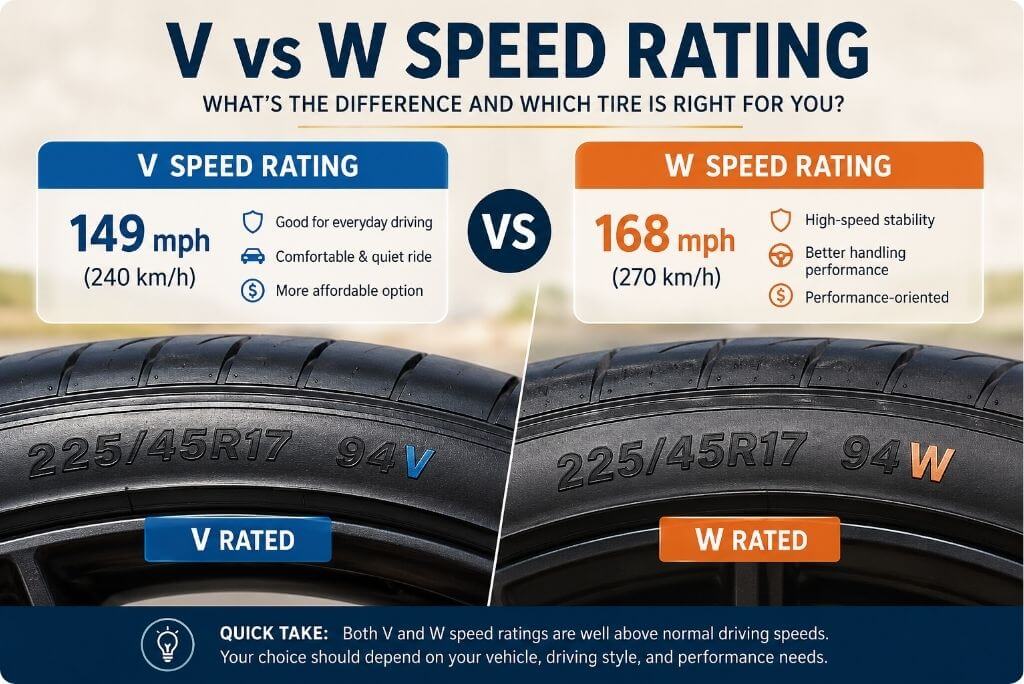
If you are shopping for new tires, the V vs W speed rating can look confusing at first. In simple terms, the speed rating tells you the maximum sustained speed a tire is designed to handle under the right load and test conditions. A V-rated tire is rated up to 149 mph (240 km/h), while a W-rated tire is rated up to 168 mph (270 km/h). Those numbers matter, but the real decision is usually about matching your vehicle’s requirements, your driving style, and the performance balance you want.
For most everyday drivers, the goal is not to buy the “fastest” tire. The goal is to choose a tire that fits the car correctly, supports safe handling, and follows the vehicle manufacturer’s recommendation.
What Is a Tire Speed Rating?
A tire speed rating is a letter on the tire sidewall that shows the maximum speed the tire is designed to handle safely under proper conditions. Common ratings include V and W. These letters are based on laboratory testing and indicate how well a tire can perform at higher speeds.
Manufacturers use speed ratings because tires generate heat as they spin faster. A properly rated tire is designed to manage that heat and maintain its strength and shape. This helps the tire perform safely and predictably.
Speed ratings are also linked to how a tire feels on the road. Higher-rated tires often offer better stability and more responsive handling, especially at highway speeds. However, that doesn’t automatically make them the best choice for every driver. In many cases, they can cost more than lower-rated alternatives.
You should never ignore the speed rating when replacing tires. Your vehicle was designed with a specific tire rating in mind, and changing it could affect handling and overall performance. The safest approach is to use the speed rating recommended by your vehicle manufacturer unless a qualified tire professional advises otherwise.
What Does a V Speed Rating Mean?
A V speed rating means the tire is certified for speeds up to 149 mph (240 km/h) under controlled testing conditions. This doesn’t mean you should drive at that speed. It simply shows that the tire is built to handle high speeds safely when properly maintained and used within its limits.
V-rated tires are commonly found on:
- Family sedans
- Crossovers and SUVs
- Entry-level luxury cars
These tires are designed to strike a balance between comfort and performance. They usually provide a smooth ride for daily driving while still offering good stability on highways and during long trips.
Another advantage is cost. V-rated tires are often less expensive than higher-rated performance tires, making them a practical choice for many drivers. The trade-off is that they may not deliver the same level of high-speed handling and steering response that some performance-oriented drivers prefer.
What Does a W Speed Rating Mean?
A W speed rating means the tire is certified for speeds up to 168 mph (270 km/h) under controlled testing conditions. Most drivers will never reach that speed, but the rating indicates that the tire is built for higher-performance demands.
W-rated tires are commonly used on:
- Sports sedans
- Performance cars
- High-performance luxury vehicles
These tires are designed to provide excellent stability at higher speeds and a more responsive feel when steering. Many drivers also notice that W-rated tires feel more precise during quick lane changes and on winding roads.
Because they are built with performance in mind, W-rated tires usually cost more than V-rated options. Some models may also prioritize handling over ride comfort. For drivers who simply commute and spend most of their time in normal traffic, the extra performance may not offer much real-world benefit.
Read More: V vs H Speed Rating
V vs W Speed Rating: Side-by-Side Comparison
| Feature | V Speed Rating | W Speed Rating |
| Maximum Certified Speed | 149 mph (240 km/h) | 168 mph (270 km/h) |
| Typical Vehicles | Family sedans, crossovers, SUVs, entry-level luxury cars | Sports sedans, performance cars, high-performance luxury vehicles |
| High-Speed Stability | Very good | Excellent |
| Steering Response | Good and predictable | Sharper and more responsive |
| Ride Comfort | Generally more comfort-focused | Often slightly firmer and performance-oriented |
| Handling Performance | Suitable for everyday driving and highway use | Better suited for spirited driving and higher-speed performance |
| Replacement Cost | Usually less expensive | Usually more expensive |
| Best For | Daily commuters and family vehicles | Drivers who want maximum performance and responsive handling |
For most drivers, the practical difference isn’t the extra 19 mph of top-speed capability. The bigger difference is how the tires are designed. V-rated tires prioritize a balance of comfort, stability, and value, while W-rated tires place more emphasis on high-speed stability and handling performance.
Read More: What Is Tire Speed Rating S?
Does a Higher Speed Rating Mean a Better Tire?
Not necessarily. A higher speed rating doesn’t automatically make a tire better for every driver. It simply means the tire is designed to handle greater performance demands.
W-rated tires can make sense if you:
- Own a sports or performance-oriented vehicle
- Frequently drive on highways and want more responsive handling
- Prefer a firmer, more connected feel behind the wheel
For these drivers, a W-rated tire may provide a more precise driving experience.
For everyone else, the benefits may be small. Most drivers never come close to the maximum speed of either V-rated or W-rated tires. Paying extra for a higher rating doesn’t always result in a noticeable improvement during everyday commuting.
The most important thing is to follow your vehicle manufacturer’s recommendation. Your car was designed to work with a specific tire specification, and using the recommended speed rating is usually the best choice for safety, performance, and overall driving comfort.
Can You Replace W-Rated Tires With V-Rated Tires?
Sometimes, but you shouldn’t assume it’s okay.
Many vehicles that come with W-rated tires are engineered around that specification. The suspension, steering, and overall handling may have been designed with a higher-performance tire in mind. Switching to a lower speed rating could change how the vehicle feels and performs, especially during emergency maneuvers or at higher highway speeds.
In some cases, replacing W-rated tires with V-rated tires may be acceptable. In others, it may go against the manufacturer’s recommendations.
Before making the switch, check your owner’s manual or the tire information label on the driver’s door jamb. If you’re unsure, speak with a qualified tire professional. A lower-rated tire might save money upfront, but using the correct specification is usually the better long-term choice for safety and performance.
Read More: H vs T Speed Rating
Which Speed Rating Should You Choose?
For most drivers, the right choice is simple: use the speed rating recommended by your vehicle manufacturer.
V-rated tires are a good choice if you:
- Already have V-rated tires on your vehicle
- Mainly use your car for commuting, errands, and family trips
- Want a balance of comfort, performance, and value
For many sedans, crossovers, and SUVs, V-rated tires provide everything needed for everyday driving.
W-rated tires make more sense if you:
- Vehicle originally came with W-rated tires
- Drive a sports or performance-oriented vehicle
- Prefer sharper handling and maximum highway stability
W-rated tires can deliver a more performance-focused driving experience, but they usually cost more. If you don’t need the extra performance, a higher speed rating may not provide any meaningful benefit in day-to-day driving.
When in doubt, follow the recommendation in your owner’s manual. Matching the tire speed rating to your vehicle’s original specifications is usually the safest and most practical decision.
Read More: W vs Y Speed Rating: What’s the Difference?
Frequently Asked Questions
Is W speed rating safer than V?
Not automatically. W-rated tires are built for a higher speed capability, but safety depends on proper fit, correct load index, inflation, tread condition, and whether the tire matches your vehicle’s requirements. A tire is not safer just because the letter is higher.
Can I put W-rated tires on a car that originally uses V-rated tires?
Sometimes, but only if the size, load index, and overall fit are correct and the tire is appropriate for the vehicle. The manufacturer’s recommendation should always be the first thing you check.
Will W-rated tires last longer than V-rated tires?
Not necessarily. Tire life depends on many things, including tread design, driving habits, road conditions, rotation, alignment, inflation, and the tire’s intended use. A higher speed rating does not guarantee longer tread life.
Are W-rated tires more expensive?
Usually, yes. Performance-focused tires often cost more because of the materials, design, and handling characteristics they are built to deliver.
Do I need W-rated tires for normal driving?
Most drivers do not. If your car does not require them, a V-rated tire is often enough for everyday driving, commuting, and highway use. The best answer is always the one that fits your vehicle’s recommendation and your driving needs.
Final Verdict: V vs W Speed Rating
The difference between V and W speed ratings is not just about the number on the sidewall. V-rated tires are certified up to 149 mph, while W-rated tires are certified up to 168 mph. More importantly, W-rated tires are usually built for stronger performance demands, while V-rated tires often give drivers a practical balance of comfort, control, and value.
For most everyday drivers, V-rated tires are more than sufficient. If your vehicle was designed for W-rated tires, or if you want the sharper feel that often comes with performance-focused tires, then W may be the right fit. The safest and smartest choice is to follow your vehicle manufacturer’s recommendation and choose the tire that matches your real driving needs.
