What Is Tire Speed Rating W? Meaning, Speed Limit, and Do You Need It?
You are shopping for tires and see a W after the size. That little letter matters more than most people realize, because it tells you how the tire is built to perform on the road.
A tire speed rating is not just about top speed. It can affect how the tire handles heat, how stable it feels at highway speeds, and whether it matches your vehicle the way it should.
This guide explains what tire speed rating W means, how it affects everyday driving, and whether it is the right choice for your vehicle.
What Is Tire Speed Rating W?
A tire speed rating tells you the maximum speed a tire is designed to handle safely under specific testing conditions. It is shown as a letter on the tire sidewall, such as H, V, W, or Y.
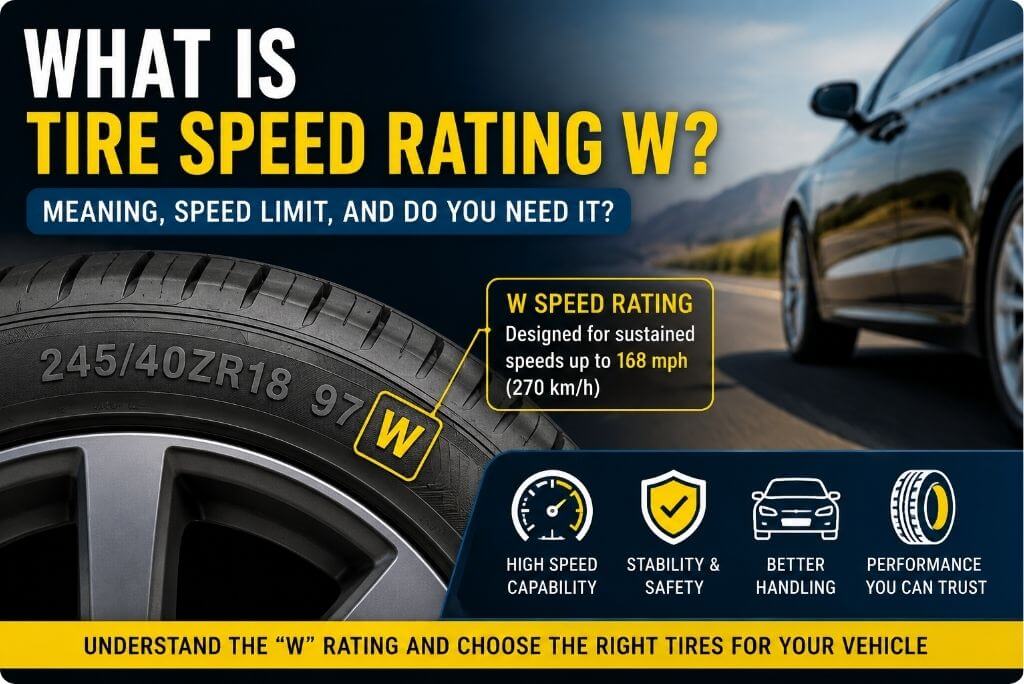
The letter W means the tire is engineered to handle sustained speeds of up to 168 mph (270 km/h). This does not mean you should drive that fast. Instead, it shows the tire’s performance capability, including its ability to manage heat and maintain stability at higher speeds.
Quick Answer: A W tire speed rating means the tire is designed and tested to handle sustained speeds of up to 168 mph (270 km/h) under specific conditions. The rating indicates the tire’s performance capability, not a recommendation to drive at those speeds.
Manufacturers assign speed ratings to help drivers choose tires that match their vehicle’s performance requirements. Many sports cars, luxury sedans, and some modern SUVs come with W-rated tires because they are built for vehicles that need strong handling and stability.
For most drivers, the important takeaway is simple: choose a tire speed rating that meets your vehicle manufacturer’s recommendation rather than focusing only on the highest letter available.
Related Topic: What Is Tire Speed Rating S?
Where Do You Find the W Speed Rating on a Tire?
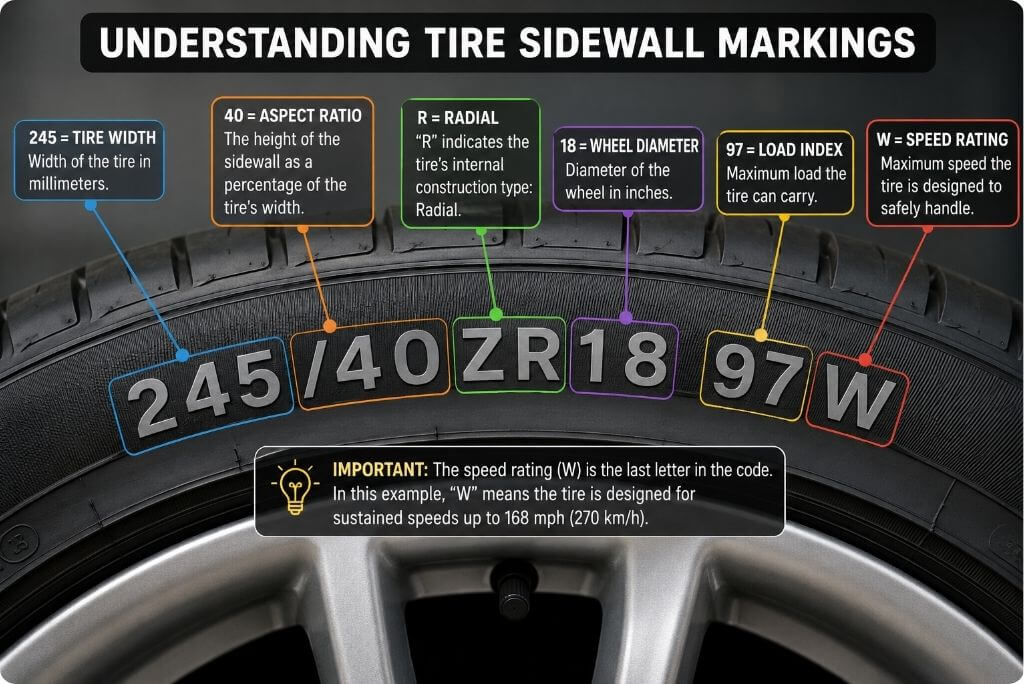
You can find the speed rating on the tire’s sidewall. It appears at the end of a series of letters and numbers printed on the tire.
For example:
245/40ZR18 97W
Here’s what each part means:
- 245 = Tire width in millimeters
- 40 = Sidewall height as a percentage of the tire’s width
- R = Radial tire construction
- 18 = Wheel diameter in inches
- 97 = Load index, which indicates how much weight the tire can carry
- W = Tire speed rating
The speed rating letter is usually the last character in the code, making it fairly easy to spot once you know where to look. If the sidewall markings seem confusing, you can also find the recommended tire specifications in your owner’s manual or on the sticker inside the driver’s door.
How Fast Is a W-Rated Tire?
A W-rated tire is designed for speeds up to 168 mph (270 km/h). That does not mean you should drive anywhere near that speed. It only means the tire has been tested to handle that level of speed under controlled conditions.
| Speed Rating | Maximum Speed |
| H | 130 mph (210 km/h) |
| V | 149 mph (240 km/h) |
| W | 168 mph (270 km/h) |
| Y | 186 mph (300 km/h) |
The speed rating shows more than just top speed. It also gives you a clue about how well the tire handles heat and stays stable at higher speeds. In general, higher-rated tires are built for stronger performance, but they may not always be the best choice for every driver.
For normal driving, legal speed limits matter far more than the tire’s maximum rating. A W-rated tire is about capability, not a target speed.

What Types of Vehicles Use W-Rated Tires?
W-rated tires are commonly found on vehicles that are designed for responsive handling and strong road stability. They are often factory-equipped on:
- Sports sedans
- Performance coupes
- Luxury vehicles
- High-performance crossovers
- Some electric vehicles
You may also see W-rated tires on certain family sedans and SUVs. Automakers sometimes choose these tires to improve handling, braking feel, and stability at highway speeds, even if the vehicle is never driven anywhere near 168 mph.
That said, not every vehicle needs a W-rated tire. The best choice is usually the speed rating recommended by the manufacturer, since it was selected to match the vehicle’s overall design and performance goals.
Do You Need W-Rated Tires for Daily Driving?
For most people, the answer is not necessarily. Very few drivers ever come close to the maximum speed a W-rated tire is designed to handle.
That said, speed ratings are not only about top speed. W-rated tires are often built to provide sharper steering, better stability in corners, and a more confident feel at highway speeds.
You may notice these benefits if you drive a performance car or spend a lot of time on the highway. For everyday city driving, however, many drivers may not feel a major difference.
The safest approach is simple: use the speed rating recommended by your vehicle manufacturer. It was chosen to match your vehicle’s handling, weight, and overall performance characteristics.
Can You Replace W-Rated Tires With a Lower Speed Rating?
In some cases, you can install tires with a lower speed rating, but it is usually not the best idea unless the vehicle manufacturer specifically allows it.
Using a lower-rated tire may change how your vehicle feels on the road. You could notice less stability at higher speeds and different handling during quick lane changes or cornering. In some situations, using the wrong speed rating may also affect warranty coverage or go against the manufacturer’s recommendations.
Before changing to a lower speed rating, check:
- Your vehicle owner’s manual
- The tire information sticker inside the driver’s door jamb
- A trusted tire professional if you’re unsure
As a general rule, matching the manufacturer’s recommended speed rating is the safest and simplest choice.
Are W-Rated Tires Better Than Other Tires?
Not necessarily. A W-rated tire is designed for higher-speed performance, but that does not automatically make it the best tire for every driver.
A W-rated tire is not always:
- Safer
- Longer-lasting
- More comfortable
- Better in snow or heavy rain
The right tire depends on your vehicle and how you use it. A daily commuter, a family SUV, and a performance car can all have very different tire needs.
When choosing tires, consider your vehicle’s requirements, driving habits, local climate, budget, and the kind of performance you expect. In many cases, the best tire is simply the one that matches your vehicle manufacturer’s recommendations and your everyday driving needs.
Tire Speed Rating W vs V vs Y
The letters V, W, and Y all indicate different levels of speed capability and performance. Higher letters generally mean the tire is designed for vehicles that demand greater stability and handling at higher speeds.
| Feature | V | W | Y |
| Max Speed | 149 mph (240 km/h) | 168 mph (270 km/h) | 186 mph (300 km/h) |
| Performance Focus | Moderate | High | Very High |
| Common Vehicles | Sedans, SUVs | Sports sedans, luxury cars | High-performance sports cars |
For many drivers, a V-rated tire is more than enough. W-rated tires are common on vehicles that place more emphasis on handling and stability, while Y-rated tires are usually found on high-performance models.
The key is not choosing the highest letter available. The best choice is the speed rating recommended for your vehicle, because it was selected to match the vehicle’s design and intended performance.
Read More:
W vs Y Speed Rating: What’s the Difference?
Common Misconceptions About W Tire Speed Ratings
Myth: A W-rated tire means you should drive 168 mph.
Reality: No. The rating simply shows the tire’s tested capability under specific conditions. It is not a recommended driving speed, and you should always follow local speed limits.
Myth: Higher speed ratings are always safer.
Reality: Not necessarily. A tire that matches your vehicle’s recommended size, load index, and speed rating is usually the safest choice.
Myth: All W-rated tires perform the same.
Reality: Two W-rated tires can feel very different on the road. Factors like tread design, rubber compounds, and overall construction affect ride comfort, wet traction, handling, and tread life.
The letter “W” tells you one important thing about a tire, but it doesn’t tell you everything. Looking at the tire as a whole will help you make a better buying decision.
How to Choose the Right Tire Speed Rating
The best way to choose the right speed rating is to start with the facts your vehicle already gives you. The owner’s manual and the tire information placard are the first places to check.
Then think about how you drive. If you mostly drive around town, your needs may be very different from someone who spends a lot of time on highways or in a more performance-focused vehicle. Climate matters too. A tire that works well in dry, warm weather may not be the best choice for wet or cold conditions.
A practical process looks like this:
- Check your current tire sidewall.
- Read your owner’s manual.
- Look at the tire label on the driver’s door jamb.
- Consider your driving style and road conditions.
- Choose a tire that meets or exceeds the vehicle maker’s recommendation.
If you are unsure, ask a tire professional. That small step can prevent a costly mistake and help you choose a tire that feels right on the road.
Frequently Asked Questions
What does W mean on a tire?
W means the tire is rated for speeds up to 168 mph (270 km/h) under specific test conditions.
Is a W-rated tire good?
Yes, it can be a very good tire choice for vehicles that need stronger high-speed stability and performance. Whether it is the right choice depends on your vehicle and driving needs.
Can I put W-rated tires on a car that originally had V-rated tires?
Sometimes yes, but you should always check the vehicle manufacturer’s recommendation first. The full tire size, load index, and intended use all matter.
Are W-rated tires more expensive?
They can be, depending on the brand, tread design, and performance category. Higher-performance tires often cost more because of their construction and materials.
Is tire speed rating more important than tire size?
No. Tire size, load index, and vehicle fit are usually just as important, and often more important, than the speed rating alone.
Conclusion
Tire speed rating W means the tire is designed to handle speeds up to 168 mph (270 km/h) under controlled test conditions. It is a sign of performance capability, not a speed you should aim for in normal driving.
For most drivers, the best tire is not simply the one with the highest rating. It is the one that matches the vehicle’s requirements, your driving habits, and the conditions you drive in every day.
If you understand what tire speed rating W means, you are in a better position to choose replacement tires with confidence. That helps you make a smarter buying decision and keeps your vehicle closer to the safety and performance balance it was designed for.
