Trailer Lug Nut Size Chart: Thread Sizes, Seat Types & Fitment
A trailer lug nut size chart makes it easier to identify common thread sizes, but choosing the correct lug nut requires more than matching the thread. The wheel stud’s diameter and pitch must match, and the lug nut’s seat must also fit the wheel.
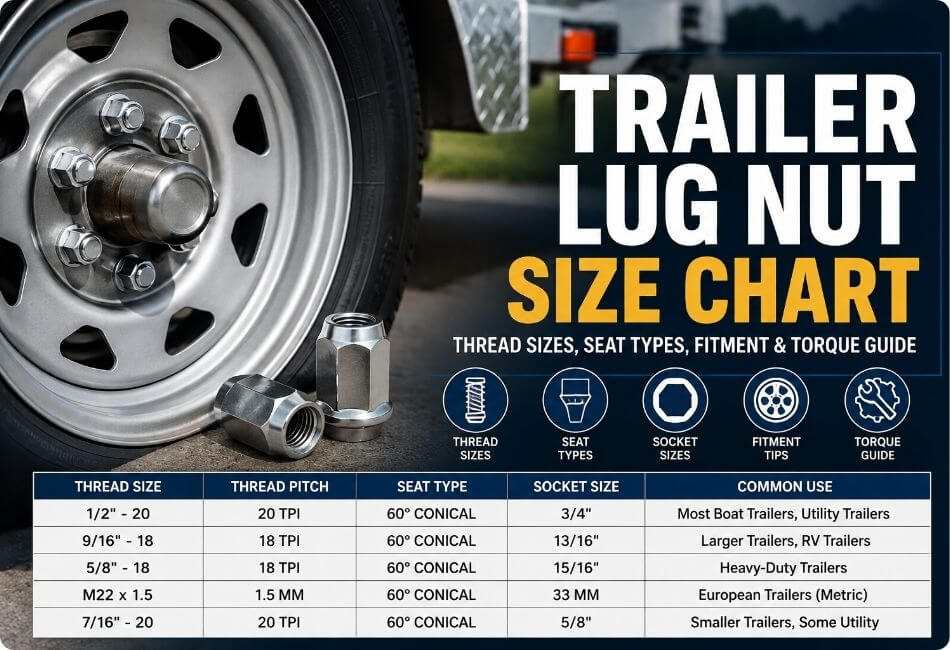
The most common trailer wheel-stud sizes include 1/2″-20, 9/16″-18, and 5/8″-18, but trailer hardware varies by application. Use the chart below as a reference, then verify the complete fitment before buying or installing replacement lug nuts.
Trailer Lug Nut Size Chart
| Trailer Lug Nut Thread Size | Thread Pitch | Thread Type | Common Seat / Nut Design | Example Socket Size* | Typical Use |
| 7/16″-20 | 20 TPI | SAE | 60° conical | 3/4″ | Smaller trailer and boat-trailer applications |
| 1/2″-20 | 20 TPI | SAE | 60° conical; other designs available | 3/4″ or 13/16″ | Very common on light- and medium-duty trailers |
| 9/16″-18 | 18 TPI | SAE | 60° or 90° conical, depending on wheel | 7/8″ or application-specific | Larger trailer and heavier-duty applications |
| 5/8″-18 | 18 TPI | SAE | 90° conical or flange, depending on wheel system | 1-1/16″, 1-1/8″, or application-specific | Heavy-duty trailer and dual-wheel applications |
| M22 × 1.5 | 1.5 mm | Metric | Swivel-flange / hub-piloted design | 32 mm (example) | Specialized heavy-duty dual-wheel applications |
*Socket size is not determined solely by thread size. Different lug nuts with the same thread specification can have different hex sizes. The values shown are examples from documented trailer lug-nut designs, not universal socket sizes.
The three most common trailer stud sizes are 1/2″-20, 9/16″-18, and 5/8″-18. The 7/16″-20 size is also documented for smaller trailer wheel applications.
The M22 × 1.5 size belongs to a specialized heavy-duty wheel system rather than the typical utility or boat trailer. Dexter documents this size for hub-piloted 22.5- and 24.5-inch dual wheels.
How to Identify Your Trailer Lug Nut Size
Finding the correct trailer lug nut size is more than measuring the outside of the nut. You need to match the thread size, thread pitch, and seat design to your trailer’s wheel and studs.
The safest approach is to verify the specification first, then measure when the original information is unavailable.
1. Check the Trailer, Axle, or Wheel Specifications
Start with the trailer manufacturer’s documentation if you have it. The axle, hub, or wheel manufacturer may also provide the correct wheel-stud and lug-nut specifications.
This is more reliable than guessing from the lug nut’s appearance or assuming that a common size such as 1/2″-20 will fit your trailer. Trailer experts also recommend measuring the actual wheel studs when the exact application cannot be confirmed from documentation.
2. Identify the Thread Diameter
Thread diameter is the nominal size of the threaded wheel stud. Trailer studs can use SAE (inch) or metric measurements.
For example, 1/2″-20 has a nominal 1/2-inch thread diameter, while M22 × 1.5 has a nominal 22 mm diameter.
A caliper can help you identify the approximate diameter, but don’t rely on the measured value alone. Compare it with the available thread specifications and confirm the result before ordering.
3. Identify the Thread Pitch
Thread pitch tells you how closely the threads are spaced.
For SAE sizes, it is normally given as threads per inch (TPI). A 1/2″-20 stud has 20 threads per inch, while a 9/16″-18 stud has 18.
For metric sizes, pitch is the distance between threads in millimeters. For example, M22 × 1.5 has a 1.5 mm thread pitch.
Two threads can look very similar but still have different pitches. Do not force a lug nut onto a stud simply because it appears to fit.
4. Check the Lug Nut Seat
The threads are only part of the fit. The bottom of the lug nut must also match the way the trailer wheel is designed to accept it.
Look at the area where the lug nut contacts the wheel. Common trailer designs use conical seats, including 60° and 90° cone designs, while some heavy-duty wheels use flange-style hardware.
A lug nut can have the correct thread but still be wrong for the wheel if its seating surface does not match.
5. Verify Before Buying
Before ordering replacement lug nuts, compare the complete specification with the trailer, axle, hub, or wheel manufacturer’s information.
Confirm the thread diameter, thread pitch, and seat design. Also make sure the replacement nut is intended for that particular wheel and stud application.
If the specification is uncertain, don’t force a lug nut onto the stud to see if it fits.
Trailer Lug Nut Seat Types Explained
The lug nut seat is the part of the nut that contacts the wheel. It matters because the nut must sit against the wheel in the way the wheel was designed to accept it.
A lug nut can have the correct thread size and still be wrong for the wheel if the seat design does not match.
Conical / Tapered Seat
A conical lug nut has a tapered seating surface that fits into the matching tapered area around the wheel’s lug hole.
Trailer wheels commonly use a 60° cone, but 90° cone designs are also used on certain applications. The two designs should not be treated as interchangeable because the taper is different.
Flat / Washer-Style Seat
A flat-seat design uses a flat surface, often with a washer or flange, to clamp the wheel against the hub.
This type of hardware is used on specific wheel designs. It should only be used when the wheel or hub manufacturer calls for it.
Shank / Mag-Style Lug Nuts
A shank-style, sometimes called a mag-style, lug nut has a smooth section that fits into a matching hole in the wheel. Some designs also use a separate washer.
Because the shank and wheel hole must work together, this hardware should not be replaced with a visually similar conical lug nut unless the wheel manufacturer specifies that combination.
Key Takeaway
Matching the thread size is not enough. The lug nut’s seat must also match the wheel.
Trailer Lug Nut Thread Size vs. Socket Size
Thread size and socket size are two different measurements. The thread size tells you whether the lug nut fits the trailer’s wheel stud. The socket size tells you which socket fits over the outside of the lug nut.
For example, a 1/2″-20 lug nut has a 1/2-inch thread diameter and 20 threads per inch. The socket size is a separate measurement based on the nut’s outside hex shape.
This means finding a socket that fits your lug nut does not confirm that the lug nut is correct for your trailer. Likewise, two lug nuts with the same thread size can have different outside hex sizes.
When replacing trailer lug nuts, identify the thread specification first and then verify the correct socket size for installation.
How to Choose the Correct Replacement Trailer Lug Nut
Choosing a replacement trailer lug nut should start with the wheel stud and wheel, not with the nut’s appearance. Before buying, verify these five details:
- Thread diameter — Confirm the stud’s nominal size, such as 1/2 inch or 9/16 inch.
- Thread pitch — Make sure the threads match exactly, such as 1/2″-20 or 9/16″-18.
- Seat type — Match the lug nut’s seating surface to the wheel.
- Wheel and stud compatibility — Make sure the replacement hardware is intended for that specific wheel and stud application.
- Manufacturer specification — Use the trailer, axle, hub, or wheel manufacturer’s information whenever available.
Don’t choose a lug nut simply because the socket fits. Socket size only tells you which tool fits the outside of the nut; it does not confirm the thread or wheel fitment.
Also, don’t assume that 1/2″-20 fits every trailer just because it is a common trailer lug nut size. Trailer wheel hardware varies by application.
Avoid mixing SAE and metric threads, even when they appear close enough to fit. Using the wrong thread can damage the stud or lug nut.
Finally, don’t buy based only on appearance. Two lug nuts can look nearly identical while having different threads or seat designs. When the specification is uncertain, verify it before ordering rather than relying on a visual match.
Trailer Lug Nut Torque: What You Need to Know
Correct lug nut torque provides the proper clamping force between the wheel and hub. Too little or too much torque can create problems with the wheel, studs, or lug nuts.
There is no single torque value for every trailer. Torque can vary with the wheel, stud size, axle or hub, lug nut design, and the manufacturer’s specifications.
Dexter’s published wheel-torque tables demonstrate this clearly. For example, its specifications include different final torque ranges for 1/2″-20, 9/16″-18, and 5/8″-18 applications, with values also varying by wheel and mounting design.
Use the torque specification provided for your particular trailer, axle, hub, or wheel. A calibrated torque wrench should be used for the final tightening.
Do not choose a torque number simply because it appears on a generic trailer lug nut chart. The correct specification should come from a source that applies to your actual wheel-end application.
Trailer Lug Nut Fitment Examples
Example 1: You Know the Stud Is 1/2″-20
Knowing that the wheel stud is 1/2″-20 gives you the thread diameter and pitch, but you still need to verify the wheel’s required seat.
If the wheel requires a 60° conical lug nut, for example, the replacement must use the correct 1/2″-20 thread and the matching seat design.
Example 2: You Only Know the Socket Size
Suppose your lug nut takes a 13/16-inch socket. That tells you the tool size, not the thread specification.
A 13/16-inch socket can fit a particular 1/2″-20 lug nut, but socket size alone cannot identify the trailer’s wheel-stud thread.
Example 3: The New Lug Nut Threads On but Does Not Seat Correctly
If a new lug nut threads onto the stud but does not sit correctly against the wheel, stop.
The thread may be correct while the seat design is wrong. Do not force the nut tight to make it fit; check the wheel’s required seat and the replacement nut’s design.
Example 4: Your Old Lug Nut Is Damaged or Corroded
A damaged lug nut may not be a reliable reference for ordering a replacement.
Instead of matching it by appearance, check the trailer, axle, hub, or wheel documentation and verify the thread size, thread pitch, seat type, and wheel/stud compatibility.
Trailer Lug Nut Size vs. Wheel Bolt Pattern
Lug nut size and wheel bolt pattern describe two different parts of wheel fitment.
The lug nut thread size describes the threaded hardware that attaches the wheel to the wheel stud, such as 1/2″-20 or 9/16″-18.
The bolt pattern describes the number and spacing of the wheel’s mounting holes, such as 5-lug or 6-lug patterns. It determines whether the wheel’s mounting holes line up with the trailer hub.
A trailer can therefore have a specific bolt pattern and a separate lug nut thread specification. Both need to match when fitting a wheel.
If you also need to identify the trailer’s wheel mounting pattern, see our Trailer Wheel Bolt Pattern Chart for the relevant measurements and patterns.
Frequently Asked Questions
What is the most common trailer lug nut size?
1/2″-20 is one of the most common trailer lug nut thread sizes, but it is not universal. Always verify the stud and wheel specifications before buying replacements.
Are trailer lug nuts universal?
No. Trailer lug nuts can differ in thread size, thread pitch, seat design, and application. The lug nut must match both the wheel stud and wheel.
What does 1/2″-20 mean?
1/2″ is the nominal thread diameter, and 20 means there are 20 threads per inch. Together, they identify the lug nut’s thread specification.
How do I know if my trailer uses metric lug nuts?
Check the trailer, axle, hub, or wheel manufacturer’s specifications first. Metric sizes are normally written with an M, such as M12 × 1.5.
Does socket size tell me the lug nut size?
No. Socket size describes the outside of the lug nut, not its thread. You need to identify the thread diameter and pitch separately.
Can I use any 1/2″-20 lug nut on my trailer?
No. The thread must be 1/2″-20, but the lug nut’s seat must also match the wheel. Verify the complete fitment before installation.
Do trailer aluminum wheels require different lug nuts?
Not necessarily. The correct hardware depends on the specific wheel and its mounting design. Follow the wheel manufacturer’s lug nut requirements rather than assuming aluminum wheels use one particular type.
How do I know the correct trailer lug nut torque?
Use the torque specification provided by the trailer, axle, hub, or wheel manufacturer for your specific application. There is no single torque value that applies to every trailer lug nut.
Final Trailer Lug Nut Fitment Checklist
Before buying or installing replacement trailer lug nuts, confirm:
- Thread diameter matches the wheel stud.
- Thread pitch matches exactly.
- Seat type matches the wheel.
- Wheel and stud compatibility is confirmed.
- Manufacturer specifications have been checked.
- Correct torque specification is used during installation.
Final Takeaway
Don’t choose a trailer lug nut by socket size or appearance alone. Verify the complete thread specification and wheel-seat design before installation, then use the correct manufacturer-specified torque.
