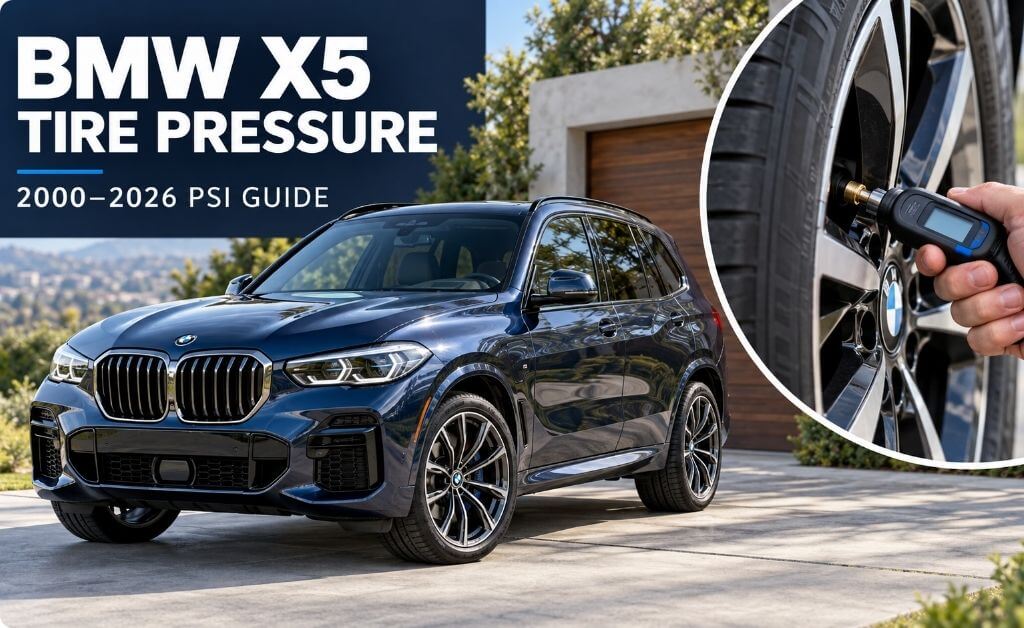
BMW X5 Tire Pressure: 2000–2026 PSI Guide
The correct BMW X5 tire pressure depends on the model year, model variant, tire specification, and applicable driving conditions. Match the front and rear tires to your vehicle’s pressure label or owner’s manual before adding air.
This guide covers selected verified US-market applications for each model year from 2000 through 2026. Start with the recent-model charts, then use the year-specific references for older X5 models. Each entry applies only to its listed setup; the charts do not cover every trim or tire package.
Quick Answer
Use the cold tire pressures specified for your BMW X5’s exact configuration. For example, the listed 2024–2026 sDrive40i and xDrive40i applications with 265/50R19 110H XL A/S tires specify 33 PSI front and 41 PSI rear for speeds up to 100 mph/160 km/h.
Other setups differ: the listed 22-inch 40i application specifies 41/45 PSI, while the M60i’s listed 22-inch application specifies 41/48 PSI. Check the vehicle’s pressure label and applicable manual entry rather than choosing a value by wheel diameter alone.
Before You Use the Charts
All values are cold inflation pressures. Tables with a speed condition identify the applicable manual category; “up to 100 mph/160 km/h” is not permission to exceed posted limits.
Match the model year, variant, front and rear tire specifications, and any seating, equipment, or load conditions. Seating configuration means the vehicle’s installed seats; load condition means its passenger-and-cargo use.
In tables below, “same as front” means the tire specification is the same on both axles. It does not mean the pressure is the same. “Front/rear PSI” gives the front value first.
BMW X5 Tire Pressure Chart: 2024–2026
These charts show cold pressures for the listed US applications at speeds up to 100 mph/160 km/h. Each of the three model-year manuals was checked separately before matching entries were combined.
X5 sDrive40i and xDrive40i
| Model years | Front tire specification | Rear tire specification | Front cold PSI | Rear cold PSI |
|---|---|---|---|---|
| 2024–2026 | 265/50R19 110H XL A/S or M+S | Same as front | 33 | 41 |
| 2024–2026 | 275/45R20 110H XL A/S or 110V XL M+S | Same as front | 33 | 41 |
| 2024–2026 | 275/45R20 110Y XL | 305/40R20 112Y XL | 33 | 39 |
| 2024–2026 | 275/40R21 107Y XL | 315/35R21 111Y XL | 36 | 42 |
| 2024–2026 | 275/35R22 104Y XL | 315/30R22 107Y XL | 41 | 45 |
| 2024–2026 | 275/40R21 107V XL M+S | 315/35R21 111V XL M+S | 36 | 42 |
The 20-inch square A/S and M+S entries specify 33/41 PSI; the listed staggered Y-rated setup specifies 33/39 PSI. Matching the wheel diameter alone would miss that distinction.
X5 M60i xDrive
| Model years | Front tire specification | Rear tire specification | Front cold PSI | Rear cold PSI |
|---|---|---|---|---|
| 2024–2026 | 275/45R20 110H XL A/S or M+S | Same as front | 35 | 42 |
| 2024–2026 | 275/40R21 107Y XL | 315/35R21 111Y XL | 36 | 42 |
| 2024–2026 | 275/35R22 104Y XL | 315/30R22 107Y XL | 41 | 48 |
| 2024–2026 | 275/40R21 107V XL M+S | 315/35R21 111V XL M+S | 36 | 42 |
The M60i is a separate application from the X5 M and X5 M Competition. Do not use this table to establish those models’ pressures.
Reference pages: 2024 manual p.332; 2025 manual p.342; 2026 manual p.344.
BMW X5 Tire Pressure Chart: 2023
These entries apply to the listed 2023 sDrive40i and xDrive40i models with two rows of seats. Values are cold pressures for speeds up to 100 mph/160 km/h.
| Front tire specification | Rear tire specification | Front cold PSI | Rear cold PSI |
|---|---|---|---|
| 265/50R19 110H XL A/S or M+S | Same as front | 33 | 41 |
| 275/45R20 110H XL A/S or 110V XL M+S | Same as front | 33 | 41 |
| 255/55R18 109W XL | Same as front | 33 | 41 |
| 275/45R20 110Y XL | 305/40R20 112Y XL | 33 | 39 |
| 275/40R21 107Y XL | 315/35R21 111Y XL | 35 | 42 |
| 275/35R22 104Y XL | 315/30R22 107Y XL | 38 | 45 |
| 275/40R21 107V XL M+S | 315/35R21 111V XL M+S | 35 | 42 |
Reference: BMW manual edition 01405A60465 — VI/22, p.356. The values were checked against its manual-page transcription.
BMW X5 Tire Pressure Chart: 2020–2022
The following selected entries apply to sDrive40i and xDrive40i models with two rows of seats. They show cold pressures for speeds up to 100 mph/160 km/h.
| Model years | Front tire specification | Rear tire specification | Front cold PSI | Rear cold PSI |
|---|---|---|---|---|
| 2020–2022 | 265/50R19 110H XL A/S or M+S | Same as front | 33 | 41 |
| 2020–2022 | 275/45R20 110Y XL | 305/40R20 112Y XL | 33 | 39 |
Each year’s entries were checked separately: 2020 p.343, 2021 p.352, and 2022 p.350. These combined rows do not establish recommendations for M50i, hybrid models, or unlisted setups.
BMW X5 Tire Pressure Chart: 2019
For the 2019 xDrive40i with two rows of seats, the manual distinguishes certain Sport Package applications. Match the equipment designation as well as the tire specification.
Values below are cold pressures for speeds up to 100 mph/160 km/h.
| Application | Front tire specification | Rear tire specification | Front cold PSI | Rear cold PSI |
|---|---|---|---|---|
| Listed 19-inch square setup* | 265/50R19 110H M+S XL A/S or M+S XL | Same as front | 33 | 41 |
| With Sport Package | 275/45R20 110Y XL | 305/40R20 112Y XL | 35 | 42 |
| With Sport Package | 275/35R22 104Y XL | 315/30R22 107Y XL | 38 | 45 |
The 19-inch entry appears before the manual’s “With Sport Package” subsection. These selected rows do not establish pressures for every 2019 configuration.
Reference: BMW manual 01402896765 — X/18, p.334.
BMW X5 Plug-In Hybrid Tire Pressure: 2021 xDrive45e
The 2021 xDrive45e has its own pressure table. Use its specific entries instead of assuming that a matching tire size uses the same pressure as a 40i.
These are cold pressures for the listed applications at speeds up to 100 mph/160 km/h.
| Front tire specification | Rear tire specification | Front cold PSI | Rear cold PSI |
|---|---|---|---|
| 265/50R19 110H XL A/S or M+S | Same as front | 35 | 42 |
| 275/45R20 110H XL A/S or 110V XL M+S | Same as front | 35 | 42 |
| 275/45R20 110Y XL | 305/40R20 112Y XL | 38 | 41 |
| 275/40R21 107Y XL | 315/35R21 111Y XL | 38 | 44 |
| 275/40R21 107V XL M+S | 315/35R21 111V XL M+S | 38 | 44 |
Reference: BMW plug-in hybrid manual 01405A03663 — II/20, p.353. This establishes the listed 2021 xDrive45e applications, not the xDrive40e or xDrive50e.
BMW X5 Tire Pressure Chart: 2014–2018
Selected 2014, 2016, 2017, and 2018 Applications
These entries apply to the listed sDrive35i, xDrive35i, xDrive50i, and xDrive35d models with two rows of seats. Values are cold pressures for speeds up to 100 mph/160 km/h.
| Model year | Tire specification on both axles | Front cold PSI | Rear cold PSI |
|---|---|---|---|
| 2014 | 255/55R18 109H M+S XL A/S RSC or M+S XL RSC | 33 | 41 |
| 2016 | 255/55R18 109H M+S XL A/S RSC or M+S XL RSC | 33 | 41 |
| 2017 | 255/55R18 109H M+S XL A/S RSC or M+S XL RSC | 33 | 41 |
| 2018 | 255/55R18 109H M+S XL A/S RSC or M+S XL RSC | 33 | 41 |
The rows were checked separately in the corresponding manuals: 2014 p.212, 2016 p.216, 2017 p.218, and 2018 p.233.
2015 X5 xDrive35i: Verified Door-Label Example
A BMW tire placard photographed in NHTSA’s report for a 2015 xDrive35i with five seats specifies:
| Front tire specification | Rear tire specification | Front cold PSI | Rear cold PSI |
|---|---|---|---|
| 255/55R18 XL | Same as front | 33 | 41 |
The label states 230 kPa/33 PSI front and 280 kPa/41 PSI rear. This verifies the photographed vehicle and setup, not every 2015 X5.
The placard does not provide separate light/full-load values or a speed condition. No such condition has been added to this example.
Additional 2016 Tire Setups
The 2016 manual lists additional sDrive35i, xDrive35i, xDrive50i, and xDrive35d applications. All values below are cold front/rear PSI for speeds up to 100 mph/160 km/h.
| Front tire specification | Rear tire specification | Two rows: front/rear PSI | Three rows: front/rear PSI |
|---|---|---|---|
| 255/55R18 109H M+S XL A/S RSC or M+S XL RSC | Same as front | 33 / 41 | 32 / 39 |
| 255/50R19 107H M+S XL A/S RSC or M+S XL RSC | Same as front | 36 / 44 | 35 / 42 |
| 255/50R19 107W XL RSC | 285/45R19 111W XL RSC | 36 / 41 | 35 / 39 |
| 275/40R20 106W XL RSC | 315/35R20 110W XL RSC | 36 / 41 | 35 / 39 |
| 275/40R20 106V M+S XL RSC | 315/35R20 110V M+S XL RSC | 36 / 41 | 35 / 39 |
| 285/35R21 105Y XL RSC | 325/30R21 108Y XL RSC | 36 / 44 | 35 / 42 |
Reference: BMW manual 01 40 2 963 410 — VI/15, pp.216–217. The seating columns describe installed configurations, not current passenger counts.
BMW X5 Tire Pressure Chart: 2007–2013
Selected 2007–2010 Applications
These rows use 255/55R18 109H M+S XL tires on both axles, with or without the Sport Package. Values are cold pressures for speeds up to 100 mph/160 km/h.
| Model year | Model application: two rows of seats | Front cold PSI | Rear cold PSI |
|---|---|---|---|
| 2007 | X5 3.0si / 4.8i | 32 | 32 |
| 2008 | X5 3.0si / 4.8i | 32 | 39 |
| 2009 | X5 xDrive30i / xDrive48i / xDrive35d | 32 | 32 |
| 2010 | X5 xDrive30i / xDrive35d | 32 | 35 |
The 2010 xDrive48i has a separate table and is not included in that row. Corresponding manual pages: 2007 p.216, 2008 p.235, 2009 p.251, and 2010 p.231.
2011 X5 xDrive35i and xDrive35d
The 2011 manual includes separate load columns. These selected square setups use cold pressures for speeds up to 100 mph/160 km/h.
| Seating configuration | Tire specification on both axles | Light load: front/rear PSI | Full load: front/rear PSI |
|---|---|---|---|
| Two rows | 255/55R18 109H M+S XL A/S or M+S XL | 32 / 32 | 32 / 39 |
| Two rows | 255/50R19 107H M+S XL A/S or M+S XL | 32 / 32 | 32 / 39 |
| Three rows | 255/55R18 109H M+S XL A/S or M+S XL | 32 / 32 | 32 / 39 |
| Three rows | 255/50R19 107H M+S XL A/S or M+S XL | 32 / 32 | 32 / 39 |
The light-load pictogram shows three occupants. Full load shows five occupants plus luggage for two-row vehicles, or seven occupants plus luggage for three-row vehicles.
Reference: BMW manual 01 41 2 604 009, pp.240 and 243. The xDrive50i and unlisted setups are outside these selected entries.
Selected 2012–2013 Applications
These cold-pressure entries apply to xDrive35i and xDrive35d models with two rows of seats, at speeds up to 100 mph/160 km/h.
| Model year | Tire specification on both axles | Equipment condition | Front cold PSI | Rear cold PSI |
|---|---|---|---|---|
| 2012 | 255/55R18 109H M+S XL A/S RSC or M+S XL RSC | With or without Sport Package | 32 | 36 |
| 2013 | 255/55R18 109H M+S XL A/S RSC or M+S XL RSC | Without Sport Package | 32 | 36 |
References: 2012 manual 01 40 2 606 735, p.253; 2013 manual 01 40 2 918 395 — III/13, p.276.
BMW X5 Tire Pressure Chart: 2000–2006
Historical 2000–2003 References
These manuals label their entries “all sizes,” subject to BMW’s tire-approval instructions. That wording refers to original approved applications; it does not establish pressures for every modern replacement or aftermarket tire.
| Model year | Manual application | Light load: front/rear cold PSI | Full load: front/rear cold PSI |
|---|---|---|---|
| 2000 | X5 4.4i, original approved applications | 32 / 32 | 36 / 39 |
| 2001 | X5 3.0i / 4.4i, original approved applications | 32 / 32 | 32 / 39 |
| 2002 | X5, original approved applications | 32 / 32 | 32 / 39 |
| 2003 | X5 3.0i / 4.4i / 4.6is, original approved applications | 32 / 32 | 32 / 39 |
Light load shows three occupants; full load shows five occupants plus luggage. These historical tables do not use the later manuals’ separate speed columns.
The 2000 full-load front pressure differs from the 2001–2003 entries. References: 2000–2001 p.31; 2002–2003 p.27.
Selected 2004–2005 Applications
These entries apply to 235/65R17 104H M+S tires on both axles.
| Model year | Model application | Light load: front/rear cold PSI | Full load: front/rear cold PSI |
|---|---|---|---|
| 2004 | X5 3.0i / 4.4i | 32 / 32 | 32 / 39 |
| 2005 | X5 3.0i | 32 / 32 | 32 / 39 |
Follow the original load pictograms: three occupants for light load, five occupants plus luggage for full load. References: 2004 p.135; 2005 p.142. The 2004 manual directs owners to the door-pillar label for original-equipment pressures.
Selected 2006 Applications
These cold front/rear pressures apply at speeds up to 100 mph/160 km/h.
| Model | Front tire specification | Rear tire specification | Light load: front/rear PSI | Full load: front/rear PSI |
|---|---|---|---|---|
| 3.0i | 235/65R17 104H M+S or 255/55R18 105H M+S | Same as front | 32 / 32 | 32 / 32 |
| 3.0i | 255/50R19 103V | 285/45R19 107V | 32 / 32 | 32 / 32 |
| 3.0i | 275/40R20 102W | 315/35R20 106W | 32 / 32 | 32 / 32 |
| 4.4i | 235/65R17 104H M+S or 255/55R18 105H M+S | Same as front | 32 / 33 | 32 / 33 |
| 4.4i | 255/50R19 103V | 285/45R19 107V | 32 / 32 | 32 / 32 |
| 4.4i | 275/40R20 102W | 315/35R20 106W | 32 / 32 | 32 / 32 |
| 4.8is | 255/55R18 109H M+S XL | Same as front | 32 / 33 | 32 / 39 |
| 4.8is | 275/40R20 106W XL | 315/35R20 110W XL | 32 / 32 | 32 / 39 |
Light load follows the three-occupant pictogram; full load follows the five-occupant-plus-luggage pictogram. Reference: 2006 manual pp.143–144.
How to Match Your X5 to the Correct Pressure Row
Start with the model year and variant, then read the markings on both axles. A staggered setup has different front and rear specifications, so checking one tire is insufficient.
Match the complete specification. For example, 275/45R20 110H XL A/S and 275/45R20 110Y XL are separate entries despite matching nominal dimensions. If the code is unfamiliar, our guide to reading tire size markings explains each part.
Finally, check seating, equipment, load, and speed conditions where stated. The H, V, W, and Y symbols help identify the listed service description; they are not road-speed recommendations. See the tire speed rating chart for their meanings.
If your older X5 has replacement wheels or an unlisted setup, establish its inflation requirements with BMW or a qualified tire professional. Similar wheel diameter alone does not establish a pressure recommendation.
Applications Not Numerically Covered
The charts do not provide verified pressures for the xDrive40e, 2024–2026 xDrive50e, or X5 M/Competition, and they omit some regular-X5 configurations. Use their own vehicle label and current manual; do not substitute 40i, 45e, or M60i values.
Where to Find the Recommended Pressure
Driver’s-Door Label
Open the driver’s door and locate the tire-pressure label on the opening or pillar. Read the front and rear cold values separately and match the listed specifications to the installed tires.
Vehicle-Specific BMW Manual
Use the supplied manual for further information on tire setups and applicable conditions. BMW’s official digital owner’s manual portal offers VIN-based access for supported model years. Your current vehicle-specific instructions take priority over a general lookup guide.
iDrive Where Supported
Supported X5 models can display actual and intended pressure. The tire settings must match the mounted tires for the displayed recommendation to be appropriate.
In the verified 2025 manual, the path is Apps → Vehicle → Vehicle status → Tire Pressure Monitor. Menu names and functions vary by vehicle and software version; consult your own manual if the route differs.
How to Check and Adjust BMW X5 Tire Pressure
1. Find the Correct Targets
Read the label or exact manual entry first. Identify separate front and rear targets and any applicable conditions. Use the vehicle recommendation, not a pressure marking on the tire itself.
2. Check Before Driving
Check before the day’s first drive, when the tires are at ambient temperature. Driving warms tires and increases pressure, so a warm reading is not a cold reading.
The verified BMW manuals describe cold-check conditions using a maximum travel distance of 1.25 miles/2 km, or at least two hours stationary after a trip. NHTSA’s general guidance uses at least three hours without driving. Checking before the first drive avoids mixing these timing references.
3. Measure All Four Tires
Remove the valve cap and press the gauge squarely onto the valve for a stable reading. Repeat for the remaining tires and compare each with its axle target.
Check the emergency spare when fitted, using its own specification. For help with gauge technique, see our step-by-step tire pressure checking guide.
4. Adjust and Recheck
Add or release air while the tires are cold, checking until each reaches its specified pressure. Refit the valve caps.
If a warm tire is significantly underinflated, address the pressure loss promptly rather than continuing to drive while waiting for it to cool. Follow the vehicle’s warning instructions, then recheck and make the final adjustment cold. Never treat a warm reading as a reason to bleed a tire down to its cold target.
5. Follow the Monitoring Instructions
After correction, follow the vehicle’s Tire Pressure Monitor or Flat Tire Monitor procedure. A reset is not required in every application; see the warning and reset section below.
BMW’s verified manuals recommend regular checks, giving twice a month and before a long trip as examples. Keep checking even without a dashboard warning.
Loaded Driving, Winter, and Run-Flat Considerations
Passengers, Cargo, and Towing
Where the manual provides separate load columns, choose the applicable passenger-and-luggage condition. A three-row vehicle carrying only the driver remains a three-row configuration.
Before towing, consult the towing instructions and applicable inflation guidance. Do not create a towing or full-load value by adding a fixed number of PSI to the chart.
Winter Tires
Falling temperatures can reduce tire pressure. Recheck cold pressures after significant weather changes and follow the entry for the installed approved winter setup.
An M+S entry, summer entry, or different service description may have its own row. Do not apply an automatic winter pressure increase or assume that matching dimensions make every entry interchangeable.
Run-Flat Tires
Some entries include the RSC run-flat designation. Follow the exact application; “run-flat” alone does not determine PSI.
If pressure is lost, follow the vehicle’s instructions for the fitted tires. This guide does not provide a universal distance or speed allowance for driving on a deflated run-flat tire.
BMW X5 Tire Pressure Warning and Reset
Check Before Resetting
If a warning appears, assess the tires and follow the warning instructions. Measure pressure and compare it with the correct recommendation before resetting.
If handling changes suddenly, vibration develops, or damage is suspected, reduce speed and stop safely. Arrange inspection or assistance as needed.
Resetting Does Not Repair a Leak
Resetting or initializing the monitoring system establishes or updates its reference information. It does not add air or repair pressure loss. Correct the pressures and confirm applicable tire settings first.
Follow Your System’s Procedure
Tire Pressure Monitor and Flat Tire Monitor arrangements vary across these years. Older verified manuals instruct owners to reset or reinitialize after adjustment.
The verified 2025 manual describes automatic acceptance of corrected pressures for applicable tire settings, with resets required for certain other applications. Follow your own manual instead of a universal reset sequence.
If the Warning Returns
Recheck pressures and note whether the same tire loses air repeatedly. Repeated loss needs inspection rather than repeated resets.
If pressures are correct but the warning remains, check tire settings and the monitoring instructions. Have a persistent warning or system fault diagnosed. Our guide to a tire pressure light that stays on after filling explains general troubleshooting considerations.
Frequently Asked Questions
Should All Four BMW X5 Tires Have the Same Pressure?
Not necessarily. Many listed applications specify different front and rear values; some older setups specify equal pressures under particular conditions. Follow the exact recommendation rather than making all readings equal.
Is 35 PSI Correct for Every BMW X5?
No. It is appropriate only where the applicable label or manual specifies it. Another X5’s pressure range does not establish the right setting for yours.
What Pressure Should 20-Inch X5 Tires Use?
Wheel diameter alone is insufficient. For the listed 2024–2026 40i applications, the square 275/45R20 110H XL A/S setup uses 33/41 PSI, while the staggered 275/45R20 110Y XL front and 305/40R20 112Y XL rear setup uses 33/39 PSI. Both are cold, up-to-100-mph entries.
Why Does iDrive Differ From My Cold Gauge Reading?
Driving increases tire temperature and pressure. Check whether you are comparing actual pressure with intended pressure and whether the installed tire settings are correct. Follow the vehicle’s instructions for interpreting the display.
Can I Use the 40i Chart for an xDrive50e?
This guide does not establish that the values apply to a 50e. Use its own label and vehicle-specific manual. Do not substitute the 2021 xDrive45e values either.
Do Run-Flat Tires Need Different Pressure?
Use the exact vehicle/tire recommendation. The run-flat designation alone is insufficient; match the stated tire specifications and conditions.
Why Does the Warning Return After Inflation?
Possible explanations include further pressure loss, temperature changes, incorrect tire settings, or a system issue. Recheck with a gauge. Persistent loss needs inspection; correct pressure with a persistent warning requires checking the settings and monitoring system.
Sources and Verification Method
This guide uses BMW-authored US-English owner’s manuals and a photographed BMW placard in an NHTSA report. Manual copies were accessed through independent archives; those hosting websites are not BMW.
Each model year from 2000 through 2026 has at least one selected verified application. The guide is not an exhaustive catalog of trims, packages, tire sizes, or markets. Specifications retain their available seating, load, equipment, and speed conditions; adjacent years are combined only after their listed values were checked separately.
The 2015 entry comes from the original door placard in NHTSA’s report for the 2015 xDrive35i test vehicle, Appendix A-2, Figure 4. It verifies the photographed five-seat 255/55R18 XL setup.
The 2023 entries were checked against BMW manual-page transcription 01405A60465 — VI/22, p.356; its original image was not separately inspected. Most other selected entries were visually checked against original tables. This is documentation-based research, not firsthand vehicle testing.
For a configuration absent from the chart, consult the actual vehicle label and current BMW manual. No tire-size conversion or aftermarket pressure calculation is implied by the listed rows.
Choosing the Correct Pressure for Your X5
Find the exact model and setup, read front and rear targets separately, and measure cold. Keep the row’s stated conditions attached to its values. If your configuration does not match, establish the vehicle-specific recommendation before adjusting pressure.
