BMW X5 Bolt Pattern by Year: 5×120 or 5×112?
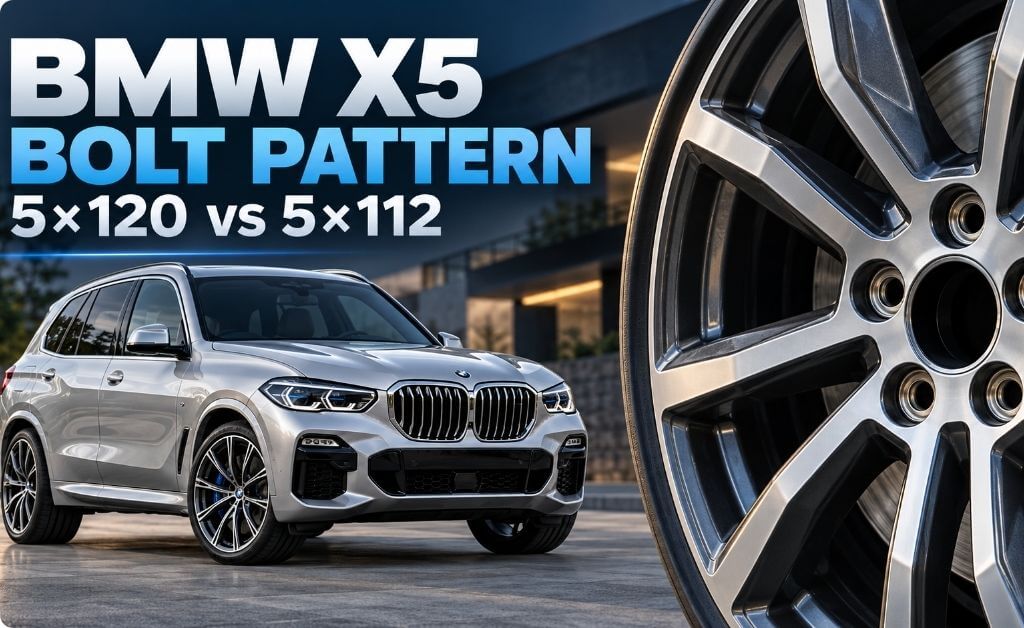
The BMW X5 bolt pattern depends on its model year and generation. Standard US-market E53, E70, and F15 models use 5×120 mm, while the G05 generation uses 5×112 mm, starting with the 2019 model year.
That difference matters when buying replacement wheels, especially a used set advertised simply as “BMW X5 wheels.” Check the donor vehicle’s generation and the wheel part numbers before purchasing.
The chart below identifies the bolt-pattern family and wheel-bolt thread. The fitment sections explain what else to check, including the important front/rear centering difference on the E70 X5 M.
Quick Answer: Standard US-market BMW X5 models from 2000–2018 use 5×120. The 2019–2026 G05 X5 uses 5×112. X5 M models have separate generation boundaries: the E70 and F85 use 5×120, while the F95 uses 5×112. A matching bolt pattern does not, by itself, confirm that a wheel fits.
BMW X5 Bolt Pattern Chart by Year
This chart follows US model years, rather than production dates or first-registration years. The wheel-bolt thread is included because the E53 uses a different pitch from the later generations.
Standard BMW X5 Models
| US model years covered | Generation | Bolt pattern / PCD | Wheel-bolt thread |
| 2000–2006 | E53 | 5×120 mm | M14×1.5 |
| 2007–2013 | E70 | 5×120 mm | M14×1.25 |
| 2014–2018 | F15 | 5×120 mm | M14×1.25 |
| 2019–2026 | G05 | 5×112 mm | M14×1.25 |
H&R’s vehicle applications support the listed patterns and thread sizes. Its current G05 catalog includes xDrive40i coverage through 2026. BMW’s US launch information identifies the second-generation X5 as a 2007 model and the fourth-generation X5 as a 2019 model.
The key transition is 2018 to 2019: a US-model-year 2018 F15 X5 uses 5×120, while a 2019 G05 X5 uses 5×112.
BMW X5 M Models
| US model years covered by the cited application catalog | Model | Generation | Bolt pattern / PCD | Wheel-bolt thread |
| 2010–2013 | X5 M | E70 | 5×120 mm | M14×1.25 |
| 2015–2018 | X5 M | F85 | 5×120 mm | M14×1.25 |
| 2020–2025 | X5 M | F95 | 5×112 mm | M14×1.25 |
| 2020–2026 | X5 M Competition | F95 | 5×112 mm | M14×1.25 |
These ranges describe H&R’s listed application coverage. A catalog’s ending year does not independently establish when vehicle production or sales ended. BMW’s official US announcement confirms the new F95 X5 M and Competition models for the 2020 model year.
E70 X5 M exception: its front and rear centering applications differ. Check the axle-specific information in the X5 M section before selecting wheels.
When Did the BMW X5 Bolt Pattern Change?
For the standard US-market X5, the change occurred with the 2019 model year, when the G05 replaced the F15. The outgoing generation uses 5×120; the incoming generation uses 5×112.
Consequently, a wheel set from a 2018 F15 should not be treated as a direct replacement for a 2019 G05, even if its diameter and tire size appear suitable.
Why Do Some Listings Say “2018 Onward”?
BMW introduced the fourth-generation X5 during the 2018 calendar year as a 2019 model. International listings and parts catalogs may therefore start their G05 coverage in 2018, while a US model-year chart starts in 2019.
For a vehicle built or first registered around the transition, confirm the model year and chassis generation. Do not rely on the registration year alone.
Parts-catalog dates can also differ from a model’s US introduction. For example, BMW announced the M50i during 2019 as a 2020 model.
Did the X5 M Change at the Same Time?
The X5 M has its own model-year boundaries. The F85 uses 5×120, while the succeeding F95 uses 5×112 and was introduced for the 2020 US model year. Use the performance-model chart rather than applying the standard X5’s 2019 transition to every X5 M.
What Do 5×120 and 5×112 Mean?
A bolt pattern describes the number of mounting holes and the diameter of the circle passing through their centers. That circle’s diameter is the pitch-circle diameter, or PCD.
| Marking | Mounting holes | Pitch-circle diameter |
| 5×120 | 5 | 120 mm |
| 5×112 | 5 | 112 mm |
The second number is not the distance between neighboring holes, the center-bore diameter, or the wheel-bolt diameter.
Are 5×120 and 5×112 Interchangeable?
No. They do not match for direct mounting. Both have five holes, but their bolt circles differ by 8 mm in diameter. The mounting-hole centers therefore occupy different positions.
Do not force bolts into a mismatched wheel. Hub-centric rings address a compatible wheel’s centering arrangement; they do not change its PCD.
Also, 5×120 is not exactly 5×4.75 inches. A 4.75-inch bolt circle measures 120.65 mm. Choose wheels by their exact specified pattern and confirmed vehicle application rather than treating nearby dimensions as interchangeable.
BMW X5 Centering Diameter and Wheel-Bolt Specifications
The center bore is the opening in the middle of the wheel that fits around the vehicle’s hub centering lip. It is separate from the PCD.
The table below reproduces the centering-diameter designations in H&R’s application catalog. These are source-specific catalog values, not independently measured BMW hub dimensions or machining tolerances.
| Standard X5 generation | US model years covered | H&R-listed centering diameter | Wheel-bolt thread |
| E53 | 2000–2006 | 72.5 mm | M14×1.5 |
| E70 | 2007–2013 | 74 mm | M14×1.25 |
| F15 | 2014–2018 | 74 mm | M14×1.25 |
| G05 | 2019–2026 | 66.5 mm | M14×1.25 |
The listed values come from H&R’s generation-specific applications and current G05 coverage.
When ordering wheels, obtain confirmation of the exact wheel bore and any required centering rings from the wheel manufacturer. Do not order machining or rings from an approximate measurement.
A wheel whose bore is too small cannot seat correctly over the hub. A larger-bore wheel may use manufacturer-specified centering rings, depending on its installation design.
What Does M14×1.25 Mean?
M14 identifies the nominal thread diameter in millimeters. 1.25 identifies the thread pitch—the distance between adjacent threads.
An M14×1.5 bolt and an M14×1.25 bolt have different pitches. They are not interchangeable simply because both have the same nominal diameter.
Check Bolt Seat and Length Too
Correct thread size is only part of hardware selection. The bolt must also have the correct seat shape and length for the wheel.
BMW’s examined E53, E70, and F15 manuals indicate that wheels other than the original BMW alloy wheels may require different bolts. Follow the replacement wheel’s installation requirements rather than automatically reusing the existing hardware.
BMW X5 M Bolt Pattern and Fitment Differences
Identify the actual performance model before selecting wheels. An M Sport package, M50i, or M60i designation does not identify the vehicle as an X5 M. H&R lists the G05 M Performance applications separately from the F95 X5 M.
E70 X5 M: Check Each Axle
For its 2010–2013 E70 X5 M applications, H&R lists 5×120, M14×1.25, and different front/rear centering diameters:
| Axle | H&R-listed centering diameter |
| Front | 74 mm |
| Rear | 72.5 mm |
The catalog identifies these as front-only and rear-only applications. A single center-bore figure therefore does not adequately describe this model’s fitment.
Confirm each wheel’s intended axle and part number. Do not assume that a rear wheel fits the front or that an E70 X5 M wheel fits a standard E70 X5.
F85 X5 M
The F85 shares the F15’s basic 5×120 pattern, M14×1.25 thread, and H&R 74 mm centering designation. That establishes a specification overlap, not approval for every wheel swap. Width, offset, brake clearance, load capacity, and hardware still need checking.
F95 X5 M and Competition
H&R lists the F95 within the 5×112, M14×1.25, 66.5 mm catalog-centering family. Sharing these basic values with the G05 does not establish that every standard X5 wheel clears the F95’s brakes or suits its installation.
Will Wheels From Another X5 Generation Fit?
Use this table to identify the first compatibility hurdle. It covers standard X5 models; X5 M applications require the separate checks above.
| Proposed swap | Do the patterns match? | What needs attention? |
| E53 ↔ standard E70 | Yes: 5×120 | Different centering dimensions and bolt threads |
| E53 ↔ F15 | Yes: 5×120 | Different centering dimensions and bolt threads |
| Standard E70 ↔ F15 | Yes: 5×120 | Wheel dimensions, brakes, load rating, and hardware |
| E53/E70/F15 ↔ G05 | No | 5×120 versus 5×112 prevents direct mounting |
| Between G05 years or trims | Yes: 5×112 | Exact wheel application, axle position, and brake package |
These conclusions follow the listed generation-specific specifications. They do not constitute approval for an individual wheel set.
E53 Wheels on an E70 or F15
Original E53 wheels should not be treated as direct-fit replacements for the later generations. The catalog shows different centering dimensions, and the vehicle’s bolt thread also changes.
For an aftermarket set, inspect the actual wheel specifications. Its bore and installation hardware may differ from those of the original wheels on the donor vehicle.
E70 Wheels on an F15
The basic pattern, thread, and catalog-centering designations match. This makes the wheel set a candidate for further checks.
Keep front and rear part numbers separate, particularly with staggered sets. Confirm the individual wheel’s width, offset, load rating, and brake clearance on the recipient vehicle.
Older Wheels on a G05
A 5×120 wheel does not directly mount to a 5×112 G05. Neither a matching tire size nor centering rings resolve that difference.
A pattern-changing adapter is a separate modification. Its application, hardware, thickness, load capability, and effect on wheel position require assessment; it is not a routine substitute for correctly specified wheels.
What to Check Before Buying Replacement Wheels
Start with wheels listed for your exact vehicle and brake package. Professional fitment checks consider more than the bolt pattern, including centering, dimensions, brake profile, and load capacity.
1. Vehicle and Wheel Identification
Confirm the model year, generation, trim, and brake package. For used BMW wheels, request clear photographs of the part numbers and dimensional markings on the back of each wheel.
If the wheels are staggered, record the front and rear specifications separately. “Fits BMW X5” is not enough information.
2. Bolt Pattern and Hub Fit
Verify the exact PCD and centering arrangement. Ask whether the wheel fits directly or requires specified centering rings.
Do not substitute a nearby bore dimension or assume compatibility because the mounting holes look close.
3. Diameter, Width, and Offset
Check these dimensions together. Wheel width affects the position of both edges; offset determines how the wheel sits relative to the hub mounting surface.
There is no universal offset for every X5 wheel size. Our wheel offset chart explains the relationship between width, ET, and estimated backspacing, but it does not approve a particular X5 fitment.
4. Brake and Suspension Clearance
Diameter alone does not establish brake clearance. The wheel barrel and spoke profile must clear the caliper, and the complete assembly must have sufficient space around suspension and body components.
A fitment check evaluates the brake-caliper profile as well as the wheel’s dimensions.
5. Wheel Load Capacity
Obtain the wheel’s documented load rating and confirmation that it meets the vehicle’s requirements. Wheel load suitability should be assessed against the relevant gross axle weight rating rather than assumed from appearance or PCD.
Wheel capacity and tire capacity are separate requirements. When selecting the tires, use the tire load rating chart to interpret their load index; it cannot establish the wheel’s capacity.
6. Correct Mounting Hardware
Confirm thread pitch, bolt seat, length, and any locking-bolt requirements. If spacers are involved, use hardware selected for the specific installation system.
H&R’s instructions require suitable bolt length and matching seat geometry for its spacer applications.
7. Compatible Tires
Verify that the tires suit the wheel widths and the vehicle’s approved setup. For staggered installations, confirm the intended front/rear pairing.
The tire size chart can help compare nominal dimensions, while the tire speed rating chart explains the sidewall’s speed symbol. Neither replaces confirmation of the complete wheel-and-tire fitment.
Before paying, obtain fitment confirmation for the exact wheel part numbers and your X5 configuration.
BMW X5 Wheel-Bolt Torque
The BMW owner’s manuals examined for this guide specify 140 Nm. The table identifies the actual evidence checked rather than claiming separate verification for every year and variant.
| Generation | Manual examined | Printed torque | Verified instruction |
| E53 | 2002 X5 | 140 Nm / 101 lb-ft | Wheel change |
| E70 | 2012 X5 xDrive35i | 140 Nm / 101 lb-ft | Wheel change |
| F15 | 2014 X5 | 140 Nm / 101 lb-ft | Wheel change |
| G05 | 2025 X5 | 140 Nm / 101 lb-ft | Wheel-lock installation |
These are BMW-authored manuals accessed through third-party document hosts. Separate torque verification has not been completed for every X5 M variant or the 2026 model year.
Why Do References Show 101 or 103 lb-ft?
The examined manuals print 140 Nm alongside 101 lb-ft. Mathematically, 140 Nm converts to approximately 103.3 lb-ft, so the printed pair is not an exact conversion.
This guide preserves the source wording and uses 140 Nm as the primary reference. Follow the instructions applicable to your installation. If the paired units need clarification, obtain it from BMW rather than averaging the figures.
Tightening Procedure
The examined E70 and F15 manuals specify a diagonal or crosswise tightening sequence. The E70 manual also calls for checking the bolts with a calibrated torque wrench.
Use the correct bolts before applying torque. Correct tightening cannot compensate for unsuitable thread, seat geometry, or bolt length.
Frequently Asked Questions
Does Every BMW X5 Use 5×120?
No. Standard US-market E53, E70, and F15 models use 5×120; the G05 uses 5×112. Check the generation rather than choosing wheels by the X5 name alone.
What Bolt Pattern Does a 2026 BMW X5 Use?
The cited H&R applications list 5×112 for the 2026 G05 xDrive40i and M60i, as well as the F95 X5 M Competition. Confirm the exact model application before ordering.
Does an E70 X5 Use M14×1.5 or M14×1.25?
H&R lists M14×1.25 for the standard E70 X5. The earlier E53 uses M14×1.5. Their shared 5×120 pattern does not make the bolt threads interchangeable.
Can Centering Rings Make 5×120 Wheels Fit a 5×112 X5?
No. Rings address the centering arrangement of a suitable wheel. They do not change the mounting-hole positions or PCD.
Will Any 5×112 Wheel Fit a G05?
No. Centering, dimensions, brake clearance, load rating, and mounting hardware must also suit the exact vehicle. A matching PCD is only the first check.
Can I Reuse My Original Bolts With Aftermarket Wheels?
Only if the replacement wheel’s instructions confirm the correct thread, seat, and length. The examined BMW manuals note that non-original alloy wheels may require different bolts.
Does the E70 X5 M Have Different Front and Rear Hub-Centering Applications?
Yes. H&R lists 74 mm front and 72.5 mm rear for its E70 X5 M applications. Check the wheel’s intended axle and part number rather than applying one centering value to the whole vehicle.
Sources and Verification Method
This guide combines BMW US launch information, BMW-authored owner’s manuals, and H&R vehicle application data.
BMW announcements establish model-year transitions, including the fourth-generation X5’s introduction for the 2019 US model year. H&R’s catalog supports the listed bolt patterns, wheel-bolt threads, centering designations, and application coverage. Torque references come from the specific manuals identified in the torque table.
The charts follow US model years. Catalog dates and first-registration years may differ, and an application listing’s ending year does not establish a production endpoint.
Centering values reproduce H&R’s terminology; they are not independently measured OEM wheel-bore specifications. Torque evidence uses representative manuals rather than separate verification for every year and variant. The examined 2025 manual passage covers wheel-lock installation.
Use the charts to identify your X5’s bolt-pattern family, then confirm the exact wheel part numbers and installation requirements with BMW or the wheel manufacturer.
