Toyota 4Runner Bolt Pattern: 1984–2026 Year-by-Year Guide
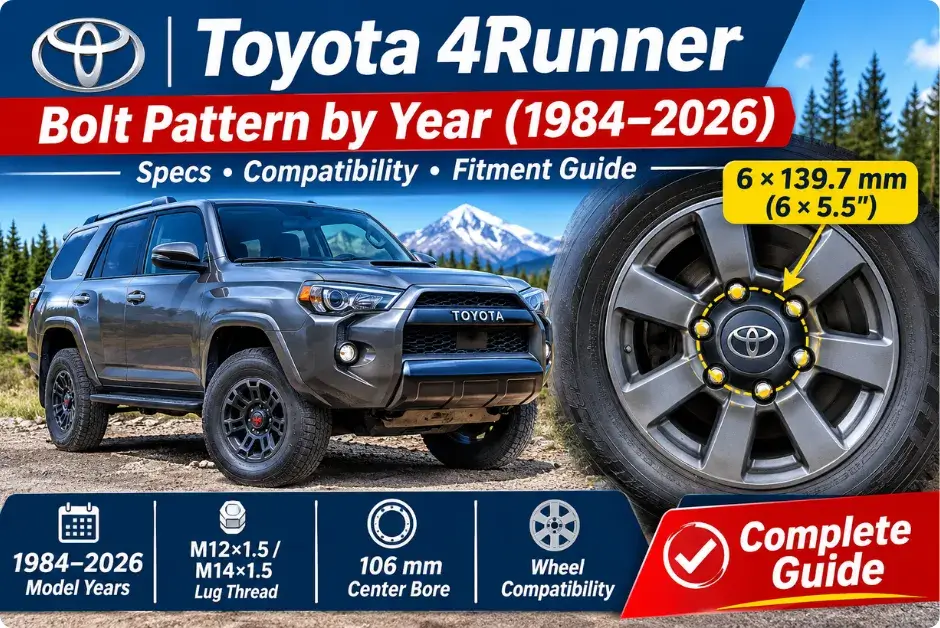
The Toyota 4Runner bolt pattern is 6×139.7 mm (6×5.5 inches) across U.S.-market model years 1984 through 2026. Every generation uses six lug positions arranged around a 139.7 mm pitch circle diameter (PCD). Although the bolt pattern has remained consistent, other wheel mounting specifications have changed over time. The 2025 sixth-generation 4Runner introduced a different center bore and larger wheel studs, which makes wheel compatibility between older and newer models especially important.
This guide includes a complete year-by-year bolt pattern chart, generation-specific specifications, lug nut information, and practical advice for choosing replacement or aftermarket wheels.
Toyota 4Runner Bolt Pattern: Quick Answer
Every U.S.-market Toyota 4Runner from 1984 through 2026 uses a 6×139.7 mm bolt pattern, also known as 6×5.5 inches.
| Specification | Toyota 4Runner |
|---|---|
| Bolt pattern | 6×139.7 mm |
| Imperial equivalent | 6×5.5 inches |
| Number of lug positions | 6 |
| Pitch circle diameter (PCD) | 139.7 mm |
| Model years covered | 1984–2026 |
Important: The bolt pattern is the same across all six generations, but the center bore and lug thread specifications changed with the 2025 redesign. Matching the bolt pattern alone does not guarantee that a replacement or aftermarket wheel will fit correctly.
Toyota 4Runner Bolt Pattern by Year (1984–2026)
The Toyota 4Runner has retained its six-lug 6×139.7 mm bolt pattern throughout its production history. Use the following chart to identify the correct bolt pattern for your model year.
Toyota 4Runner Bolt Pattern Chart
| Model Year | Generation | Metric Bolt Pattern | Imperial Bolt Pattern |
|---|---|---|---|
| 1984 | First | 6×139.7 mm | 6×5.5 inches |
| 1985 | First | 6×139.7 mm | 6×5.5 inches |
| 1986 | First | 6×139.7 mm | 6×5.5 inches |
| 1987 | First | 6×139.7 mm | 6×5.5 inches |
| 1988 | First | 6×139.7 mm | 6×5.5 inches |
| 1989 | First | 6×139.7 mm | 6×5.5 inches |
| 1990 | Second | 6×139.7 mm | 6×5.5 inches |
| 1991 | Second | 6×139.7 mm | 6×5.5 inches |
| 1992 | Second | 6×139.7 mm | 6×5.5 inches |
| 1993 | Second | 6×139.7 mm | 6×5.5 inches |
| 1994 | Second | 6×139.7 mm | 6×5.5 inches |
| 1995 | Second | 6×139.7 mm | 6×5.5 inches |
| 1996 | Third | 6×139.7 mm | 6×5.5 inches |
| 1997 | Third | 6×139.7 mm | 6×5.5 inches |
| 1998 | Third | 6×139.7 mm | 6×5.5 inches |
| 1999 | Third | 6×139.7 mm | 6×5.5 inches |
| 2000 | Third | 6×139.7 mm | 6×5.5 inches |
| 2001 | Third | 6×139.7 mm | 6×5.5 inches |
| 2002 | Third | 6×139.7 mm | 6×5.5 inches |
| 2003 | Fourth | 6×139.7 mm | 6×5.5 inches |
| 2004 | Fourth | 6×139.7 mm | 6×5.5 inches |
| 2005 | Fourth | 6×139.7 mm | 6×5.5 inches |
| 2006 | Fourth | 6×139.7 mm | 6×5.5 inches |
| 2007 | Fourth | 6×139.7 mm | 6×5.5 inches |
| 2008 | Fourth | 6×139.7 mm | 6×5.5 inches |
| 2009 | Fourth | 6×139.7 mm | 6×5.5 inches |
| 2010 | Fifth | 6×139.7 mm | 6×5.5 inches |
| 2011 | Fifth | 6×139.7 mm | 6×5.5 inches |
| 2012 | Fifth | 6×139.7 mm | 6×5.5 inches |
| 2013 | Fifth | 6×139.7 mm | 6×5.5 inches |
| 2014 | Fifth | 6×139.7 mm | 6×5.5 inches |
| 2015 | Fifth | 6×139.7 mm | 6×5.5 inches |
| 2016 | Fifth | 6×139.7 mm | 6×5.5 inches |
| 2017 | Fifth | 6×139.7 mm | 6×5.5 inches |
| 2018 | Fifth | 6×139.7 mm | 6×5.5 inches |
| 2019 | Fifth | 6×139.7 mm | 6×5.5 inches |
| 2020 | Fifth | 6×139.7 mm | 6×5.5 inches |
| 2021 | Fifth | 6×139.7 mm | 6×5.5 inches |
| 2022 | Fifth | 6×139.7 mm | 6×5.5 inches |
| 2023 | Fifth | 6×139.7 mm | 6×5.5 inches |
| 2024 | Fifth | 6×139.7 mm | 6×5.5 inches |
| 2025 | Sixth | 6×139.7 mm | 6×5.5 inches |
| 2026 | Sixth | 6×139.7 mm | 6×5.5 inches |
Quick takeaway: All 43 model years from 1984 through 2026 use the same 6×139.7 mm (6×5.5-inch) bolt pattern.
Toyota 4Runner Bolt Pattern by Generation
Toyota introduced six generations of the 4Runner between 1984 and 2026. Each generation retained the same six-lug bolt pattern, although other wheel specifications changed with the 2025 redesign.
| Generation | Model Years | Bolt Pattern |
|---|---|---|
| First Generation | 1984–1989 | 6×139.7 mm |
| Second Generation | 1990–1995 | 6×139.7 mm |
| Third Generation | 1996–2002 | 6×139.7 mm |
| Fourth Generation | 2003–2009 | 6×139.7 mm |
| Fifth Generation | 2010–2024 | 6×139.7 mm |
| Sixth Generation | 2025–2026 | 6×139.7 mm |
The first-generation 4Runner debuted in 1984 with a pickup-based design and a removable fiberglass rear top. Toyota introduced the second generation in 1990 with a more conventional SUV body.
The third generation arrived in 1996, followed by the fourth generation in 2003. Toyota introduced the fifth generation for 2010, which continued through the 2024 model year.
The completely redesigned sixth generation arrived for 2025 on Toyota’s TNGA-F truck platform.
Despite these major redesigns, the six-lug 6×139.7 mm bolt pattern remained unchanged. You can review Toyota’s official 4Runner generation history for additional background.
First-Generation Toyota 4Runner (1984–1989)
The first-generation Toyota 4Runner was introduced for the 1984 model year. Based on the Toyota Hilux pickup, it featured a removable fiberglass rear top and a rugged, utility-focused design.
All first-generation model years use a 6×139.7 mm bolt pattern. Fitment references also commonly list a 106.1 mm center bore and M12×1.5 lug thread.
When replacing original wheels, check the exact wheel diameter, width, offset, center bore, and brake clearance rather than relying only on the bolt pattern.
Second-Generation Toyota 4Runner (1990–1995)
Toyota redesigned the 4Runner for 1990, replacing the removable rear top with a more integrated SUV body and adding rear passenger doors.
The wheel bolt pattern remained 6×139.7 mm throughout the generation.
Commonly listed mounting specifications include a 106.1 mm center bore and M12×1.5 lug thread. Original wheel dimensions can vary by model and equipment, so verify the particular vehicle before purchasing replacements.
Third-Generation Toyota 4Runner (1996–2002)
The third-generation 4Runner arrived for 1996 with a redesigned chassis, updated engines, and additional safety and comfort features.
Toyota retained the 6×139.7 mm bolt pattern for every model year from 1996 through 2002.
Fitment references commonly list a 106.1 mm center bore and M12×1.5 lug thread. Factory wheel diameters and widths vary by trim and configuration, so a replacement wheel should be checked against the original specifications.
Fourth-Generation Toyota 4Runner (2003–2009)
The fourth-generation 4Runner debuted in 2003 with updated styling, additional equipment, and an available V8 engine.
Its bolt pattern remained 6×139.7 mm throughout the 2003–2009 model years.
Common fitment specifications include a 106.1 mm center bore and M12×1.5 lug thread. Factory wheel configurations included different diameters depending on trim and equipment.
A wheel with the correct bolt pattern can still cause clearance problems if its width, offset, or internal spoke design differs from the original.
Fifth-Generation Toyota 4Runner (2010–2024)
Toyota introduced the fifth-generation 4Runner for 2010. This generation received several updates during its long production run, including a major redesign for the 2014 model year.
The 2010–2024 models retained the 6×139.7 mm bolt pattern.
Their commonly listed wheel mounting specifications are:
| Specification | Fifth-Generation 4Runner |
|---|---|
| Model years | 2010–2024 |
| Bolt pattern | 6×139.7 mm |
| Center bore | 106.1 mm |
| Lug thread | M12×1.5 |
Factory wheel sizes and offsets vary by trim. Many configurations use 17-inch wheels, while some Limited and TRD Sport models use larger factory wheels.
Always verify the exact year and trim before ordering replacement wheels.
Sixth-Generation Toyota 4Runner (2025–2026)
Toyota introduced the sixth-generation 4Runner for 2025, built on the TNGA-F truck platform.
The new generation retained the familiar 6×139.7 mm bolt pattern but introduced different hub and lug hardware specifications.
| Specification | Sixth-Generation 4Runner |
|---|---|
| Model years | 2025–2026 |
| Bolt pattern | 6×139.7 mm |
| Commonly listed center bore | 95.1 mm |
| Lug thread | M14×1.5 |
Factory wheel diameter, width, and offset vary by trim. The 2025–2026 models include 17-inch, 18-inch, and 20-inch factory wheel configurations.
The change from M12×1.5 to M14×1.5 lug hardware is particularly important when selecting replacement wheels and lug nuts.
Do not assume that fifth-generation and sixth-generation factory wheels are directly interchangeable simply because they share the same bolt pattern.
What Does 6×139.7 mm (6×5.5 Inches) Mean?
The Toyota 4Runner’s 6×139.7 mm bolt pattern describes two measurements: the number of wheel mounting positions and the diameter of the circle passing through their centers.
Understanding the Six-Lug Configuration
The first number, 6, represents the number of lug positions on the wheel.
Each Toyota 4Runner wheel has six mounting holes arranged evenly around its center opening. These holes align with the six wheel studs on the vehicle’s hub.
A six-lug configuration is also commonly called a six-bolt pattern or six-lug wheel pattern.
What Is the 139.7 mm Pitch Circle Diameter?
The second number, 139.7 mm, represents the pitch circle diameter (PCD).
PCD is the diameter of an imaginary circle passing through the centers of all six lug holes.
For a Toyota 4Runner, the six lug-hole centers sit on a circle measuring 139.7 mm across.
Both parts of the bolt pattern must match for the wheel’s mounting holes to align with the vehicle’s studs. A six-lug wheel with a different PCD is not a direct fit.
Remember that PCD is different from center bore. PCD describes the arrangement of the lug holes, while center bore describes the large opening in the middle of the wheel.
Is 6×139.7 the Same as 6×5.5 Inches?
Yes. Both measurements describe the same bolt pattern using different units.
- 6×139.7 mm is the metric designation.
- 6×5.5 inches is the imperial designation commonly used in the United States.
One inch equals exactly 25.4 millimeters.
5.5 × 25.4 = 139.7 mm
Therefore, a wheel advertised with a 6×5.5-inch bolt pattern has the same PCD as a 6×139.7 mm wheel.
How to Measure a Six-Lug Bolt Pattern
To identify a six-lug wheel, measure the distance from the center of one lug hole to the center of the hole directly opposite it.
Follow these steps:
- Count the six lug holes around the wheel.
- Choose one lug hole and locate the hole directly opposite it.
- Measure from the center of the first hole to the center of the opposite hole.
- Compare the result with 139.7 mm or 5.5 inches.
For a six-lug pattern, the opposite hole is three positions away from the starting hole.
Do not measure between adjacent holes or between the outside edges of two holes. PCD measurements use the centers of the mounting holes.
For more detailed measurement instructions, see our step-by-step guide to measuring a wheel bolt pattern.
Toyota 4Runner Center Bore by Year (1984–2026)
The center bore is the circular opening in the middle of a wheel that fits over the raised center portion of the vehicle’s hub.
Although the Toyota 4Runner has retained its 6×139.7 mm bolt pattern, its commonly published center-bore specification changed with the sixth-generation redesign.
| Generation | Model Years | Bolt Pattern | Commonly Listed Center Bore |
|---|---|---|---|
| First | 1984–1989 | 6×139.7 mm | 106.1 mm |
| Second | 1990–1995 | 6×139.7 mm | 106.1 mm |
| Third | 1996–2002 | 6×139.7 mm | 106.1 mm |
| Fourth | 2003–2009 | 6×139.7 mm | 106.1 mm |
| Fifth | 2010–2024 | 6×139.7 mm | 106.1 mm |
| Sixth | 2025–2026 | 6×139.7 mm | 95.1 mm* |
*Some fitment databases report 95.2 mm for sixth-generation models. The commonly listed specification is 95.1 mm. Confirm the actual vehicle hub and wheel measurements before ordering a centering ring.
Why Is Center Bore Important?
The wheel’s center opening must be large enough to clear the vehicle’s hub pilot.
For example, a wheel with a 95.1 mm center opening cannot fit directly over a hub measuring 106.1 mm.
A wheel with a larger center bore may fit over a smaller hub if its other mounting specifications are compatible. A properly sized hub-centric ring may be required or recommended by the wheel manufacturer.
What Are Hub-Centric Rings?
Hub-centric rings are small adapters that fit between an aftermarket wheel’s larger center opening and the vehicle’s smaller hub.
For example, an aftermarket wheel with a 106.1 mm center bore installed on a vehicle with a 95.1 mm hub may require a ring with:
- Outer diameter: 106.1 mm
- Inner diameter: 95.1 mm
The outer measurement matches the wheel opening, while the inner measurement matches the vehicle hub.
A hub-centric ring helps center a compatible wheel. It does not change the bolt pattern or make an otherwise incompatible wheel fit.
If the wheel’s center bore is smaller than the vehicle’s hub, a ring cannot solve the problem. The wheel will not clear the hub as supplied.
Toyota 4Runner Lug Nut Size and Thread Pitch (1984–2026)
The commonly listed Toyota 4Runner lug stud specifications are M12×1.5 for 1984–2024 models and M14×1.5 for 2025–2026 models.
| Generation | Model Years | Commonly Listed Thread Size |
|---|---|---|
| First | 1984–1989 | M12×1.5 |
| Second | 1990–1995 | M12×1.5 |
| Third | 1996–2002 | M12×1.5 |
| Fourth | 2003–2009 | M12×1.5 |
| Fifth | 2010–2024 | M12×1.5 |
| Sixth | 2025–2026 | M14×1.5 |
The early-generation hardware figures are supported by replacement-parts and fitment references; equivalent Toyota factory documentation for every historical model year was not located.
What Does M12×1.5 or M14×1.5 Mean?
The first number represents the nominal thread diameter, while the second represents the distance between successive thread peaks.
- M12×1.5: 12 mm nominal diameter and 1.5 mm thread pitch.
- M14×1.5: 14 mm nominal diameter and 1.5 mm thread pitch.
The 2025 redesign introduced the larger M14×1.5 hardware. An M12×1.5 lug nut is not compatible with an M14×1.5 stud.
What Socket Size Does a Toyota 4Runner Use?
Socket size refers to the hexagonal outside dimension of the lug nut. It is not determined by thread size alone.
A 21 mm socket is common for many Toyota 4Runner replacement lug nuts, but different replacement designs may use other hex dimensions.
Before using a socket, check the actual lug nut. A locking lug nut also requires its matching wheel-lock key.
Toyota 4Runner Lug Nut Seat Types
The lug nut seat is the contact surface between the lug nut and the wheel.
Common designs include:
- 60-degree conical seat: A tapered contact surface designed to fit a matching tapered opening in the wheel.
- Flat or washer seat: A flat contact surface, commonly with an integrated washer, designed for a matching wheel seat.
- Radius seat: A rounded contact surface used with wheels designed for that shape.
These designs are not interchangeable. The wheel manufacturer’s specifications determine the correct lug nut.
Toyota’s wheel installation instructions also distinguish between steel and aluminum wheel contact surfaces. Certain Toyota aluminum-wheel applications use washer-style lug nut contact, while steel-wheel applications use a tapered contact surface.
Always follow the applicable model-year owner’s manual and the wheel manufacturer’s hardware requirements.
Are All Toyota 4Runner Wheels Interchangeable?
No. Although every Toyota 4Runner from 1984 through 2026 uses a 6×139.7 mm bolt pattern, not all generation-specific wheels are direct replacements for one another.
The center-bore and lug-stud changes introduced in 2025 are particularly important.
Fifth-Generation vs. Sixth-Generation Wheel Compatibility
| Specification | 2010–2024 4Runner | 2025–2026 4Runner |
|---|---|---|
| Bolt pattern | 6×139.7 mm | 6×139.7 mm |
| Center bore | 106.1 mm | 95.1 mm* |
| Lug thread | M12×1.5 | M14×1.5 |
*Commonly listed sixth-generation fitment value.
Will 2024 Toyota 4Runner Wheels Fit a 2025 4Runner?
They are not guaranteed to be a direct replacement.
A 2024 4Runner wheel commonly has a 106.1 mm center opening, which is larger than the commonly listed 95.1 mm hub on the 2025 model.
The larger opening may clear the newer hub, although a correctly specified hub-centric ring may be needed to center the wheel.
However, the older wheel’s lug holes must also provide adequate clearance for the newer M14 studs. The lug nut seat, thread engagement, offset, wheel width, and brake clearance must also be verified.
Do not assume that a 2024 factory wheel will fit a 2025 4Runner without checking its exact part number and mounting dimensions.
Will 2025–2026 Wheels Fit a 2024 or Older 4Runner?
Not directly.
The commonly listed 95.1 mm center opening on a sixth-generation wheel is smaller than the 106.1 mm hub on a fifth-generation or earlier 4Runner. The wheel therefore cannot slide over the older vehicle’s hub.
The M14 lug hardware also differs from the older M12 hardware.
Do not purchase sixth-generation factory wheels expecting them to be direct replacements for 1984–2024 4Runners.
Will Toyota Tacoma Wheels Fit a 4Runner?
Some Tacoma wheels are potential interchange candidates, but compatibility depends on the Tacoma’s model year, drivetrain, wheel dimensions, and the destination 4Runner.
Many six-lug 2005–2023 Tacoma wheels in 17- or 18-inch sizes share important mounting specifications with 2010–2024 4Runners:
| Specification | Six-Lug 2005–2023 Tacoma | 2010–2024 4Runner |
|---|---|---|
| Bolt pattern | 6×139.7 mm | 6×139.7 mm |
| Common center bore | 106.1 mm | 106.1 mm |
| Lug thread | M12×1.5 | M12×1.5 |
These are potential fitment matches, not a guarantee that every Tacoma wheel will fit every fifth-generation 4Runner.
Sixteen-inch Tacoma wheels should not be assumed to clear the larger front brakes on 2010–2024 4Runners. Wheel barrel shape and spoke design also affect brake clearance.
The 2024-and-newer Tacoma shares the newer core mounting specifications with the 2025-and-newer 4Runner:
| Specification | 2024+ Tacoma | 2025+ 4Runner |
|---|---|---|
| Bolt pattern | 6×139.7 mm | 6×139.7 mm |
| Common center bore | 95.1 mm | 95.1 mm |
| Lug thread | M14×1.5 | M14×1.5 |
These matching dimensions make newer Tacoma wheels promising candidates for sixth-generation 4Runners. Still, check the exact wheel width, offset, lug nut seat, brake clearance, tire clearance, and load rating before installation.
Some older two-wheel-drive Tacoma configurations use five lug positions instead of six. Identify the exact Tacoma configuration before purchasing used wheels.
Will Toyota Tundra Wheels Fit a 4Runner?
Tundra wheel compatibility depends on the donor vehicle’s generation.
| Tundra Model Years | Bolt Pattern | Common Center Bore | Lug Thread |
|---|---|---|---|
| 2000–2006 | 6×139.7 mm | 106.1 mm | M12×1.5 |
| 2007–2021 | 5×150 mm | 110.1 mm | M14×1.5 |
| 2022–2026 | 6×139.7 mm | 95.1 mm | M14×1.5 |
The 2007–2021 Tundra uses a five-lug 5×150 mm pattern. It does not directly match the 4Runner’s six-lug 6×139.7 mm pattern.
The 2000–2006 and 2022–2026 Tundra generations are potential donor-wheel candidates for different 4Runner generations because their basic mounting specifications correspond to the older and newer 4Runner configurations.
However, matching bolt pattern, center bore, and thread size does not guarantee complete fitment. Check the exact wheel’s width, offset, lug seat, brake clearance, and load capacity.
What Should You Check Before Buying Toyota 4Runner Wheels?
Before purchasing replacement or aftermarket wheels, verify all the important mounting and clearance specifications for your exact model year and trim.
1. Bolt Pattern
Confirm that the wheel has six lug positions arranged on a 139.7 mm pitch circle diameter.
2. Center Bore
The wheel’s center opening must clear the vehicle hub. If the opening is larger, check whether the wheel manufacturer requires a correctly sized hub-centric ring.
3. Lug Thread and Seat
Match the vehicle’s M12×1.5 or M14×1.5 studs and use lug nuts with the correct seating design for the wheel.
4. Wheel Diameter and Width
Verify that the selected wheel accommodates the vehicle’s brake components and is compatible with the intended tire size.
5. Wheel Offset and Backspacing
Offset determines how far the wheel’s mounting surface sits from its centerline. Backspacing measures the distance from the mounting surface to the inner wheel edge.
A change in either measurement can affect suspension, brake, and fender clearance.
Use our wheel offset chart to compare offset and estimated backspacing for different wheel widths.
6. Brake and Suspension Clearance
Check the inner barrel and spoke clearance around the brake calipers. Also verify that the wheel does not contact suspension components.
Two wheels with the same diameter can have different internal shapes and brake clearance.
Where possible, request a vehicle-specific brake clearance template from the wheel manufacturer and test-fit one wheel before mounting tires.
7. Fender and Tire Clearance
Check the tire’s clearance at full left and right steering lock and throughout the suspension’s usable travel.
A wheel that clears when the vehicle is parked may still rub against the fender liner, bumper, mud flap, or suspension components while turning or driving over uneven terrain.
8. Wheel Load Rating
Check the wheel manufacturer’s load rating and compare it with the vehicle’s requirements, including the applicable gross axle weight ratings.
Do not assume that a physically larger or heavier wheel automatically has sufficient load capacity.
9. Tire Compatibility
Confirm that the selected tire is approved for the wheel’s rim width and meets the vehicle’s load and speed requirements.
Also check its overall diameter and available clearance against the vehicle’s original specifications.
For factory tire specifications, see our Toyota 4Runner tire size chart by year.
10. TPMS Compatibility
Confirm that the wheel accommodates compatible tire pressure monitoring system valves and transmitters.
Replacement sensors may require registration or initialization according to Toyota’s instructions.
11. Tire Pressure
Use the recommended cold inflation pressure on the driver’s-side Tire and Loading Information Label or in the applicable owner’s manual.
Do not automatically use the maximum pressure printed on the tire sidewall.
12. Final Installation
Inspect the wheels for cracks, bends, and other damage. Confirm that each wheel seats properly against the hub and that the correct lug hardware is installed.
Use a calibrated torque wrench and follow the exact model-year Toyota owner’s manual and wheel manufacturer’s installation instructions. Do not lubricate wheel studs or lug nut threads unless specifically instructed by the manufacturer.
Related Topic: Toyota 4Runner Lug Nut Torque
Frequently Asked Questions About Toyota 4Runner Bolt Pattern
What Is the Bolt Pattern on a Toyota 4Runner?
The Toyota 4Runner uses a 6×139.7 mm (6×5.5-inch) bolt pattern across U.S.-market model years 1984–2026. Every wheel has six mounting positions.
Do All Toyota 4Runners Have the Same Bolt Pattern?
Yes. All six generations use the same 6×139.7 mm bolt pattern. However, center bore and lug thread specifications changed with the 2025 redesign.
Is 6×139.7 the Same as 6×5.5?
Yes. They represent the same bolt pattern in metric and imperial units. A 139.7 mm pitch circle equals 5.5 inches.
Did the Toyota 4Runner Bolt Pattern Change in 2025?
No. The sixth-generation 2025 model retained the 6×139.7 mm bolt pattern. However, its commonly listed center bore changed to 95.1 mm and its lug thread changed to M14×1.5.
How Many Lug Nuts Does a Toyota 4Runner Have?
Each wheel uses six lug nuts. Four road wheels therefore require 24 lug nuts in total. The spare wheel also needs six compatible nuts when installed.
Will Tacoma Wheels Fit a Toyota 4Runner?
Some do. Six-lug Tacoma wheels can share important mounting specifications with particular 4Runner generations, but model year, drivetrain, center bore, thread size, offset, width, and brake clearance must be verified.
Will 2024 4Runner Wheels Fit a 2025 4Runner?
Not as a guaranteed direct replacement. The 2024 wheel’s larger center bore may clear the 2025 hub, but its lug holes must accommodate the newer M14 studs, and the seat and other dimensions must be compatible.
What Is the Center Bore of a Toyota 4Runner?
The commonly published specification is 106.1 mm for 1984–2024 models and 95.1 mm for 2025–2026 models. Some fitment databases report 95.2 mm for the newer model.
Can I Use 6×135 Wheels on a Toyota 4Runner?
No. A 6×135 mm wheel has a different PCD from the 4Runner’s 6×139.7 mm pattern. The mounting holes will not correctly align with the vehicle’s six wheel studs.
Does Matching the Bolt Pattern Guarantee Wheel Compatibility?
No. Center bore, lug-hole clearance, thread size, lug nut seat, wheel diameter, width, offset, brake clearance, and load rating must also be checked before installing a wheel.
Final Takeaway
The Toyota 4Runner has retained its 6×139.7 mm (6×5.5-inch) bolt pattern from 1984 through 2026, making the six-lug configuration consistent across all six generations.
However, the 2025 sixth-generation redesign introduced important wheel mounting differences, including a smaller commonly listed center bore and larger M14×1.5 lug studs.
Before purchasing replacement or aftermarket wheels, verify the complete mounting specifications for your exact model year and trim. Matching the bolt pattern is only the first step toward safe and correct wheel fitment.
