Michelin Pilot Super Sport Reviews (2026)
Last updated on April 6th, 2026
If you are searching for honest Michelin Pilot Super Sport reviews, this guide will help you decide whether this tire is the right fit for your car and your driving style. The Pilot Super Sport is known for strong dry grip, sharp steering, and confident wet-road performance, but it is not the best choice for every driver. In this review, we will look at how it performs in real driving, what kind of comfort you can expect, and whether it is truly worth the price.
This article is written to answer the questions most buyers ask before spending money on performance tires. You will learn where the Michelin Pilot Super Sport shines, where it falls short, and how it compares with other popular options. By the end, you will have a clear idea of whether this tire matches your needs or if another choice makes more sense.
The Verdict (Quick Summary)
The Michelin Pilot Super Sport is a high-performance summer tire that still delivers excellent dry grip, sharp steering response, and strong highway stability. It feels confident and controlled when driving fast or taking corners, which is why many enthusiasts still trust it even today. However, its biggest weakness is that wet performance and cold-weather grip are not as strong as newer tires, especially in heavy rain or low temperatures.
Best for: Drivers who want sporty handling, strong dry-road performance, and a connected driving feel in warm weather.
Avoid if: You need winter driving ability, soft comfort, or the safest option for frequent heavy rain in cold conditions.
Score breakdown:
- Dry: 9.5/10
- Wet: 8.4/10
- Comfort: 8.1/10
- Value: 8.3/10

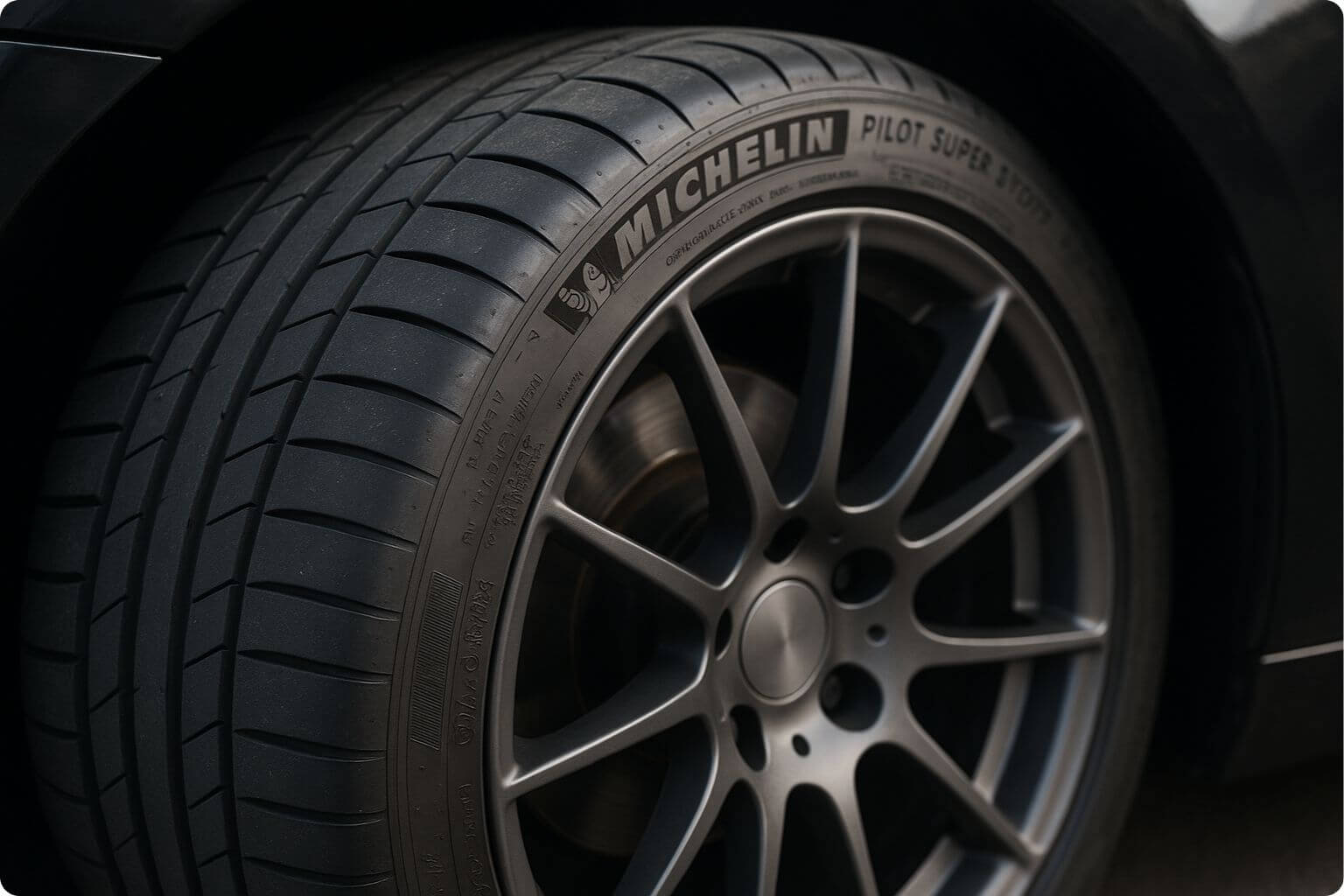
Michelin Pilot Super Sport
Quick Specs (At a Glance) — Michelin Pilot Super Sport
| Specification | Details |
| Tire Type | Max Performance Summer Tire |
| Season | Summer (Not for winter use) |
| Vehicle Type | Sports cars, performance sedans, supercars |
| UTQG Rating | ~300 AA A (varies by size) |
| Treadwear Warranty | 30,000 miles |
| Speed Rating | Y (up to 186 mph) |
| Construction | Radial, asymmetric tread design |
| Technology | Twaron belt + Bi-Compound tread |
| Dry Performance | Excellent (track-inspired grip) |
| Wet Performance | Very strong for a summer tire |
| Snow/Ice Performance | ❌ Not suitable |
| Comfort Level | Medium (performance-focused) |
| Noise Level | Low to moderate |
| Fuel Efficiency | Moderate (performance priority) |
| Available Rim Sizes | ~18″ to 22″ |
| OEM Fitments | Ferrari, Porsche, BMW, Mercedes, Tesla |
| Warranty Extras | 60-day satisfaction + roadside assistance |
| Average Rating | 4.7/5 (based on 400+ reviews) |
What Makes the Pilot Super Sport Different?
The Michelin Pilot Super Sport stands out because it was built with performance in mind first. It is not trying to be the quietest or the softest tire. Instead, it focuses on grip, control, and confidence when you drive harder than usual.
One of the biggest reasons it feels different is its bi-compound construction. That means Michelin uses two different rubber compounds in the tread. The outer part is made to hold better when you take corners, while the inner part helps the tire work better on wet roads. In simple terms, it is designed to give you a strong grip in more than one situation without feeling one-dimensional.
The tire also uses an asymmetric tread design, which means the pattern on the tire is not the same across the whole surface. One side is built differently from the other side. This helps the tire stay stable in corners, move water away in the rain, and keep traction when road conditions change.
Another thing you notice is high-speed stability. At faster speeds, the tire feels planted and steady instead of nervous or loose. That does not just matter on a track. It also helps on highways, especially when you are changing lanes quickly or driving a car with a lot of power.
The Pilot Super Sport is also very focused on dry grip. On warm, dry pavement, it holds the road extremely well and gives the driver a strong sense of control. That is one of the main reasons performance car owners like it. The trade-off is that tires built this way are usually not as soft or forgiving as comfort-first tires.
In wet weather, the tire still does a good job because of how it moves water away from the contact area. This helps reduce the chance of slipping on standing water. It is not a rain tire, and it is still a summer tire, but it handles wet roads better than many people expect from a tire this performance-focused.
Michelin Pilot Super Sport Performance Review
Dry Handling & Braking
On dry roads, the Michelin Pilot Super Sport feels confident and well connected to the pavement. It does not feel vague or slow to respond. When you turn the wheel, the tire reacts quickly, which gives the driver a strong sense of control.
Cornering grip is one of its biggest strengths. In simple terms, that means the tire holds the road well when you take turns at speed. It stays steady instead of sliding or feeling soft, which is exactly what many performance drivers want.
High-speed stability is also impressive. Even when the car is moving fast, the tire feels planted and predictable. That matters on highways, open roads, and in spirited driving because the tire does not give you that loose or nervous feeling some tires can have.
Braking on dry pavement is strong as well. The tire helps the car stop with confidence and feels responsive when you press the brakes hard. Emergency stops still depend on the car, road, and driver, but the tire gives solid support and helps build trust.
The only real downside is that this sharp performance comes with a firmer feel. It is built to perform, not to feel soft and relaxed. For drivers who care most about grip and control, though, that trade-off makes sense.
Wet Grip & Aquaplaning
On wet roads, the Michelin Pilot Super Sport performs better than many people expect from a performance-focused tire. It does not feel overly slippery, and it keeps a decent level of grip as long as you drive with some care.
Rain traction is solid in normal driving. The tire can handle light to moderate rain without feeling unstable. When you accelerate or take turns, it still holds the road reasonably well, though you will notice it is not as confident as it is in dry conditions.
Hydroplaning resistance is good, but not perfect. The tread design helps move water away from the tire, which reduces the chance of losing contact with the road. At higher speeds in heavy rain, though, you still need to slow down. Like any summer tire, it has limits when water builds up.
In real-world driving, the tire feels safe and predictable if you stay within those limits. It does not suddenly lose grip without warning, which is important. You can feel when traction is starting to drop, giving you time to adjust.
The downside is simple: this is still a performance summer tire. In heavy rain or standing water, it cannot match a tire designed mainly for wet conditions. If you often drive in strong rain, you will need to be a bit more careful with speed and braking.
Snow & Ice Performance
This is where the Michelin Pilot Super Sport clearly shows its limits. It is a summer tire, which means it is not designed for cold weather, snow, or ice.
In temperatures close to freezing, the rubber starts to harden. When that happens, the tire loses grip quickly, even on dry roads. Add snow or ice, and traction drops even more.
On light snow, the tire struggles to find grip when starting, turning, or braking. On ice, it can feel very slippery and unpredictable. Even careful driving will not fully fix this because the tire simply is not built for those conditions.
From a safety point of view, it is best to avoid using this tire in winter altogether. If you live in an area where temperatures regularly drop or snow is common, switching to proper winter or all-season tires is the safer choice.
The bottom line is simple: the Pilot Super Sport performs well in warm conditions, but it is not safe for winter driving.
Comfort & Road Noise
The Michelin Pilot Super Sport is not built with comfort as the main goal, and you can feel that in everyday driving. The ride is a bit firm, especially on rough or uneven roads. You will notice bumps more compared to softer touring tires.
Ride stiffness becomes more obvious in city driving where roads are not perfect. Small cracks and sharp edges come through the cabin more clearly. It is not uncomfortable, but it is definitely on the sportier side.
On the highway, things improve a bit. At steady speeds, the tire feels stable and controlled, which actually makes long drives feel more confident. The firmness is still there, but it is less noticeable on smoother roads.
Road noise is present but not excessive. You will hear some tire sound, especially at higher speeds, but it does not become loud or annoying for most drivers. It sits somewhere in the middle—not the quietest, but far from the noisiest.
The trade-off is clear. You give up some softness and quietness to get better grip and control. For many drivers, that balance feels fair, but if comfort is your top priority, this may not be the ideal choice.
Treadwear & Expected Mileage
For a performance tire, the Michelin Pilot Super Sport holds up better than many people expect. It is not built to last as long as a touring tire, but it does not wear out too quickly either if you drive normally.
In real-world use, many drivers see somewhere around 20,000 to 30,000 miles. That lines up fairly well with the official rating, though some may get a bit more with careful driving and regular maintenance.
Driving style makes a big difference here. If you accelerate hard, brake aggressively, or take corners fast, the tire will wear down faster. That extra grip comes at a cost, and you pay for it in tread life.
On the other hand, smoother driving can stretch the life of the tire. Keeping the correct tire pressure and rotating the tires on time also helps them wear more evenly.
The key thing to understand is balance. This tire gives strong performance, and in return, you get moderate lifespan. It is a fair trade-off, but not ideal if your main goal is long-lasting tires.
Fuel Economy / Rolling Resistance
The Michelin Pilot Super Sport is not built to save fuel. It is designed for grip and control, and that usually means slightly higher fuel use compared to comfort-focused tires.
In everyday driving, the difference is not huge, but it is noticeable over time. You might see a small drop in fuel economy, especially if you drive in the city or push the car harder.
Compared to touring tires, which are made to roll easily and save fuel, this tire puts more rubber on the road. That helps with traction, but it also creates more resistance, which can use a bit more fuel.
On the highway, the impact is smaller. At steady speeds, fuel use stays fairly stable, and most drivers will not find it a dealbreaker.
The trade-off is simple. You give up a little efficiency to gain better grip and performance. If fuel savings is your top priority, a touring tire is a better fit. If the driving feel matters more, this tire still makes sense.
Available Sizes & Fitment Guide
Michelin sells the Pilot Super Sport in size-specific fitments rather than one universal version, so the right choice depends on your exact wheel size and vehicle setup. Michelin also warns that you should check your owner’s manual or tire placard before buying, because the wrong size or load rating can affect safety and handling.
On Michelin’s U.S. page, the tire is tied to performance-car brands such as BMW, Mercedes-Benz, Audi, Lexus, Ford, Chevrolet, and others. Michelin also lists OE sidewall markings for BMW, Mercedes-Benz, Porsche, Ferrari, Ford, Lexus, and GM, which is a good sign that this tire was built for high-performance factory fitments as well as replacements.
For popular sizes, current listings show a strong focus on 19-inch and 20-inch fitments. Examples include 245/35ZR19, 255/35ZR19, 255/45ZR19, 275/35ZR19, 245/35ZR20, 245/40ZR20, 275/35ZR20, and 295/35ZR20, with some versions marked for BMW, Mercedes-Benz, Porsche, Ferrari, or Volvo applications.
The easiest way to choose the right size is to match what your car already uses from the factory, then check whether your vehicle needs an OE-marked version. If you are replacing only two tires, make sure the new size matches the axle and the vehicle’s speed and load requirements. Michelin also notes that high-speed use may require specific pressure and load adjustments, so it is worth checking with a tire dealer if your car is driven hard.
Pros & Cons of Michelin Pilot Super Sport
Pros
- Excellent dry grip and steering response.
- Strong wet traction and hydroplaning resistance for a summer tire.
- Still delivers a premium, sporty feel that many drivers enjoy.
Cons
- Not suitable for snow, ice, or freezing temperatures.
- Ride is firm compared with comfort-first tires.
- Tread life can drop quickly if alignment, pressure, or driving style are not managed well.
Comparison With Key Competitors
Michelin Pilot Super Sport vs Pilot Sport 4S
The Pilot Sport 4S is Michelin’s current summer performance flagship, and Tire Rack reviews describe it as excellent in warm dry and wet conditions, with strong comfort and low noise. The Pilot Super Sport still feels sharp and highly capable, but the Pilot Sport 4S is usually the better all-around choice if you want a more modern balance of grip, comfort, and everyday refinement. That is my practical reading of the available review data.
Choose the Pilot Super Sport if you find it at a better price and care most about crisp steering and strong performance feel. Choose the Pilot Sport 4S if you want the more rounded street tire.
Michelin Pilot Super Sport vs Continental ExtremeContact Sport
Continental’s current equivalent is the ExtremeContact Sport 02, which Continental describes as a summer ultra-high performance tire with improved handling and tread life, better wet-road grip, and precise steering. Tire Rack feedback also points to strong dry traction, reliable wet performance, and a generally smooth ride.
Compared with the Michelin, Continental looks like the more comfort-friendly and value-focused option, while the Pilot Super Sport stays more focused on sharp performance feel. If you want a tire that still drives sportily but leans a bit more toward daily comfort and wet-road confidence, the Continental is a strong rival.
Michelin Pilot Super Sport vs Pirelli P Zero
Pirelli says the P Zero is its ultra-high performance summer tire for high-end cars, with excellent wet and dry performance, strong braking, and good aquaplaning control. Tire Rack reviews also show strong dry traction and good wet grip, but some owners mention more road hum and less hydroplaning confidence in heavier rain.
In simple terms, the P Zero is a serious competitor, but the Michelin still stands out for its steering precision and overall confidence. The Pirelli may appeal more if you want a slightly different balance of comfort and performance, while the Michelin feels like the more focused enthusiast tire.
Pricing and Value of Michelin Pilot Super Sport
The Michelin Pilot Super Sport sits in the higher price range for performance tires. It is not a budget option, and you will usually notice that when you compare it with more basic summer or all-season tires.
The price is mainly because it is built for strong grip, fast response, and high-speed stability. In simple terms, you are paying for how the tire feels when you drive hard, especially on dry roads and highways.
For many drivers, the cost makes sense if they actually enjoy driving or own a sporty car. The tire gives a more confident and controlled feel, which you can notice in quick turns, sudden braking, and highway speed changes.
But it is also fair to say it is not the best value for everyone. If you mostly drive slowly in the city or want something that lasts as long as possible, this tire can feel expensive for what you get.
You should also consider that performance tires like this tend to wear faster if driven aggressively. So even though the upfront price is high, the long-term cost depends a lot on how you drive and maintain them.
In short, this tire is worth the money if you care about driving feel and safety at higher speeds. If you only want basic transport and low running cost, there are cheaper options that will suit you better.
Read More: Summer Tires vs All-Season Tires
FAQ
Are Michelin Pilot Super Sport tires good in the rain?
Yes. They are one of the stronger wet-weather summer tires, with Tire Rack ratings showing excellent wet traction and hydroplaning resistance.
How long do Pilot Super Sport tires last?
Michelin lists a 30,000-mile limited warranty, but real-world life depends heavily on driving style, alignment, and tire pressure.
Can I use Michelin Pilot Super Sport in winter?
No. They are summer tires and are not intended for near-freezing temperatures, snow, or ice.
How do they compare to Michelin Pilot Sport 4S?
The Pilot Sport 4S is the better all-around modern summer tire for most buyers, while the Pilot Super Sport still appeals to drivers who want a very direct, sporty feel.
Are they worth the premium price?
Yes, for drivers who care about steering precision, dry grip, and wet confidence. No, if your main goal is comfort, winter use, or maximum mileage.
Conclusion
The Michelin Pilot Super Sport is still a top-tier choice for drivers who want serious summer performance without giving up wet-road confidence. It is fast, sharp, and confidence-building, and it still holds up well against newer rivals in the categories that matter most to enthusiasts.
Buy it if you want a true performance tire for warm weather and you value the way a car feels on the road. Do not buy it if you need winter capability or a softer, quieter ride. For the right driver, it is still a very smart pick.
