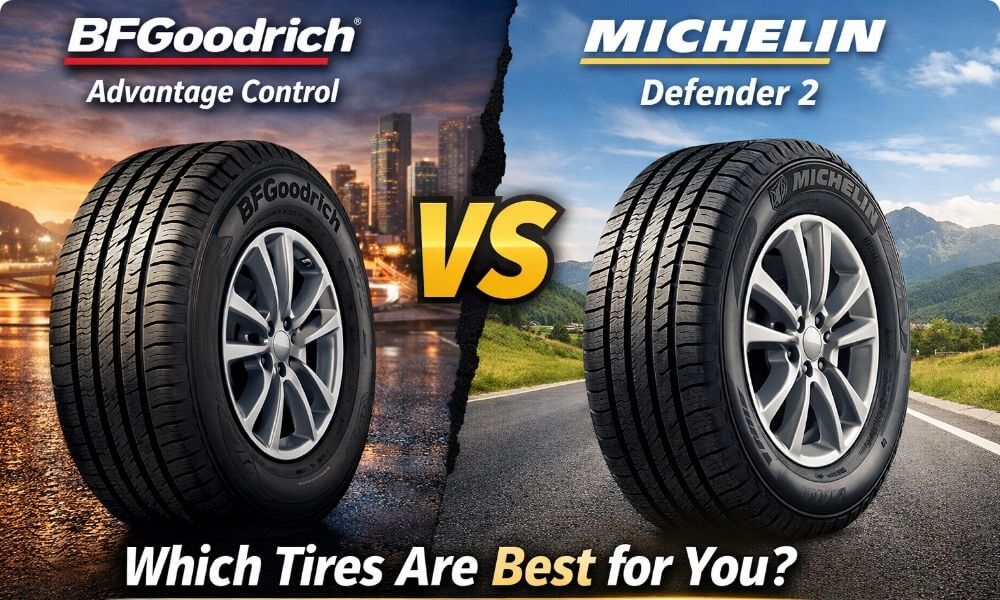
BFGoodrich Advantage Control vs Michelin Defender 2: Which Tire Should You Choose?
When it comes to choosing reliable all-season tires, drivers often compare performance, comfort, and long-term value. That’s why many people are searching for BFGoodrich Advantage Control vs Michelin Defender 2.
Both tires are designed for everyday driving, but they offer different strengths depending on your priorities.
In this post, we’ll break down how each tire handles wet and dry roads, comfort, tread life, and cost, so you can make an informed decision and pick the right tire for your vehicle and driving needs.
Quick Answer for Busy Buyers (Decision Snapshot)
If you want a tire that lasts a long time, feels quiet and smooth on the road, and gives good value over many miles, the Michelin Defender 2 is the better choice. It costs more up front, but many drivers find the extra comfort and long life worth it.
If you’re looking to spend less money initially, want solid wet-road performance, and just need a reliable tire for everyday driving, the BFGoodrich Advantage Control is a strong option. It won’t last quite as long as the Michelin, but it delivers good performance for the price.
This quick snapshot helps you pick without getting bogged down in details.
Who This Tire Comparison Is For
This comparison is meant for everyday drivers who want a reliable, all-season tire without overthinking it. If you drive a sedan, compact SUV, or crossover, both of these tires are designed with your kind of use in mind.
They work best for normal daily driving—commuting to work, running errands, road trips, and family use. If most of your miles are on city streets or highways, these tires are built to handle that comfortably and safely.
That said, these aren’t performance tires. If you enjoy aggressive cornering or spirited driving, you’ll likely find them a bit soft and unexciting.
They’re also not made for harsh winter conditions. While they can handle light snow, they aren’t a replacement for true winter tires in areas with heavy snow or ice.
If your goal is dependable, low-stress driving rather than sporty performance or extreme weather capability, this comparison is relevant to you.
Overview of Each Tire (What They’re Designed to Do)
BFGoodrich Advantage Control
This tire is built to give reliable, all-season traction while keeping the price reasonable. Its tread and siping are tuned to move water away and improve wet grip, so it feels confident in rain.
It’s aimed at drivers who want solid everyday performance without paying a premium. Expect good handling and a comfortable ride for normal driving, though it won’t outlast the longest-wearing touring tires.

Pros & Cons of BFGoodrich Advantage Control
Pros
- Lower upfront price, easier on your wallet today.
- Strong wet grip for rainy roads.
- Comfortable for daily city and highway driving.
- Good range of common tire sizes available.
Cons
- Typically wears sooner than premium touring tires.
- Can be a bit noisier at highway speeds.
- Not the best choice for heavy snow or ice.
- Less long-term value if you drive very high miles each year.
Michelin Defender 2
The Defender 2 is focused on long tread life and a quiet, smooth ride. Michelin’s tests and owner feedback point to noticeably longer wear and a very comfortable feel on highways and daily commutes.
That makes it a good pick if you plan to keep your tires for many years and want lower cost per mile over time. The trade-off is a higher upfront price compared with value-focused options.

Pros and Cons of Michelin Defender 2
Pros
- Longer expected tread life and solid mileage warranty.
- Very quiet and smooth on long trips.
- Better cost-per-mile for frequent drivers.
- Consistent performance across everyday conditions.
Cons
- Higher upfront cost compared with value-focused options.
- Not worth it if you drive very little or change tires frequently.
- May be overkill for drivers on a tight budget.
- Slightly fewer low-end size/price options in some markets.
Side-by-Side Comparison Table: BFGoodrich Advantage Control vs Michelin Defender 2
Here’s a clear comparison table you can include in your blog post to help readers decide between BFGoodrich Advantage Control and Michelin Defender 2. It’s based on available performance data and manufacturer info so your audience can quickly see the differences and make an informed choice:
| Feature / Metric | BFGoodrich Advantage Control | Michelin Defender 2 |
| Intended Use | All-season touring tire for sedans/crossovers | All-season touring tire with focus on longevity |
| Dry Performance | Strong dry traction, good handling | Excellent dry traction, slight edge over BFG |
| Wet Performance | Excellent wet grip with Aqua-Flume tech | Excellent wet handling and hydroplaning resistance |
| Snow / Winter | Decent in light snow, not for heavy ice | Decent in light snow; overall similar to BFG |
| Comfort & Noise | Comfortable ride; some report moderate noise | Very smooth and quiet ride |
| Tread Life Warranty | ~6 years / 65,000 mi typical | ~6–7 years / up to 80,000 mi typical |
| Price Range | Generally slightly lower | Generally slightly higher |
| Size Availability | Wider range (14″–20″) | Slightly narrower range (16″–20″) |
| Best For | Value-focused drivers prioritizing wet/dry performance | Drivers seeking longest tread life and quiet ride |
A few notes for context
- Both tires are positioned as all-season touring tires with similar core strengths and target everyday driving users.
- Michelin Defender 2 often edges out the BFGoodrich slightly in dry performance, noise, and tread life warranty, which is why it’s often perceived as the more premium choice.
- BFGoodrich Advantage Control typically delivers excellent wet grip and a slightly more budget-friendly option with comparable everyday performance.
In-Depth Real-World Performance Breakdown
When you actually drive on the road, tires behave differently than on paper. Here’s what you’ll notice with these two tires in everyday conditions.
Ride & Comfort
Both tires are comfortable for normal driving, but they feel a bit different. The Michelin Defender 2 tends to feel a bit smoother and a touch quieter on long highway drives, so you won’t hear much road noise inside the car. The BFGoodrich Advantage Control is also comfortable, but some drivers notice more road sound at higher speeds compared with premium touring tires.
Wet Grip & Braking
In wet conditions, both tires hold the road well. You’ll feel confident braking and cornering in rain with either option. The Advantage Control has grooves designed to push water out from under the tire to help prevent sliding, and the Defender 2 has a tread pattern that also handles rain safely. On balance, performance in the rain is very close between the two.
Light Snow & Cold Weather
Neither tire is a winter tire, so don’t expect magic in heavy snow or ice. In light snow or slush, they give you enough grip for short trips, but performance drops once conditions get severe. If you live somewhere with real winter weather, proper winter tires are still the better choice.
Handling & Steering Feel
For everyday driving, both tires feel stable on the road. You won’t get the sporty “tight” feel of performance tires, but they stay predictable in curves and don’t surprise you. The Michelin may feel slightly more planted at higher speeds, while some drivers feel the Advantage Control is a bit softer and easier going in normal city traffic.
Tread Wear & Long-Term Cost
Michelin backs the Defender 2 with a strong tread life warranty and many owners report long tire life with even wear. The BFGoodrich also has a solid warranty, and many drivers get good mileage out of them too. On average, Defender 2 tires are expected to last a bit longer, which can help lower your cost per mile over time.
Read More: Michelin CrossClimate 2 vs Defender 2
Tread Life, Warranty & Long-Term Value
Tread life and warranty matter because they affect how much you actually pay to drive a mile, not just the sticker price. Michelin generally backs the Defender 2 with a longer treadwear warranty, while the BFGoodrich usually has a shorter warranty but lower upfront cost.
A quick way to compare is cost-per-mile. Pick a realistic price and expected miles, then divide. Example: if one tire costs $160 and you expect it to last 80,000 miles, do 160 ÷ 80,000 = 0.002. That’s $0.002 per mile (0.2¢). For a set of four, multiply by 4 → $0.008 per mile (0.8¢).
If another tire costs $140 and lasts 60,000 miles: 140 ÷ 60,000 = 0.002333… ($0.00233 per mile, 0.233¢). Four tires → $0.00933 per mile (0.933¢). In this example, the more expensive tire ends up cheaper over time.
Keep in mind real life: driving habits, tire rotation, alignment, and inflation change results. If you drive a few miles a year or sell the car soon, the lower upfront price can make more sense. If you keep a car for many years and put on lots of miles, a higher-priced tire with longer life often saves money overall. Calculate with your own expected prices and mileage to see which choice fits you.
Price Comparison & Value Perspective
One of the first things most people notice is the price tag. In general, the Michelin Defender 2 costs more per tire than the BFGoodrich Advantage Control. Depending on your tire size and where you buy, the Defender 2 can be roughly 10–15 % more expensive than the Advantage Control.
So the real question for most drivers is: “Is that extra money worth it?”
For many people, it can be worth paying a bit more for the Michelin. That tire tends to last longer and offers a very smooth and quiet ride. If you put a lot of miles on your car every year, you may end up buying fewer sets of tires over time, which brings the total cost down per mile you drive.
But if you don’t drive heavy annual mileage or you’re trying to keep upfront costs lower, the BFGoodrich is still a solid choice. It costs less at the start and still delivers good everyday performance in dry and wet conditions. If you think you’ll replace tires before reaching very high mileage, spending more on the Michelin might not make sense for your situation.
In short: Michelin’s higher price can make sense for drivers focused on long life and comfort, while BFGoodrich fits better for drivers who want good performance at a lower initial cost without thinking about long-term ownership.
Which Tire Is Best for You? (Use-Case Scenarios)
Long highway commuter: Pick the Michelin Defender 2. It holds up well on long miles and stays comfortable at freeway speeds. Tip: the slightly higher upfront cost often pays off if you drive a lot each year.
City driver with rough roads: Choose the BFGoodrich Advantage Control. It feels forgiving on potholes and rough pavement and won’t blow your budget. Note: you may hear a bit more road noise at highway speeds.
Budget-conscious buyer: Go with the BFGoodrich. You get solid everyday performance for less money up front. If you don’t rack up huge mileage, it’s the practical choice.
Driver planning to keep the car 5+ years: Lean toward the Michelin Defender 2. It’s built for longer wear and a quieter ride over time. Be ready to pay more now for fewer tire changes later.
Read More: BFGoodrich Advantage Control vs Michelin CrossClimate 2
Conclusion
Both the BFGoodrich Advantage Control and Michelin Defender 2 are excellent all-season tires, but the best choice depends on what matters most to you.
If you prioritize longer tread life and a quieter, smoother ride, the Michelin Defender 2 is a strong pick.
If wet traction, comfort, and value are your top concerns, the BFGoodrich Advantage Control delivers impressive performance at a slightly lower cost.
By understanding the differences in performance, durability, and price, you can choose the tire that aligns perfectly with your driving needs and budget.
Frequently Asked Questions
Is Michelin Defender 2 really worth it?
Many drivers feel the Defender 2 is worth the extra cost because it often lasts longer and gives a very smooth, quiet ride. It has a strong tread life reputation and a solid warranty backing it up, so if you plan to keep the tires for years and drive a lot, it often pays off over time.
How long does BFGoodrich Advantage Control last?
The Advantage Control tire is built to last and comes with a good treadwear warranty (up to around 75,000 miles depending on size). That said, its real‑world wear may be a bit shorter than premium touring tires like the Michelin.
Are these good for snow?
Both tires can handle light snow and cold weather reasonably well, but they aren’t made for serious winter conditions. They aren’t true winter tires, so they won’t perform as well on deep snow or icy roads as dedicated winter tires would.
Which tire is quieter?
The Michelin Defender 2 is generally described as slightly quieter and smoother on the road compared with the Advantage Control, especially on highways. Both are comfortable, but the Michelin often has the edge for cabin quietness.
