How to Read Tire Date Code (DOT Code Explained + Chart)
Wondering how to read tire date code? You’re not alone. Many drivers notice the numbers printed after the DOT marking on a tire but aren’t sure what they mean or whether the tire is still safe to use.
The good news is that reading a DOT tire date code is surprisingly simple. The last four digits tell you the week and year the tire was manufactured. Once you know how to decode those numbers, you can quickly determine a tire’s age, inspect used tires with confidence, and make smarter replacement decisions.
Knowing a tire’s age is just as important as checking its tread depth. Even a tire that looks almost new can become less reliable as the rubber naturally ages over time. That’s why tire manufacturers and safety experts recommend checking the manufacturing date as part of every tire inspection.
In this guide, you’ll learn:
- What the DOT tire code means
- Where to find the tire date code on the sidewall
- How to read the four-digit manufacturing date
- How to calculate a tire’s age
- How old a tire is considered too old
- What else to inspect before buying or driving on a tire
Whether you’re buying used tires, checking the tires on your own vehicle, or simply want to understand the markings on the sidewall, this guide will help you read the tire date code correctly and make a more informed, safety-focused decision.
What Is a DOT Tire Code?
A DOT tire code is a series of letters and numbers printed on a tire’s sidewall. DOT stands for the Department of Transportation, which requires tires sold for road use to carry this identification code.
The full code contains information about the tire, such as where it was made and other manufacturing details. For most drivers, though, you don’t need to understand every part of it.
The only section most people need is the last four digits. These four numbers tell you when the tire was manufactured.
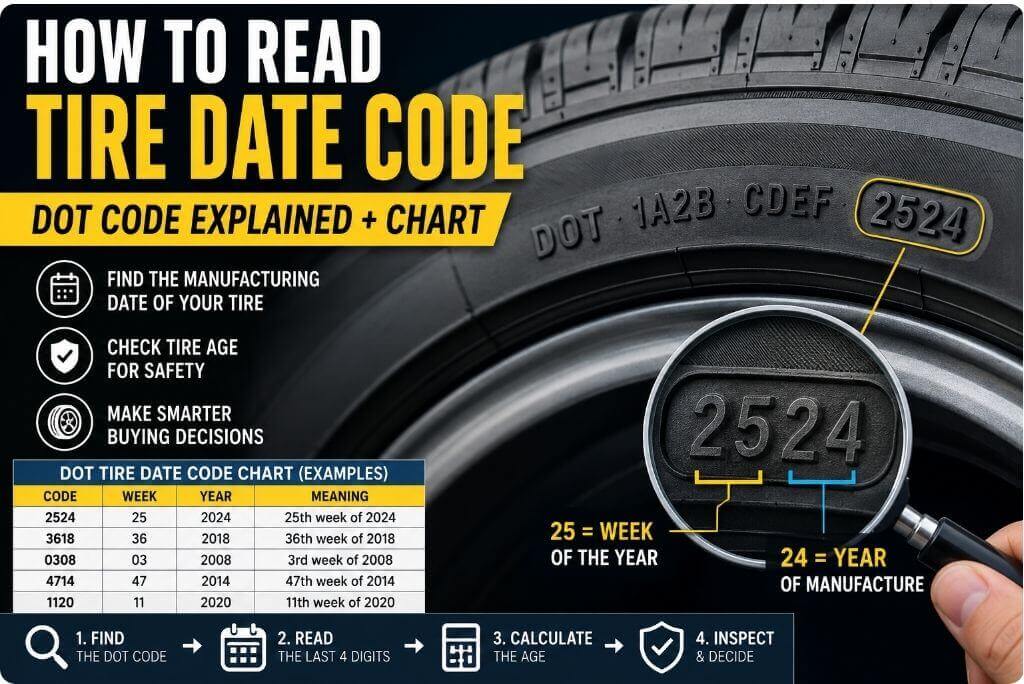
The first two digits show the week the tire was made, and the last two digits show the year. Knowing this makes it easy to check a tire’s age before buying it, using it, or deciding if it’s time to replace it.
Don’t confuse the DOT code with the tire size or other markings on the sidewall. They serve different purposes, and only the DOT date code tells you when the tire was manufactured.
Where to Find the DOT Date Code on the Tire
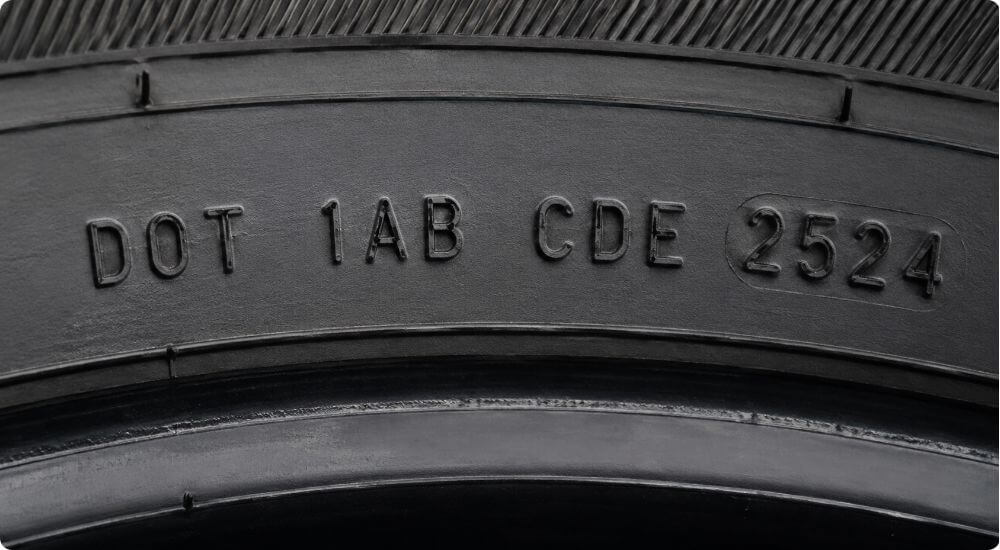
The DOT date code is printed on the tire’s sidewall, usually near the rim. Look for a group of letters and numbers that begins with “DOT.” This is the Tire Identification Number, and the date code is at the end of it.
If you can’t find the complete code, don’t assume it’s missing. On many tires, the full DOT code is printed on only one sidewall, while the other side may show only a shortened version.
If the code isn’t visible, slowly roll the vehicle forward or backward until you can see more of the tire. On some vehicles, you may need to turn the steering wheel or look behind the tire for a better view. A flashlight can also help if the sidewall is dirty or in shadow.
Once you’ve found the full DOT code, you’re ready to read the tire’s manufacturing date in the next section.
Visual cue: Look for the letters “DOT” molded into the tire’s sidewall, followed by a series of letters and numbers, such as DOT 1AB CDE 2524. The last four digits are the date code.
How to Read the Tire Date Code
The basic format
On modern tires, the last four digits of the DOT code tell you the manufacture week and year. The first two digits show the week of the year, and the last two digits show the year. For example, a code ending in 2524 means the tire was made in the 25th week of 2024. NHTSA gives the same basic example format with 0308, meaning the third week of 2008.
That means the code is not giving you the exact day the tire was built. It is giving you the production week and year, which is enough to estimate tire age accurately for practical use.
Example breakdowns
| DOT Date Code | Meaning |
| 2524 | Made in the 25th week of 2024 |
| 3618 | Made in the 36th week of 2018 |
| 0123 | Made in the 1st week of 2023 |
| 4921 | Made in the 49th week of 2021 |
The pattern is always the same for modern tires: week first, year second. Once you understand that, reading the code takes only a few seconds.
What older 3-digit codes mean
If the tire has a 3-digit date code, it is an older pre-2000 format. Bridgestone says a 3-digit week-and-year code means the tire was made before the year 2000 and should be replaced due to age. That is a strong sign that the tire is no longer appropriate for regular use, even if the tread still looks decent.
If you see a 3-digit code, treat it as a red flag. Even if the tire has been stored indoors, age still matters because rubber changes over time. In real life, that kind of tire should usually be replaced rather than “used up.”
Tire date Code Chart
Use the chart below to quickly understand what a DOT date code means. The first two digits represent the week, and the last two digits represent the year the tire was manufactured.
| DOT Date Code | Week | Year | Approximate Age (2026) | Meaning |
| 0126 | 1st Week | 2026 | New | Manufactured in the first week of 2026 |
| 1025 | 10th Week | 2025 | About 1 year | Manufactured in the tenth week of 2025 |
| 2524 | 25th Week | 2024 | About 2 years | Manufactured in the twenty-fifth week of 2024 |
| 4123 | 41st Week | 2023 | About 3 years | Manufactured in the forty-first week of 2023 |
| 1522 | 15th Week | 2022 | About 4 years | Manufactured in the fifteenth week of 2022 |
| 4921 | 49th Week | 2021 | About 5 years | Manufactured in the forty-ninth week of 2021 |
| 0820 | 8th Week | 2020 | About 6 years | Manufactured in the eighth week of 2020 |
| 3619 | 36th Week | 2019 | About 7 years | Manufactured in the thirty-sixth week of 2019 |
| 2418 | 24th Week | 2018 | About 8 years | Manufactured in the twenty-fourth week of 2018 |
| 0117 | 1st Week | 2017 | About 9 years | Manufactured in the first week of 2017 |
| 2616 | 26th Week | 2016 | About 10 years | Manufactured in the twenty-sixth week of 2016 |
| 5005 | 50th Week | 2005 | About 21 years | Very old tire—replace rather than use on the road |
| 237 (3-digit code) | 23rd Week | 1997* | Over 25 years | Pre-2000 date code. Extremely old and not recommended for normal road use. |
Note: The “Approximate Age” column is based on the current year (2026). If you’re reading this later, simply subtract the manufacture year from the current year to estimate the tire’s age.
How to Calculate Tire Age
Once you know the tire’s manufacture week and year, calculating its age is straightforward. Compare the manufacturing year with the current year to get the approximate age.
For example, if the date code shows 2524 and the current year is 2026, the tire is about 2 years old. If you want a more accurate estimate, also consider the manufacture week. A tire made late in the year will be slightly younger than one made early in the same year.
Always calculate a tire’s age from the date it was manufactured, not from the day you bought it or had it installed. A tire may have spent months—or even longer—in storage before it was sold.
Good storage can help slow down rubber aging, while heat, sunlight, and heavy use can speed it up. Even so, the manufacture date is still the best starting point when checking a tire’s age.
How Old Is Too Old?
There isn’t a single age at which every tire automatically becomes unsafe. How a tire is stored, driven, and maintained all affect how well it ages.
As a general rule, it’s a good idea to have tires inspected regularly once they are about 5 years old. Many tire manufacturers also recommend considering replacement when a tire reaches around 10 years from its manufacturing date, even if it still has usable tread.
Age is only one part of the picture. A well-maintained tire may be in better condition than a younger tire that has been exposed to heat, sunlight, or poor maintenance. That’s why the manufacturing date should always be considered alongside the tire’s overall condition.
Pay extra attention if you notice sidewall cracks, dry rot, bulges, deep cuts, or other visible damage. These are stronger warning signs than age alone and may mean the tire should be replaced sooner.
If you’re ever unsure about an older tire, especially before a long trip or when buying a used vehicle, a professional tire inspection is the safest way to confirm whether it’s still suitable for road use.
What to Check Besides the Date Code
The DOT date code tells you when a tire was made, but it doesn’t tell you whether the tire is still in good condition. Before deciding to keep or buy a tire, take a few minutes to inspect it carefully.
Check for these common warning signs:
| What to Check | Why It Matters |
| Tread depth | Worn tread reduces grip, especially on wet roads. |
| Sidewall cracks | Small cracks can be a sign that the rubber is aging and weakening. |
| Dry rot | Dry, brittle rubber is more likely to crack or fail. |
| Bulges or cuts | Bulges may indicate internal damage, while deep cuts can weaken the tire. |
| Uneven wear | Wear that’s heavier on one side or in patches may point to alignment, suspension, or inflation problems. |
| Previous repairs | Look for plugs or patches. A properly repaired puncture may be safe, but multiple or poorly repaired areas deserve extra caution. |
A tire with a recent manufacturing date can still be unsafe if it has visible damage. On the other hand, an older tire that has been well cared for may look better, but it should still be inspected carefully before you rely on it.
If you find more than one of these warning signs, it’s best to have the tire checked by a professional or replace it rather than take the risk.
Common Mistakes Readers Make
One common mistake is mixing up the manufacture date with the purchase date. A tire may have been sold recently but still be several years old.
Another easy mistake is checking only one side of the tire. On some tires, the full DOT code is printed on just one sidewall, so it helps to look at both sides before giving up.
People also misread the last four digits. It is worth slowing down and checking each number carefully, because one wrong digit changes the tire’s age completely.
If a tire has a 3-digit code, do not treat it like a modern date code. That usually means the tire is very old and should be looked at with extra caution.
Finally, do not assume good tread means the tire is safe. Rubber ages over time, even if the tire still looks usable from the outside.
What to Do After Reading the Code
Once you’ve worked out the tire’s age, use it as the starting point—not the final decision.
- If the tire is fairly new: Keep checking it during your regular maintenance. Make sure the tread, air pressure, and overall condition remain in good shape.
- If the tire is getting older: Inspect it more often for cracks, uneven wear, bulges, or other signs of aging. Older tires deserve closer attention, even if they still look usable.
- If the tire is very old, has visible damage, or the date code can’t be read: Don’t guess. Have it inspected by a qualified tire professional or replace it if its safety is in doubt.
When you’re unsure, it’s always safer to be cautious. A tire is one of the few parts of your vehicle that stays in constant contact with the road, so replacing a questionable tire is usually a better choice than risking a failure while driving.
Quick checklist for readers
Before you finish checking a tire, run through this simple list:
- Find the DOT code on the sidewall
- Read the last four digits
- Convert the week and year
- Check both sidewalls if needed
- Inspect tread, cracks, bulges, and wear
- Decide whether to keep, inspect, or replace the tire
This checklist keeps the process fast and practical. It also helps you avoid the most common mistake: trusting the tread alone and forgetting about age.
FAQs
1. What does the DOT date code on a tire mean?
It shows when the tire was made. The last four digits tell you the week and year of manufacture.
2. Can a tire be old even if it looks fine?
Yes. Tires can age inside and out, so good-looking tread does not always mean the tire is still safe.
3. Is the tire age based on when I bought it?
No. Tire age starts from the manufacture date, not the purchase date or install date.
4. What if the DOT code is hard to read?
If the code is unclear, have the tire checked by a professional. Do not guess on tire age.
5. Should I worry about a 3-digit tire date code?
Yes. A 3-digit code is very old and usually means the tire was made before 2000.
Conclusion
Reading a tire date code is simple once you know the pattern: the last four digits tell you the week and year the tire was made. From there, you can judge tire age, compare used tires, and spot when a tire deserves a closer look. The best rule is not to rely on the date code alone. Check the tire’s actual condition too, because age, cracks, wear, and damage all matter. NHTSA and major tire makers agree that older tires need more caution, and tires around ten years from manufacture should not be ignored.
