Lug Nut Size Chart: Thread Sizes, Socket Sizes & Vehicle Fitment
Finding the correct lug nut size is essential when replacing wheel fasteners, changing wheels, or installing aftermarket rims. The correct fastener must match your vehicle’s thread specification and the wheel’s seating design. A lug nut that looks similar to the original may still have incompatible threads, an incorrect seat, or insufficient clearance.
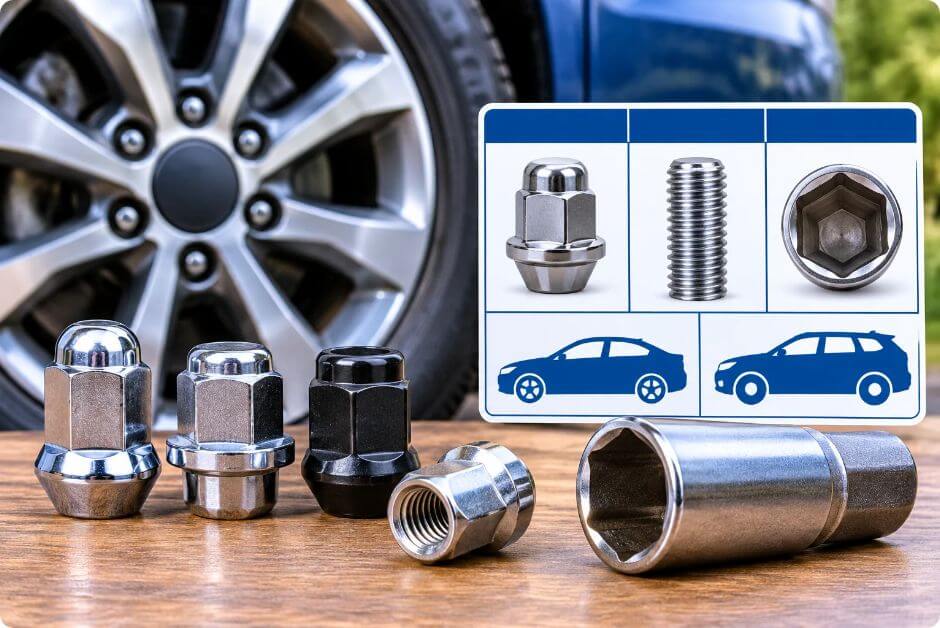
This lug nut size chart covers selected metric and SAE thread specifications, vehicle-specific applications, common socket sizes, and different wheel-fastener designs. It also explains how to measure lug nuts, identify the correct replacement hardware, and follow important installation requirements.
Use the charts to narrow down the correct specification for your application. Then confirm the complete fitment using your vehicle’s owner’s manual, OEM parts information, and wheel manufacturer’s instructions. Thread size alone does not guarantee that a replacement lug nut or bolt will fit correctly.
Quick Lug Nut Size Chart
Lug nut thread sizes are generally expressed using metric or SAE (imperial) measurements. Metric specifications identify the nominal thread diameter and pitch in millimeters. SAE specifications typically identify the nominal diameter in inches and the number of threads per inch (TPI).
Metric Lug Nut Thread Size Chart
| Thread Size | Nominal Diameter | Thread Pitch |
|---|---|---|
| M12 × 1.25 | 12 mm | 1.25 mm |
| M12 × 1.5 | 12 mm | 1.50 mm |
| M12 × 1.75 | 12 mm | 1.75 mm |
| M14 × 1.5 | 14 mm | 1.50 mm |
| M14 × 2.0 | 14 mm | 2.00 mm |
SAE / Imperial Lug Nut Thread Size Chart
| Thread Size | Nominal Diameter | Threads Per Inch |
|---|---|---|
| 7/16″-20 | 7/16 in (11.11 mm) | 20 TPI |
| 1/2″-20 | 1/2 in (12.70 mm) | 20 TPI |
| 9/16″-18 | 9/16 in (14.29 mm) | 18 TPI |
These are selected wheel-fastener specifications documented in the FMSI wheel nut manufacturer catalog. They are not a complete list of every available thread size or a universal vehicle fitment chart.
How to Read a Lug Nut Thread Size
A metric thread designation contains two measurements:
- First number: The nominal thread diameter in millimeters.
- Second number: The distance between adjacent thread crests, known as the thread pitch, in millimeters.
For example, M12 × 1.5 means a nominal diameter of 12 mm and a thread pitch of 1.5 mm.
An SAE designation uses a different format. For example, 1/2″-20 means a nominal diameter of 1/2 inch and 20 threads per inch.
Important: Thread Diameter and Pitch Must Both Match
Two fasteners can have the same nominal diameter but different thread pitches. For example, M12 × 1.25 and M12 × 1.5 are different thread specifications and are not interchangeable.
Similarly, 1/2″-20 is not the same as M12 × 1.5. Their nominal diameters and thread specifications differ, even though their measurements may appear relatively close.
Never force an unidentified lug nut onto a wheel stud or a lug bolt into a threaded hub.
Important: The correct thread size is only one part of wheel-fastener compatibility. You must also verify the fastener type, seating surface, hex dimension, length, and required thread engagement.
Lug Nut Size Chart by Vehicle Make, Model and Year
Lug nut and wheel bolt specifications vary by vehicle, model year, and hardware application. Some vehicles use M12 × 1.5 threads, while others require M12 × 1.25, M14 × 1.5, or different specifications.
The following chart includes selected applications supported by vehicle manufacturer documentation or replacement fastener manufacturer catalogs.
OEM specifications and replacement-part applications are identified separately.
OEM Lug Nut and Bolt Specifications
| Vehicle | Model Year | Thread Size | Fastener Type | Hex / Socket | Seat |
|---|---|---|---|---|---|
| Ford F-150 | 2025 | M14 × 1.5 | Wheel nut | Not specified | Not specified |
| Ram 1500 | 2026 | M14 × 1.50 | Nut/bolt per manual | 22 mm | Cone |
| Jeep Wrangler | 2025 | M14 × 1.50 | Nut/bolt per manual | 22 mm | Not specified |
The specifications come from the respective manufacturer manuals:
- Ford 2025 F-150 Owner’s Manual: M14 × 1.5 wheel fasteners.
- Ram 2026 1500 Owner’s Manual: M14 × 1.50, 22 mm socket and cone-type hardware.
- Jeep 2025 Wrangler Owner’s Manual: M14 × 1.50 and 22 mm socket.
These entries apply to the documented model years. The manuals do not establish every possible wheel package or replacement hardware configuration. In particular, the Ford manual’s cited wheel-fastener table does not specify a hex size or seat design.
Chevrolet and GMC: Selected GM Genuine Parts Applications
GM Genuine Parts catalog lists part number 19212925 as an M14 × 1.5-6H wheel lug nut.
The documented applications for this particular part include:
| Manufacturer | Vehicle | Model Years | Listed Applications |
|---|---|---|---|
| Chevrolet | Blazer | 2019–2022 | L, Premier, RS |
| Chevrolet | Colorado | 2015–2022 | WT, LT, Z71 |
| Chevrolet | Equinox | 2014–2015 | Catalog-listed applications |
| Chevrolet | Equinox EV | 2024–2025 | LT |
| Chevrolet | Silverado 1500 | 2014–2018 | Extended Cab Pickup |
| GMC | Acadia | 2020 | Denali, SL, SLE, SLT, AT4 |
| GMC | Canyon | 2015–2022 | Multiple listed trims |
| GMC | Sierra 1500 | 2014–2018 | Crew Cab and Extended Cab |
| GMC | Sierra 1500 Limited | 2019 | Catalog-listed application |
Sources:
These listings establish the thread designation and the specified vehicle applications. They do not establish a universal hex size or seating surface for every listed vehicle configuration.
Replacement Lug Nut Applications: Honda and Nissan
Replacement fastener manufacturers also publish vehicle-specific application information. These entries describe the fitment of the specified replacement products, not universal specifications for every factory or aftermarket wheel.
| Vehicle Application | Thread Size | Fastener | Hex Size | Replacement Part |
|---|---|---|---|---|
| Honda Civic (2016–2025) | M12 × 1.5 | Open-ended lug nut | 19 mm | Dorman 611-939 |
| Selected Nissan models | M12 × 1.25 | Lug nut | 21 mm | Dorman 611-210 |
Dorman’s Honda Civic replacement lug nut 611-939 is listed for 2016–2025 Civic applications. Its specifications include an M12 × 1.5 thread, a 19 mm hex and an open-ended design.
Dorman’s product listing contains inconsistent seat terminology, so the seat type is not presented here as a confirmed application specification. Verify the wheel’s actual seating surface before installation.
Dorman’s Nissan replacement lug nut 611-210 specifies M12 × 1.25 threads, a 21 mm hex, and a 60-degree conical seat.
Its listed Nissan applications include:
| Nissan Model | Listed Model Years |
|---|---|
| Altima | 2002–2012 |
| Frontier | 2005–2025 |
| NV200 | 2014–2015 |
| Pathfinder | 2007–2010 |
| Quest | 2004–2011 |
| Sentra | 2001–2013 |
| Titan | 2004–2015 and 2017–2024 |
| Xterra | 2005–2015 |
These model-year ranges apply to the specified replacement part. Verify the exact vehicle and wheel application before ordering.
Volkswagen EuroVan Wheel Bolt Application
Some vehicles use wheel bolts rather than the traditional stud-and-lug-nut arrangement.
Dorman part 610-535 is a replacement wheel bolt listed for selected Volkswagen EuroVan applications.
| Specification | Dorman 610-535 |
|---|---|
| Vehicle | Volkswagen EuroVan |
| Model Years | 1993–1997 and 1999–2004 |
| Fastener Type | Wheel bolt |
| Thread Size | M14 × 1.5 |
| Hex Size | 19 mm |
| Seat Type | Ball |
Source: Dorman Volkswagen EuroVan Wheel Bolt 610-535.
The published product title and detailed thread-length field are inconsistent, so no thread-length value is included here.
What If Your Vehicle Is Not Listed?
If your make and model are not included, check the owner’s manual, OEM parts catalog, or replacement fastener manufacturer’s application guide.
Do not select a lug nut based only on the vehicle brand or another model from the same manufacturer.
Also remember that lug nut specifications are different from wheel bolt patterns. A 5-lug bolt pattern chart helps identify the arrangement and diameter of the wheel’s mounting holes. It does not identify the lug nut’s thread diameter or pitch.
For a vehicle-specific example, see our Toyota Sienna bolt pattern chart by year.
Lug Nut Socket Size Chart
The correct lug nut socket size depends on the fastener’s external hex dimensions, not its thread diameter or pitch.
Common metric socket sizes include 17 mm, 19 mm, 21 mm, and 22 mm. However, the actual requirement depends on the particular fastener design.
Common Metric Lug Nut Socket Sizes
| Hex / Socket Size | Exact Inch Equivalent | Nearest Common SAE Fraction |
|---|---|---|
| 17 mm | 0.6693 in | 11/16 in |
| 19 mm | 0.7480 in | 3/4 in |
| 21 mm | 0.8268 in | 13/16 in |
| 22 mm | 0.8661 in | 7/8 in |
The inch measurements are calculated using 1 inch = 25.4 mm. The SAE fractions are approximate dimensional comparisons, not recommended socket substitutions.
A nearby SAE socket may have too much clearance or may not fit correctly. Whenever possible, use the exact socket size specified for the fastener.
Actual Lug Nut and Bolt Examples
| Hex Size | Documented Fastener Example | Thread |
|---|---|---|
| 17 mm | FMSI wheel nut product | M12 × 1.5 |
| 19 mm | Dorman Honda Civic replacement lug nut | M12 × 1.5 |
| 21 mm | Dorman Nissan replacement lug nut | M12 × 1.25 |
| 22 mm | Ram 1500 factory wheel fastener | M14 × 1.50 |
These are individual manufacturer product and vehicle examples. They do not establish a universal socket-size mapping for a thread specification.
Why Thread Size Does Not Determine Socket Size
A particular thread specification can be available with different hex dimensions.
For example, FMSI’s wheel hardware catalog lists M12 × 1.5 lug nuts with different hex sizes, including 19 mm and 21 mm. It also documents M14 × 1.5 products with multiple hex dimensions.
Therefore, always check the actual fastener or manufacturer’s product specification before choosing a socket.
Vehicle-Specific Socket Examples
| Vehicle | Model Year | Thread Specification | Socket Size |
|---|---|---|---|
| Jeep Wrangler | 2025 | M14 × 1.50 | 22 mm |
| Ram 1500 | 2026 | M14 × 1.50 | 22 mm |
| Tesla Model Y | Current US manual | Not stated in cited manual | 21 mm |
Tesla’s published Model Y manual provides the socket size but does not establish the thread designation in the cited instruction. Do not infer thread size from socket size.
For best results, use a correctly fitting six-point deep socket that fully engages the fastener.
Types of Lug Nuts and Seat Designs
Choosing the correct lug nut also requires matching its seating surface to the wheel.
The three principal seating designs are conical, ball or radius, and flat or mag/shank. Spline-drive is a separate drive style rather than a fourth seat type.
Conical or Tapered Seat Lug Nuts
Conical-seat lug nuts have an angled, cone-shaped seating surface that fits into a matching tapered recess in the wheel.
A 60-degree cone is a common design. However, the specified angle must be verified for the particular wheel.
Conical-seat fasteners are available in different forms, including standard acorn, bulge-acorn, open-ended and closed-ended designs.
Before choosing one, verify the thread specification, seat angle, fastener length, and wheel compatibility.
Never assume that every acorn-style lug nut fits every wheel.
Ball or Radius Seat Lug Nuts
Ball-seat fasteners have a rounded, spherical seating surface designed to match a curved recess in the wheel.
Manufacturers may identify seating radii with designations such as R12, R13, and R14.
These numbers describe the seating radius, not the thread diameter or pitch.
A matching thread specification does not automatically establish a matching seat radius. Always check the radius specified for the wheel and fastener application.
Flat, Mag, or Shank Seat Lug Nuts
Flat-seat lug nuts have a flat contact surface that rests against a corresponding flat area on the wheel.
Mag-style or shank-seat fasteners commonly include a cylindrical shank and a washer. The shank passes through the wheel’s mounting hole, while the washer provides the seating contact.
Important dimensions include:
- Shank diameter.
- Shank length.
- Washer dimensions.
- Overall fastener length.
- Correct thread engagement.
A shank that is too long may bottom out against the hub assembly before the washer properly contacts the wheel. A shank that is too short may not provide the intended fit.
Spline-Drive Lug Nuts
Spline-drive lug nuts feature narrow external grooves or splines that require a matching installation key.
They are useful for certain aftermarket wheels with narrow lug-hole pockets or special installation requirements.
However, spline-drive describes the drive interface, not the seating surface. A spline-drive lug nut must still have the correct conical or other specified seat for the wheel.
Lug Nut Seat Compatibility Chart
| Wheel Seat | Required Fastener | Additional Requirement |
|---|---|---|
| Conical / Tapered | Matching conical seat | Correct angle |
| Ball / Radius | Matching spherical seat | Exact radius |
| Flat / Mag | Matching flat-seat fastener | Washer and shank dimensions |
| Shank Style | Matching shank design | Correct shank diameter and length |
Using a fastener with the wrong seating surface can prevent proper wheel contact and clamping.
For aftermarket wheel examples, see American Racing’s lug nut compatibility guidance.
Lug Nuts vs. Lug Bolts: What’s the Difference?
Lug nuts and lug bolts perform the same basic job: securing the wheel to the vehicle hub. However, their mounting arrangements are different.
Lug Nut System
In a lug nut system, threaded wheel studs are attached to the hub assembly.
The wheel is positioned over the studs, and separate lug nuts thread onto them to secure the wheel.
Studs also help align and support the wheel during installation.
Lug Bolt System
In a lug bolt system, the hub contains threaded mounting holes. Each bolt passes through the wheel and screws directly into the hub.
There are no separate protruding wheel studs in this arrangement.
The installer must align the wheel holes with the threaded hub holes before starting the bolts.
Lug Nuts vs. Lug Bolts Comparison
| Feature | Lug Nuts | Lug Bolts |
|---|---|---|
| Main fastener | Lug nut | Lug bolt |
| Hub arrangement | Protruding wheel studs | Threaded hub holes |
| Installation | Nut threads onto stud | Bolt threads into hub |
| Separate wheel studs | Required | Not required |
| Wheel alignment | Studs assist alignment | Wheel holes must align with hub |
| Important fitment checks | Thread, seat and nut engagement | Thread, seat, bolt length and hub engagement |
Both systems must use fasteners that match the vehicle and wheel manufacturer’s specifications.
One-Piece and Two-Piece Wheel Bolts
Some wheel bolts have a one-piece construction. Others use a separate floating or free-spinning seating washer.
The washer is part of the specific fastener assembly and should not be treated as an ordinary interchangeable washer.
Check the vehicle or fastener manufacturer’s part specification before replacing one design with another.
Thread Engagement Requirements
Lug nuts and lug bolts use different thread-engagement checks.
McGard recommends minimum nut engagement equal to the nominal diameter of the wheel stud. For example, its guidance specifies at least 12 mm of engagement for an M12 stud.
For its applicable lug bolt installations, McGard specifies at least 5½ complete revolutions into the hub assembly.
These are McGard’s published installation criteria. Follow the exact vehicle and fastener manufacturer’s requirements for your application.
How to Identify and Measure Lug Nut Size
Measuring a wheel fastener can help identify its specifications, but one measurement alone is not enough.
You need to check the thread diameter, pitch, hex size, seating surface, and relevant length dimensions.
Tools Needed
| Tool | Purpose |
|---|---|
| Digital caliper | External thread diameter, hex and shank measurements |
| Metric/SAE pitch gauge | Thread pitch or TPI identification |
| Thread plug gauge | Checking an internal thread |
| Correct six-point socket | Confirming hex fit |
| OEM or wheel manufacturer’s drawing | Confirming seat and full application |
How to Measure External Thread Diameter
- Clean an accessible, undamaged threaded section.
- Place the caliper jaws across opposite thread crests.
- Keep the caliper perpendicular to the fastener axis.
- Record the approximate outside diameter.
- Compare the reading with the vehicle’s documented thread specification.
The measured diameter may differ slightly from the nominal designation because of manufacturing tolerances, coatings, or wear.
Note: An ordinary external caliper measurement of a lug nut’s internal opening does not reliably establish its nominal thread diameter. Use the OEM specification or an appropriate thread gauge.
How to Measure Thread Pitch
Thread pitch is the distance between adjacent thread crests.
For metric threads, use a metric pitch gauge. For SAE threads, use an inch-based gauge marked in TPI.
- Select a suitable gauge blade.
- Place it along the external thread.
- Check that its teeth align with the thread grooves.
- Look for gaps or mismatched teeth.
- Try another blade if necessary.
- Record the marking of the blade that fits correctly.
Always check thread diameter and pitch together.
How to Measure Hex Size
Measure across two opposing flat sides of the fastener head using a digital caliper.
Do not measure across the corners of the hex.
The result identifies the external hex dimension and helps establish the correct socket size.
How to Identify Seat Type
Inspect the original fastener and the wheel’s mating surface.
| Seat | What to Identify |
|---|---|
| Conical | Matching tapered profile and specified angle |
| Ball / Radius | Matching rounded profile and radius |
| Flat / Mag | Flat surface, washer and shank design |
A caliper alone cannot accurately establish every seating angle or spherical radius. Use the wheel manufacturer’s specification or appropriate profile-measuring equipment when necessary.
How to Measure Lug Bolt Length
For lug bolts, check:
- Overall bolt length.
- Thread length.
- Shank length.
- Shank diameter.
- Seating surface.
Some one-piece and floating-seat fasteners use different shank-length measurement reference points. Follow the particular manufacturer’s technical drawing instead of measuring from an arbitrary point.
Complete Lug Nut Identification Checklist
| Measurement or Requirement | What to Confirm |
|---|---|
| Vehicle | Make, model, year and trim |
| Fastener system | Lug nut or lug bolt |
| Thread diameter | Correct nominal diameter |
| Thread pitch | Correct metric pitch or SAE TPI |
| Hex dimension | Correct socket size |
| Seat | Cone, ball, flat or shank |
| Length | Correct overall or shank length |
| Engagement | Manufacturer’s specified minimum |
| Wheel | Factory or aftermarket requirements |
Never force an unidentified fastener onto a stud or into a threaded hub to test compatibility.
How to Choose the Correct Lug Nuts for Your Wheels
The correct replacement fastener must match both the vehicle’s mounting system and the wheel’s requirements.
Factory / OEM Wheels
When replacing factory lug nuts or bolts, begin with the owner’s manual and OEM parts information.
Check the exact model year, trim, fastener type, thread size, seat, hex dimensions and length.
Different models from the same manufacturer may use different wheel hardware. Factory wheels may also have different requirements from the vehicle’s spare wheel.
Aftermarket Wheels
Aftermarket wheels may require different hardware from the original equipment wheels.
Some aftermarket wheels specify 60-degree conical-seat lug nuts, while others allow particular OEM hardware to be reused.
Before installation, verify:
- Vehicle thread diameter and pitch.
- Wheel manufacturer’s specified seat.
- Required nut or bolt style.
- Fastener length and shank dimensions.
- Hex or special installation-key requirement.
- Clearance around wheel holes and center caps.
Do not assume that factory lug nuts will fit every aftermarket wheel.
Open-End vs. Closed-End Lug Nuts
Open-ended lug nuts have a through-hole, while closed-end lug nuts have an enclosed top.
Open-ended designs may be needed for longer studs or certain wheel-cap arrangements. Closed-end nuts must have sufficient internal depth to avoid bottoming out before properly seating against the wheel.
| Feature | Open-End | Closed-End |
|---|---|---|
| Top design | Open | Enclosed |
| Longer studs | Can accommodate longer studs when specified | Must have sufficient internal clearance |
| Main check | Thread engagement | Internal depth and bottoming clearance |
Extended-Shank / ET Lug Nuts
Some wheels use extended-shank or ET-style fasteners with a cylindrical extension below the seating surface.
Certain Toyota and Lexus wheel applications use this design, but it should not be assumed for every model.
Verify the shank length, diameter, seat, and thread specification for the exact wheel application.
Spline-Drive and Tuner-Style Lug Nuts
Spline-drive fasteners require a matching external spline key. Tuner-style fasteners commonly use an internal-drive key.
These designs can be useful for wheels with narrow installation pockets, but the seat must still match the wheel’s requirements.
Wheel Locks
Wheel locks are specialized lug nuts or bolts that require a matching key or adapter.
Verify their thread specification, seating surface, length, and key compatibility. Keep the key in the vehicle so the hardware can be removed during a roadside tire change.
Spare Wheel Compatibility
Road wheels and spare wheels may use different mounting arrangements.
For example, a vehicle may have aluminum alloy road wheels and a steel spare wheel. Their seating surfaces and fastener requirements should not automatically be assumed to be the same.
Check the spare wheel’s hardware requirements and retain the correct original equipment fasteners in the vehicle.
Wheel Spacers and Modified Vehicles
Wheel spacers, adapters and modified hub assemblies can change fastener requirements.
Check the spacer manufacturer’s instructions, required fastener length, thread engagement, wheel-seat compatibility and component clearance.
Do not substitute a generic longer lug nut or bolt for an approved spacer installation kit.
Complete Lug Nut Selection Checklist
| Requirement | What to Verify |
|---|---|
| Vehicle application | Exact make, model, year and trim |
| Fastener type | Lug nut or lug bolt |
| Thread | Diameter and pitch |
| Seat design | Cone, ball, flat or shank |
| Hex size | Correct socket dimension |
| Fastener style | Standard, open, closed, spline or locking |
| Length | Correct overall and shank dimensions |
| Washer | Correct type and contact, where applicable |
| Engagement | Required thread engagement |
| Wheel compatibility | OEM or aftermarket wheel requirements |
| Spare wheel | Separate hardware compatibility |
| Installation | Manufacturer’s torque and procedure |
For additional wheel-fitment information, see our Wheel Offset Chart. Wheel offset affects the wheel’s position relative to the hub and vehicle, but it does not determine lug nut thread size or seat type.
Lug Nut Torque and Installation Safety
Correct wheel-fastener torque helps create the clamping force needed to secure the wheel against the hub.
Under-tightening can result in insufficient clamping, while over-tightening can damage threads, stretch studs, or affect other wheel and brake components.
There is no universal lug nut torque specification. Always use the value specified for the exact vehicle and hardware application.
Vehicle-Specific Lug Nut Torque Examples
| Vehicle Application | Model Year | Specified Torque |
|---|---|---|
| Ford F-150 | 2025 | 150 lb-ft (204 N·m) |
| Ram 1500 | 2026 | 130 lb-ft (176 N·m) |
| Jeep Wrangler | 2025 | 130 lb-ft (176 N·m) |
| Honda Civic Sedan | 2025 | 80 lb-ft (108 N·m) |
| Honda Civic Hatchback (CVT) | 2025 | 80 lb-ft (108 N·m) |
| Honda Civic Hatchback (Manual) | 2025 | 94 lb-ft (127 N·m) |
| Chevrolet Silverado 1500 | 2025 | 140 lb-ft (190 N·m) |
These figures are documented in the respective vehicle manuals and apply to their stated configurations and factory wheel applications.
Sources: Ford 2025 F-150 manual, Ram 2026 1500 manual, Jeep 2025 Wrangler manual, Honda 2025 Civic Sedan manual, Honda 2025 Civic Hatchback manual, and the 2025 Chevrolet Silverado 1500 owner’s manual.
These torque specifications are not interchangeable between vehicles, body styles, or wheel applications.
Use a Calibrated Torque Wrench
Use an appropriately calibrated torque wrench for final tightening.
- Find the correct specification in the owner’s manual.
- Confirm the required measurement unit.
- Select the correct six-point socket.
- Set the wrench to the specified torque.
- Start the fasteners by hand.
- Tighten progressively using the manufacturer’s specified pattern.
- Complete final tightening using the calibrated torque wrench.
An impact wrench should not replace a calibrated torque wrench for final tightening unless the applicable manufacturer’s procedure specifically permits a controlled method.
Clean and Inspect the Mounting Surfaces
Before installation, inspect the wheel and hub mounting surfaces.
Remove loose dirt, corrosion and foreign material according to the vehicle manufacturer’s service instructions.
Check the wheel mounting face, hub surface, pilot bore, fastener threads and seating surfaces.
The Ford and Ram manuals warn that contamination or incorrect metal-to-metal contact can contribute to loose wheel fasteners and unsafe wheel mounting.
Dry Threads and Lubrication
Do not assume that wheel-stud or lug-bolt threads should be lubricated.
Manufacturer instructions differ by application. For example, the 2026 Ram 1500 manual instructs users not to oil wheel studs. McGard also advises against oil, grease or anti-seize on its specified wheel-fastener threads.
Follow the exact vehicle and replacement hardware manufacturer’s instructions. Never apply a torque specification intended for one thread condition to a differently lubricated fastener without an approved procedure.
Follow the Correct Tightening Sequence
Many vehicles use a progressive star or crisscross pattern to distribute clamping pressure across the wheel.
The correct numbered sequence depends on the number and arrangement of fasteners.
Start every fastener by hand, tighten progressively using the manufacturer’s illustrated pattern, and apply final torque according to the owner’s manual.
Do not assume that one universal numbered sequence applies to every four-, five-, six-, or eight-lug wheel.
When Should Lug Nuts Be Re-Torqued?
Re-torque instructions depend on the vehicle and hardware manufacturer.
Examples include:
| Source | Published Instruction |
|---|---|
| 2025 Ford F-150 owner’s manual | Retighten within 100 miles (160 km) after wheel disturbance |
| 2026 Ram 1500 owner’s manual | Check after 25 miles (40 km) |
| McGard installation instructions | Re-torque its applicable lug nuts after 25 miles |
These are separate manufacturer instructions, not a universal mileage schedule.
Follow the interval specified for your exact vehicle and wheel hardware.
Frequently Asked Questions About Lug Nut Sizes
What Is the Most Common Lug Nut Size?
There is no single lug nut thread specification that fits most or all vehicles. Common cataloged sizes include M12 × 1.25, M12 × 1.5, M12 × 1.75, M14 × 1.5, 1/2″-20 and 9/16″-18.
The correct size depends on the vehicle and wheel application.
How Do I Know What Size Lug Nuts My Car Needs?
Check the owner’s manual or OEM parts catalog for the specified fastener. Confirm the vehicle’s thread diameter, pitch, nut or bolt type, seat design and hex size. For aftermarket wheels, also follow the wheel manufacturer’s hardware instructions.
Are Lug Nuts Universal?
No. Lug nuts differ in thread specifications, seating surfaces, length, hex dimensions and design. A fastener with the correct thread can still be incompatible with the wheel.
Are M12 × 1.5 and M12 × 1.25 Interchangeable?
No. Both have a 12 mm nominal diameter, but their thread pitches differ. Using the wrong pitch can damage the stud or fastener.
Is 1/2″-20 the Same as M12 × 1.5?
No. A 1/2″-20 thread has a nominal diameter of 12.7 mm and 20 threads per inch. M12 × 1.5 has a nominal diameter of 12 mm and a 1.5 mm pitch. They are not interchangeable.
Does Lug Nut Thread Size Determine Socket Size?
No. Thread size identifies the diameter and pitch of the threaded portion. Socket size identifies the fastener’s external hex dimension. Always check the actual fastener specification.
What Size Socket Do Most Lug Nuts Use?
Common metric socket sizes include 17 mm, 19 mm, 21 mm and 22 mm. Some applications use SAE sockets. Verify the exact dimension for your fastener rather than assuming a universal socket size.
Can I Use Factory Lug Nuts on Aftermarket Wheels?
Only when the wheel manufacturer permits reuse of the original hardware. Aftermarket wheels may require a different seat, shank, length or fastener style.
What Is the Difference Between Lug Nuts and Lug Bolts?
Lug nuts thread onto wheel studs attached to the hub. Lug bolts pass through the wheel and thread directly into the hub. The two systems have different installation and fitment requirements.
Can I Drive With a Missing Lug Nut?
Driving with a missing wheel fastener is not recommended because it can compromise wheel retention. Stop normal driving, arrange safe assistance, and have the wheel, studs or hub threads, and remaining fasteners inspected before the vehicle returns to service.
How Much Thread Engagement Should a Lug Nut Have?
McGard recommends minimum lug nut engagement equal to the nominal diameter of the wheel stud. For an M12 stud, its guidance specifies at least 12 mm of engagement. McGard gives a separate minimum of 5½ complete turns for its applicable lug bolt installations.
Follow the exact vehicle and fastener manufacturer’s requirements.
How Often Should Lug Nuts Be Re-Torqued?
Follow the vehicle and wheel manufacturer’s instructions. Published examples include a check after 25 miles for the 2026 Ram 1500 and a retightening requirement within 100 miles after wheel disturbance for the 2025 Ford F-150. These intervals are not universal.
After a wheel installation or service, always check the applicable instructions and use the specified torque with an appropriate calibrated torque wrench.
Conclusion
Choosing the correct lug nut size involves more than matching a thread diameter. You also need to verify the thread pitch, fastener type, seating surface, hex size, and required length for your specific vehicle and wheel application.
Use this lug nut size chart and the vehicle-specific references to narrow down the correct hardware. Then confirm the complete specification through your owner’s manual, OEM parts information, and wheel manufacturer’s instructions.
For aftermarket wheels, never assume that factory lug nuts or bolts will automatically fit. Before installation, check thread engagement, confirm that the seating surfaces match, and use the manufacturer’s specified torque with a calibrated torque wrench.
The safest choice is always the fastener that matches both your vehicle’s mounting system and your wheel’s specified requirements.
How We Verified Lug Nut Specifications
This guide uses vehicle manufacturer owner’s manuals, OEM parts catalog listings, and established wheel hardware manufacturers’ product specifications to document lug nut and wheel bolt information.
OEM specifications and replacement-part applications are identified separately because a replacement product listing does not necessarily establish universal fitment for every factory or aftermarket wheel.
We do not assume missing thread, hex, seat, or torque specifications. Where manufacturer documentation is incomplete or inconsistent, the affected detail is identified as unverified rather than presented as a confirmed vehicle specification.
Always confirm replacement hardware using the exact vehicle and wheel manufacturer’s instructions before installation.
