Tire Pressure Conversion Chart: PSI to Bar to kPa Explained
If you have ever looked at a tire gauge, an air compressor, or a vehicle manual and seen different pressure units, you are not alone. Some tools show PSI, some use Bar, and others use kPa. That can be confusing at first, especially when you just want to make sure your tires are inflated correctly.
This tire pressure conversion chart makes the process simple. It helps you convert tire pressure quickly, understand what each unit means, and avoid common mistakes when checking or adjusting tire pressure. Whether you drive a car, truck, motorcycle, RV, or trailer, knowing how to convert pressure units can save time and prevent errors.
What Is Tire Pressure Conversion?
Tire pressure conversion means changing a pressure reading from one unit to another without changing the actual air pressure inside the tire. The three units you’ll see most often are PSI (pounds per square inch), Bar, and kPa (kilopascals).
Different countries, vehicle manufacturers, and tire gauges use different pressure units. For example, many vehicles sold in the United States list tire pressure in PSI, while some European vehicles use Bar, and many modern manuals also include kPa.
This can be confusing if your owner’s manual, dashboard, and tire gauge don’t use the same unit. A tire pressure conversion chart lets you compare these measurements quickly, so you can inflate your tires accurately without doing the math yourself.
The conversion only changes how the pressure is displayed—it does not change the correct tire pressure for your vehicle. Always use the pressure recommended on your vehicle’s tire information placard or in the owner’s manual, then convert it only if your air gauge uses a different unit.
Tire Pressure Units Explained
The air inside a tire can be measured in different units. They all describe the same pressure, but the numbers look different depending on the unit used.
PSI (Pounds per Square Inch)
PSI is the most common tire pressure unit in the United States. If you drive a car, SUV, or pickup in the U.S., your vehicle’s tire pressure label and most air gauges will likely use PSI.
PSI is easy to recognize because the numbers are small and familiar. For example, many passenger vehicles recommend a tire pressure between 30 and 35 PSI.
Bar
Bar is commonly used in many European countries and on some imported vehicles. Some air compressors and digital tire gauges let you switch between PSI and Bar.
Since Bar uses smaller numbers than kPa but larger values than PSI, it can seem unfamiliar at first. A quick conversion chart makes it easy to compare the two.
kPa (Kilopascals)
kPa is part of the metric system and is widely used in countries such as Canada, Australia, and many parts of Asia. You’ll also find kPa listed in many modern owner’s manuals alongside PSI.
The numbers are higher than PSI, which can surprise first-time users. For example, 35 PSI equals about 241 kPa, even though the tire pressure itself is exactly the same.
Tire Pressure Conversion Chart
Use this chart to quickly convert the most common tire pressure readings between PSI, Bar, and kPa. The pressure stays the same — only the unit changes.
| PSI | Bar | kPa |
| 1 | 0.069 | 6.9 |
| 2 | 0.138 | 13.8 |
| 3 | 0.207 | 20.7 |
| 4 | 0.276 | 27.6 |
| 5 | 0.345 | 34.5 |
| 6 | 0.414 | 41.4 |
| 7 | 0.483 | 48.3 |
| 8 | 0.552 | 55.2 |
| 9 | 0.621 | 62.1 |
| 10 | 0.690 | 69.0 |
| 11 | 0.759 | 75.9 |
| 12 | 0.827 | 82.7 |
| 13 | 0.896 | 89.6 |
| 14 | 0.965 | 96.5 |
| 15 | 1.034 | 103.4 |
| 16 | 1.103 | 110.3 |
| 17 | 1.172 | 117.2 |
| 18 | 1.241 | 124.1 |
| 19 | 1.310 | 131.0 |
| 20 | 1.379 | 137.9 |
| 21 | 1.448 | 144.8 |
| 22 | 1.517 | 151.7 |
| 23 | 1.586 | 158.6 |
| 24 | 1.655 | 165.5 |
| 25 | 1.724 | 172.4 |
| 26 | 1.793 | 179.3 |
| 27 | 1.862 | 186.2 |
| 28 | 1.931 | 193.1 |
| 29 | 2.000 | 200.0 |
| 30 | 2.069 | 206.8 |
| 31 | 2.138 | 213.8 |
| 32 | 2.207 | 220.6 |
| 33 | 2.276 | 227.5 |
| 34 | 2.345 | 234.4 |
| 35 | 2.414 | 241.3 |
| 36 | 2.483 | 248.2 |
| 37 | 2.552 | 255.1 |
| 38 | 2.620 | 262.0 |
| 39 | 2.689 | 268.9 |
| 40 | 2.759 | 275.8 |
| 41 | 2.828 | 282.7 |
| 42 | 2.897 | 289.6 |
| 43 | 2.966 | 296.5 |
| 44 | 3.035 | 303.4 |
| 45 | 3.104 | 310.3 |
| 46 | 3.173 | 317.2 |
| 47 | 3.242 | 324.1 |
| 48 | 3.311 | 331.0 |
| 49 | 3.380 | 337.9 |
| 50 | 3.447 | 344.7 |
| 51 | 3.516 | 351.6 |
| 52 | 3.586 | 358.5 |
| 53 | 3.655 | 365.4 |
| 54 | 3.724 | 372.3 |
| 55 | 3.793 | 379.2 |
| 56 | 3.862 | 386.1 |
| 57 | 3.931 | 393.0 |
| 58 | 4.000 | 399.9 |
| 59 | 4.069 | 406.8 |
| 60 | 4.137 | 413.7 |
| 61 | 4.206 | 420.6 |
| 62 | 4.275 | 427.5 |
| 63 | 4.344 | 434.4 |
| 64 | 4.413 | 441.3 |
| 65 | 4.482 | 448.2 |
| 66 | 4.551 | 455.1 |
| 67 | 4.620 | 462.0 |
| 68 | 4.689 | 468.9 |
| 69 | 4.758 | 475.8 |
| 70 | 4.827 | 482.7 |
| 71 | 4.896 | 489.6 |
| 72 | 4.965 | 496.5 |
| 73 | 5.034 | 503.4 |
| 74 | 5.103 | 510.3 |
| 75 | 5.172 | 517.1 |
| 76 | 5.241 | 524.0 |
| 77 | 5.310 | 530.9 |
| 78 | 5.379 | 537.8 |
| 79 | 5.448 | 544.7 |
| 80 | 5.516 | 551.6 |
| 81 | 5.585 | 558.5 |
| 82 | 5.655 | 565.4 |
| 83 | 5.724 | 572.3 |
| 84 | 5.793 | 579.2 |
| 85 | 5.862 | 586.1 |
| 86 | 5.931 | 593.0 |
| 87 | 6.000 | 599.9 |
| 88 | 6.069 | 606.8 |
| 89 | 6.138 | 613.7 |
| 90 | 6.206 | 620.6 |
| 91 | 6.275 | 627.5 |
| 92 | 6.344 | 634.4 |
| 93 | 6.413 | 641.3 |
| 94 | 6.482 | 648.2 |
| 95 | 6.551 | 655.1 |
| 96 | 6.620 | 662.0 |
| 97 | 6.689 | 668.9 |
| 98 | 6.758 | 675.8 |
| 99 | 6.827 | 682.7 |
| 100 | 6.895 | 689.5 |
| 101 | 6.964 | 696.4 |
| 102 | 7.033 | 703.3 |
| 103 | 7.102 | 710.2 |
| 104 | 7.171 | 717.1 |
| 105 | 7.240 | 724.0 |
| 106 | 7.309 | 730.9 |
| 107 | 7.378 | 737.8 |
| 108 | 7.447 | 744.7 |
| 109 | 7.516 | 751.6 |
| 110 | 7.585 | 758.5 |
| 111 | 7.654 | 765.4 |
| 112 | 7.723 | 772.3 |
| 113 | 7.792 | 779.2 |
| 114 | 7.861 | 786.1 |
| 115 | 7.930 | 793.0 |
| 116 | 7.998 | 799.8 |
| 117 | 8.067 | 806.7 |
| 118 | 8.136 | 813.6 |
| 119 | 8.205 | 820.5 |
| 120 | 8.274 | 827.4 |
A quick way to remember the basics is this: PSI is the most common unit in the U.S., Bar is common internationally, and kPa is often used in technical or factory specifications.
If you are looking for a specific tire pressure, this chart gives you a fast starting point without having to do the math yourself.
How to Convert Tire Pressure Manually
You don’t always need a conversion chart or calculator. If you know the basic formulas, you can convert tire pressure between PSI, Bar, and kPa in just a few seconds.
The formulas below are based on standard pressure conversions used by vehicle manufacturers and tire pressure gauges.
- PSI to Bar: Multiply PSI by 0.06895
- Bar to PSI: Multiply Bar by 14.5038
- PSI to kPa: Multiply PSI by 6.8948
- kPa to PSI: Divide kPa by 6.8948
For example, if your vehicle recommends 35 PSI but your air compressor displays Bar, multiply 35 × 0.06895. The result is about 2.41 Bar.
If your tire gauge uses kPa, multiply 35 × 6.8948. The result is about 241 kPa.
These formulas give accurate results, but doing the math isn’t always convenient when you’re at a gas station or using a portable air pump. That’s why many drivers prefer using a tire pressure conversion chart for quick reference and to reduce the chance of calculation mistakes.
Common Tire Pressure Conversions
Most passenger cars recommend tire pressures between 30 and 35 PSI, while some SUVs, trucks, and vehicles carrying heavier loads may require 40 PSI or more. If your air gauge uses a different unit, these quick conversions can help you set the correct pressure without doing the math.
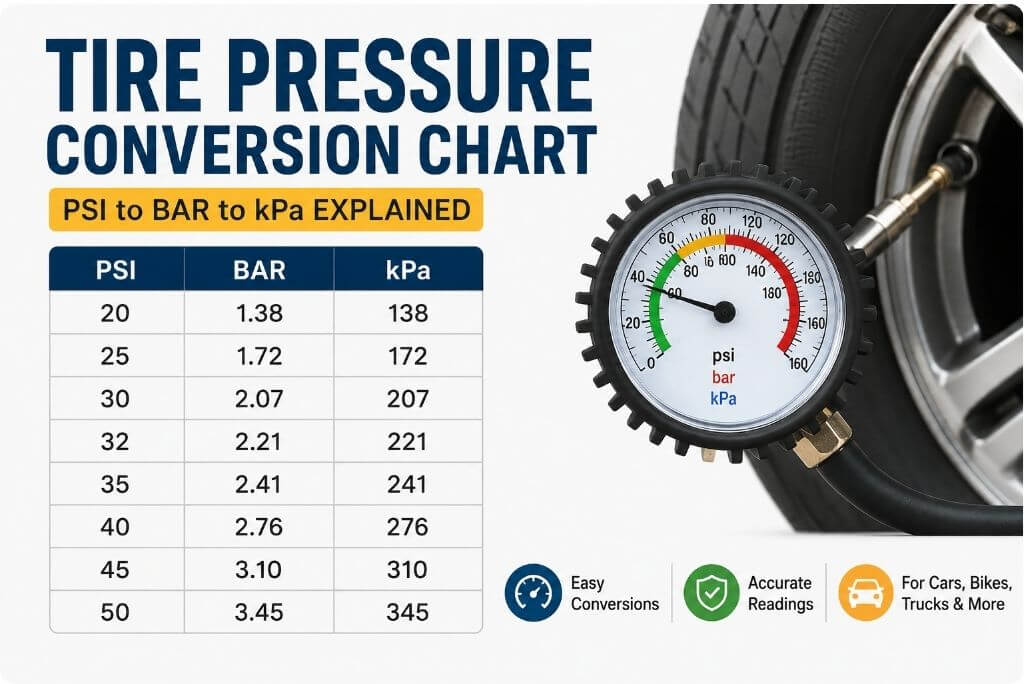
| PSI | Bar | kPa |
| 30 | 2.07 | 206.8 |
| 32 | 2.21 | 220.6 |
| 35 | 2.41 | 241.3 |
| 40 | 2.76 | 275.8 |
| 50 | 3.45 | 344.7 |
Here are a few examples of when you might use these values:
- 30 PSI = 2.07 Bar = 206.8 kPa – A common recommendation for many compact cars and sedans.
- 32 PSI = 2.21 Bar = 220.6 kPa – One of the most common factory tire pressures for passenger vehicles.
- 35 PSI = 2.41 Bar = 241.3 kPa – Frequently recommended for midsize cars, crossovers, and SUVs.
- 40 PSI = 2.76 Bar = 275.8 kPa – Often used for some SUVs, light trucks, or vehicles carrying heavier loads.
- 50 PSI = 3.45 Bar = 344.7 kPa – Common on certain commercial tires, trailer tires, or heavy-duty applications. Always confirm this value against your vehicle or trailer manufacturer’s recommendation.
These are reference conversions only. The correct tire pressure depends on your specific vehicle and tire size, so always follow the pressure listed on the driver’s door placard or in the owner’s manual rather than choosing a pressure based on a conversion table alone.
Which Tire Pressure Unit Should You Use?
The best tire pressure unit is the one that matches your vehicle’s recommended pressure or the air gauge you’re using. PSI, Bar, and kPa all measure the same tire pressure—they simply display it in different numbers.
In the United States, PSI is the standard unit you’ll see on most vehicles, tire gauges, and air compressors. If your vehicle was built for the U.S. market, you’ll usually work with PSI.
Bar is more common in many European countries and on some imported vehicles. Some digital tire inflators let you switch between PSI and Bar, making it easy to use either one.
kPa is widely used in countries that follow the metric system, including Canada, Australia, and many parts of Asia. Many modern owner’s manuals list both PSI and kPa, so drivers can use whichever unit their gauge displays.
If your vehicle’s recommended pressure and your tire gauge use different units, you don’t need to guess or change the pressure target. Simply convert the value or use a tire pressure conversion chart to find the matching number. The pressure stays the same—the unit is the only thing that changes.
Common Mistakes to Avoid
A small mistake when checking tire pressure can lead to inaccurate readings or improper inflation. Keeping these points in mind will help you avoid the most common problems.
- Using the tire sidewall pressure as your target: The number on the tire sidewall is the maximum pressure the tire can safely hold, not the recommended pressure for everyday driving. Always follow the pressure shown on your vehicle’s door placard or in the owner’s manual.
- Rounding too much: Small differences are usually fine, but rounding a value too far can leave your tires slightly overinflated or underinflated. Use the closest conversion value whenever possible.
- Mixing pressure units: Make sure your tire gauge and the pressure recommendation use the same unit. For example, don’t mistake 35 PSI for 35 kPa—they are very different values.
- Checking pressure after driving: Tire pressure increases as tires warm up. For the most accurate reading, check and adjust tire pressure when the tires are cold, such as before your first drive of the day.
Taking a few extra seconds to confirm the correct unit and pressure can help improve tire wear, handling, and fuel efficiency while reducing the chance of avoidable mistakes.
How to Check Tire Pressure Correctly
Checking your tire pressure only takes a few minutes, but doing it the right way gives the most accurate results.
- Check the tires when they are cold. Measure the pressure before driving or after the vehicle has been parked for at least three hours. Warm tires can give a higher reading.
- Find the recommended tire pressure. Look at the sticker on the driver’s side door jamb or check your owner’s manual. Use this recommended pressure instead of the number printed on the tire sidewall.
- Match the pressure unit. Compare your tire gauge with the recommended value. If they use different units, use a tire pressure conversion chart to find the correct equivalent.
- Adjust the pressure slowly. Add or release air in small amounts, then check the pressure again. Repeat until the gauge matches the recommended value.
- Replace the valve cap. After you’re finished, tighten the valve cap to help keep dirt and moisture out of the valve stem.
Making tire pressure checks part of your monthly maintenance routine can help improve tire life, fuel economy, and overall driving safety.
Final Thoughts
A tire pressure conversion chart makes it easy to switch between PSI, Bar, and kPa without doing the calculations yourself. Whether you’re using a different tire gauge, an imported vehicle, or an air compressor with another pressure unit, a quick conversion helps you read the correct value with confidence.
Keep in mind that the chart only converts the measurement—it does not tell you the correct tire pressure for your vehicle. For the right inflation pressure, always check the tire information placard inside the driver’s door jamb or your owner’s manual.
Using the correct pressure and the correct unit helps improve tire life, fuel economy, handling, and overall driving safety. Saving this chart or printing a copy can make routine tire maintenance quicker and more convenient.
Frequently Asked Questions
1. Is PSI more accurate than Bar or kPa?
No. PSI, Bar, and kPa are equally accurate. They simply express the same tire pressure using different units.
2. Why do some tire gauges use different pressure units?
Tire gauges are designed for different markets. Some display PSI, while others use Bar, kPa, or allow you to switch between them.
3. Can I use the same tire pressure after converting the units?
Yes. Converting only changes the way the pressure is displayed. The actual tire pressure remains the same.
4. Do motorcycles, trucks, and trailers use the same conversion chart?
Yes. The conversion between PSI, Bar, and kPa is universal. However, the recommended tire pressure varies by vehicle and tire type.
5. How often should I check my tire pressure?
Check your tire pressure at least once a month and before long trips. Regular checks help maintain safe driving and even tire wear.
