Tire Size Chart: Complete Guide for Drivers & Enthusiasts
Last updated on January 14th, 2026
Tire size is more than just numbers on the sidewall—it plays a critical role in safety, vehicle performance, ride comfort, and speedometer accuracy. Choosing the wrong tire can affect handling, braking, fuel efficiency, and even your car’s overall stability. That’s why understanding tire size is essential for every vehicle owner.
This guide is designed for everyday drivers, DIY car owners, truck and SUV enthusiasts, as well as performance and off-road enthusiasts. Whether you’re replacing your tires, upgrading for off-road adventures, or simply curious about the right fit, this guide will help you make informed decisions.
By reading this guide, you will learn:
- How to read tire sizes so you know exactly what the numbers mean.
- How to use tire size charts to pick the right tire for your vehicle.
- How to compare tire sizes safely without compromising performance or safety.
Understanding tire size ensures your vehicle stays safe, comfortable, and performs at its best—making this guide a must-read before your next tire purchase.
Understanding Tire Size Basics (Before Using a Chart)
Imagine you’re standing in front of a wall of tires at a store or browsing online, trying to pick the right one for your car or truck. Everywhere you look, tires are labeled with numbers like 265/70R17. It might feel like reading a secret code—but don’t worry! Once you know what the numbers mean, you’ll be able to understand tire charts and pick the right size with confidence.
How to Read a Tire Size (Example: 265/70R17)
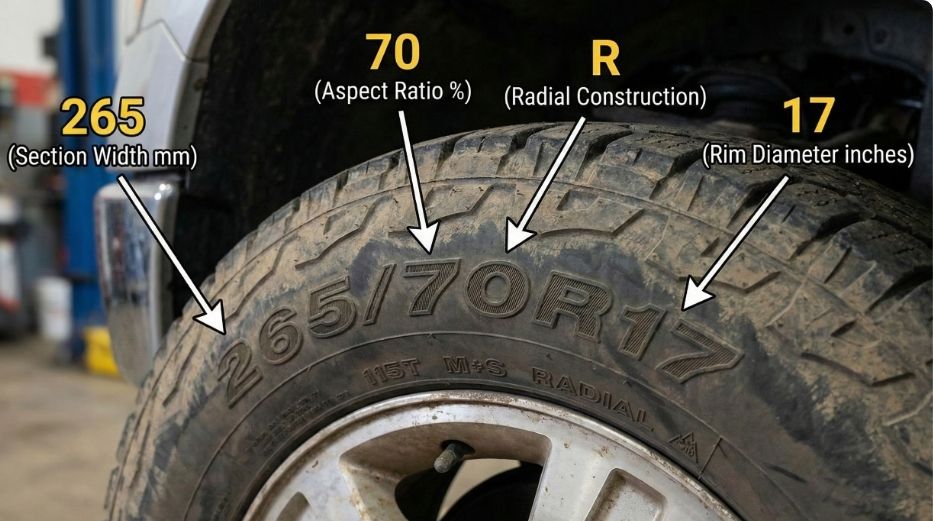
Let’s break down 265/70R17 step by step:
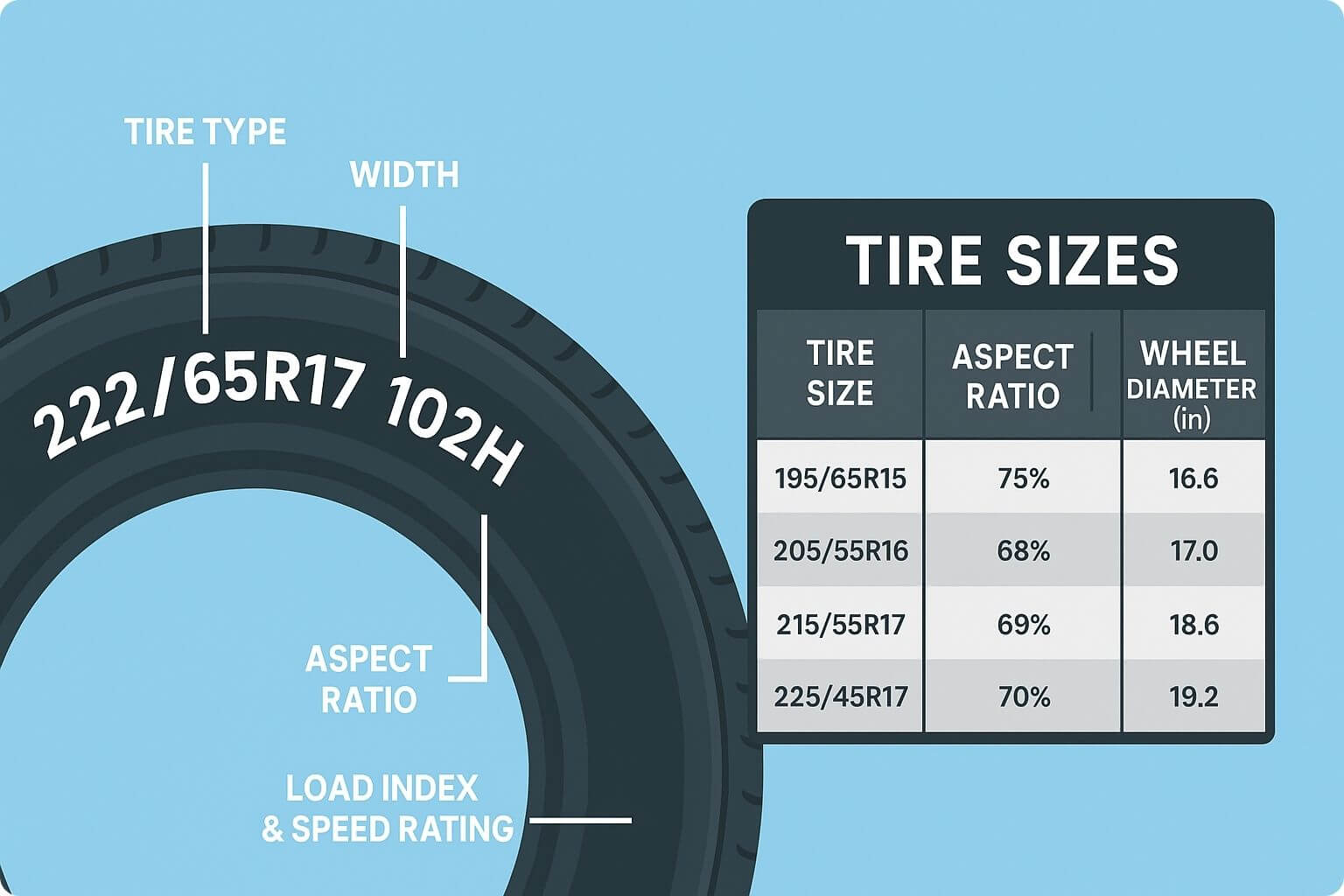
- 265 – This is the section width in millimeters. It’s the distance from one sidewall to the other. Think of it as how “wide” the tire is.
- 70 – This is the aspect ratio, which is the height of the tire’s sidewall compared to its width. A 70% aspect ratio means the sidewall height is 70% of the width. Taller sidewalls give a smoother ride; shorter ones are better for sporty handling.
- R – This stands for Radial construction, which is the most common type of tire today. Radial tires are strong, flexible, and last longer.
- 17 – This is the wheel diameter in inches. It tells you what size rim the tire fits on.
So when you see 265/70R17, you now know it’s a tire 265 mm wide, with a sidewall that’s 70% of that width, built for radial construction, and fits a 17-inch wheel. Simple, right?
Key Tire Measurement Terms Explained
Before diving into charts, it helps to understand the key measurements you’ll see:
- Section Width – How wide the tire is from sidewall to sidewall, usually in millimeters.
- Aspect Ratio – The sidewall height as a percentage of the section width. A larger number = taller sidewall.
- Wheel Size – The diameter of the rim the tire fits, in inches.
- Sidewall Height – The actual height of the tire’s sidewall, from the rim to the tread.
- Overall Diameter – The total height of the tire from the ground to the top of the tread.
- Circumference – The distance around the tire. This affects speedometer readings and gearing.
- Revolutions per Mile (Revs/Mile) – How many times the tire rotates in one mile. Smaller tires spin more times per mile; larger tires spin fewer times.
Where to Find Your Correct Tire Size
Imagine you’re ready to buy new tires, but you don’t know the exact size your vehicle needs. Don’t worry—your car or truck already has the answer written down in a few key places. Let’s go on a little treasure hunt to find it.
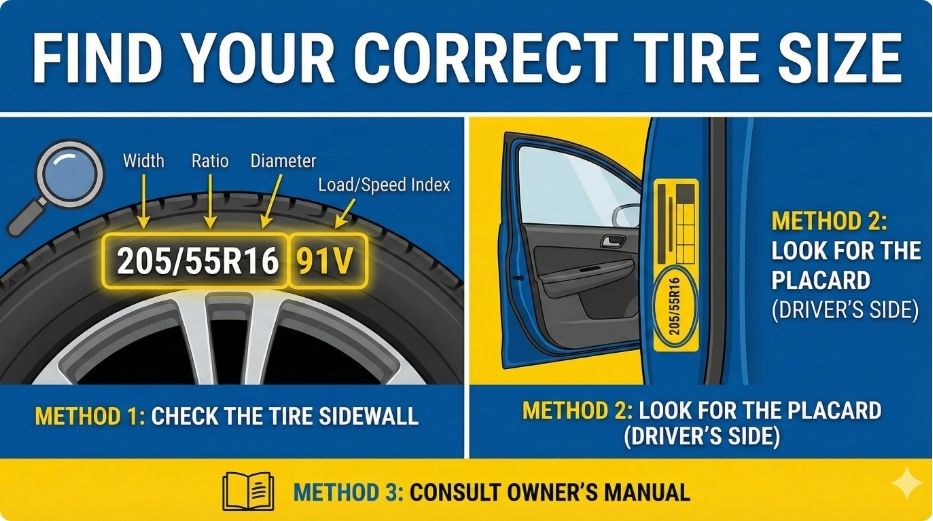
1. Driver-Side Door Jamb Sticker
Open the driver’s side door and look at the frame where the door latches. There’s usually a sticker with all sorts of numbers and information about your vehicle. Hidden in there is the recommended tire size. It might say something like P265/70R17—this is your golden ticket to the correct tires.
Think of this sticker as the manufacturer whispering directly to you: “This is what fits your vehicle best.”
2. Owner’s Manual
Every vehicle comes with an owner’s manual, that little book you might have glanced at when you bought the car. Inside, you’ll find a section on tires with the recommended sizes, pressures, and even load limits. It’s like having a guidebook written specifically for your car, explaining exactly what it needs to stay safe and perform well.
3. Current Tire Sidewall
Take a look at the tires already on your vehicle. Right on the sidewall, you’ll see numbers like 265/70R17 or P225/60R16. This tells you the tire’s width, aspect ratio, and wheel size.
Reading your current tires is a quick and easy way to know what’s already on your vehicle—but remember, if you’re changing sizes, always check the manufacturer’s recommendations to make sure new tires will fit safely.
4. Manufacturer Specifications
If you can’t find the sticker or manual, you can check the manufacturer’s website. Most car makers have a section where you can enter your vehicle model and year, and it will show the official tire sizes and recommended pressures. This is especially useful for older vehicles or if you’re ordering online and want to double-check.
Tire Size Charts Explained (How to Use Them Correctly)
Imagine you’re standing in front of a big table full of numbers—your tire size chart. At first glance, it might look confusing, but once you know how to read it, it’s like having a map that shows exactly which tires fit your vehicle and how they compare to others. Let’s break it down together.
How to Read Rows and Columns
Think of the chart like a spreadsheet. Each row is a different tire size, and each column shows a specific measurement or characteristic:
- Tire size – the numbers on the sidewall (like 265/70R17)
- Section width – how wide the tire is
- Aspect ratio – the height of the sidewall as a percentage of the width
- Wheel diameter – the rim size it fits
- Sidewall height – actual sidewall height in inches
- Overall diameter – the total tire height from the ground to the top of the tread
- Circumference – distance around the tire
- Revolutions per mile (Revs/Mile) – how many times the tire spins in a mile
- Vehicle type – which vehicles commonly use this tire
When you read a row across, it tells you everything you need to know about that specific tire. Columns let you compare sizes quickly, for example, seeing which tires are taller or wider than others.
Why Wheel Size and Diameter Both Matter
You might notice some charts are organized by wheel size (the rim) and others by overall diameter (total tire height). Both are important:
- Wheel size charts are helpful when you want to replace tires on your existing rims.
- Diameter charts are useful when you’re upsizing or changing the tire’s overall height, such as for a lifted truck or off-road setup.
Using the wrong chart can lead to mistakes, so always pick the one that matches your goal: replacement or comparison.
When Charts Should Be Used for Comparison vs Replacement
- Comparison: You’re shopping for a new tire and want to see how different sizes stack up. Charts let you compare overall diameter, sidewall height, and Revs/Mile to find the right balance for your vehicle.
- Replacement: You’re buying a tire to match your vehicle’s recommended size. Here, charts confirm you’re picking the correct measurements to maintain safety, speedometer accuracy, and handling.
Think of it like picking shoes: sometimes you want the same size, and sometimes you’re comparing widths or styles before choosing.
Safety Note About Manufacturer Tolerances
Even with charts, remember: tires have small manufacturing tolerances. Two tires labeled the same size may vary slightly in width or diameter. Always check:
- Fitment – Make sure tires clear the wheel wells and suspension
- Load rating – Tires must support your vehicle’s weight
- Speed rating – Tires must match or exceed the speed capability of your vehicle
Charts are a guide, not a guarantee. Think of them as a GPS: they point you in the right direction, but you still need to pay attention to road conditions.
Using tire size charts correctly makes shopping, upgrading, or replacing tires safer and easier. Once you understand how to read rows, columns, and the difference between wheel size and diameter, you’ll feel confident navigating any chart.
Why Wheel-Based Tire Size Charts Are Useful
Imagine you’re looking at your car’s tires and wondering, “What size should I get if I need replacements or want to upgrade?” The easiest place to start is the wheel size—the diameter of the rim that holds the tire.
Wheel-based charts are the most common starting point because every tire must fit the rim perfectly. If the tire doesn’t match the wheel size, it simply won’t fit. Think of it like shoes: a size 10 shoe won’t fit a size 9 foot, no matter how wide or long the shoe is.
Starting with wheel size makes it simple to narrow down your options and ensures safety, proper fit, and smooth driving.
Wheel-based charts are especially helpful for a few common scenarios:
- Replacing stock tires
Maybe your tires are worn out, or you just want the same size replacements. Wheel-based charts help you quickly find compatible options for your existing rims. - Upsizing wheels
If you’re looking to give your car a sportier look or improve handling, you might want larger wheels. A wheel-based chart shows which tire sizes fit each wheel diameter, so you can safely “upsize” without guessing. - Custom builds
For custom projects—like a lifted truck, a lowered sports car, or a show car—wheel-based charts make it easier to compare sizes and pick tires that not only fit the wheel but also match your design goals.
In short, wheel-based charts are your roadmap for choosing the right tire for any project, from everyday replacements to high-performance builds.
Tire Size Chart Structure (Used Across All Wheel Sizes)
When you open a wheel-based chart, it might seem full of numbers at first—but each column tells you something important about the tire. Here’s what you need to know:
- Tire size: The label on the sidewall, like 225/45R17. This is the “name” of the tire.
- Section width (mm): How wide the tire is from sidewall to sidewall. Wider tires can improve grip, narrower tires may improve efficiency.
- Aspect ratio (%): This is the sidewall height compared to the width. A lower number = shorter sidewall = sportier feel; a higher number = taller sidewall = smoother ride.
- Overall diameter (in): The total height of the tire, from the ground to the top of the tread. This affects speedometer accuracy and clearance.
- Sidewall (in): The actual height of the sidewall in inches.
- Circumference (in): How far the tire travels in one full rotation. Important for speedometer and odometer readings.
- Revs/Mile: How many times the tire spins in one mile. Bigger tires spin less; smaller tires spin more.
- Vehicle Type: Shows which vehicles commonly use this size—compact cars, sedans, SUVs, trucks, or performance vehicles.
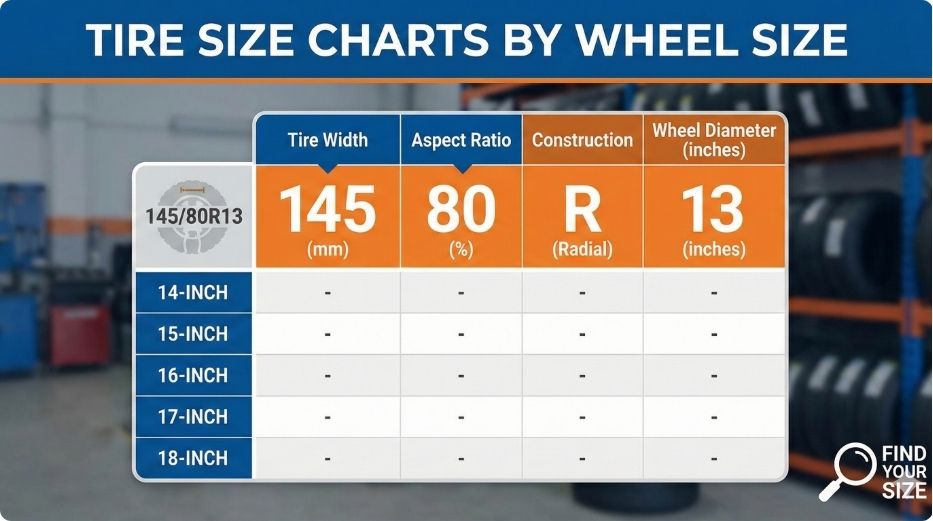
Tire Size Charts by Wheel Size
Tire Size Chart for 13″ Wheels
| Tire size | Section width (mm) | Aspect ratio (%) | Overall diameter (in) | Sidewall (in) | Circumference (in) | Revs / Mile | Vehicle Type |
| 145/80R13 | 145 | 80 | 22.13 | 4.567 | 69.54 | 911.2 | Very small city cars, older compacts |
| 155/80R13 | 155 | 80 | 22.76 | 4.882 | 71.52 | 886.0 | Small cars, hatchbacks |
| 155/70R13 | 155 | 70 | 21.54 | 4.330 | 67.68 | 936.2 | Small/ economy cars |
| 155/65R13 | 155 | 65 | 20.93 | 4.134 | 65.76 | 963.5 | Small economy cars |
| 165/80R13 | 165 | 80 | 23.39 | 4.882 | 73.49 | 862.1 | Small sedans, older compact cars |
| 165/70R13 | 165 | 70 | 22.09 | 4.358 | 69.41 | 912.8 | Compact cars, small sedans |
| 165/65R13 | 165 | 65 | 21.45 | 4.234 | 67.37 | 940.5 | Compact / economy cars |
| 175/70R13 | 175 | 70 | 22.65 | 4.478 | 71.14 | 890.6 | Compact cars, small family cars |
| 175/65R13 | 175 | 65 | 21.96 | 4.478 | 68.98 | 918.5 | Compact cars |
| 185/65R13 | 185 | 65 | 22.47 | 4.734 | 70.59 | 897.6 | Larger compacts, small sedans, some vans |
Tire Size Chart for 14″ Wheels
| Tire size | Section width (mm) | Aspect ratio (%) | Overall diameter (in) | Sidewall (in) | Circumference (in) | Revs / Mile | Vehicle Type |
| 145/80R14 | 145 | 80 | 23.13 | 4.567 | 72.68 | 871.8 | Very small city cars, older compacts |
| 155/80R14 | 155 | 80 | 23.76 | 4.882 | 74.66 | 848.7 | Small cars, older subcompacts |
| 155/70R14 | 155 | 70 | 22.54 | 4.272 | 70.82 | 894.6 | Small / economy cars, hatchbacks |
| 155/65R14 | 155 | 65 | 21.93 | 3.967 | 68.90 | 919.5 | Small economy cars |
| 165/80R14 | 165 | 80 | 24.39 | 5.197 | 76.64 | 826.8 | Small sedans, older compact vans |
| 165/70R14 | 165 | 70 | 23.09 | 4.547 | 72.55 | 873.3 | Compact cars, small sedans |
| 165/65R14 | 165 | 65 | 22.44 | 4.222 | 70.51 | 898.6 | Compact / economy cars |
| 175/70R14 | 175 | 70 | 23.65 | 4.823 | 74.29 | 852.9 | Compact cars, small family cars |
| 175/65R14 | 175 | 65 | 22.96 | 4.478 | 72.12 | 878.5 | Compact sedans, hatchbacks |
| 185/70R14 | 185 | 70 | 24.20 | 5.098 | 76.02 | 833.5 | Larger compacts, small sedans |
| 185/65R14 | 185 | 65 | 23.47 | 4.734 | 73.73 | 859.4 | Compact sedans and small family cars |
| 195/70R14 | 195 | 70 | 24.75 | 5.374 | 77.75 | 814.9 | Mid-size compacts, some small vans |
| 195/60R14 | 195 | 60 | 23.21 | 4.606 | 72.92 | 868.8 | Sportier compacts, small sedans |
Tire Size for 15″ Wheels
| Tire size | Section width (mm) | Aspect ratio (%) | Overall diameter (in) | Sidewall (in) | Circumference (in) | Revs / Mile | Vehicle Type |
| 165/70R15 | 165 | 70 | 24.09 | 4.547 | 75.70 | 837.0 | Very small cars, older compacts |
| 175/70R15 | 175 | 70 | 24.65 | 4.823 | 77.43 | 818.3 | Small / compact cars |
| 175/65R15 | 175 | 65 | 23.69 | 4.323 | 74.42 | 851.9 | Small sedans, hatchbacks |
| 185/70R15 | 185 | 70 | 25.19 | 5.118 | 79.13 | 821.7 | Small sedans, wagons |
| 185/65R15 | 185 | 65 | 24.55 | 4.734 | 77.13 | 821.3 | Compact & mid-size cars |
| 185/60R15 | 185 | 60 | 23.90 | 4.449 | 75.13 | 843.4 | Compact cars, sporty compacts |
| 195/65R15 | 195 | 65 | 25.03 | 4.992 | 78.64 | 804.8 | Mid-size sedans, small SUVs |
| 195/60R15 | 195 | 60 | 24.36 | 4.803 | 76.50 | 828.2 | Compact & mid-size cars |
| 195/55R15 | 195 | 55 | 23.68 | 4.288 | 74.40 | 851.6 | Sportier compacts, tuners |
| 205/65R15 | 205 | 65 | 25.70 | 5.236 | 80.79 | 783.8 | Older sedans, light vans |
| 205/60R15 | 205 | 60 | 25.03 | 4.921 | 78.64 | 804.6 | Mid-size sedans, crossovers |
| 205/55R15 | 205 | 55 | 24.36 | 4.489 | 76.50 | 828.2 | Performance compacts, sedans |
| 205/50R15 | 205 | 50 | 23.67 | 4.031 | 74.37 | 852.2 | Sport compacts, tuners |
| 215/60R15 | 215 | 60 | 25.16 | 5.079 | 79.03 | 801.7 | Crossovers, larger sedans |
| 225/50R15 | 225 | 50 | 23.86 | 4.429 | 74.95 | 845.3 | Sports cars, performance sedans |
Tire Size for 16″ Wheels
| Tire size | Section width (mm) | Aspect ratio (%) | Overall diameter (in) | Sidewall (in) | Circumference (in) | Revs / Mile | Vehicle Type |
| 185/65R16 | 185 | 65 | 25.47 | 4.734 | 80.01 | 791.9 | Small/compact cars |
| 195/65R16 | 195 | 65 | 25.98 | 4.990 | 81.62 | 776.3 | Compact sedans, hatchbacks |
| 195/60R16 | 195 | 60 | 25.17 | 4.493 | 79.05 | 802.0 | Compact/economy cars |
| 205/55R16 | 205 | 55 | 24.97 | 4.443 | 78.45 | 808.0 | Sporty compacts, sedans |
| 205/60R16 | 205 | 60 | 25.83 | 4.918 | 81.12 | 781.0 | Sedans, crossovers |
| 205/65R16 | 205 | 65 | 26.69 | 5.394 | 83.86 | 755.8 | Small SUVs, older sedans |
| 215/55R16 | 215 | 55 | 25.92 | 4.645 | 81.44 | 776.8 | Mid-size sedans, sporty cars |
| 215/60R16 | 215 | 60 | 26.78 | 5.189 | 84.12 | 752.9 | Crossovers, SUVs |
| 225/50R16 | 225 | 50 | 24.72 | 4.429 | 77.66 | 815.8 | Performance compacts |
| 225/55R16 | 225 | 55 | 25.77 | 4.925 | 80.96 | 782.4 | Mid-size sedans, small SUVs |
| 225/60R16 | 225 | 60 | 26.63 | 5.315 | 83.66 | 757.3 | SUVs, crossovers |
| 235/60R16 | 235 | 60 | 27.10 | 5.551 | 85.14 | 744.1 | Larger crossovers, older SUVs |
Tire Size for 16.5″ Wheels
| Tire size | Section width (mm) | Aspect ratio (%) | Overall diameter (in) | Sidewall (in) | Circumference (in) | Revs / Mile | Vehicle Type |
| 215/70R16.5 | 215 | 70 | 27.06 | 5.05 | 84.99 | 742 | Light trucks, vans, commercial vehicles |
| 225/70R16.5 | 225 | 70 | 27.87 | 5.27 | 87.53 | 720 | Light trucks, vans |
| 235/70R16.5 | 235 | 70 | 28.67 | 5.56 | 90.07 | 701 | Medium vans, commercial vehicles |
| 245/70R16.5 | 245 | 70 | 29.48 | 5.72 | 92.61 | 682 | Trucks, vans, buses |
| 255/70R16.5 | 255 | 70 | 30.29 | 5.97 | 95.15 | 665 | Trucks, larger commercial vehicles |
| 215/65R16.5 | 215 | 65 | 26.34 | 4.95 | 82.84 | 763 | Light trucks, vans |
| 225/65R16.5 | 225 | 65 | 27.13 | 4.89 | 85.38 | 741 | Vans, light trucks |
| 235/65R16.5 | 235 | 65 | 27.93 | 4.88 | 87.92 | 721 | Medium vans, commercial vehicles |
Tire Size Chart — 17″ Wheels
| Tire size | Section width (mm) | Aspect ratio (%) | Overall diameter (in) | Sidewall (in) | Circumference (in) | Revs / Mile | Vehicle Type |
| 205/55R17 | 205 | 55 | 25.88 | 4.44 | 81.30 | 779.4 | Compact / mid-size cars (daily drivers) |
| 205/60R17 | 205 | 60 | 26.69 | 4.84 | 83.83 | 755.8 | Compact cars, some small SUVs / crossovers |
| 215/55R17 | 215 | 55 | 26.31 | 4.65 | 82.63 | 766.6 | Compact & mid-size cars; sporty compacts |
| 215/60R17 | 215 | 60 | 27.16 | 5.08 | 85.31 | 742.8 | Mid-size sedans, small SUVs |
| 215/50R17 | 215 | 50 | 25.46 | 4.12 | 79.99 | 792.0 | Sporty compacts and performance trims |
| 225/45R17 | 225 | 45 | 24.97 | 3.98 | 78.52 | 806.8 | Sport compact / performance cars |
| 225/50R17 | 225 | 50 | 25.86 | 3.98 | 81.22 | 780.3 | Mid-size sedans, crossovers |
| 225/55R17 | 225 | 55 | 26.74 | 4.87 | 84.01 | 754.3 | Mid-size sedans, family cars |
| 235/45R17 | 235 | 45 | 25.33 | 4.16 | 79.58 | 796.0 | Sporty sedans and performance crossovers |
| 235/50R17 | 235 | 50 | 26.25 | 4.63 | 82.45 | 768.3 | Crossovers, SUVs, light trucks |
| 235/55R17 | 235 | 55 | 27.18 | 5.09 | 85.34 | 742.6 | SUVs and light trucks |
| 245/45R17 | 245 | 45 | 25.68 | 4.45 | 80.66 | 785.4 | Performance sedans and sporty crossovers |
| 245/50R17 | 245 | 50 | 26.65 | 4.82 | 83.73 | 757.0 | Larger sedans and crossovers |
| 255/40R17 | 255 | 40 | 25.03 | 3.98 | 78.64 | 805.7 | High-performance cars |
| 255/45R17 | 255 | 45 | 26.04 | 4.52 | 81.79 | 774.6 | Performance sedans and larger sporty cars |
Tire Size for 18″ Wheels
| Tire size | Section width (mm) | Aspect ratio (%) | Overall diameter (in) | Sidewall (in) | Circumference (in) | Revs / Mile | Vehicle Type |
| 215/45R18 | 215 | 45 | 25.21 | 4.85 | 79.20 | 797 | Compact / sporty sedans |
| 225/40R18 | 225 | 40 | 24.13 | 3.90 | 75.80 | 832 | Sporty sedans, coupes |
| 225/45R18 | 225 | 45 | 25.41 | 4.52 | 79.81 | 789 | Mid-size sedans, crossovers |
| 235/40R18 | 235 | 40 | 24.63 | 4.05 | 77.44 | 813 | Sporty sedans, performance cars |
| 235/45R18 | 235 | 45 | 25.66 | 4.52 | 80.60 | 780 | Performance sedans, small SUVs |
| 245/40R18 | 245 | 40 | 25.00 | 4.05 | 78.54 | 797 | Sport sedans and coupes |
| 245/45R18 | 245 | 45 | 26.10 | 4.92 | 81.97 | 763 | Larger sedans, crossovers |
| 255/35R18 | 255 | 35 | 24.00 | 3.54 | 75.40 | 832 | High-performance coupes |
| 255/40R18 | 255 | 40 | 25.32 | 4.10 | 79.50 | 790 | Performance sedans and crossovers |
| 265/35R18 | 265 | 35 | 24.41 | 3.52 | 76.63 | 820 | Sports cars, performance sedans |
| 265/40R18 | 265 | 40 | 25.80 | 4.22 | 80.99 | 775 | Performance sedans, crossovers |
| 275/35R18 | 275 | 35 | 25.14 | 3.52 | 78.99 | 795 | High-performance cars |
| 275/40R18 | 275 | 40 | 26.60 | 4.40 | 83.57 | 751 | Sports sedans, crossovers |
| 285/35R18 | 285 | 35 | 25.56 | 3.56 | 80.33 | 781 | High-performance sedans and coupes |
| 285/40R18 | 285 | 40 | 26.98 | 4.56 | 84.99 | 735 | Larger sports cars, SUVs |
Tire Size for 19″ Wheels
| Tire size | Section width (mm) | Aspect ratio (%) | Overall diameter (in) | Sidewall (in) | Circumference (in) | Revs / Mile | Vehicle Type |
| 225/35R19 | 225 | 35 | 24.32 | 3.94 | 76.41 | 825 | Sports coupes, compact performance sedans |
| 225/40R19 | 225 | 40 | 25.09 | 4.41 | 78.79 | 800 | Compact and mid-size sedans |
| 235/35R19 | 235 | 35 | 24.78 | 4.05 | 77.81 | 809 | Sporty sedans and coupes |
| 235/40R19 | 235 | 40 | 25.55 | 4.57 | 80.16 | 784 | Mid-size sedans, crossovers |
| 245/35R19 | 245 | 35 | 25.30 | 4.30 | 79.44 | 791 | Performance sedans, sporty crossovers |
| 245/40R19 | 245 | 40 | 26.09 | 4.61 | 81.97 | 766 | Larger sedans, crossovers |
| 255/35R19 | 255 | 35 | 25.65 | 4.25 | 80.50 | 782 | Sports cars, performance sedans |
| 255/40R19 | 255 | 40 | 26.43 | 4.53 | 83.08 | 756 | Mid-size performance sedans, crossovers |
| 265/35R19 | 265 | 35 | 26.00 | 4.30 | 81.55 | 772 | High-performance sedans and coupes |
| 265/40R19 | 265 | 40 | 26.79 | 4.58 | 84.17 | 751 | Sports sedans, crossovers |
| 275/35R19 | 275 | 35 | 26.35 | 4.35 | 82.59 | 762 | High-performance cars |
| 275/40R19 | 275 | 40 | 27.14 | 4.60 | 85.74 | 736 | Larger performance sedans, sporty SUVs |
| 285/35R19 | 285 | 35 | 26.70 | 4.48 | 83.63 | 754 | High-performance coupes, sedans |
| 285/40R19 | 285 | 40 | 27.49 | 4.76 | 86.98 | 729 | Performance sedans, sporty SUVs |
| 295/35R19 | 295 | 35 | 27.06 | 4.55 | 84.64 | 743 | High-performance cars and crossovers |
Tire Size for 20″ Wheels
| Tire size | Section width (mm) | Aspect ratio (%) | Overall diameter (in) | Sidewall (in) | Circumference (in) | Revs / Mile | Vehicle Type |
| 245/35R20 | 245 | 35 | 26.44 | 3.42 | 83.04 | 761 | Sports sedans, performance crossovers |
| 245/40R20 | 245 | 40 | 27.18 | 3.86 | 85.39 | 741 | Larger sedans, crossovers |
| 255/35R20 | 255 | 35 | 26.78 | 3.77 | 84.18 | 751 | Performance cars, sporty sedans |
| 255/40R20 | 255 | 40 | 27.55 | 4.08 | 86.81 | 728 | Mid-size sedans, sporty SUVs |
| 265/35R20 | 265 | 35 | 27.03 | 3.79 | 85.05 | 743 | High-performance sedans, coupes |
| 265/40R20 | 265 | 40 | 27.81 | 4.06 | 87.66 | 720 | Performance sedans, crossovers |
| 275/35R20 | 275 | 35 | 27.34 | 3.81 | 86.06 | 735 | Sports cars, performance sedans |
| 275/40R20 | 275 | 40 | 28.13 | 4.10 | 88.78 | 712 | Performance sedans, crossovers |
| 285/35R20 | 285 | 35 | 27.69 | 3.97 | 87.10 | 726 | High-performance sedans, coupes |
| 285/40R20 | 285 | 40 | 28.49 | 4.14 | 89.85 | 703 | Sports sedans, SUVs |
| 295/35R20 | 295 | 35 | 28.06 | 4.06 | 88.28 | 715 | High-performance cars, sporty SUVs |
| 295/40R20 | 295 | 40 | 28.86 | 4.18 | 91.05 | 692 | Larger sedans, sporty SUVs |
| 305/35R20 | 305 | 35 | 28.41 | 4.04 | 89.33 | 705 | Performance SUVs, sporty sedans |
| 305/40R20 | 305 | 40 | 29.22 | 4.16 | 92.07 | 683 | SUVs, performance sedans |
| 315/35R20 | 315 | 35 | 29.08 | 4.10 | 91.55 | 687 | High-performance SUVs, trucks |
Tire Size for 21″ Wheels
| Tire size | Section width (mm) | Aspect ratio (%) | Overall diameter (in) | Sidewall (in) | Circumference (in) | Revs / Mile | Vehicle Type |
| 255/35R21 | 255 | 35 | 28.09 | 3.57 | 88.26 | 716 | Sports sedans, performance SUVs |
| 255/40R21 | 255 | 40 | 29.05 | 4.10 | 91.25 | 692 | Mid-size performance sedans, crossovers |
| 265/35R21 | 265 | 35 | 28.54 | 3.65 | 89.69 | 704 | Performance sedans, sporty SUVs |
| 265/40R21 | 265 | 40 | 29.51 | 4.18 | 92.71 | 680 | Mid-size performance sedans, crossovers |
| 275/35R21 | 275 | 35 | 29.00 | 3.83 | 91.09 | 693 | High-performance cars, SUVs |
| 275/40R21 | 275 | 40 | 29.97 | 4.40 | 94.20 | 667 | Performance sedans, SUVs |
| 285/35R21 | 285 | 35 | 29.47 | 3.90 | 92.49 | 683 | Sports sedans, high-performance SUVs |
| 285/40R21 | 285 | 40 | 30.44 | 4.20 | 95.44 | 658 | Larger sedans, SUVs |
| 295/35R21 | 295 | 35 | 30.00 | 4.10 | 94.18 | 667 | High-performance SUVs, sporty sedans |
| 295/40R21 | 295 | 40 | 30.97 | 4.30 | 97.32 | 643 | SUVs, performance sedans |
| 305/35R21 | 305 | 35 | 30.52 | 4.10 | 95.78 | 657 | Sports SUVs, performance sedans |
| 305/40R21 | 305 | 40 | 31.49 | 4.45 | 98.89 | 634 | Large sedans, SUVs |
| 315/35R21 | 315 | 35 | 31.08 | 4.10 | 97.61 | 644 | High-performance SUVs, trucks |
| 315/40R21 | 315 | 40 | 32.04 | 4.55 | 100.73 | 622 | SUVs, high-performance trucks |
| 325/35R21 | 325 | 35 | 31.54 | 4.05 | 99.01 | 635 | High-performance trucks, sporty SUVs |
Tire Size for 22″ Wheels
| Tire size | Section width (mm) | Aspect ratio (%) | Overall diameter (in) | Sidewall (in) | Circumference (in) | Revs / Mile | Vehicle Type |
| 275/35R22 | 275 | 35 | 30.33 | 3.82 | 95.22 | 666 | Sports SUVs, performance cars |
| 275/40R22 | 275 | 40 | 31.17 | 4.02 | 97.92 | 647 | Performance sedans, crossovers |
| 285/35R22 | 285 | 35 | 30.85 | 3.98 | 96.83 | 654 | High-performance SUVs |
| 285/40R22 | 285 | 40 | 31.70 | 4.15 | 99.58 | 636 | Large sedans, sporty SUVs |
| 295/35R22 | 295 | 35 | 31.34 | 4.12 | 98.48 | 642 | Performance SUVs, high-end trucks |
| 295/40R22 | 295 | 40 | 32.19 | 4.35 | 101.24 | 623 | Large SUVs, performance sedans |
| 305/35R22 | 305 | 35 | 32.03 | 4.18 | 100.81 | 627 | High-performance trucks, SUVs |
| 305/40R22 | 305 | 40 | 32.87 | 4.42 | 103.58 | 609 | SUVs, performance trucks |
| 315/35R22 | 315 | 35 | 32.62 | 4.15 | 102.17 | 618 | High-performance SUVs and trucks |
| 315/40R22 | 315 | 40 | 33.47 | 4.50 | 104.98 | 601 | Large SUVs, performance trucks |
| 325/35R22 | 325 | 35 | 33.03 | 4.25 | 103.53 | 610 | High-performance trucks, SUVs |
| 325/40R22 | 325 | 40 | 33.88 | 4.50 | 106.33 | 593 | Large trucks, SUVs |
| 335/35R22 | 335 | 35 | 33.54 | 4.33 | 105.21 | 600 | Heavy-duty SUVs, trucks |
| 335/40R22 | 335 | 40 | 34.39 | 4.55 | 108.03 | 583 | Large trucks, SUVs |
| 345/35R22 | 345 | 35 | 34.09 | 4.35 | 106.91 | 591 | Performance SUVs, trucks |
Tire Size for 23″ Wheels
| Tire size | Section width (mm) | Aspect ratio (%) | Wheel (in) | Sidewall (in) | Overall diameter (in) | Circumference (in) | Revs / Mile | Vehicle Type |
| 275/35R23 | 275 | 35 | 23 | 3.79 | 30.58 | 96.07 | 659.5 | SUVs, large crossovers, trucks |
| 285/35R23 | 285 | 35 | 23 | 3.93 | 30.85 | 96.93 | 653.9 | SUVs, large crossovers, trucks |
| 295/35R23 | 295 | 35 | 23 | 4.06 | 31.11 | 97.79 | 648.4 | SUVs, large crossovers, trucks |
| 305/35R23 | 305 | 35 | 23 | 4.20 | 31.37 | 98.66 | 642.8 | Large SUVs, trucks, performance SUVs |
| 315/35R23 | 315 | 35 | 23 | 4.33 | 31.64 | 99.53 | 637.3 | Large SUVs, trucks, performance SUVs |
| 325/35R23 | 325 | 35 | 23 | 4.47 | 31.90 | 100.40 | 631.9 | Large SUVs, trucks, performance SUVs |
| 335/35R23 | 335 | 35 | 23 | 4.60 | 32.16 | 101.27 | 626.6 | Large SUVs, trucks, performance SUVs |
| 285/40R23 | 285 | 40 | 23 | 4.48 | 31.96 | 100.39 | 632.0 | SUVs, crossovers, trucks |
| 295/40R23 | 295 | 40 | 23 | 4.61 | 32.24 | 101.32 | 626.0 | SUVs, crossovers, trucks |
| 305/40R23 | 305 | 40 | 23 | 4.80 | 32.60 | 102.45 | 618.5 | Large SUVs, trucks |
| 315/40R23 | 315 | 40 | 23 | 4.96 | 32.92 | 103.43 | 612.6 | Large SUVs, trucks |
| 325/40R23 | 325 | 40 | 23 | 5.11 | 33.22 | 104.31 | 607.4 | Large SUVs, trucks |
| 285/45R23 | 285 | 45 | 23 | 5.11 | 33.11 | 104.02 | 608.9 | SUVs, large crossovers, trucks |
| 295/45R23 | 295 | 45 | 23 | 5.26 | 33.45 | 105.10 | 602.9 | SUVs, large crossovers, trucks |
| 305/45R23 | 305 | 45 | 23 | 5.40 | 33.81 | 106.21 | 596.6 | SUVs, large crossovers, trucks |
Tire Size for 24″ Wheels
| Tire size | Section width (mm) | Aspect ratio (%) | Wheel (in) | Sidewall (in) | Overall diameter (in) | Circumference (in) | Revs / Mile | Vehicle Type |
| 285/35R24 | 285 | 35 | 24 | 3.98 | 32.96 | 103.61 | 610 | Large SUVs, trucks, performance SUVs |
| 295/35R24 | 295 | 35 | 24 | 4.11 | 33.22 | 104.57 | 604 | SUVs, performance trucks |
| 305/35R24 | 305 | 35 | 24 | 4.18 | 33.50 | 105.43 | 598 | Large trucks, performance SUVs |
| 315/35R24 | 315 | 35 | 24 | 4.40 | 33.96 | 106.74 | 590 | Large SUVs, trucks |
| 325/35R24 | 325 | 35 | 24 | 4.55 | 34.31 | 107.77 | 584 | High-performance trucks, SUVs |
| 335/35R24 | 335 | 35 | 24 | 4.67 | 34.63 | 108.80 | 578 | SUVs, trucks |
| 285/40R24 | 285 | 40 | 24 | 4.52 | 34.04 | 106.90 | 588 | SUVs, crossovers, trucks |
| 295/40R24 | 295 | 40 | 24 | 4.63 | 34.50 | 108.50 | 580 | SUVs, trucks |
| 305/40R24 | 305 | 40 | 24 | 4.82 | 34.90 | 109.80 | 573 | Large trucks, SUVs |
| 315/40R24 | 315 | 40 | 24 | 4.96 | 35.32 | 111.10 | 566 | Large trucks, SUVs |
| 325/40R24 | 325 | 40 | 24 | 5.08 | 35.72 | 112.35 | 559 | SUVs, trucks |
| 335/40R24 | 335 | 40 | 24 | 5.25 | 36.05 | 113.35 | 554 | Large trucks, SUVs |
| 285/45R24 | 285 | 45 | 24 | 5.15 | 35.30 | 110.86 | 568 | SUVs, crossovers, trucks |
| 295/45R24 | 295 | 45 | 24 | 5.28 | 35.61 | 111.97 | 562 | SUVs, trucks |
| 305/45R24 | 305 | 45 | 24 | 5.43 | 36.05 | 113.15 | 554 | Large SUVs, trucks |
Tire Size for 26″ Wheels
| Tire size | Section width (mm) | Aspect ratio (%) | Wheel (in) | Sidewall (in) | Overall diameter (in) | Circumference (in) | Revs / Mile | Vehicle Type |
| 295/35R26 | 295 | 35 | 26 | 4.11 | 35.11 | 110.27 | 572 | Large SUVs, performance trucks |
| 305/35R26 | 305 | 35 | 26 | 4.18 | 35.47 | 111.38 | 565 | Large SUVs, trucks |
| 315/35R26 | 315 | 35 | 26 | 4.40 | 35.88 | 112.74 | 556 | High-performance SUVs, trucks |
| 325/35R26 | 325 | 35 | 26 | 4.55 | 36.20 | 113.73 | 551 | Large trucks, SUVs |
| 335/35R26 | 335 | 35 | 26 | 4.67 | 36.52 | 114.73 | 545 | SUVs, trucks |
| 295/40R26 | 295 | 40 | 26 | 4.63 | 35.97 | 113.00 | 555 | SUVs, trucks |
| 305/40R26 | 305 | 40 | 26 | 4.82 | 36.42 | 114.42 | 547 | Large trucks, SUVs |
| 315/40R26 | 315 | 40 | 26 | 4.96 | 36.88 | 115.80 | 540 | Large trucks, SUVs |
| 325/40R26 | 325 | 40 | 26 | 5.08 | 37.28 | 117.10 | 533 | SUVs, trucks |
| 335/40R26 | 335 | 40 | 26 | 5.25 | 37.55 | 118.06 | 528 | Large trucks, SUVs |
| 305/45R26 | 305 | 45 | 26 | 5.43 | 37.86 | 119.02 | 523 | Large SUVs, trucks |
| 315/45R26 | 315 | 45 | 26 | 5.58 | 38.26 | 120.11 | 518 | Large trucks, SUVs |
| 325/45R26 | 325 | 45 | 26 | 5.76 | 38.76 | 121.78 | 511 | SUVs, trucks |
| 335/45R26 | 335 | 45 | 26 | 5.90 | 39.28 | 123.34 | 504 | Large trucks, SUVs |
| 345/45R26 | 345 | 45 | 26 | 6.05 | 39.62 | 124.42 | 499 | High-performance SUVs, trucks |
Tire Size for 28″ Wheels
| Tire size | Section width (mm) | Aspect ratio (%) | Wheel (in) | Sidewall (in) | Overall diameter (in) | Circumference (in) | Revs / Mile | Vehicle Type |
| 305/35R28 | 305 | 35 | 28 | 4.18 | 36.68 | 115.30 | 539 | Large SUVs, performance trucks |
| 315/35R28 | 315 | 35 | 28 | 4.40 | 37.10 | 116.70 | 532 | High-performance SUVs, trucks |
| 325/35R28 | 325 | 35 | 28 | 4.55 | 37.42 | 117.72 | 527 | SUVs, trucks |
| 335/35R28 | 335 | 35 | 28 | 4.67 | 37.74 | 118.73 | 522 | Large trucks, SUVs |
| 345/35R28 | 345 | 35 | 28 | 4.83 | 38.08 | 119.85 | 516 | High-performance SUVs, trucks |
| 305/40R28 | 305 | 40 | 28 | 4.82 | 37.62 | 118.17 | 524 | SUVs, trucks |
| 315/40R28 | 315 | 40 | 28 | 4.96 | 38.08 | 119.88 | 516 | Large trucks, SUVs |
| 325/40R28 | 325 | 40 | 28 | 5.08 | 38.48 | 121.00 | 511 | SUVs, trucks |
| 335/40R28 | 335 | 40 | 28 | 5.25 | 38.88 | 122.18 | 505 | Large trucks, SUVs |
| 345/40R28 | 345 | 40 | 28 | 5.38 | 39.18 | 123.10 | 500 | High-performance SUVs, trucks |
| 315/45R28 | 315 | 45 | 28 | 5.63 | 39.63 | 124.47 | 494 | Large SUVs, trucks |
| 325/45R28 | 325 | 45 | 28 | 5.76 | 40.16 | 126.21 | 487 | SUVs, trucks |
| 335/45R28 | 335 | 45 | 28 | 5.92 | 40.58 | 127.46 | 482 | Large trucks, SUVs |
| 345/45R28 | 345 | 45 | 28 | 6.05 | 41.05 | 129.00 | 476 | High-performance trucks, SUVs |
| 355/45R28 | 355 | 45 | 28 | 6.18 | 41.40 | 130.13 | 471 | Large SUVs, trucks |
Tire Size for 30″ Wheels
| Tire size | Section width (mm) | Aspect ratio (%) | Wheel (in) | Sidewall (in) | Overall diameter (in) | Circumference (in) | Revs / Mile | Vehicle Type |
| 315/35R30 | 315 | 35 | 30 | 4.41 | 39.41 | 123.73 | 500 | Large SUVs, performance trucks |
| 325/35R30 | 325 | 35 | 30 | 4.55 | 39.71 | 124.70 | 495 | SUVs, trucks |
| 335/35R30 | 335 | 35 | 30 | 4.67 | 40.03 | 125.83 | 490 | High-performance SUVs, trucks |
| 345/35R30 | 345 | 35 | 30 | 4.83 | 40.38 | 126.90 | 485 | SUVs, trucks |
| 355/35R30 | 355 | 35 | 30 | 4.95 | 40.68 | 127.95 | 480 | Large trucks, SUVs |
| 315/40R30 | 315 | 40 | 30 | 4.96 | 39.92 | 124.73 | 493 | SUVs, trucks |
| 325/40R30 | 325 | 40 | 30 | 5.08 | 40.48 | 126.98 | 485 | Large SUVs, trucks |
| 335/40R30 | 335 | 40 | 30 | 5.20 | 40.92 | 128.57 | 479 | SUVs, trucks |
| 345/40R30 | 345 | 40 | 30 | 5.28 | 41.28 | 129.79 | 474 | Large trucks, SUVs |
| 355/40R30 | 355 | 40 | 30 | 5.38 | 41.38 | 130.90 | 470 | High-performance SUVs, trucks |
| 325/45R30 | 325 | 45 | 30 | 5.76 | 42.76 | 134.36 | 457 | Large SUVs, trucks |
| 335/45R30 | 335 | 45 | 30 | 5.92 | 43.18 | 135.62 | 452 | Large trucks, SUVs |
| 345/45R30 | 345 | 45 | 30 | 6.05 | 43.55 | 136.90 | 447 | SUVs, trucks |
| 355/45R30 | 355 | 45 | 30 | 6.18 | 43.95 | 138.05 | 442 | High-performance SUVs, trucks |
| 365/45R30 | 365 | 45 | 30 | 6.33 | 44.33 | 139.18 | 437 | Large trucks, SUVs |
Why Diameter-Based Tire Size Charts Matter
Imagine this: you’ve lifted your truck a few inches or swapped your SUV’s tires for a bigger off-road set. Suddenly, your speedometer feels “off,” and your vehicle doesn’t handle quite the way it used to. That’s where diameter-based charts come in.
Tires aren’t just about width or wheel size—they also have an overall diameter, which is the total height from the ground to the top of the tire. Keeping track of this number is crucial because it affects speedometer accuracy, vehicle handling, and compatibility with other tires.
Diameter-based charts are particularly helpful for:
- Trucks and heavy-duty vehicles: These often carry different tire sizes depending on load and terrain.
- Off-road vehicles: Bigger tires mean more ground clearance, but you need to know exactly how large you can go without causing rubbing or drivetrain issues.
- Lifted vehicles: When suspensions are modified, diameter-based sizing ensures the tires fit safely.
- Comparing metric vs flotation sizes: Some tires are measured in millimeters (metric), while others use inches (flotation). Diameter charts make it easy to see which sizes are truly equivalent.
Think of these charts as a road map for safe tire swaps—they help you pick tires that fit, perform well, and keep your vehicle reading correctly.
Tire Size Chart Structure (By Diameter)
Now let’s talk about how the chart works. We’ve designed it to give you all the key information in one glance, without confusing numbers.
Here’s what each column means, in simple terms:
- Tire size: The label on the sidewall, like 305/70R16. This is the “name” of the tire.
- Section width (mm): How wide the tire is from sidewall to sidewall.
- Aspect ratio (%): The height of the sidewall compared to the width. Lower = shorter sidewall, sharper handling; higher = taller, softer ride.
- Wheel (in): The diameter of the rim the tire fits.
- Sidewall (in): The height of the sidewall in inches.
- Circumference (in): How far the tire rolls in one full rotation. Helps with speedometer accuracy.
- Vehicle Type: Shows which vehicles commonly use this size—trucks, off-road vehicles, lifted SUVs, and more.
When you look at a diameter-based chart, you’ll immediately see which tires are comparable in height, even if their widths or wheel sizes differ. This is especially handy when trying to match new tires to an existing lift or comparing metric and flotation tires.

Tire Size Charts by Diameter
Tire Size Chart for 21″ Diameter
| Tire size | Section width (mm) | Aspect ratio (%) | Wheel (in) | Approx. Overall Diameter (in) | Approx. Sidewall (in) | Notes / Vehicle Type |
| 245/30R21 | 245 | 30 | 21 | ~26.8″ | ~3.6″ | Lower profile sports tires (smaller sidewall) |
| 245/35R21 | 245 | 35 | 21 | ~27.8″ | ~4.0″ | Popular sports sedan & coupe size |
| 245/40R21 | 245 | 40 | 21 | ~28.7″ | ~4.4″ | Balanced height for mid‑size cars |
| 255/30R21 | 255 | 30 | 21 | ~27.0″ | ~3.8″ | Wider, low‑profile fit for performance models |
| 255/35R21 | 255 | 35 | 21 | ~28.0″ | ~4.2″ | Often used on sporty crossovers & sedans |
| 255/40R21 | 255 | 40 | 21 | ~29.0″ | ~4.6″ | Good balance of grip & comfort |
| 255/50R21 | 255 | 50 | 21 | ~31.0″ | ~5.0″ | Taller profile used on SUVs & larger crossovers |
| 265/35R21 | 265 | 35 | 21 | ~28.3″ | ~4.3″ | Sporty sedans & performance crossovers |
| 265/40R21 | 265 | 40 | 21 | ~29.3″ | ~4.6″ | Popular on performance SUVs |
| 265/45R21 | 265 | 45 | 21 | ~30.4″ | ~5.0″ | Taller so slightly off true “21″ but close in height |
| 275/35R21 | 275 | 35 | 21 | ~28.6″ | ~4.5″ | Wider performance choice |
| 285/35R21 | 285 | 35 | 21 | ~28.9″ | ~4.6″ | Often used on sporty SUVs & large crossovers |
| 305/35R21 | 305 | 35 | 21 | ~29.7″ | ~5.1″ | Plus sizes for luxury SUVs & trucks |
Tire Size Chart for 22″ Diameter
| Tire size | Section width (mm) | Aspect ratio (%) | Wheel (in) | Approx. Overall Diameter (in) | Approx. Sidewall (in) | Typical Use / Vehicle Type |
| 175/65R14 | 175 | 65 | 14 | 23.0″ | ~4.6″ | Small sedans, economy cars |
| 185/60R14 | 185 | 60 | 14 | 22.8″ | ~4.4″ | Compact cars |
| 185/65R14 | 185 | 65 | 14 | 23.7″ | ~4.8″ | Compact sedans |
| 195/60R15 | 195 | 60 | 15 | 23.0″ | ~4.7″ | Compact/mid‑size cars |
| 195/65R15 | 195 | 65 | 15 | 24.1″ | ~5.2″ | Mid‑size sedans |
| 205/55R16 | 205 | 55 | 16 | 24.4″ | ~4.5″ | Compact/mid‑size cars |
| 205/50R16 | 205 | 50 | 16 | 23.4″ | ~4.1″ | Sporty sedans |
| 215/55R16 | 215 | 55 | 16 | 25.0″ | ~4.5″ | SUVs/crossovers (smaller) |
| 225/50R17 | 225 | 50 | 17 | 25.9″ | ~4.4″ | Mid‑size cars, SUVs (small) |
| 225/45R17 | 225 | 45 | 17 | 25.0″ | ~4.0″ | Sport sedans |
| 235/45R17 | 235 | 45 | 17 | 25.5″ | ~4.2″ | Sport / crossover |
| 245/40R18 | 245 | 40 | 18 | 25.8″ | ~4.0″ | Sport sedans, crossovers |
| 255/40R18 | 255 | 40 | 18 | 26.1″ | ~4.1″ | Sport SUVs / sedans |
| 225/60R17 | 225 | 60 | 17 | 27.2″ | ~5.3″ | SUVs / crossovers |
| 235/55R18 | 235 | 55 | 18 | 27.4″ | ~5.1″ | Larger SUVs |
Tire Size Chart for 23″ Diameter
| Tire size | Section width (mm) | Aspect ratio (%) | Wheel (in) | Approx. Overall Diameter (in) | Approx. Sidewall (in) | Typical Use / Vehicle Type |
| 185/65R15 | 185 | 65 | 15 | ~23.0″ | ~4.7″ | Compact & mid-size sedans |
| 195/60R15 | 195 | 60 | 15 | ~22.8″ | ~4.7″ | Small cars, sedans |
| 195/65R15 | 195 | 65 | 15 | ~23.7″ | ~5.1″ | Compact & mid-size cars |
| 205/55R16 | 205 | 55 | 16 | ~23.6″ | ~4.5″ | Compact & sporty sedans |
| 205/60R16 | 205 | 60 | 16 | ~24.3″ | ~4.9″ | Mid-size sedans, crossovers |
| 215/55R16 | 215 | 55 | 16 | ~24.0″ | ~4.7″ | Mid-size sedans, small SUVs |
| 215/50R17 | 215 | 50 | 17 | ~23.5″ | ~4.3″ | Sporty sedans |
| 225/50R17 | 225 | 50 | 17 | ~24.0″ | ~4.5″ | Sedans, small crossovers |
| 225/45R17 | 225 | 45 | 17 | ~23.1″ | ~4.1″ | Sport sedans |
| 235/45R17 | 235 | 45 | 17 | ~23.6″ | ~4.2″ | Sport sedans & small SUVs |
| 245/40R18 | 245 | 40 | 18 | ~23.7″ | ~3.9″ | Performance sedans & SUVs |
| 255/40R18 | 255 | 40 | 18 | ~24.1″ | ~4.0″ | Performance sedans, crossovers |
| 225/55R17 | 225 | 55 | 17 | ~24.6″ | ~4.5″ | Crossovers, small SUVs |
Tire Size Chart for 24″ Diameter
| Tire size | Section width (mm) | Aspect ratio (%) | Wheel (in) | Approx. Overall Diameter (in) | Approx. Sidewall (in) | Typical Use / Vehicle Type |
| 205/60R16 | 205 | 60 | 16 | ~24.4″ | ~4.9″ | Mid-size sedans, crossovers |
| 215/55R16 | 215 | 55 | 16 | ~24.0″ | ~4.7″ | Mid-size sedans, small SUVs |
| 215/60R16 | 215 | 60 | 16 | ~24.9″ | ~5.2″ | Mid-size cars, small SUVs |
| 225/55R17 | 225 | 55 | 17 | ~24.9″ | ~4.9″ | Mid-size sedans, crossovers |
| 225/50R17 | 225 | 50 | 17 | ~24.2″ | ~4.5″ | Sporty sedans |
| 235/50R17 | 235 | 50 | 17 | ~24.7″ | ~4.7″ | Sport sedans, small SUVs |
| 235/55R17 | 235 | 55 | 17 | ~25.5″ | ~5.0″ | Crossovers, small SUVs |
| 245/45R18 | 245 | 45 | 18 | ~24.6″ | ~4.4″ | Performance sedans, SUVs |
| 245/50R18 | 245 | 50 | 18 | ~25.1″ | ~4.9″ | Performance SUVs, mid-size cars |
| 255/45R18 | 255 | 45 | 18 | ~25.2″ | ~4.6″ | Sports SUVs, sedans |
| 255/50R18 | 255 | 50 | 18 | ~25.8″ | ~5.1″ | SUVs, crossovers |
| 265/45R18 | 265 | 45 | 18 | ~25.7″ | ~4.7″ | Larger sedans, SUVs |
Tire Size Chart for 25″ Diameter
| Tire size | Section width (mm) | Aspect ratio (%) | Wheel (in) | Approx. Overall Diameter (in) | Approx. Sidewall (in) | Typical Use / Vehicle Type |
| 215/60R16 | 215 | 60 | 16 | ~25.2″ | ~5.1″ | Mid-size sedans, crossovers |
| 225/55R17 | 225 | 55 | 17 | ~25.0″ | ~4.9″ | Sedans, small SUVs |
| 225/60R17 | 225 | 60 | 17 | ~25.8″ | ~5.3″ | Crossovers, SUVs |
| 235/55R17 | 235 | 55 | 17 | ~25.5″ | ~5.0″ | Sport sedans, small SUVs |
| 235/60R17 | 235 | 60 | 17 | ~26.2″ | ~5.6″ | Crossovers, mid-size SUVs |
| 245/50R18 | 245 | 50 | 18 | ~25.5″ | ~4.9″ | Performance sedans, SUVs |
| 245/55R18 | 245 | 55 | 18 | ~26.2″ | ~5.4″ | SUVs, crossovers |
| 255/50R18 | 255 | 50 | 18 | ~25.8″ | ~5.1″ | Mid-size SUVs, sedans |
| 255/55R18 | 255 | 55 | 18 | ~26.5″ | ~5.5″ | SUVs, crossovers |
| 265/50R18 | 265 | 50 | 18 | ~26.1″ | ~5.2″ | Larger sedans, SUVs |
| 265/55R18 | 265 | 55 | 18 | ~26.8″ | ~5.6″ | SUVs, trucks |
| 275/50R18 | 275 | 50 | 18 | ~26.5″ | ~5.3″ | Performance SUVs, trucks |
| 275/55R18 | 275 | 55 | 18 | ~27.2″ | ~5.7″ | Large SUVs, light trucks |
Tire Size Chart for 26″ Diameter
| Tire size | Section width (mm) | Aspect ratio (%) | Wheel (in) | Approx. Overall Diameter (in) | Approx. Sidewall (in) | Typical Use / Vehicle Type |
| 225/65R17 | 225 | 65 | 17 | ~26.0″ | ~5.2″ | Small SUVs, crossovers |
| 235/60R17 | 235 | 60 | 17 | ~26.1″ | ~5.1″ | Mid-size SUVs, crossovers |
| 235/65R17 | 235 | 65 | 17 | ~26.8″ | ~5.5″ | SUVs, light trucks |
| 245/60R18 | 245 | 60 | 18 | ~26.2″ | ~5.2″ | Mid-size SUVs, crossovers |
| 245/65R18 | 245 | 65 | 18 | ~26.9″ | ~5.6″ | SUVs, light trucks |
| 255/60R18 | 255 | 60 | 18 | ~26.6″ | ~5.3″ | Large SUVs, crossovers |
| 255/65R18 | 255 | 65 | 18 | ~27.3″ | ~5.6″ | SUVs, trucks |
| 265/60R18 | 265 | 60 | 18 | ~26.9″ | ~5.4″ | Large SUVs, trucks |
| 265/65R18 | 265 | 65 | 18 | ~27.6″ | ~5.8″ | SUVs, light trucks |
| 275/60R18 | 275 | 60 | 18 | ~27.2″ | ~5.5″ | Large SUVs, performance trucks |
| 275/65R18 | 275 | 65 | 18 | ~27.9″ | ~5.8″ | SUVs, trucks |
Tire Size Chart for 27″ Diameter
| Tire size | Section width (mm) | Aspect ratio (%) | Wheel (in) | Approx. Overall Diameter (in) | Approx. Sidewall (in) | Typical Use / Vehicle Type |
| 225/70R16 | 225 | 70 | 16 | ~27.0″ | ~5.7″ | Mid-size SUVs, light trucks |
| 235/65R17 | 235 | 65 | 17 | ~27.0″ | ~5.5″ | SUVs, crossovers |
| 235/70R16 | 235 | 70 | 16 | ~27.5″ | ~5.8″ | SUVs, light trucks |
| 245/65R17 | 245 | 65 | 17 | ~27.5″ | ~5.6″ | SUVs, light trucks |
| 245/70R16 | 245 | 70 | 16 | ~28.0″ | ~5.9″ | Mid-size trucks, SUVs |
| 255/65R17 | 255 | 65 | 17 | ~28.0″ | ~5.6″ | Large SUVs, trucks |
| 255/70R16 | 255 | 70 | 16 | ~28.5″ | ~6.0″ | Light trucks, SUVs |
| 265/65R17 | 265 | 65 | 17 | ~28.3″ | ~5.8″ | Large SUVs, trucks |
| 265/70R16 | 265 | 70 | 16 | ~28.8″ | ~6.1″ | Trucks, SUVs |
| 275/65R17 | 275 | 65 | 17 | ~28.8″ | ~5.9″ | SUVs, light trucks |
| 275/70R16 | 275 | 70 | 16 | ~29.3″ | ~6.1″ | Large trucks, SUVs |
Tire Size Chart for 28″ Diameter
| Tire size | Section width (mm) | Aspect ratio (%) | Wheel (in) | Approx. Overall Diameter (in) | Approx. Sidewall (in) | Typical Use / Vehicle Type |
| 235/70R17 | 235 | 70 | 17 | ~28.0″ | ~5.7″ | Mid-size SUVs, light trucks |
| 245/65R18 | 245 | 65 | 18 | ~28.0″ | ~5.6″ | SUVs, crossovers |
| 245/70R17 | 245 | 70 | 17 | ~28.5″ | ~5.9″ | SUVs, trucks |
| 255/65R18 | 255 | 65 | 18 | ~28.3″ | ~5.6″ | Large SUVs, trucks |
| 255/70R17 | 255 | 70 | 17 | ~28.8″ | ~6.0″ | Light trucks, SUVs |
| 265/65R18 | 265 | 65 | 18 | ~28.8″ | ~5.8″ | Large SUVs, trucks |
| 265/70R17 | 265 | 70 | 17 | ~29.3″ | ~6.1″ | Trucks, SUVs |
| 275/65R18 | 275 | 65 | 18 | ~29.3″ | ~5.9″ | SUVs, light trucks |
| 275/70R17 | 275 | 70 | 17 | ~29.8″ | ~6.1″ | Large trucks, SUVs |
| 285/65R18 | 285 | 65 | 18 | ~29.8″ | ~6.0″ | Large SUVs, trucks |
| 285/70R17 | 285 | 70 | 17 | ~30.3″ | ~6.2″ | Light trucks, SUVs |
Tire Size Chart for 29″ Diameter
| Tire size | Section width (mm) | Aspect ratio (%) | Wheel (in) | Approx. Overall Diameter (in) | Approx. Sidewall (in) | Typical Use / Vehicle Type |
| 245/70R18 | 245 | 70 | 18 | ~29.0″ | ~5.9″ | SUVs, light trucks |
| 255/65R18 | 255 | 65 | 18 | ~29.0″ | ~5.6″ | Large SUVs, trucks |
| 255/70R17 | 255 | 70 | 17 | ~29.3″ | ~6.0″ | Light trucks, SUVs |
| 265/65R18 | 265 | 65 | 18 | ~29.3″ | ~5.8″ | Large SUVs, trucks |
| 265/70R17 | 265 | 70 | 17 | ~29.8″ | ~6.1″ | Trucks, SUVs |
| 275/65R18 | 275 | 65 | 18 | ~29.8″ | ~5.9″ | SUVs, light trucks |
| 275/70R17 | 275 | 70 | 17 | ~30.3″ | ~6.1″ | Large trucks, SUVs |
| 285/65R18 | 285 | 65 | 18 | ~30.3″ | ~6.0″ | Large SUVs, trucks |
| 285/70R17 | 285 | 70 | 17 | ~30.8″ | ~6.2″ | Light trucks, SUVs |
| 295/65R18 | 295 | 65 | 18 | ~30.8″ | ~6.1″ | Trucks, SUVs |
| 295/70R17 | 295 | 70 | 17 | ~31.3″ | ~6.2″ | Large trucks, SUVs |
Tire Size Chart for 30″ Diameter
| Tire size | Section width (mm) | Aspect ratio (%) | Wheel (in) | Approx. Overall Diameter (in) | Approx. Sidewall (in) | Typical Use / Vehicle Type |
| 255/70R18 | 255 | 70 | 18 | ~30.0″ | ~6.0″ | SUVs, light trucks |
| 265/65R18 | 265 | 65 | 18 | ~30.0″ | ~5.8″ | Large SUVs, trucks |
| 265/70R17 | 265 | 70 | 17 | ~30.3″ | ~6.1″ | Trucks, SUVs |
| 275/65R18 | 275 | 65 | 18 | ~30.3″ | ~5.9″ | SUVs, light trucks |
| 275/70R17 | 275 | 70 | 17 | ~30.8″ | ~6.1″ | Large trucks, SUVs |
| 285/65R18 | 285 | 65 | 18 | ~30.8″ | ~6.0″ | Large SUVs, trucks |
| 285/70R17 | 285 | 70 | 17 | ~31.3″ | ~6.2″ | Light trucks, SUVs |
| 295/65R18 | 295 | 65 | 18 | ~31.3″ | ~6.1″ | Trucks, SUVs |
| 295/70R17 | 295 | 70 | 17 | ~31.8″ | ~6.2″ | Large trucks, SUVs |
| 305/65R18 | 305 | 65 | 18 | ~31.8″ | ~6.1″ | Large trucks, SUVs |
| 305/70R17 | 305 | 70 | 17 | ~32.3″ | ~6.3″ | Trucks, off-road vehicles |
Tire Size Chart for 31″ Diameter
| Tire size | Section width (mm) | Aspect ratio (%) | Wheel (in) | Approx. Overall Diameter (in) | Approx. Sidewall (in) | Typical Use / Vehicle Type |
| 265/70R17 | 265 | 70 | 17 | ~31.0″ | ~6.1″ | SUVs, trucks |
| 275/65R18 | 275 | 65 | 18 | ~31.0″ | ~5.9″ | SUVs, light trucks |
| 275/70R17 | 275 | 70 | 17 | ~31.5″ | ~6.1″ | Large trucks, SUVs |
| 285/65R18 | 285 | 65 | 18 | ~31.5″ | ~6.0″ | Large SUVs, trucks |
| 285/70R17 | 285 | 70 | 17 | ~32.0″ | ~6.2″ | Light trucks, SUVs |
| 295/65R18 | 295 | 65 | 18 | ~32.0″ | ~6.1″ | Trucks, SUVs |
| 295/70R17 | 295 | 70 | 17 | ~32.5″ | ~6.2″ | Large trucks, SUVs |
| 305/65R18 | 305 | 65 | 18 | ~32.5″ | ~6.1″ | Large trucks, SUVs |
| 305/70R17 | 305 | 70 | 17 | ~33.0″ | ~6.3″ | Trucks, off-road vehicles |
| 315/65R18 | 315 | 65 | 18 | ~33.0″ | ~6.1″ | Off-road trucks, SUVs |
| 315/70R17 | 315 | 70 | 17 | ~33.5″ | ~6.3″ | Heavy-duty trucks, off-road vehicles |
Tire Size Chart for 32″ Diameter
| Tire size | Section width (mm) | Aspect ratio (%) | Wheel (in) | Approx. Overall Diameter (in) | Approx. Sidewall (in) | Typical Use / Vehicle Type |
| 275/70R17 | 275 | 70 | 17 | ~32.0″ | ~6.1″ | Large trucks, SUVs |
| 285/65R18 | 285 | 65 | 18 | ~32.0″ | ~6.0″ | Large SUVs, trucks |
| 285/70R17 | 285 | 70 | 17 | ~32.5″ | ~6.2″ | Light trucks, SUVs |
| 295/65R18 | 295 | 65 | 18 | ~32.5″ | ~6.1″ | Trucks, SUVs |
| 295/70R17 | 295 | 70 | 17 | ~33.0″ | ~6.2″ | Large trucks, SUVs |
| 305/65R18 | 305 | 65 | 18 | ~33.0″ | ~6.1″ | Large trucks, SUVs |
| 305/70R17 | 305 | 70 | 17 | ~33.5″ | ~6.3″ | Trucks, off-road vehicles |
| 315/65R18 | 315 | 65 | 18 | ~33.5″ | ~6.1″ | Off-road trucks, SUVs |
| 315/70R17 | 315 | 70 | 17 | ~34.0″ | ~6.3″ | Heavy-duty trucks, off-road vehicles |
| 325/65R18 | 325 | 65 | 18 | ~34.0″ | ~6.3″ | Large trucks, SUVs |
| 325/70R17 | 325 | 70 | 17 | ~34.5″ | ~6.5″ | Off-road trucks, heavy-duty SUVs |
Tire Size Chart for 33″ Diameter
| Tire size | Section width (mm) | Aspect ratio (%) | Wheel (in) | Approx. Overall Diameter (in) | Approx. Sidewall (in) | Typical Use / Vehicle Type |
| 285/70R17 | 285 | 70 | 17 | ~33.0″ | ~6.2″ | Light trucks, SUVs |
| 285/75R16 | 285 | 75 | 16 | ~33.1″ | ~6.4″ | Trucks, SUVs |
| 295/70R17 | 295 | 70 | 17 | ~33.5″ | ~6.2″ | Large trucks, SUVs |
| 295/75R16 | 295 | 75 | 16 | ~33.6″ | ~6.6″ | Off-road trucks, SUVs |
| 305/70R17 | 305 | 70 | 17 | ~33.8″ | ~6.3″ | Trucks, off-road SUVs |
| 305/75R16 | 305 | 75 | 16 | ~33.9″ | ~6.8″ | Heavy-duty trucks, off-road vehicles |
| 315/70R17 | 315 | 70 | 17 | ~34.3″ | ~6.3″ | Off-road trucks, SUVs |
| 315/75R16 | 315 | 75 | 16 | ~34.4″ | ~6.8″ | Off-road vehicles, trucks |
| 325/70R17 | 325 | 70 | 17 | ~34.5″ | ~6.4″ | Large trucks, off-road SUVs |
| 325/75R16 | 325 | 75 | 16 | ~34.6″ | ~6.9″ | Heavy-duty off-road vehicles |
Tire Size Chart for 34″ Diameter
| Tire size | Section width (mm) | Aspect ratio (%) | Wheel (in) | Approx. Overall Diameter (in) | Approx. Sidewall (in) | Typical Use / Vehicle Type |
| 285/75R16 | 285 | 75 | 16 | ~34.0″ | ~6.8″ | Trucks, SUVs |
| 295/70R17 | 295 | 70 | 17 | ~34.0″ | ~6.2″ | Large trucks, SUVs |
| 295/75R16 | 295 | 75 | 16 | ~34.1″ | ~6.6″ | Off-road trucks, SUVs |
| 305/70R17 | 305 | 70 | 17 | ~34.3″ | ~6.3″ | Trucks, off-road SUVs |
| 305/75R16 | 305 | 75 | 16 | ~34.4″ | ~6.8″ | Heavy-duty trucks, off-road vehicles |
| 315/70R17 | 315 | 70 | 17 | ~34.8″ | ~6.3″ | Off-road trucks, SUVs |
| 315/75R16 | 315 | 75 | 16 | ~34.9″ | ~6.8″ | Off-road vehicles, trucks |
| 325/70R17 | 325 | 70 | 17 | ~35.0″ | ~6.4″ | Large trucks, off-road SUVs |
| 325/75R16 | 325 | 75 | 16 | ~35.1″ | ~6.9″ | Heavy-duty off-road vehicles |
| 335/70R17 | 335 | 70 | 17 | ~35.3″ | ~6.6″ | Off-road trucks, SUVs |
Tire Size Chart for 35″ Diameter
| Tire size | Section width (mm) | Aspect ratio (%) | Wheel (in) | Approx. Overall Diameter (in) | Approx. Sidewall (in) | Typical Use / Vehicle Type |
| 285/75R16 | 285 | 75 | 16 | ~35.0″ | ~6.8″ | Trucks, SUVs |
| 295/70R17 | 295 | 70 | 17 | ~35.0″ | ~6.2″ | Large trucks, SUVs |
| 295/75R16 | 295 | 75 | 16 | ~35.1″ | ~6.6″ | Off-road trucks, SUVs |
| 305/70R17 | 305 | 70 | 17 | ~35.3″ | ~6.3″ | Trucks, off-road SUVs |
| 305/75R16 | 305 | 75 | 16 | ~35.4″ | ~6.8″ | Heavy-duty trucks, off-road vehicles |
| 315/70R17 | 315 | 70 | 17 | ~35.8″ | ~6.3″ | Off-road trucks, SUVs |
| 315/75R16 | 315 | 75 | 16 | ~35.9″ | ~6.8″ | Off-road vehicles, trucks |
| 325/70R17 | 325 | 70 | 17 | ~36.0″ | ~6.4″ | Large trucks, off-road SUVs |
| 325/75R16 | 325 | 75 | 16 | ~36.1″ | ~6.9″ | Heavy-duty off-road vehicles |
| 335/70R17 | 335 | 70 | 17 | ~36.3″ | ~6.6″ | Off-road trucks, SUVs |
| 335/75R16 | 335 | 75 | 16 | ~36.4″ | ~7.0″ | Off-road trucks, heavy-duty SUVs |
Tire Size Chart for 36″ Diameter
| Tire size | Section width (mm) | Aspect ratio (%) | Wheel (in) | Approx. Overall Diameter (in) | Approx. Sidewall (in) | Typical Use / Vehicle Type |
| 285/75R16 | 285 | 75 | 16 | ~36.0″ | ~6.8″ | Trucks, SUVs |
| 295/70R17 | 295 | 70 | 17 | ~36.0″ | ~6.2″ | Large trucks, SUVs |
| 295/75R16 | 295 | 75 | 16 | ~36.1″ | ~6.6″ | Off-road trucks, SUVs |
| 305/70R17 | 305 | 70 | 17 | ~36.3″ | ~6.3″ | Trucks, off-road SUVs |
| 305/75R16 | 305 | 75 | 16 | ~36.4″ | ~6.8″ | Heavy-duty trucks, off-road vehicles |
| 315/70R17 | 315 | 70 | 17 | ~36.8″ | ~6.3″ | Off-road trucks, SUVs |
| 315/75R16 | 315 | 75 | 16 | ~36.9″ | ~6.8″ | Off-road vehicles, trucks |
| 325/70R17 | 325 | 70 | 17 | ~37.0″ | ~6.4″ | Large trucks, off-road SUVs |
| 325/75R16 | 325 | 75 | 16 | ~37.1″ | ~6.9″ | Heavy-duty off-road vehicles |
| 335/70R17 | 335 | 70 | 17 | ~37.3″ | ~6.6″ | Off-road trucks, SUVs |
| 335/75R16 | 335 | 75 | 16 | ~37.4″ | ~7.0″ | Off-road trucks, heavy-duty SUVs |
Tire Size Chart for 37″ Diameter
| Tire size | Section width (mm) | Aspect ratio (%) | Wheel (in) | Approx. Overall Diameter (in) | Approx. Sidewall (in) | Typical Use / Vehicle Type |
| 295/75R16 | 295 | 75 | 16 | ~37.0″ | ~6.6″ | Off-road trucks, SUVs |
| 305/70R17 | 305 | 70 | 17 | ~37.0″ | ~6.3″ | Trucks, off-road SUVs |
| 305/75R16 | 305 | 75 | 16 | ~37.1″ | ~6.8″ | Heavy-duty trucks, off-road vehicles |
| 315/70R17 | 315 | 70 | 17 | ~37.5″ | ~6.3″ | Off-road trucks, SUVs |
| 315/75R16 | 315 | 75 | 16 | ~37.6″ | ~6.8″ | Off-road vehicles, trucks |
| 325/70R17 | 325 | 70 | 17 | ~37.7″ | ~6.4″ | Large trucks, off-road SUVs |
| 325/75R16 | 325 | 75 | 16 | ~37.8″ | ~6.9″ | Heavy-duty off-road vehicles |
| 335/70R17 | 335 | 70 | 17 | ~38.0″ | ~6.6″ | Off-road trucks, SUVs |
| 335/75R16 | 335 | 75 | 16 | ~38.1″ | ~7.0″ | Off-road trucks, heavy-duty SUVs |
| 345/70R17 | 345 | 70 | 17 | ~38.3″ | ~6.8″ | Off-road trucks, large SUVs |
| 345/75R16 | 345 | 75 | 16 | ~38.4″ | ~7.1″ | Heavy-duty off-road vehicles |
Tire Size Chart for 38″ Diameter
| Tire size | Section width (mm) | Aspect ratio (%) | Wheel (in) | Approx. Overall Diameter (in) | Approx. Sidewall (in) | Typical Use / Vehicle Type |
| 305/75R16 | 305 | 75 | 16 | ~38.0″ | ~6.8″ | Heavy-duty trucks, off-road vehicles |
| 315/70R17 | 315 | 70 | 17 | ~38.0″ | ~6.3″ | Off-road trucks, SUVs |
| 315/75R16 | 315 | 75 | 16 | ~38.1″ | ~6.8″ | Off-road vehicles, trucks |
| 325/70R17 | 325 | 70 | 17 | ~38.2″ | ~6.4″ | Large trucks, off-road SUVs |
| 325/75R16 | 325 | 75 | 16 | ~38.3″ | ~6.9″ | Heavy-duty off-road vehicles |
| 335/70R17 | 335 | 70 | 17 | ~38.5″ | ~6.6″ | Off-road trucks, SUVs |
| 335/75R16 | 335 | 75 | 16 | ~38.6″ | ~7.0″ | Off-road trucks, heavy-duty SUVs |
| 345/70R17 | 345 | 70 | 17 | ~38.8″ | ~6.8″ | Off-road trucks, large SUVs |
| 345/75R16 | 345 | 75 | 16 | ~38.9″ | ~7.1″ | Heavy-duty off-road vehicles |
| 355/70R17 | 355 | 70 | 17 | ~39.0″ | ~7.0″ | Large trucks, off-road SUVs |
| 355/75R16 | 355 | 75 | 16 | ~39.1″ | ~7.2″ | Heavy-duty off-road vehicles |
Tire Size Chart for 39″ Diameter
| Tire size | Section width (mm) | Aspect ratio (%) | Wheel (in) | Approx. Overall Diameter (in) | Approx. Sidewall (in) | Typical Use / Vehicle Type |
| 315/75R16 | 315 | 75 | 16 | ~39.0″ | ~6.8″ | Off-road trucks, SUVs |
| 325/70R17 | 325 | 70 | 17 | ~39.0″ | ~6.4″ | Large trucks, off-road SUVs |
| 325/75R16 | 325 | 75 | 16 | ~39.1″ | ~6.9″ | Heavy-duty off-road vehicles |
| 335/70R17 | 335 | 70 | 17 | ~39.3″ | ~6.6″ | Off-road trucks, SUVs |
| 335/75R16 | 335 | 75 | 16 | ~39.4″ | ~7.0″ | Off-road trucks, heavy-duty SUVs |
| 345/70R17 | 345 | 70 | 17 | ~39.6″ | ~6.8″ | Off-road trucks, large SUVs |
| 345/75R16 | 345 | 75 | 16 | ~39.7″ | ~7.1″ | Heavy-duty off-road vehicles |
| 355/70R17 | 355 | 70 | 17 | ~39.9″ | ~7.0″ | Large trucks, off-road SUVs |
| 355/75R16 | 355 | 75 | 16 | ~40.0″ | ~7.2″ | Heavy-duty off-road vehicles |
| 365/70R17 | 365 | 70 | 17 | ~40.2″ | ~7.1″ | Off-road trucks, SUVs |
| 365/75R16 | 365 | 75 | 16 | ~40.3″ | ~7.3″ | Heavy-duty off-road vehicles |
Tire Size Chart for 40″ Diameter
| Tire size | Section width (mm) | Aspect ratio (%) | Wheel (in) | Approx. Overall Diameter (in) | Approx. Sidewall (in) | Typical Use / Vehicle Type |
| 325/75R16 | 325 | 75 | 16 | ~40.0″ | ~6.9″ | Heavy-duty off-road vehicles |
| 335/70R17 | 335 | 70 | 17 | ~40.0″ | ~6.6″ | Off-road trucks, SUVs |
| 335/75R16 | 335 | 75 | 16 | ~40.1″ | ~7.0″ | Off-road trucks, heavy-duty SUVs |
| 345/70R17 | 345 | 70 | 17 | ~40.3″ | ~6.8″ | Off-road trucks, large SUVs |
| 345/75R16 | 345 | 75 | 16 | ~40.4″ | ~7.1″ | Heavy-duty off-road vehicles |
| 355/70R17 | 355 | 70 | 17 | ~40.6″ | ~7.0″ | Large trucks, off-road SUVs |
| 355/75R16 | 355 | 75 | 16 | ~40.7″ | ~7.2″ | Heavy-duty off-road vehicles |
| 365/70R17 | 365 | 70 | 17 | ~40.9″ | ~7.1″ | Off-road trucks, SUVs |
| 365/75R16 | 365 | 75 | 16 | ~41.0″ | ~7.3″ | Heavy-duty off-road vehicles |
| 375/70R17 | 375 | 70 | 17 | ~41.2″ | ~7.2″ | Off-road trucks, SUVs |
| 375/75R16 | 375 | 75 | 16 | ~41.3″ | ~7.4″ | Heavy-duty off-road vehicles |
Tire Size Chart for 41–54″ Diameter
| Tire size | Section width (mm) | Aspect ratio (%) | Wheel (in) | Approx. Overall Diameter (in) | Approx. Sidewall (in) | Typical Use / Vehicle Type |
| 365/75R16 | 365 | 75 | 16 | ~41.0″ | ~7.3″ | Heavy-duty off-road vehicles |
| 375/70R17 | 375 | 70 | 17 | ~41.2″ | ~7.2″ | Off-road trucks, SUVs |
| 375/75R16 | 375 | 75 | 16 | ~41.3″ | ~7.4″ | Heavy-duty off-road vehicles |
| 385/70R17 | 385 | 70 | 17 | ~41.5″ | ~7.3″ | Off-road trucks, large SUVs |
| 385/75R16 | 385 | 75 | 16 | ~41.6″ | ~7.5″ | Heavy-duty off-road vehicles |
| 395/70R17 | 395 | 70 | 17 | ~41.8″ | ~7.4″ | Large off-road trucks, SUVs |
| 395/75R16 | 395 | 75 | 16 | ~41.9″ | ~7.6″ | Heavy-duty off-road vehicles |
| 405/70R17 | 405 | 70 | 17 | ~42.0″ | ~7.5″ | Extreme off-road trucks |
| 405/75R16 | 405 | 75 | 16 | ~42.1″ | ~7.7″ | Extreme off-road trucks |
| 425/65R17 | 425 | 65 | 17 | ~42.5″ | ~7.3″ | Monster trucks, off-road SUVs |
| 445/65R17 | 445 | 65 | 17 | ~43.5″ | ~7.5″ | Monster trucks, specialty off-road |
| 455/60R17 | 455 | 60 | 17 | ~44.0″ | ~7.4″ | Monster trucks, specialty vehicles |
| 465/60R17 | 465 | 60 | 17 | ~44.5″ | ~7.5″ | Monster trucks, specialty vehicles |
| 475/60R17 | 475 | 60 | 17 | ~45.0″ | ~7.6″ | Monster trucks, specialty vehicles |
| 495/55R20 | 495 | 55 | 20 | ~46.0″ | ~6.8″ | Monster trucks, exhibition vehicles |
| 525/50R22 | 525 | 50 | 22 | ~47.0″ | ~6.5″ | Monster trucks, exhibition vehicles |
| 555/50R22 | 555 | 50 | 22 | ~49.0″ | ~6.8″ | Monster trucks, exhibition vehicles |
| 585/50R22 | 585 | 50 | 22 | ~51.0″ | ~7.0″ | Monster trucks, exhibition vehicles |
| 615/50R22 | 615 | 50 | 22 | ~53.0″ | ~7.5″ | Monster trucks, exhibition vehicles |
| 645/50R22 | 645 | 50 | 22 | ~54.0″ | ~7.8″ | Monster trucks, exhibition vehicles |
If you want more accuracy than a chart, you can use our tire size calculator to quickly find the exact dimensions for your vehicle.
Comparing Tire Sizes: Can You Change Your Tire Size?
Imagine you’re thinking about swapping your current tires for something bigger or smaller. Maybe you want a sportier look, better off-road performance, or just a smoother ride. Before you make a change, it’s important to understand what will change and what will stay the same when you pick a different tire size.
Plus Sizing and Minus Sizing Explained
There’s a simple way people often change tire size: plus sizing or minus sizing.
- Plus sizing: You increase the wheel diameter but usually pick a tire with a lower sidewall so the overall height stays similar.
- Minus sizing: You decrease the wheel diameter and pick a tire with a taller sidewall to keep the total height close to the original.
What changes?
- Width, sidewall height, and sometimes rim size change.
- The look of the wheel and tire combo can change dramatically.
What stays the same?
- Overall diameter can stay nearly the same if done correctly, which helps maintain speedometer accuracy and clearance.
Pros and Cons:
Plus Sizing Pros:
- Sportier handling
- Sharper appearance
Plus Sizing Cons:
- Harsher ride because of shorter sidewalls
- Higher risk of damage from potholes
Minus Sizing Pros:
- Smoother ride with taller sidewalls
- Better for off-road comfort and absorbing bumps
Minus Sizing Cons:
- Can look less aggressive or sporty
- May slightly affect handling response
Think of it like choosing shoes: a bigger sole can make you taller but less agile, while a smaller sole can make you feel cushioned but less precise in your steps.
Effects of Changing Tire Size
Changing your tire size isn’t just about looks—it affects performance and safety.
- Speedometer Accuracy: Bigger or smaller tires can make your speedometer read faster or slower than your actual speed. Always check the overall diameter.
- Fuel Economy: Wider or heavier tires can slightly reduce fuel efficiency because your engine works harder to turn them.
- Ride Comfort: Taller sidewalls absorb bumps better, shorter sidewalls feel firmer.
- Handling: Plus sizing can make cornering sharper, minus sizing can make the ride softer but less precise.
- Braking Performance: Tire size affects stopping distance. Bigger tires can increase braking distance slightly; smaller tires may improve it a little.
Think of it as swapping sneakers: a different sole can change how you run, jump, or stop. The key is balance—choose a size that meets your needs without compromising safety or performance.
Using this approach, readers can understand the effects of changing tire sizes in simple, real-world terms, making it easier to decide whether to plus size, minus size, or stick with the original tire.
Common Tire Size Mistakes to Avoid
When it comes to picking the right tire size, it’s easy to make mistakes if you’re not careful. Let me walk you through some of the most common ones, so you don’t end up with problems on the road.
1. Choosing Tires Based on Looks Only
Imagine you’re at the tire shop. You spot a tire that looks big, aggressive, and “cool.” It seems perfect… until you realize it doesn’t actually fit your car properly.
Choosing tires just because they look good is risky. Tires need to match your vehicle’s size, weight, and performance requirements, not just your style. A tire that doesn’t fit correctly can affect handling, braking, and even safety.
Tip: Always check your car’s recommended tire sizes before falling in love with a design.
2. Ignoring Load Rating
A load rating is basically how much weight a tire can safely carry. Think of it like a backpack — if you carry more than it’s rated for, it could break.
Some drivers pick tires that seem fine visually, but the load rating is too low for their vehicle. On a small car, this might not be a huge deal. But on SUVs, trucks, or vehicles that carry heavy loads, ignoring load rating can cause tire failure, poor handling, or even accidents.
Tip: Always pick a tire with a load rating that meets or exceeds your vehicle’s specifications.
3. Not Checking Wheel Width Compatibility
Tires and wheels work together like shoes and feet. If the tire is too narrow or too wide for the wheel, it won’t sit correctly.
Imagine wearing shoes that are three sizes too big — you’d be clumsy and uncomfortable. The same goes for tires. Mounting the wrong tire width can lead to uneven wear, poor handling, and even unsafe driving conditions.
Tip: Check both the tire width and your wheel’s width range before buying.
4. Overlooking Clearance and Suspension Limits
Even if a tire fits the wheel perfectly, it still needs room to move without rubbing against the wheel well or suspension parts.
Picture trying to fit a giant suitcase into a small trunk — it just won’t work. If a tire is too tall or wide, it can rub while turning, affect suspension, and even damage your car over time.
Tip: Always consider your car’s clearance and suspension limits, especially if you’re thinking about upsizing or switching to a different tire profile.
Expert Tips for Choosing the Right Tire Size
Choosing the right tire size might feel tricky at first, but a few simple rules can make it much easier—and safer. Think of these tips as advice from a friend who knows tires inside and out.
Stick Within ±3% Diameter Change
Imagine your tires are like shoes for your car. If you go too big or too small, it can make your vehicle feel “off” and even affect safety. A good rule of thumb is to stay within about 3% of your original tire diameter.
- Why it matters: Staying close to the original size keeps your speedometer accurate, your brakes reliable, and your handling predictable.
- Example: If your current tires are 30 inches tall, try not to go smaller than ~29 inches or bigger than ~31 inches.
Think of it as picking a new pair of shoes that fit just right—you wouldn’t grab one that’s two sizes too big or small.
Match Tire Type to Driving Conditions
Not all tires are made equal. Some are perfect for highways, others excel off-road, and some are designed for winter snow or rain.
- Highway/All-season tires: Smooth, quiet, and great for everyday driving.
- All-terrain/off-road tires: Strong sidewalls and deep treads for mud, rocks, or sand.
- Winter tires: Special rubber and tread patterns for snow and ice.
Choosing a tire that matches your driving conditions keeps you safer and improves performance. It’s like wearing hiking boots on a trail instead of flip-flops—they’re built for the job.
Consult Manufacturer Recommendations
Your vehicle’s manufacturer has already done the homework for you. Check:
- Driver-side door sticker
- Owner’s manual
- Manufacturer website
These sources tell you the ideal tire sizes and load ratings for your vehicle. Following them ensures your car stays safe, efficient, and comfortable.
Think of it as listening to the car maker’s advice—it’s like following a recipe from the chef who created the dish.
When to Talk to a Tire Professional
Even with charts and manuals, sometimes it’s best to ask an expert. Tire professionals can help if you’re:
- Considering upsizing or downsizing tires
- Switching to specialty tires like off-road or performance types
- Unsure about load ratings, clearance, or brake performance
They have the experience to guide you, making sure your tires fit safely and perform well.
Think of it as visiting a guide before hiking a tough trail—they know the path and can prevent mistakes.
Following these tips makes choosing tires less stressful and much safer, ensuring your vehicle performs the way it was designed to.
Conclusion: How to Use Tire Size Charts with Confidence
By now, you’ve learned that tire size charts aren’t just numbers—they’re tools that help you make smart choices for your vehicle. Let’s recap the key takeaways:
- Understand the basics first: Know what the numbers on a tire mean—section width, aspect ratio, wheel size, and overall diameter—so charts make sense.
- Find the right tire size: Check your door jamb sticker, owner’s manual, or current tire sidewall, and always consider manufacturer recommendations.
- Use charts wisely: Read rows and columns carefully, and know the difference between wheel-size charts and diameter-based charts for comparison or replacement.
- Consider changes carefully: Plus sizing or minus sizing can change ride, handling, and speedometer accuracy, so always weigh the pros and cons.
- Match your tires to your driving needs: Whether it’s highway driving, off-road adventures, or winter conditions, pick tires that fit both your vehicle and your lifestyle.
- Seek expert advice when needed: Tire professionals can help with complex decisions, especially when changing sizes or choosing specialty tires.
The most important thing to remember is safety and compatibility. Using the right tire size ensures your vehicle handles properly, your brakes work as expected, and your speedometer stays accurate.
Think of tire size charts like a map—they guide you in the right direction. By reading them carefully and following these tips, you can confidently pick the tires that are safe, effective, and perfect for your ride.
FAQs About Tire Size Chart
Can I put larger tires on my car?
Sometimes — if overall diameter stays within ~±3% and load/speed ratings meet or exceed OEM. Confirm clearance and ABS/ECU compatibility.
What does LT mean vs P?
LT = Light Truck (designed for heavier loads and tougher construction). P = Passenger metric (cars, SUVs). Don’t swap LT for P without checking load/inflation tables.
How do I convert metric to imperial?
1 inch = 25.4 mm. To get rim diameter in mm: multiply the rim inches by 25.4 (e.g., 17 × 25.4 = 431.8 mm). See the diameter formula above.
Does tire size affect gas mileage?
Yes — wider/heavier tires can increase rolling resistance and lower mpg; larger overall diameter can change gearing slightly, affecting fuel economy.
How often should I replace tires?
Replace when tread wear indicators are reached, when uneven wear or structural damage appears, or as recommended by manufacturer guidelines (inspect monthly).
