
Tire Load Rating Chart: Complete Guide to Load Index, Load Range & PSI
Last updated on April 21st, 2026
Choosing the right tires is not just about size or brand. One of the most important things to understand is the tire load rating. This rating tells you how much weight a tire can safely carry, and it plays a big role in safety, ride quality, tire life, and overall vehicle performance.
If you drive a car, SUV, pickup truck, van, or trailer, learning how to read a tire load rating chart can help you avoid under-rated tires, improve safety, and make smarter buying decisions. In this guide, we will break down tire load index, load range, ply rating, sidewall markings, tire pressure, and more in simple language.
What Is a Tire Load Rating?
A tire load rating is the amount of weight a tire can safely support when it is properly inflated and used under normal driving conditions. In other words, it tells you how much stress the tire can handle without becoming unsafe.
This rating is important because every vehicle carries weight. That weight includes the vehicle itself, passengers, cargo, and sometimes trailer tongue weight. If a tire is not strong enough for the load, it can wear out faster, run hotter, and become more dangerous on the road.
Tire load rating is not the same as tire size. Two tires can look similar on the outside but have very different weight capacities. That is why checking the load rating is just as important as checking the size.
Why Tire Load Rating Matters
Safety
Safety is the biggest reason to pay attention to tire load rating. Tires support the entire vehicle, so if they are overloaded, they may not handle braking, steering, or cornering properly. Overloaded tires can also build up too much heat, which increases the chance of failure.
A tire that is rated too low for the vehicle may not show problems right away, but over time it can become a serious risk. That is why using the correct load rating is so important, especially for family vehicles, SUVs, and work trucks.
Tire Life
The right load rating can also help your tires last longer. When a tire is carrying the correct amount of weight, it wears more evenly and stays in better condition. If it is asked to carry more than it should, the tread can wear faster, and the sidewall can take extra stress.
A tire that is always overloaded may still work for a while, but it will usually age faster than it should. That means you may end up replacing it sooner than expected.
Vehicle Performance
Load rating affects more than just durability. It also affects how the vehicle feels on the road. Tires that are not rated properly can make steering feel less stable, braking less responsive, and the ride less controlled.
This becomes even more important when you are towing, carrying heavy cargo, or driving on rough roads. The right tire load rating helps the vehicle stay balanced and predictable.
Legal and Manufacturer Requirements
Vehicle makers do not choose tire specifications randomly. The recommended tire size and load rating are based on the vehicle’s design, weight distribution, and intended use. That information is usually listed on the door placard or in the owner’s manual.
Using tires that do not meet the manufacturer’s load requirements can lead to poor performance and may also create legal or insurance problems in some situations. Following the recommended specification is the safest place to start.
Tire Load Index
What Is Tire Load Index?
The tire load index is a simple number that tells you how much weight one tire can safely carry. You’ll usually see it as a small number on the tire sidewall, like 91, 95, or 100.
Each of these numbers is linked to a specific weight limit. For example, a lower number means the tire carries less weight, while a higher number means it can handle more. It’s basically a coded way of showing strength without writing the full weight on the tire.
This system helps keep things standard across all tire brands, so mechanics and drivers can quickly understand the tire’s capacity.
Tire Load Index Chart
Below is a clean, complete Tire Load Index Chart (0–150) with weight in kg and lbs.
| Index | Weight (kg) | Weight (lbs) |
| 0 | 45 | 99 |
| 1 | 46.2 | 102 |
| 2 | 47.5 | 105 |
| 3 | 48.7 | 107 |
| 4 | 50 | 110 |
| 5 | 51.5 | 114 |
| 6 | 53 | 117 |
| 7 | 54.5 | 120 |
| 8 | 56 | 123 |
| 9 | 58 | 128 |
| 10 | 60 | 132 |
| 11 | 61.5 | 136 |
| 12 | 63 | 139 |
| 13 | 65 | 143 |
| 14 | 67 | 148 |
| 15 | 69 | 152 |
| 16 | 71 | 157 |
| 17 | 73 | 161 |
| 18 | 75 | 165 |
| 19 | 77.5 | 171 |
| 20 | 80 | 176 |
| 21 | 82.5 | 182 |
| 22 | 85 | 187 |
| 23 | 87.5 | 193 |
| 24 | 90 | 198 |
| 25 | 92.5 | 204 |
| 26 | 95 | 209 |
| 27 | 97 | 214 |
| 28 | 100 | 220 |
| 29 | 103 | 227 |
| 30 | 106 | 234 |
| 31 | 109 | 240 |
| 32 | 112 | 247 |
| 33 | 115 | 254 |
| 34 | 118 | 260 |
| 35 | 121 | 267 |
| 36 | 125 | 276 |
| 37 | 128 | 282 |
| 38 | 132 | 291 |
| 39 | 136 | 300 |
| 40 | 140 | 309 |
| 41 | 145 | 320 |
| 42 | 150 | 331 |
| 43 | 155 | 342 |
| 44 | 160 | 353 |
| 45 | 165 | 364 |
| 46 | 170 | 375 |
| 47 | 175 | 386 |
| 48 | 180 | 397 |
| 49 | 185 | 408 |
| 50 | 190 | 419 |
| 51 | 195 | 430 |
| 52 | 200 | 441 |
| 53 | 206 | 454 |
| 54 | 212 | 467 |
| 55 | 218 | 481 |
| 56 | 224 | 494 |
| 57 | 230 | 507 |
| 58 | 236 | 520 |
| 59 | 243 | 536 |
| 60 | 250 | 551 |
| 61 | 257 | 567 |
| 62 | 265 | 584 |
| 63 | 272 | 600 |
| 64 | 280 | 617 |
| 65 | 290 | 639 |
| 66 | 300 | 661 |
| 67 | 307 | 677 |
| 68 | 315 | 694 |
| 69 | 325 | 717 |
| 70 | 335 | 739 |
| 71 | 345 | 761 |
| 72 | 355 | 783 |
| 73 | 365 | 805 |
| 74 | 375 | 827 |
| 75 | 387 | 853 |
| 76 | 400 | 882 |
| 77 | 412 | 908 |
| 78 | 425 | 937 |
| 79 | 437 | 964 |
| 80 | 450 | 992 |
| 81 | 462 | 1,018 |
| 82 | 475 | 1,047 |
| 83 | 487 | 1,074 |
| 84 | 500 | 1,102 |
| 85 | 515 | 1,135 |
| 86 | 530 | 1,168 |
| 87 | 545 | 1,202 |
| 88 | 560 | 1,235 |
| 89 | 580 | 1,279 |
| 90 | 600 | 1,323 |
| 91 | 615 | 1,356 |
| 92 | 630 | 1,389 |
| 93 | 650 | 1,433 |
| 94 | 670 | 1,477 |
| 95 | 690 | 1,521 |
| 96 | 710 | 1,565 |
| 97 | 730 | 1,609 |
| 98 | 750 | 1,653 |
| 99 | 775 | 1,709 |
| 100 | 800 | 1,764 |
| 101 | 825 | 1,819 |
| 102 | 850 | 1,874 |
| 103 | 875 | 1,929 |
| 104 | 900 | 1,984 |
| 105 | 925 | 2,039 |
| 106 | 950 | 2,094 |
| 107 | 975 | 2,149 |
| 108 | 1,000 | 2,205 |
| 109 | 1,030 | 2,271 |
| 110 | 1,060 | 2,337 |
| 111 | 1,090 | 2,403 |
| 112 | 1,120 | 2,469 |
| 113 | 1,150 | 2,535 |
| 114 | 1,180 | 2,601 |
| 115 | 1,215 | 2,679 |
| 116 | 1,250 | 2,756 |
| 117 | 1,285 | 2,834 |
| 118 | 1,320 | 2,910 |
| 119 | 1,360 | 2,998 |
| 120 | 1,400 | 3,086 |
| 121 | 1,450 | 3,197 |
| 122 | 1,500 | 3,307 |
| 123 | 1,550 | 3,417 |
| 124 | 1,600 | 3,527 |
| 125 | 1,650 | 3,638 |
| 126 | 1,700 | 3,748 |
| 127 | 1,750 | 3,858 |
| 128 | 1,800 | 3,968 |
| 129 | 1,850 | 4,079 |
| 130 | 1,900 | 4,189 |
| 131 | 1,950 | 4,299 |
| 132 | 2,000 | 4,409 |
| 133 | 2,060 | 4,541 |
| 134 | 2,120 | 4,674 |
| 135 | 2,180 | 4,806 |
| 136 | 2,240 | 4,938 |
| 137 | 2,300 | 5,071 |
| 138 | 2,360 | 5,203 |
| 139 | 2,430 | 5,358 |
| 140 | 2,500 | 5,512 |
| 141 | 2,575 | 5,677 |
| 142 | 2,650 | 5,841 |
| 143 | 2,725 | 6,007 |
| 144 | 2,800 | 6,173 |
| 145 | 2,900 | 6,393 |
| 146 | 3,000 | 6,614 |
| 147 | 3,075 | 6,779 |
| 148 | 3,150 | 6,944 |
| 149 | 3,250 | 7,165 |
| 150 | 3,350 | 7,385 |
How to Read Load Index on a Tire
Let’s take an example: 225/45R17 91V
At first glance, it looks complicated, but it’s actually simple once you break it down.
The “91” is the load index. This is the part that tells you how much weight the tire can safely carry. The higher the number, the more weight it supports.
The rest of the code describes the tire size and speed limit. The “225/45R17” is the size, and the “V” is the speed rating. But for load capacity, the key part is the number in the middle—91.
So in this example, the tire is designed to carry a specific weight limit per tire, based on that 91 rating. If all four tires have the same rating, you multiply that capacity to understand the total load the car can safely handle.
One small thing to keep in mind is that this rating only works properly when the tire is inflated correctly. If the air pressure is off, the real load capacity can change, even if the number stays the same.
Tire Load Range
What Is Load Range?
Load range is a way to show how strong a tire is using letters like C, D, or E. Instead of a number, it uses letters to explain how much pressure and weight the tire can handle.
In simple terms, a higher letter means a stronger tire. For example, a Load Range E tire is stronger than a Load Range C tire. Stronger tires can handle heavier loads and higher air pressure safely.
This system is mostly used for tougher tires, not everyday small car tires. It helps people choose tires based on how hard the vehicle will be used.
Tire Load Range Chart (Complete Guide)
| Load Range | Ply Rating (Equivalent) | Max PSI | Typical Use |
| B | 4-ply | 35 PSI | Passenger vehicles (older standard) |
| C | 6-ply | 50 PSI | Light trucks, small pickups, SUVs |
| D | 8-ply | 65 PSI | Heavier loads, larger trucks, towing |
| E | 10-ply | 80 PSI | Heavy-duty trucks, hauling, towing |
| F | 12-ply | 95 PSI | Commercial trucks, medium-duty use |
| G | 14-ply | 110 PSI | Heavy commercial, industrial use |
| H | 16-ply | 125 PSI | Extreme heavy-duty, large vehicles |
| J | 18-ply | 140 PSI | Specialized commercial applications |
| L | 20-ply | 160 PSI | Industrial and off-road heavy equipment |
Load Range vs Ply Rating
Before load range existed, tires were described using something called “ply rating.” Ply basically referred to how many layers of rubber and fabric were inside the tire. More layers meant a stronger tire.
But modern tires are made differently now. A tire doesn’t need many physical layers to be strong, so the old ply system became less accurate. That’s why manufacturers switched to load range instead.
Load range is more practical. It doesn’t just talk about layers—it reflects real strength and how much air pressure the tire can safely handle. Still, you might sometimes see both terms used together, especially on older tires or in casual conversation.
Where You’ll See Load Range
You’ll mostly find load range on vehicles that carry heavy weight. This includes pickup trucks, SUVs, vans, and commercial vehicles. These vehicles often need stronger tires because they carry passengers, cargo, or towing loads.
For example, a pickup truck used for hauling materials will usually need a higher load range than a small family SUV.
In most regular passenger cars, you won’t see load range at all. Those tires usually use only the load index number instead. So if you drive a standard sedan, you probably don’t need to worry about load range when choosing tires.
Tire Ply Rating
What Is Tire Ply Rating?
Ply rating is an old way of showing how strong a tire is. In the past, tires were built using layers of fabric and rubber inside the tire. Each layer was called a “ply,” so more plies meant a stronger tire.
For example, a 6-ply tire had more internal layers than a 4-ply tire. That usually meant it could carry more weight and handle tougher road conditions.
Today, tires are made very differently. They don’t rely on simple stacked layers anymore. But the term “ply rating” is still used as a general strength label, even though it doesn’t always match the actual number of layers inside.
So now, ply rating is more of a strength category than a literal count of layers.
Tire Ply Rating Chart
| Load Range | Ply Rating Equivalent | Max PSI | Typical Use |
| SL | Standard Load | 35–36 psi | Most passenger tires |
| LL | Light Load | 35–36 psi | Special P-metric passenger tires |
| XL / RF | Extra Load / Reinforced | 41–42 psi | Heavier-duty passenger tires |
| B | 4-ply | 35 psi | Light truck / trailer use |
| C | 6-ply | 50 psi | Light trucks, small pickups, SUVs |
| D | 8-ply | 65 psi | Heavier loads, towing, larger pickups |
| E | 10-ply | 80 psi | Heavy-duty light trucks, hauling, towing |
| F | 12-ply | 95 psi | More demanding commercial LT use |
| G | 14-ply | 105 psi | Heavy commercial truck use |
Ply Rating vs Load Range
Ply rating and load range both try to explain the same thing: how strong a tire is. But they do it in different ways.
Ply rating uses older terms like 6-ply or 10-ply. It’s simple, but not very precise anymore because modern tire construction has changed.
Load range is the newer system. It uses letters like C, D, or E to describe tire strength and how much air pressure it can safely handle. It gives a more accurate idea of real-world performance.
In short, ply rating is the older language, while load range is the modern version. Most newer trucks and SUVs now use load range, but you may still see ply rating mentioned, especially in casual use or on older tires.
Tire Load vs Inflation Pressure Chart
Why Tire Pressure Affects Load Capacity
Tire pressure is one of the biggest factors that affects how much weight a tire can safely carry. Even if a tire has a high load rating, it won’t perform properly without the right air pressure.
When a tire is underinflated, it becomes softer and bends more while driving. This creates extra heat and stress inside the tire. Over time, it can reduce how much weight the tire can safely handle and may even lead to damage.
On the other hand, overinflation makes the tire too stiff. It may not grip the road properly, and the center of the tire wears out faster. So both too low and too high pressure can cause problems, just in different ways.
Tire Load vs PSI Chart
Here’s a simple way to understand how tire pressure affects load capacity. This is a general idea, not an exact rule for every tire, but it helps you see the relationship clearly.
| Tire Pressure (PSI) | Load Capacity (Approx.) |
| 20 PSI | ~70% of rated load |
| 25 PSI | ~80% of rated load |
| 30 PSI | ~90% of rated load |
| 35 PSI | 100% (full rated load) |
| 40 PSI | Slight increase (but not always safe for all tires) |
As you can see, lower pressure means the tire can’t safely carry as much weight. Full load capacity is usually reached at the manufacturer’s recommended pressure.
Recommended PSI vs Maximum PSI
It’s important to understand that “recommended PSI” and “maximum PSI” are not the same thing.
The recommended PSI is what your vehicle manufacturer suggests for everyday driving. You can find it on a sticker inside the driver’s door or in the owner’s manual. This number is based on comfort, safety, and proper tire wear.
The maximum PSI, on the other hand, is the highest pressure the tire itself can safely handle. It’s printed on the tire sidewall. But this is not the pressure you should normally use.
Driving at maximum PSI all the time can make the ride uncomfortable and may reduce grip. In most cases, it’s better to follow the recommended PSI unless you have a specific need like heavy towing.
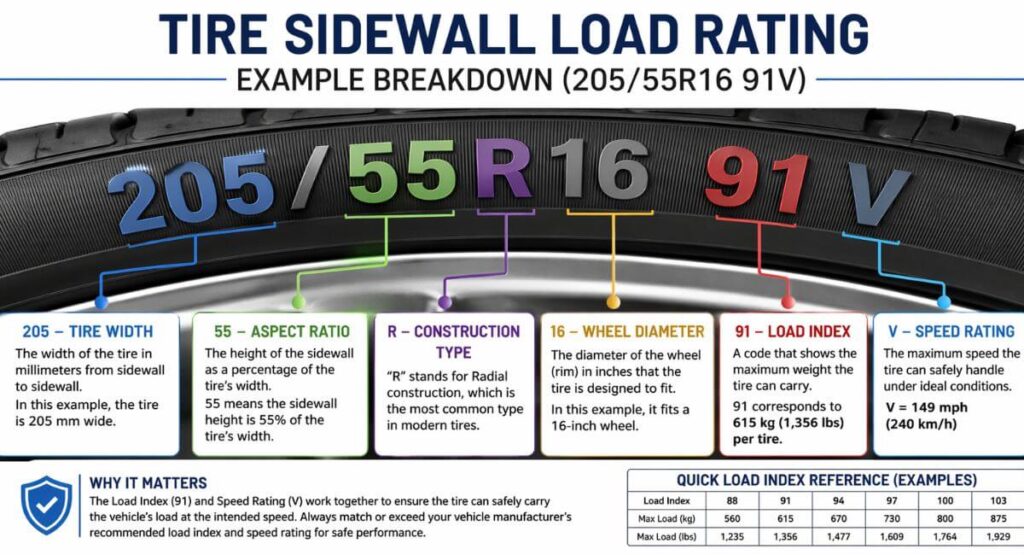
How to Read Tire Sidewall Load Rating
Example Breakdown (205/55R16 91V)
When you look at a tire, you’ll see a code like 205/55R16 91V written on the side. At first, it looks confusing, but each part has a simple meaning.
The first part, 205, is the width of the tire in millimeters. It tells you how wide the tire is from one side to the other.
The next number, 55, is the height of the tire side compared to its width. A lower number usually means a shorter sidewall, which can feel a bit sportier but slightly less soft on bumps.
The R16 means the tire fits a 16-inch wheel. This must match your car’s rim size, or the tire won’t fit properly.
The last part, 91V, is the most important for this topic. The 91 is the load rating, which tells you how much weight the tire can carry. The V is the speed rating, which shows how fast the tire is safely designed to go.
So in simple terms, the load rating is just one small part of the full code, but it carries a very important safety meaning.
Max Load & Max Pressure Markings
Some tires also show extra information like “Max Load” and “Max Pressure” on the sidewall. These give you direct numbers instead of codes.
For example, you might see something like:
“Max Load: 615 kg (1356 lbs)”
“Max Pressure: 44 PSI”
The max load tells you the highest weight the tire can safely carry when used correctly. The max pressure tells you the highest air pressure the tire can handle without damage.
It’s important not to confuse max pressure with recommended pressure. The recommended PSI for daily driving is usually lower and is listed on your car’s door sticker, not on the tire itself.
Speed Rating vs Load Rating
Speed rating and load rating are two different limits, but they work together.
The load rating tells you how much weight the tire can carry safely. The speed rating tells you how fast you can drive on that tire safely.
A tire might be strong enough to carry heavy weight, but still not be designed for very high speeds. On the other hand, a high-speed tire may not always have the highest load capacity.
In real driving, both matter. If you exceed either limit—too much weight or too much speed—you reduce safety. The tire can heat up more, wear faster, or lose grip.
So even though they measure different things, they both work together to keep your driving safe and stable.
Load Index vs Load Range (Key Differences)
People often confuse load index and load range because both talk about how much weight a tire can carry. But they are not the same system. They are used in different types of tires and in different ways.
Load index is a number-based system mostly used on regular passenger car tires. Load range is a letter-based system used more on trucks and heavy-duty vehicles. One gives a precise weight value, while the other gives a strength category.
Here’s a simple comparison to make it clear:
| Feature | Load Index | Load Range |
| Format | Numeric (e.g., 91, 95, 100) | Letter (e.g., C, D, E) |
| Vehicle Type | Passenger cars, small SUVs | Pickup trucks, heavy SUVs, vans |
| Meaning | Exact weight capacity per tire | Overall strength and pressure capacity |
| Precision | Very specific and exact | More general strength level |
| Focus | How much weight it can carry | How tough the tire is built |
Load index is more precise because each number matches a specific weight limit. This makes it easy to calculate total load for a car.
Load range is less exact but more practical for heavy-duty use. It tells you how strong the tire is overall, especially when carrying heavy loads or using higher air pressure.
One small drawback is that load range doesn’t give exact weight numbers like load index. So you need a bit more experience or reference charts to understand it fully.
In simple terms, load index is about exact numbers, while load range is about strength categories.
How to Calculate Tire Load Capacity
A simple way to estimate total tire capacity is to look at the load rating of one tire and multiply it by four. That gives you a rough total for all four tires.
For example, if one tire has a load index of 91, that tire can carry about 615 kg. Four tires at that rating could support about 2,460 kg in total.
That number is only a rough total, though. It is not the same as your actual payload capacity. The vehicle’s axle limits, suspension, passenger weight, fuel, cargo, and towing all matter too.
So this calculation is helpful, but it should not replace the vehicle’s own weight ratings. Think of it as a quick check, not the final answer.
Single vs Dual Tire Load Rating
Some trucks use single tires, while others use dual tires on the same axle. Dual tires are the pairs of tires you sometimes see on the back of a heavy truck.
A tire’s rating can change depending on whether it is being used alone or as part of a dual setup. That is because two tires sharing the load do not behave exactly the same as one tire carrying the load by itself.
This is important for trucks and commercial vehicles. A tire that looks fine in a single setup may have a different limit in a dual setup.
If your vehicle uses dual rear tires, always check the exact tire information from the manufacturer or the tire sidewall. Do not assume the rating is the same in both cases.
What Happens If Tire Load Rating Is Wrong
If the load rating is too low for the job, the tire may overheat, wear out faster, and fail under heavy use. This can become dangerous quickly, especially at highway speed or when towing.
A tire that is rated higher than needed is usually not a safety problem by itself, but it may feel a little stiffer. Some drivers notice a firmer ride or slightly less comfort.
The real problem is usually using a tire that is too weak for the vehicle. That is the one to avoid.
Real-World Factors That Affect Tire Load Capacity
The load rating printed on the tire is not the whole story. Real driving conditions matter too.
High speed can build heat inside the tire. Hot weather can add even more heat. Rough roads, long trips, heavy cargo, and towing all put extra stress on the tire.
Underinflation is another big issue. Even a tire with a strong load rating can become unsafe if the pressure is too low.
That is why the number on the sidewall is only part of the picture. The way you use the tire matters just as much.
How to Choose the Right Tire Load Rating
Choosing the right tire load rating is not complicated, but it does need a bit of attention. The goal is simple: make sure your tires can safely handle your car’s weight in real driving conditions.
Step-by-Step Guide
Start with your vehicle manual. It clearly tells you the correct tire size and load rating your car was designed for. This is always the safest starting point.
Next, check the OEM tire specs. OEM means the original tires your car came with from the factory. These give you a good baseline for what your car needs.
After that, make sure the new tire matches or goes slightly above the recommended load index. Going lower is risky because the tire may not handle the weight safely.
Finally, think about your driving conditions. If you often carry passengers, luggage, or drive on rough roads, a slightly higher load rating can give extra safety and durability.
The key idea is simple: never go below the recommended rating, but going a bit higher is usually fine.
Load Rating for Different Vehicles
Different vehicles need different levels of tire strength, and this is where load rating becomes important.
For a sedan, the load needs are usually lower. These cars are designed for everyday driving with light to moderate weight, so standard passenger tire ratings are usually enough.
For an SUV, the load rating should be a bit higher. SUVs are heavier and often carry more passengers or cargo, so they need stronger tires for stability and safety.
Pickup trucks need even stronger tires. These vehicles are often used for towing or carrying heavy loads, so a higher load range or load index is important to avoid tire stress.
Commercial vehicles have the highest demands. They carry heavy cargo regularly, so they need the strongest tires available within their category. In these cases, durability matters as much as weight capacity.
One thing to remember is that using the wrong rating can affect safety, tire life, and comfort. So it’s always better to match your vehicle type carefully instead of guessing.
Complete Tire Load Rating Chart (All-in-One Summary)
This table brings everything together in one place. It’s not meant to replace detailed charts, but it gives you a quick, practical overview you can refer to anytime.
| Load Index | Max Load (kg) | Load Range | Ply Rating (Approx.) | Typical PSI Range | Common Use |
| 85 | 515 kg | B | 4 Ply | 30–35 PSI | Small cars |
| 90 | 600 kg | C | 6 Ply | 35–50 PSI | SUVs, light trucks |
| 95 | 690 kg | C | 6 Ply | 35–50 PSI | SUVs, crossovers |
| 100 | 800 kg | D | 8 Ply | 50–65 PSI | Pickup trucks |
| 105 | 925 kg | D | 8 Ply | 50–65 PSI | Heavy SUVs |
| 110 | 1060 kg | E | 10 Ply | 65–80 PSI | Heavy-duty trucks |
| 115 | 1215 kg | E | 10 Ply | 65–80 PSI | Towing, hauling |
| 120 | 1400 kg | F | 12 Ply | 80–95 PSI | Commercial vehicles |
How to Use This Table
You don’t need to memorize everything here. Just use it as a quick reference when comparing tires.
- If you’re driving a regular car, focus on the load index and recommended PSI.
- If you have an SUV or pickup, pay attention to load range and ply rating too.
- If you’re doing heavy work or towing, higher load range and PSI matter more.
Common Mistakes to Avoid
A few simple mistakes cause a lot of tire problems.
One is choosing a tire with a lower load rating than the vehicle needs. Another is thinking that maximum PSI is the same as recommended PSI. They are not the same.
A third mistake is assuming that a tire is fine just because it fits the wheel. Size and load rating are separate. A tire can fit and still be wrong for the vehicle.
It is also easy to ignore the extra weight from passengers, luggage, tools, or towing. That can push a tire past its safe limit even when the car itself seems normal.
Conclusion
Understanding tire load rating isn’t just about numbers—it’s about safety and making the right choice for your vehicle.
When you know how to read load index and load range, you can confidently choose tires that match your needs. Always follow your vehicle manufacturer’s recommendations, keep your tires properly inflated, and never ignore load limits.
A little knowledge here can save you from big problems later—and keep every drive safer and smoother.
