Tire UTQG Rating Chart: UTQG Ratings Explained
Last updated on August 14th, 2026
If you have ever looked at a tire sidewall and seen a number followed by two letters, you have probably come across a UTQG rating.
UTQG stands for Uniform Tire Quality Grading. It provides comparative information about three specific aspects of applicable passenger-car tire performance: treadwear, traction, and temperature resistance.
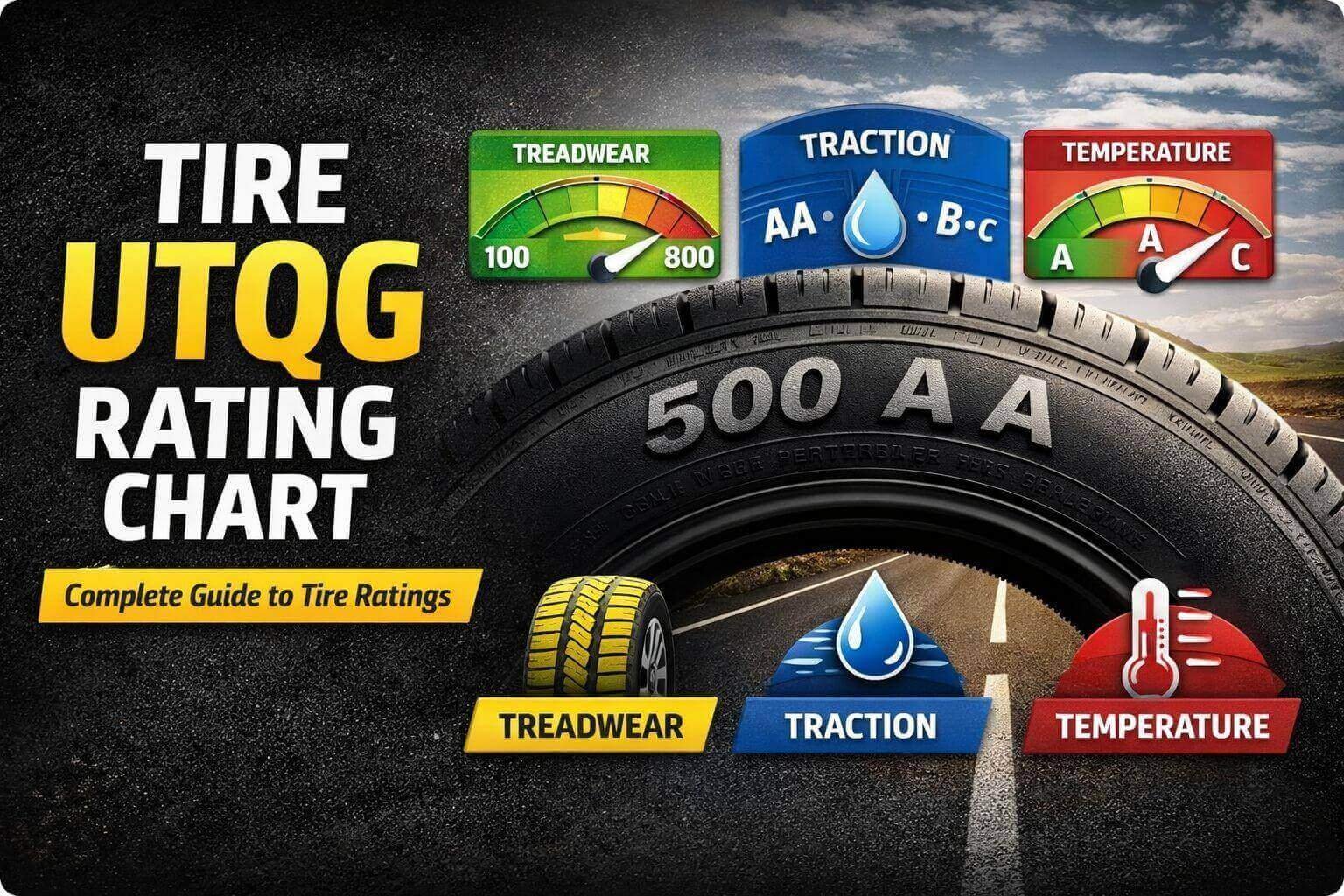
A typical UTQG marking might look like 600 A A. The 600 is the treadwear grade, the first A is the traction grade, and the second A is the temperature grade.
These ratings can be useful when comparing tires, but UTQG is not an overall tire-quality score. Each part measures something different under defined testing conditions.
This guide explains how to read a Tire UTQG Rating Chart, what the three ratings mean, how they are tested, and what UTQG does—and does not—tell you about a tire.
Tire UTQG Rating Chart
| UTQG Component | Rating / Range | Relative Level | What the Rating Means |
| Treadwear | Below 200 | Lower relative wear rating | Indicates a lower relative treadwear grade compared with higher-rated tires under the UTQG test |
| Treadwear | 200–300 | Moderate relative wear rating | Indicates greater relative treadwear performance than ratings below 200 |
| Treadwear | 301–400 | Higher relative wear rating | Indicates greater relative treadwear performance than lower-numbered grades |
| Treadwear | 401–500 | Higher relative wear rating | Indicates greater relative treadwear performance than lower-numbered grades |
| Treadwear | 501–600 | High relative wear rating | Indicates greater relative treadwear performance than lower-numbered grades |
| Treadwear | 601+ | Higher relative wear rating | Indicates greater relative treadwear performance than lower-numbered grades |
| Traction | AA | Highest | Highest UTQG traction grade; based on controlled wet straight-line braking tests |
| Traction | A | Second-highest | Higher traction grade than B or C under the UTQG test |
| Traction | B | Lower | Lower traction grade than A or AA under the UTQG test |
| Traction | C | Lowest | Lowest UTQG traction grade; represents the lowest level in the UTQG scale |
| Temperature | A | Highest | Highest UTQG temperature-resistance grade |
| Temperature | B | Intermediate | Intermediate temperature-resistance grade |
| Temperature | C | Lowest | Lowest UTQG temperature-resistance grade; the minimum level required for applicable passenger-car tires |
Important: UTQG measures specific characteristics under defined test conditions. It is not an overall tire-quality score and should not be used by itself to predict mileage, complete wet-weather performance, or a tire’s overall suitability for your vehicle.
UTQG Ratings Explained
A UTQG marking such as 600 A A contains three separate ratings. Reading them from left to right makes the marking easier to understand: the number represents treadwear, the first letter represents traction, and the second letter represents temperature.
600 → Treadwear
The 600 is the tire’s treadwear grade. It is a relative comparison based on the UTQG treadwear test, with higher numbers generally indicating greater relative treadwear performance than lower numbers.
The important point is that 600 does not mean 60,000 miles. UTQG treadwear is not a mileage prediction or a guarantee of how long the tire will last on your vehicle.
A → Traction
The first A is the tire’s UTQG traction grade. It indicates the tire’s performance in the specified wet straight-line braking test.
The traction scale runs from AA to C, with AA the highest grade. However, this rating should not be treated as an overall wet-weather score because it does not fully describe cornering grip, hydroplaning resistance, or snow and ice performance.
A → Temperature
The second A is the temperature grade. It indicates the tire’s resistance to heat under the specified UTQG temperature test conditions.
The temperature scale runs from A to C, with A the highest grade. A temperature grade should not be interpreted as a universal safe-speed recommendation; actual operating conditions, tire condition, inflation, vehicle load, and other factors also matter.
What Does the Treadwear Number Mean?
The treadwear number is the numerical part of a tire’s UTQG rating. It indicates the tire’s relative treadwear performance compared with the standardized reference used for the UTQG test. In general, a higher number indicates greater relative wear resistance under comparable test conditions.
For example, a tire rated 600 has a higher relative treadwear rating than one rated 400. But that does not mean the 600-rated tire will last 50% longer in everyday driving.
That is because UTQG treadwear is designed for comparison, not exact mileage prediction. NHTSA specifically notes that actual tire mileage can vary with factors such as driving style, road conditions, weather, and maintenance.
So, avoid treating a treadwear number as a mileage figure. A 600 rating does not mean 60,000 miles, and there is no reliable formula that converts the number directly into the mileage you should expect from your tires.
The best way to use the number is to compare tires tested under the same UTQG system, while remembering that real-world wear can differ considerably.
For a detailed breakdown of treadwear numbers and how to compare them, see our [Treadwear Rating Chart].
What Does the Traction Rating Mean?
The UTQG traction grade tells you how well a tire can stop on wet pavement under the specified UTQG test conditions. The grades run from AA to C, with AA the highest and C the lowest.
| Traction Grade | What It Indicates |
| AA | Highest UTQG traction grade |
| A | Second-highest grade |
| B | Lower traction grade |
| C | Lowest traction grade |
A higher grade generally means the tire produced stronger wet-braking performance in the standardized test. The test evaluates traction on wet asphalt and wet concrete, allowing the grades to provide a consistent basis for comparison.
For example, an AA-rated tire demonstrated higher measured wet traction than an A-rated tire under the UTQG criteria. That makes AA the higher grade, but it does not mean the tire will always stop sooner in every real-world situation.
What the Traction Grade Does Not Tell You
This is where the UTQG traction rating needs some context. It is based on straight-ahead wet braking, not a complete evaluation of wet-weather handling.
The rating does not measure acceleration traction, cornering grip, hydroplaning resistance, peak traction, or performance on snow and ice.
So, if two tires have AA traction ratings, you should not assume they will have identical wet cornering or hydroplaning performance. The UTQG grade simply tells you how they compare within this specific standardized traction test.
In practical terms, use the traction grade as one useful comparison point—not as a complete wet-weather performance rating.
What Does the Temperature Rating Mean?
The UTQG temperature grade indicates a tire’s ability to resist heat buildup and dissipate heat under the conditions of the standardized temperature test. Excessive heat can contribute to tire degradation, so temperature resistance is an important part of tire performance.
The temperature grades are:
| Temperature Grade | Relative Grade |
| A | Highest |
| B | Intermediate |
| C | Lowest |
A tire with a Grade A temperature rating performed better than a Grade B or C tire in the applicable UTQG temperature test. However, the grade is a test-based comparison, not a statement that the tire can safely operate at any particular speed or temperature.
What the Temperature Grade Does Not Tell You
A common mistake is to treat Temperature A as a high-speed rating. It is not.
The temperature grade should not be confused with the tire’s speed rating, which is a separate specification. A tire’s actual operating conditions depend on factors such as inflation pressure, vehicle load, speed, ambient temperature, road conditions, and tire condition.
The grade also does not tell you how a tire will handle, brake, or corner. Those characteristics require other performance information.
In practical terms, use the temperature grade to understand a tire’s relative heat-resistance performance under UTQG testing, while relying on the tire’s speed rating and vehicle manufacturer’s requirements for operating limits.
How UTQG Ratings Are Tested
UTQG ratings are based on specific standardized tests, but the three ratings are not measuring the same thing. Treadwear, traction, and temperature each evaluate a different aspect of tire performance.
Treadwear is determined through a controlled comparison test against a government-designated reference tire. The resulting number is a relative wear rating, not an estimate of how many miles the tire will last on your vehicle.
Traction is evaluated through wet-braking testing on specified pavement surfaces. The test measures the tire’s ability to generate traction during straight-line braking, which is why the resulting AA, A, B, or C grade should not be treated as a complete measure of wet-weather handling.
Temperature evaluates a tire’s resistance to heat generation and its ability to dissipate heat under the specified test conditions. The resulting A, B, or C grade reflects the tire’s performance in that test rather than establishing a universal operating-speed limit.
One important point is that UTQG test results are useful for comparison, but they cannot predict exactly how a tire will perform or wear on every vehicle and road. Driving habits, climate, road surfaces, inflation pressure, vehicle condition, and maintenance can all affect real-world results.
That is why UTQG works best as one part of a tire comparison, rather than as a complete measure of tire quality.
How to Read UTQG Ratings on a Tire Sidewall
You can usually find the UTQG information on the tire sidewall. It appears as a treadwear number followed by traction and temperature grades, such as:
TREADWEAR 600 TRACTION A TEMPERATURE A
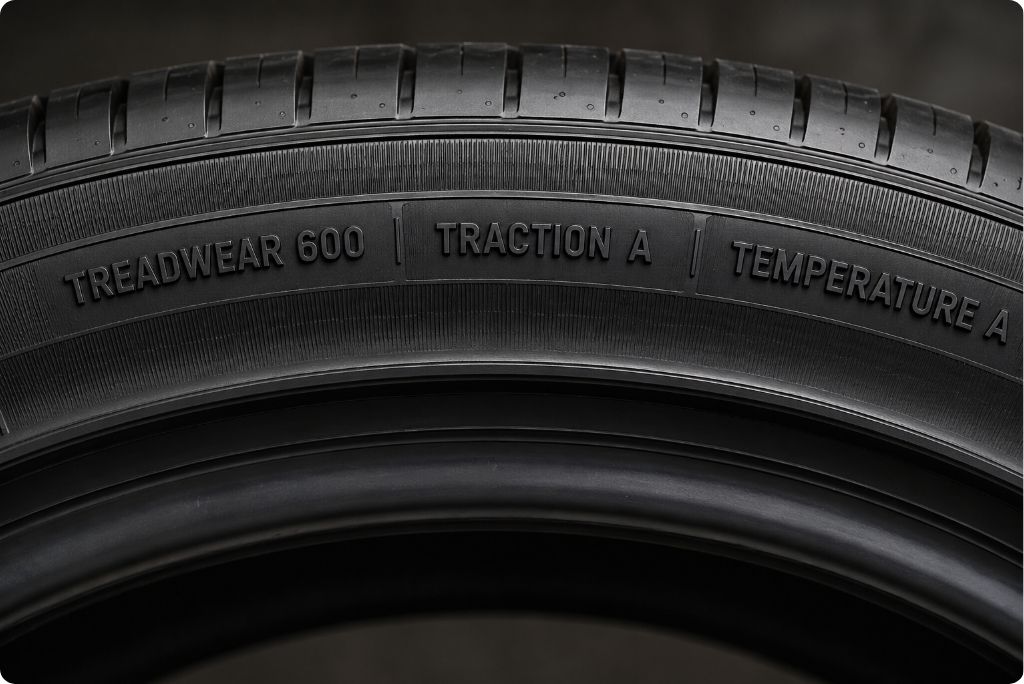
Reading this marking is straightforward once you know what each part represents.
600 — Treadwear: This is the tire’s relative treadwear grade. A higher number generally indicates greater relative wear performance under the UTQG comparison system. It is not a mileage rating.
A — Traction: This is the tire’s UTQG traction grade, which reflects performance in the specified wet straight-line braking test. The scale runs from AA to C.
A — Temperature: This is the tire’s temperature grade, reflecting resistance to heat under the specified UTQG test conditions. The scale runs from A to C.
So, 600 A A does not produce one overall score. It gives you three separate pieces of information about the tire.
When checking a tire in person, look for the “TREADWEAR,” “TRACTION,” and “TEMPERATURE” markings rather than assuming that every number or letter on the sidewall is part of the UTQG rating. Tire size, load index, speed rating, DOT information, and other markings appear nearby but serve different purposes.
Tip: If you are comparing two tires, write down all three UTQG ratings. Comparing the complete set is more useful than focusing on the treadwear number alone.
How to Compare UTQG Ratings Between Tires
UTQG ratings are most useful when you compare the same three categories side by side rather than looking for one “best” number.
For example:
| Tire | Treadwear | Traction | Temperature |
| Tire A | 600 | A | A |
| Tire B | 400 | AA | A |
At first glance, neither tire is automatically the better choice.
Tire A has the higher treadwear number, which indicates greater relative treadwear performance in the UTQG comparison. Tire B has the higher traction grade, while both tires have the same temperature grade.
This illustrates why UTQG should not be treated as a single overall score. A tire can have a higher treadwear rating but a lower traction grade, or vice versa.
Compare Ratings Based on What Matters to You
If long-term wear is an important consideration, the treadwear number can help you compare relative wear performance. If wet straight-line braking is a bigger concern, the traction grade provides another useful comparison.
Temperature can also help distinguish tires, but it should be considered alongside the tire’s speed rating and intended use, rather than used as a substitute for them.
There is another important limitation: UTQG ratings do not capture every part of real-world tire performance. Two tires with similar—or even identical—UTQG ratings can still differ in ride comfort, road noise, dry handling, wet cornering, snow performance, and other characteristics.
For that reason, use UTQG as a comparison tool, not a final verdict. Check the tire’s size, load and speed ratings, intended application, warranty, independent testing, and real-world reviews before making your final choice.
Does UTQG Predict Tire Mileage?
No.
The treadwear number is a relative comparison from the UTQG system, not a mileage guarantee.
A 600 treadwear rating does not mean 60,000 miles. Actual tread life can vary because tires are used under different vehicles, roads, climates, loads, inflation pressures, maintenance conditions, and driving habits.
A manufacturer treadwear warranty is also different from the UTQG treadwear grade. A warranty states the manufacturer’s coverage under specific terms; it is not a conversion of the UTQG number into expected tire life.
Does UTQG Predict Tire Mileage?
No.
The treadwear number is a relative comparison from the UTQG system, not a mileage guarantee.
A 600 treadwear rating does not mean 60,000 miles. Actual tread life can vary because tires are used under different vehicles, roads, climates, loads, inflation pressures, maintenance conditions, and driving habits.
A manufacturer treadwear warranty is also different from the UTQG treadwear grade. A warranty states the manufacturer’s coverage under specific terms; it is not a conversion of the UTQG number into expected tire life.
What UTQG Does Not Tell You
UTQG covers three specific areas, but it does not provide a complete picture of a tire.
It does not fully describe:
- Dry handling
- Steering response
- Ride comfort
- Road noise
- Wet cornering
- Hydroplaning resistance
- Snow and ice performance
- Fuel efficiency
- Exact real-world tread life
The limitation is especially important with traction. An AA grade is the highest UTQG traction grade, but the traction test is focused on the specified wet straight-line braking procedure rather than every type of wet-road performance.
The same principle applies to treadwear. A high treadwear number tells you about relative wear performance under the UTQG system, but it cannot tell you exactly how many miles the tire will deliver on your vehicle.
Common UTQG Misconceptions
“A 600 treadwear rating means 60,000 miles.”
No. The number is a relative treadwear grade, not a mileage figure.
“AA traction means the tire is best in every wet condition.”
No. AA is the highest UTQG traction grade, but the test focuses on wet straight-line braking and does not cover every aspect of wet performance.
“Temperature A means the tire has a higher speed rating.”
No. Temperature grade and speed rating are separate specifications.
“The highest UTQG combination is always the best tire.”
No. UTQG covers only three specific characteristics. Vehicle fitment, intended use, climate, and other performance factors also matter.
“Two tires with the same UTQG ratings will perform identically.”
Not necessarily. Tires can have identical UTQG ratings while differing in handling, comfort, noise, winter performance, and real-world tread life.
How to Use UTQG When Buying Tires
UTQG works best as a comparison tool, not as the final decision.
First, confirm that the tire has the correct size, load index, and speed rating for your vehicle.
Then use UTQG to compare the characteristics it actually measures:
- Treadwear for relative wear performance
- Traction for wet straight-line braking
- Temperature for heat-resistance performance under the UTQG test
After that, consider the factors UTQG does not cover.
Think about your climate, road conditions, driving style, winter requirements, desired ride quality, and how much you value handling versus tread life.
Check the manufacturer’s warranty and credible independent testing or reviews when available.
The goal is not to find the tire with the biggest number or highest letter grade. The goal is to find the tire whose complete performance profile fits the way you drive.
When evaluating an existing tire, remember that its UTQG treadwear grade is different from its current tread condition. Checking the tire tread depth can help you determine how much usable tread remains.
FAQs About UTQG Ratings
What does UTQG mean on a tire?
UTQG stands for Uniform Tire Quality Grading. It provides comparative information about treadwear, traction, and temperature for applicable passenger-car tires.
What is a good UTQG rating?
There is no single UTQG combination that is best for every driver. The useful rating depends on which characteristic you are comparing and what you need from the tire.
What does UTQG 500 mean?
A 500 treadwear grade represents a relative treadwear value within the UTQG system. It does not mean 50,000 miles.
What does 600 AA A mean?
600 is the treadwear grade, AA is the traction grade, and A is the temperature grade. They are three separate ratings, not one overall score.
Is AA traction better than A?
Yes. AA is the highest UTQG traction grade, followed by A, B, and C.
What does temperature A mean?
Temperature A is the highest UTQG temperature grade. It represents the highest level in the applicable temperature-resistance grading scale.
Can I compare UTQG ratings between tire brands?
Yes, but use the ratings as one part of the comparison. Tires can have similar UTQG ratings while differing in characteristics that the system does not measure.
Why don’t some tires have UTQG ratings?
Certain tire categories are excluded from the UTQG requirements, including specific winter-type and temporary-use tires.
Final Takeaway
The Tire UTQG Rating Chart gives you a useful way to compare three specific aspects of tire performance: treadwear, traction, and temperature.
Remember what each part means:
- Treadwear: relative wear performance—not a mileage guarantee.
- Traction: wet straight-line braking performance—not a complete wet-weather score.
- Temperature: heat-resistance performance under the UTQG test—not a universal speed rating.
UTQG is most useful when you treat it as one part of the tire-buying decision. Check the tire’s size, load and speed ratings, intended use, warranty, and other real-world performance information before choosing a tire.
A higher UTQG rating can be useful in a specific category, but there is no single UTQG combination that makes a tire the best choice for every driver or vehicle.
