H vs T Speed Rating
If you are shopping for new tires, you may have noticed the letters H and T printed in the tire size information. At first, these letters can look confusing, but they actually tell you something important about how the tire is built to perform.
The main difference between H vs T speed rating is simple: both ratings show how much speed a tire can handle safely, but they are designed for slightly different driving needs. One is more focused on comfort and everyday use, while the other gives a bit more room for higher-speed driving and sharper handling.
In this guide, we will explain what those ratings mean, how they compare in real life, and how to choose the right one for your vehicle. The goal is not just to define the terms, but to help you make a smart and confident decision.
What a Tire Speed Rating Means
A tire speed rating is a letter that shows the maximum speed a tire is designed to handle safely under normal driving conditions. You can find this rating on the tire sidewall, usually as part of the tire size information.
The rating is based on tests that measure how well a tire performs at higher speeds while carrying its rated load. A higher speed rating generally means the tire is built to handle more heat and stress.
However, a speed rating is not a measure of overall tire quality. A higher-rated tire is not automatically the best choice for every driver. Some tires with lower speed ratings may offer a smoother ride, longer tread life, or a lower price.
When choosing tires, the speed rating should be considered alongside other factors such as your vehicle’s requirements, driving habits, comfort preferences, and budget. The goal is to choose a tire that matches how you actually drive, not simply the one with the highest rating.
H vs T Speed Rating: Quick Comparison
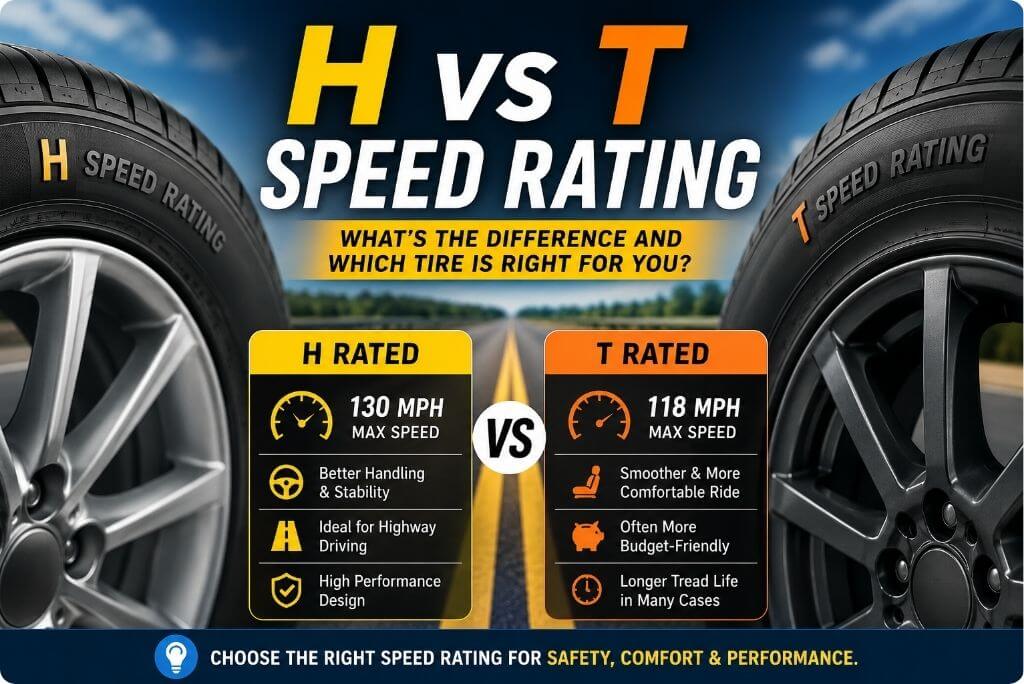
Here is the simple version: T-rated tires are built for up to 118 mph, while H-rated tires are built for up to 130 mph. Tire makers and retailers also group them a little differently in practice: T is commonly used for family sedans and vans, while H is often found on sport sedans and coupes.
| Feature | T Rating | H Rating |
| Maximum speed | Up to 118 mph | Up to 130 mph |
| Handling feel | Usually more relaxed | Usually more responsive |
| Ride comfort | Often softer and quieter | Often a bit firmer |
| Tire construction | More comfort-focused | More performance-focused |
| Price | Often the lower-cost choice | Often costs more |
T-rated tires are usually a good fit for drivers who want a comfortable, everyday tire for commuting, family driving, and normal highway use. H-rated tires are usually a better match for drivers who want sharper steering feel, a little more stability at higher speeds, and a more performance-oriented tire.
One important note: the letter by itself does not decide everything. Tire size, tread design, brand, and your vehicle’s factory recommendation matter too, so the best choice is the one that matches how you actually drive.
What Is a T Speed Rating?
A T speed rating means a tire is designed to safely handle speeds of up to 118 mph under proper conditions. While most drivers will never come close to that speed, the rating also gives clues about how the tire is built and what kind of driving it is intended for.
T-rated tires are commonly found on family sedans, minivans, and small SUVs. They are designed for everyday driving, including commuting, city traffic, and regular highway travel.
One reason many drivers choose T-rated tires is comfort. These tires are often tuned to provide a smooth ride and predictable handling during normal driving. They can also be a more affordable option than higher-rated tires.
That said, T-rated tires are not built with the same performance focus as H-rated tires. They may not feel as responsive during quick steering inputs or provide the same level of stability at higher speeds.
For drivers who mainly use their vehicle for daily transportation and want a comfortable, practical tire, a T-rated tire is often a good fit.
What Is an H Speed Rating?
An H speed rating means a tire is designed to safely handle speeds of up to 130 mph under proper conditions. While few drivers ever reach those speeds, the rating also reflects a tire that is built with a greater focus on performance and control.
H-rated tires are commonly used on sedans, crossovers, and some sporty vehicles. They are often chosen by drivers who spend a lot of time on highways or prefer a more confident and responsive driving feel.
One of the main benefits of an H-rated tire is improved handling. Steering often feels more precise, and the tire can provide better stability during lane changes, curves, and higher-speed driving. Many drivers notice that the vehicle feels more planted on the road.
The trade-off is that H-rated tires may cost more than comparable T-rated tires. Depending on the tire design, the ride may also feel slightly firmer, which some drivers enjoy while others may prefer a softer, comfort-focused feel.
For drivers who want a balance of everyday comfort and stronger road performance, H-rated tires are often a solid choice.
Main Differences Between H and T Rated Tires
Speed Capability
The most obvious difference is the maximum speed each tire is designed to handle. T-rated tires are rated up to 118 mph, while H-rated tires are rated up to 130 mph.
Even if you never drive anywhere near those speeds, the rating still matters. Tires built for higher speed capability are often designed to handle more heat and stress, which can affect how they feel and perform on the road.
Handling and Steering Feel
Many drivers notice the biggest difference in handling.
H-rated tires often provide a more responsive feel when steering. The vehicle may feel more stable during lane changes and more controlled on winding roads.
T-rated tires usually focus more on everyday comfort. Steering may feel slightly less sharp, but many drivers find them perfectly suitable for daily commuting and normal highway driving.
Ride Comfort
In many cases, T-rated tires deliver a softer and smoother ride. They are often chosen by drivers who prioritize comfort over sporty handling.
H-rated tires can sometimes feel a little firmer because of their performance-oriented design. This is not always a bad thing—it often contributes to better road control—but some drivers may prefer the more relaxed feel of a T-rated tire.
Tread Life and Durability
Speed rating alone does not determine how long a tire will last.
Tread life depends on several factors, including the tire’s rubber compound, driving habits, road conditions, tire pressure, alignment, and regular maintenance.
A well-maintained H-rated tire can outlast a neglected T-rated tire, so it is important to look at the tire’s overall design and treadwear rating rather than focusing only on the speed rating.
Price Difference
H-rated tires often cost more because they are built to deliver higher levels of performance and stability.
For some drivers, the extra cost is worth it because they prefer the improved handling and road feel. For others, a T-rated tire provides everything they need at a lower price.
The best value is not necessarily the cheaper tire or the more expensive one—it’s the tire that matches how you actually use your vehicle.
Which One Should You Choose?
The safest place to start is your vehicle’s manual or tire placard. If the car came with a specific speed rating, that is usually the best choice unless a tire professional tells you otherwise.
From there, think about how you drive. If you mostly drive in the city and want a smooth, quiet ride, a T-rated tire often makes sense. If you spend more time on highways or like a tire that feels more stable and responsive, H-rated tires are often the better fit.
For mixed daily use, either can work well. The right choice depends less on which rating is “higher” and more on what matters most to you: comfort, handling, price, or the way your vehicle was originally designed.
In the end, the best tire is the one that matches your driving habits and your car’s requirements. A higher rating does not always mean better for your situation.
Can You Replace H-Rated Tires With T-Rated Tires?
In some cases, replacing H-rated tires with T-rated tires may be possible, but it is not always the best choice. Before making any change, check your vehicle owner’s manual or the tire information placard, usually found inside the driver’s door.
If your vehicle was originally equipped with H-rated tires, the manufacturer selected that rating for a reason. Switching to a lower speed rating could change how the vehicle handles and performs, especially during highway driving.
For drivers who mainly use their vehicle for short trips and everyday commuting, the difference may not seem noticeable at first. However, lowering the speed rating below the manufacturer’s recommendation can reduce the level of performance the vehicle was designed to have.
In most situations, matching the original tire specification is the safest and simplest option. It helps ensure the vehicle performs as intended and avoids potential compromises in handling, stability, or overall driving feel.
If you’re considering a different speed rating, it’s worth confirming that the replacement tire meets your vehicle’s requirements before making a purchase.
Common Mistakes Drivers Make
One common mistake is choosing tires only by price. A cheaper tire may save money today, but it may also ride worse, wear faster, or feel less stable than a better-matched option.
Another mistake is thinking a higher speed rating always means a better tire. It does not. A tire should match the vehicle and the way you drive, not just the highest number on the sidewall.
Many drivers also ignore the vehicle maker’s recommendation. That can lead to tires that do not fit the car’s intended balance of comfort, control, and safety.
It is also easy to confuse speed rating with load index. Speed rating tells you how fast the tire can safely go, while load index tells you how much weight it can carry. They are not the same thing.
The last mistake is not thinking about real use. A tire that works well for highway driving may not be the best choice for short city trips, and a comfort-focused tire may not suit a driver who wants sharper handling.
Read More: W vs Y Speed Rating: What’s the Difference?
Simple Buying Guide for Everyday Drivers
Before choosing between H and T, ask yourself a few simple questions:
- What does my owner’s manual recommend?
- Do I want more comfort or more handling?
- Do I drive mostly in the city or on highways?
- Am I trying to save money, or do I want the original driving feel?
- Do I often carry passengers or drive long distances?
If comfort and value are your top priorities, T-rated tires may be enough. If you want a more planted feel and more confidence at higher speeds, H-rated tires may be the better fit.
The best choice is the one that matches how you really drive, not how you imagine driving.
Final Recommendation
The difference between H vs T speed rating is not just about top speed. It is about how the tire is built and what kind of driving experience it is meant to support.
In simple terms, T-rated tires are usually the comfort-focused choice for everyday driving, while H-rated tires are the more performance-oriented choice with better highway stability and steering feel.
If your vehicle recommends one of these ratings, follow that guidance first. Then choose based on comfort, driving habits, and budget. That approach will help you buy tires that feel right, last well, and keep your car driving the way it should.
Read More: V vs H Speed Rating
FAQ
1. Is H better than T?
Not always. H is better if you want more responsive handling and higher-speed stability. T is better if you want a softer ride and a more comfort-focused tire.
2. Are T-rated tires safer than H-rated tires?
No. Both can be safe when they are the correct tire for the vehicle and used properly. Safety depends on choosing the right tire for the car, maintaining proper pressure, and driving responsibly.
3. Do H-rated tires wear out faster?
Not necessarily. Tire wear depends on many factors, including driving style, road conditions, tire maintenance, and the specific tire design. The speed rating alone does not decide tread life.
4. Can I mix H and T tires on the same vehicle?
It is usually best to avoid mixing different speed ratings unless a tire professional or the vehicle maker says it is acceptable. Tires should be matched as closely as possible for balanced handling.
5. Which speed rating is better for daily driving?
For many daily drivers, both can work well. T-rated tires are often a great choice for comfort and value. H-rated tires are a better choice if you want a little more responsiveness and highway confidence.
