Tire Rotation Pattern: Which Pattern Is Right for Your Vehicle?
Last updated on September 8th, 2026
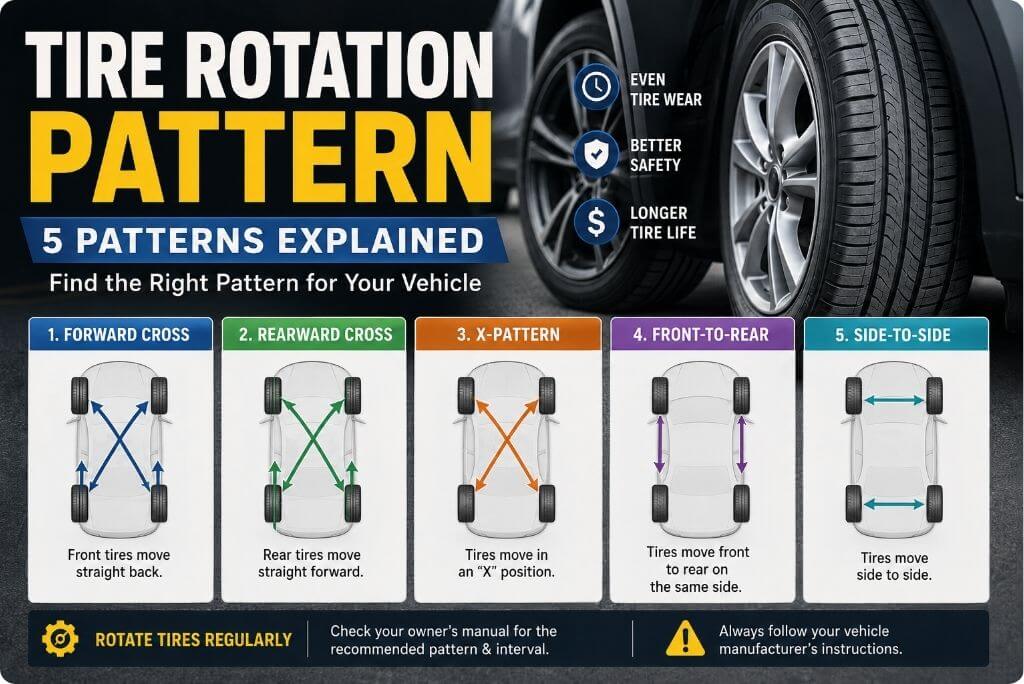
The correct tire rotation pattern depends on your tire size, tread design, wheel setup, and vehicle manufacturer’s recommendations. For four same-size, non-directional tires, Forward Cross is commonly used on front-wheel-drive vehicles, while Rearward Cross is commonly used on many rear-wheel-drive and four-wheel-drive vehicles. An X-pattern may also be appropriate when approved by the vehicle or tire manufacturer.
Directional tires generally require Front-to-Rear rotation on the same side, while staggered setups may allow Side-to-Side rotation. Before moving any tire, check the tire’s direction arrows, INSIDE/OUTSIDE markings, tire sizes, and your owner’s manual.
The pattern that fits your drivetrain is not always the pattern that fits your tires.
Quick Tire Rotation Pattern Chart
Use this chart as a starting point, then confirm the pattern in your owner’s manual. Tire direction, tire size, wheel position, and tread design can override the usual drivetrain-based pattern.
| Tire & Vehicle Setup | Common Rotation Pattern | What to Check First |
| FWD + 4 same-size, non-directional tires | Forward Cross | Confirm the tires are non-directional and all four positions use the same size |
| RWD + 4 same-size, non-directional tires | Rearward Cross | Confirm the vehicle manufacturer allows cross-rotation |
| 4WD + 4 same-size, non-directional tires | Rearward Cross or manufacturer-approved pattern | Follow the vehicle’s recommended rotation procedure |
| AWD + 4 same-size, non-directional tires | Manufacturer-approved cross pattern | Do not assume one pattern is correct for every AWD vehicle |
| 4 same-size, directional tires | Front-to-Rear | Keep each tire on the same side so its rolling direction does not change |
| Staggered, non-directional tires | Side-to-Side, when approved | Front and rear tire sizes must remain in their designated positions |
| Staggered + directional tires | Usually no simple tire-position rotation | Dismounting and remounting may be required to change sides |
| Asymmetric tires | Depends on the tire and wheel setup | Keep the OUTSIDE side facing outward; rotation may still be possible |
| Directional + asymmetric tires | Usually Front-to-Rear on the same side | Keep both the directional arrow and OUTSIDE marking correct |
| Matching full-size spare + 4 matching tires | 5-Tire Rotation, when approved | The spare must be a full-size, matching tire suitable for road use |
| Compact temporary spare (“donut”) | Do not include in rotation | Temporary spares are not intended for normal rotation |
Important: The pattern that normally matches your drivetrain may not match your actual tire setup. Before rotating, check the tire sidewall for directional arrows and INSIDE/OUTSIDE markings, compare front and rear tire sizes, and follow the vehicle manufacturer’s instructions.
What Is a Tire Rotation Pattern?
A tire rotation pattern is the planned way tires are moved from one position on a vehicle to another. For example, a front tire may move to the rear while a rear tire moves to the opposite side or front position.
Tires do not wear at the same rate because each position performs a different job. Steering, braking, acceleration, cornering, weight distribution, and drivetrain forces can all affect tread wear.
Regular rotation helps distribute these differences across the tire set and can promote more even tread wear.
However, rotation is not a repair for abnormal wear. If a tire is wearing heavily on one edge, developing cupping, or wearing much faster than the others, the underlying cause may be tire pressure, alignment, wheel balance, suspension condition, or another mechanical problem.
How to Choose the Correct Tire Rotation Pattern
Choosing the correct rotation pattern is not simply a matter of whether your vehicle is FWD, RWD, AWD, or 4WD. Start with the tires and wheel setup, because directional tread, different tire sizes, and asymmetric construction can limit where each tire can safely move.
1. Check the Tire Sizes
First, compare the tire sizes on the front and rear axles. If all four tires are the same size, several rotation patterns may be possible.
If the front and rear tires use different sizes, the vehicle has a staggered setup. A normal front-to-rear rotation may not be possible because each tire must remain on its designated axle.
Never move a tire into a position that requires a different size unless that configuration is approved for your vehicle.
2. Check for Directional Arrows
Look at the tire sidewall for a ROTATION marking or directional arrow. A directional tire must continue rolling in its intended direction.
For a typical same-size setup, directional tires are rotated Front-to-Rear on the same side. Moving a mounted directional tire directly from left to right would reverse its intended rolling direction.
3. Check for INSIDE/OUTSIDE Markings
An asymmetric tire may have OUTSIDE and INSIDE markings instead of a rotation arrow. The OUTSIDE side must remain facing outward after installation.
An asymmetric tire is not automatically directional. What matters is maintaining the mounting orientation specified on the sidewall.
Some tires are both directional and asymmetric, creating additional restrictions.
4. Check for Staggered Fitment
If the front and rear axles use different tire sizes, determine whether the tires are also directional.
A non-directional staggered setup may allow Side-to-Side rotation when the manufacturer permits it. Directional staggered tires can be even more restrictive and may require dismounting and remounting to change sides correctly.
5. Follow the Owner’s Manual
After checking the tire and wheel configuration, use the vehicle manufacturer’s recommended rotation procedure as the final authority.
The NHTSA’s tire safety guidance also recommends checking your owner’s manual for the correct rotation procedure.
Simple rule: Check tire size → directional arrow → INSIDE/OUTSIDE markings → staggered fitment → owner’s manual before moving any tire.
The 5 Main Tire Rotation Patterns
The five common rotation patterns cover most standard tire and wheel configurations, but not every vehicle can use every pattern. Always check tire markings and the manufacturer’s instructions before rotating.
Forward Cross Pattern
Best starting use: Most FWD vehicles with four matching, non-directional tires.
Movement:
- Front tires → straight to the rear
- Rear tires → cross to the opposite front
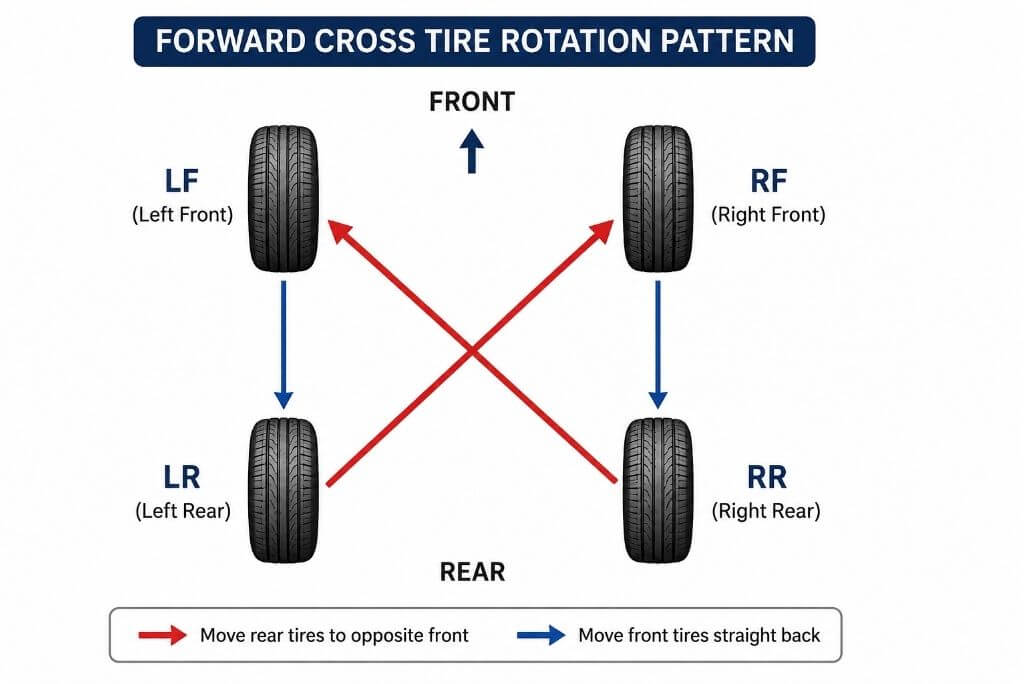
The Forward Cross is commonly used on FWD vehicles because the front tires typically handle more steering, braking, and driving forces. Moving the rear tires diagonally to the front and the front tires straight back helps distribute those loads across the four tire positions.
It is not automatically correct for every FWD vehicle, so confirm the manufacturer’s recommended procedure.
Rearward Cross Pattern
Best starting use: Many RWD and 4WD vehicles with four matching, non-directional tires.
Movement:
- Rear tires → straight to the front
- Front tires → cross to the opposite rear
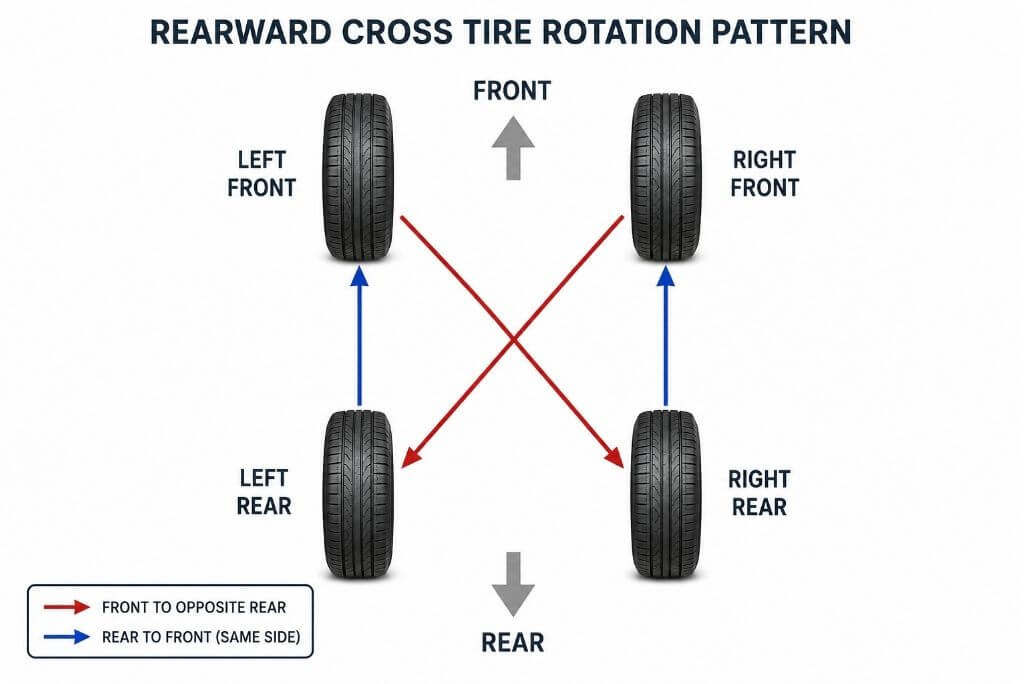
The Rearward Cross reverses the movement used by the Forward Cross. It is a common pattern for vehicles where the rear axle performs more of the driving work.
However, drivetrain alone does not determine the correct pattern. Tire design, tire size, wheel configuration, and manufacturer instructions still matter.
X Pattern
Best starting use: Approved same-size, non-directional tire setups.
Movement:
- Every tire → crosses diagonally to the opposite corner
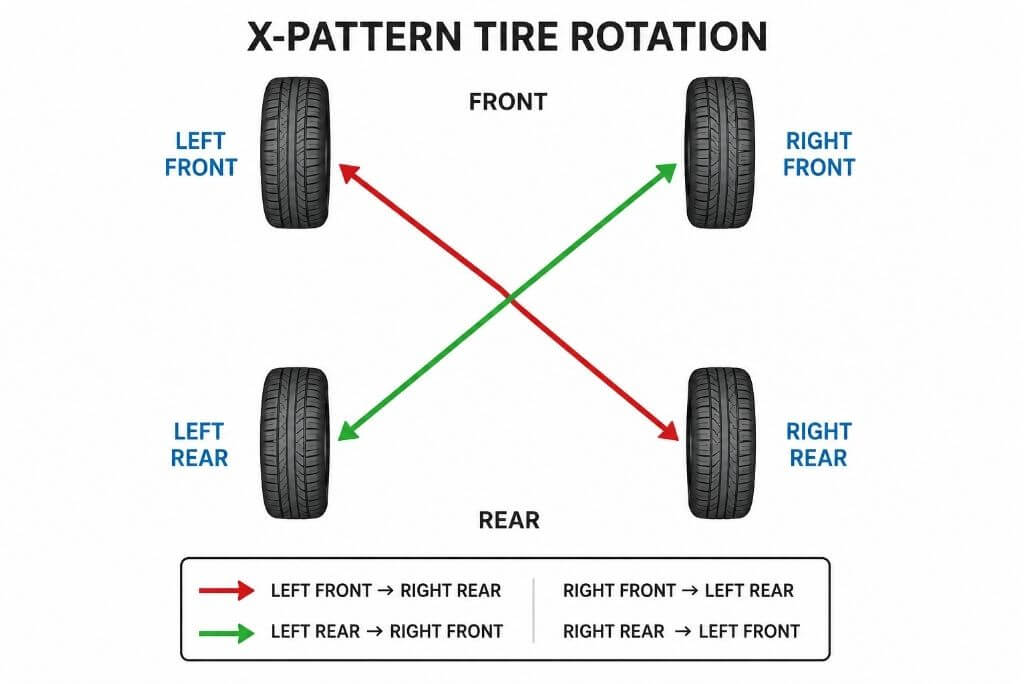
The X Pattern moves every tire to the opposite axle and opposite side. It can be an appropriate alternative for some same-size, non-directional setups.
Important: An X Pattern is not automatically the best pattern for every AWD vehicle. AWD systems and manufacturer recommendations vary, so do not select an X Pattern simply because the vehicle is AWD.
Front-to-Rear Pattern
Best starting use: Same-size directional tires.
Movement:
- Front left ↔ rear left
- Front right ↔ rear right
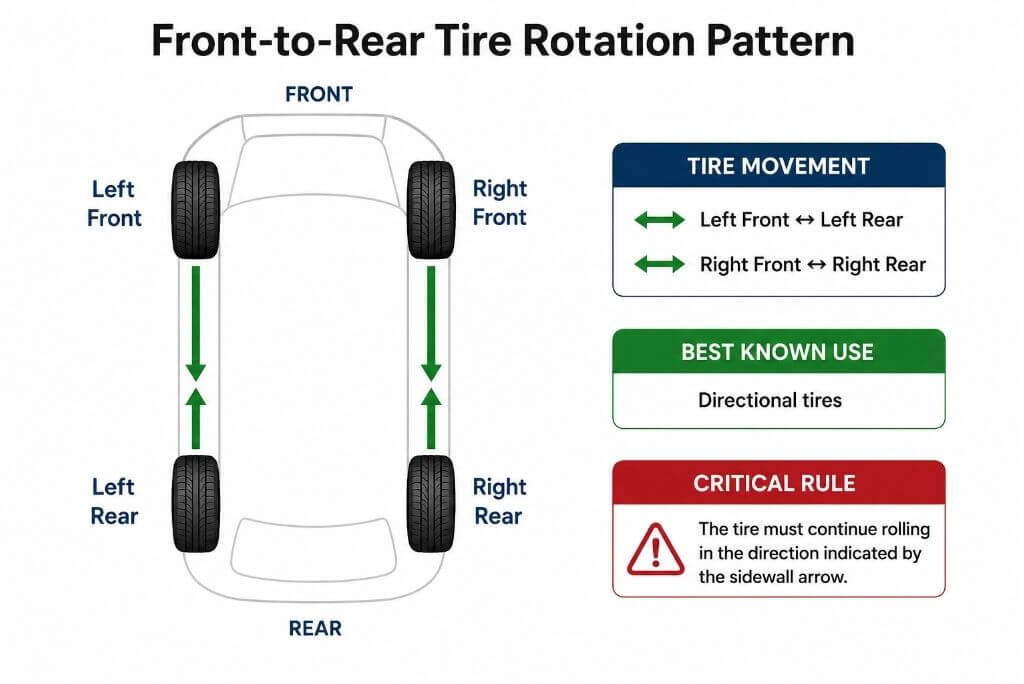
This pattern keeps each directional tire on the same side of the vehicle, preserving its intended rolling direction.
A directional tire should not simply be moved to the opposite side while remaining mounted on the wheel. If it needs to cross sides, dismounting and remounting may be required.
Side-to-Side Pattern
Best starting use: Staggered, non-directional setups when approved.
Movement:
- Left front ↔ right front
- Left rear ↔ right rear
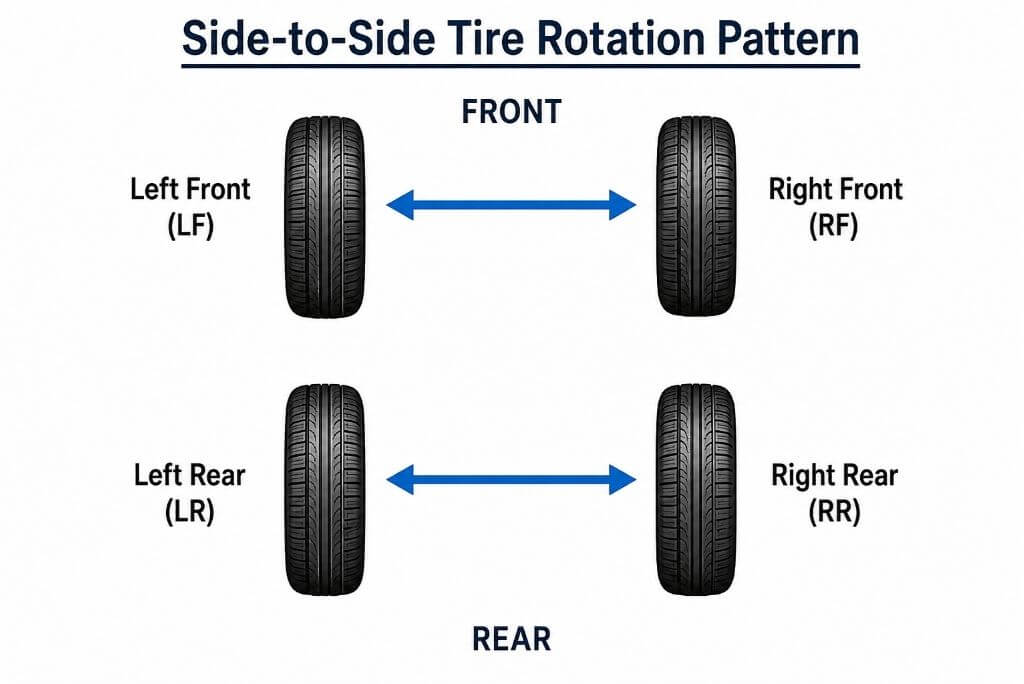
Because staggered vehicles use different tire sizes on the front and rear axles, the tires generally remain on their original axle.
Directional tires create an additional restriction because moving a mounted tire from one side to the other changes its rolling direction. In those cases, dismounting and remounting may be necessary.
Tire Rotation Pattern Comparison
| Rotation Pattern | Tire Movement | Best Starting Use | Tire Restriction | Key Limitation |
| Forward Cross | Front → straight rear; rear → opposite front | Many FWD vehicles with matching non-directional tires | Must allow cross-rotation | Not suitable for directional tires without remounting |
| Rearward Cross | Rear → straight front; front → opposite rear | Many RWD and 4WD vehicles with matching non-directional tires | Tire sizes and wheel positions must allow movement | Manufacturer may specify another pattern |
| X Pattern | Every tire crosses diagonally | Approved same-size, non-directional setups | Tires must be able to change both axle and side | Not automatically the best AWD pattern |
| Front-to-Rear | Front ↔ rear on the same side | Same-size directional tires | Tire must remain in its required rolling direction | Does not change the tire’s side |
| Side-to-Side | Left ↔ right on the same axle | Approved staggered, non-directional setups | Different front/rear sizes remain on their axles | Directional tires may prevent side-to-side movement |
For four same-size, non-directional tires, Forward Cross, Rearward Cross, and X Pattern are the main standard options. Directional tires generally use Front-to-Rear, while different-size non-directional setups may use Side-to-Side when approved. Some configurations require the tires to be dismounted, remounted, and rebalanced.
Tire Rotation Pattern by Drivetrain
Your vehicle’s drivetrain can help identify a common tire rotation pattern, but it should not be the only factor you consider. Tire size, tread direction, wheel configuration, and the manufacturer’s instructions can change which pattern is appropriate.
FWD: Forward Cross Is a Common Starting Point
For many front-wheel-drive vehicles equipped with four matching, non-directional tires, the Forward Cross is a common starting pattern.
The front tires move straight to the rear, while the rear tires cross diagonally to the opposite front positions. This helps distribute the higher steering, braking, and driving forces typically experienced by the front tires.
An alternative pattern may be specified by the vehicle or tire manufacturer, so check the owner’s manual before rotating.
RWD: Rearward Cross Is Common
Many rear-wheel-drive vehicles with four matching, non-directional tires commonly use the Rearward Cross pattern.
The rear tires move straight to the front, while the front tires cross to the opposite rear positions. This distributes wear between the axles while changing the side-to-side position of the front tires.
The actual vehicle recommendation should take priority over the general drivetrain rule.
AWD: Do Not Assume One Universal Pattern
There is no single tire rotation pattern that is automatically correct for every AWD vehicle.
Depending on the vehicle and tire setup, an AWD model may use a cross pattern or another manufacturer-approved procedure. Some AWD systems also have tighter requirements for tire size, tread depth, and overall tire circumference.
For AWD vehicles, check the owner’s manual and follow the manufacturer’s specified rotation procedure. If the tires are different sizes, directional, or otherwise restricted, the available rotation options may be limited.
4WD: Rearward Cross Is a Common Starting Point
Many 4WD vehicles with four matching, non-directional tires commonly use the Rearward Cross pattern: rear tires move straight forward and front tires cross to the opposite rear positions.
However, 4WD does not automatically determine the correct pattern. Vehicle-specific recommendations, tire construction, and wheel fitment still matter.
The Bottom Line
Use drivetrain as a starting clue, not a final answer:
- FWD: Forward Cross is common
- RWD: Rearward Cross is common
- 4WD: Rearward Cross is common on many matching setups
- AWD: Follow the vehicle-specific recommendation
If the tire sidewall markings or front/rear tire sizes prevent the common pattern, the tire configuration takes priority over the drivetrain rule.
Directional vs. Asymmetric vs. Staggered Tires: What Changes?
Not all tires can be rotated using the same pattern. Tire markings and tire sizes can limit where each tire can safely move.
Directional Tires
Look for a ROTATION arrow on the sidewall. A directional tire is designed to roll in one specific direction.
These tires usually move from front to rear on the same side. Moving one to the opposite side may require removing it from the wheel and remounting it so the tread continues to roll in the correct direction.
Asymmetric Tires
Look for OUTSIDE and INSIDE markings. The OUTSIDE side must face away from the vehicle.
An asymmetric tire is not automatically directional. It can change positions as long as it remains mounted with the correct inner and outer orientation.
Directional + Asymmetric Tires
Some tires combine directional and asymmetric characteristics. These tires must satisfy both requirements: they must roll in the correct direction and remain mounted with the correct inside/outside orientation.
This can prevent a normal cross-rotation pattern. Dismounting and remounting may be necessary if the tire needs to change sides.
Staggered Tires
A staggered setup uses different tire sizes on the front and rear axles.
Because the sizes differ, normal front-to-rear rotation is generally not possible. A non-directional staggered setup may allow Side-to-Side rotation if the manufacturer approves it.
If the staggered tires are also directional, rotation can be even more restricted and may require tire remounting.
Key rule: The tire sidewall tells you how the tire must be mounted and, when applicable, which direction it must roll. The vehicle manufacturer’s instructions tell you how that tire setup should be maintained.
When Tire Rotation Requires Dismounting and Remounting
Not every tire rotation can be completed by simply moving a wheel from one corner of the vehicle to another. Some configurations require the tire to be removed from the wheel, repositioned, and balanced again.
Dismounting and remounting may be necessary when:
- Directional tires need to change sides
- A tire is both directional and asymmetric
- A staggered setup has additional directional restrictions
- Front and rear wheels have different fitment or offset requirements
- The manufacturer specifically requires a different service procedure
For example, moving a directional tire from the left side to the right side while leaving it mounted the same way would reverse its intended rolling direction.
For four matching, non-directional tires mounted on interchangeable wheels, normal rotation can usually be completed by moving complete wheel-and-tire assemblies.
When a tire is dismounted and remounted, the assembly should be balanced according to the applicable service procedure.
5-Tire Rotation Pattern With a Full-Size Spare
A full-size spare can sometimes be included in a 5-tire rotation to distribute wear across all five tires. This can help keep the spare closer in tread depth to the tires in service and ensure it remains ready for regular road use.
However, the spare should be included only when it is a matching full-size tire and the vehicle manufacturer specifically permits a five-tire rotation.
How a 5-Tire Rotation Works
The spare is periodically moved into the active rotation while one of the four road tires becomes the new spare. The exact movement depends on the vehicle and manufacturer’s recommended pattern.
A common five-tire rotation uses the spare to replace one road tire, with the other tires following a prescribed cross-rotation sequence. Because rotation procedures can vary, use the pattern specified in the owner’s manual rather than applying a generic five-tire sequence to every vehicle.
Important Checks Before Using the Spare
Make sure the spare:
- Is the correct full-size tire for the vehicle
- Matches the required tire size and load rating
- Is approved for normal road use
- Has compatible tread type and construction
- Is inflated to the recommended pressure
- Meets the vehicle manufacturer’s requirements for AWD or 4WD systems
A compact temporary spare or “donut” should not be included in a normal five-tire rotation. Temporary spares are designed for limited emergency use, not regular tire rotation.
For AWD and some 4WD vehicles, differences in tire circumference or tread depth can be particularly important. Follow the manufacturer’s instructions before putting a spare into regular service.
Bottom line: A matching full-size spare can be part of a five-tire rotation when the vehicle manufacturer approves it. A temporary spare should remain an emergency-only tire.
When You Should Not Simply Rotate Your Tires
Tire rotation can distribute normal tread wear, but it cannot repair the cause of abnormal wear. If a tire is already wearing unevenly, moving it to another position may simply move the problem.
Stop and Inspect Abnormal Wear First
Pay attention to:
- Inner or outer-edge wear: May indicate alignment, inflation, or suspension issues
- Feathered tread: Can indicate an alignment-related problem
- Cupped or scalloped wear: May be associated with balance or suspension problems
- Large tread-depth differences: Can matter on vehicles with specific drivetrain requirements
- Visible damage: Cuts, bulges, exposed cords, or severe cracking require inspection
- Persistent vibration or pulling: May indicate a mechanical, tire, wheel, or alignment problem
These wear patterns are clues, not definite diagnoses.
Related Topic: How Often Should You Get a Wheel Alignment? A Complete Guide
Rotation Does Not Replace Repair
A tire that is losing air, wearing rapidly, or showing structural damage should be inspected before it is rotated.
For AWD and some 4WD vehicles, differences in tire circumference or tread depth can also be important. Follow the vehicle manufacturer’s requirements instead of rotating tires simply to equalize wear.
Practical rule: If the tires show normal, even wear, use the appropriate rotation pattern. If wear is abnormal or a safety-related symptom is present, inspect and diagnose the cause before moving the tires.
How Often Should You Rotate Tires?
Tire rotation should be performed according to your vehicle and tire manufacturer’s recommended maintenance schedule. The appropriate interval can vary based on the vehicle, tire type, drivetrain, driving conditions, and wear pattern.
Rather than repeating the complete rotation schedule here, see our detailed guide for mileage guidance, maintenance intervals, and the factors that can affect how often your tires need to be rotated.
For the full schedule, see How Often Should You Rotate Your Tires?.
Can You Rotate Your Tires Yourself?
Yes. Tire rotation can be a reasonable DIY maintenance job when you have the correct tools, a safe working area, and a setup that does not require special tire mounting.
Before starting, verify the rotation pattern and check the tire sidewalls for ROTATION arrows or INSIDE/OUTSIDE markings. Also confirm that the front and rear tire sizes allow the planned movement.
A safe DIY rotation requires a suitable jack, properly rated jack stands, the correct lug wrench or socket, and a torque wrench. Work on a firm, level surface and follow the vehicle manufacturer’s lifting and wheel-service instructions.
DIY rotation is most straightforward when you have:
- Four matching, non-directional tires
- Interchangeable wheel positions
- No unusual tire wear or visible damage
- A clearly specified rotation pattern
Professional service is a better choice when directional tires need to change sides, a staggered setup has additional restrictions, tires need to be dismounted and remounted, or the vehicle has abnormal wear, vibration, pulling, or other unexplained symptoms.
Never rely on a vehicle’s jack as the only support while working around the wheels.
Common Tire Rotation Mistakes to Avoid
A tire rotation is straightforward only when the tire and wheel configuration allows the planned movement.
1. Choosing a Pattern Based Only on Drivetrain
FWD, RWD, AWD, and 4WD can suggest a common pattern, but drivetrain alone does not determine the correct procedure.
2. Ignoring Directional Arrows
Moving a directional tire to the opposite side can reverse its intended rolling direction. Always check the ROTATION arrow before using a cross pattern.
3. Installing an Asymmetric Tire Backward
An asymmetric tire must maintain the correct INSIDE/OUTSIDE orientation.
4. Moving Different-Size Tires Between Axles
Staggered vehicles use different front and rear tire sizes. Do not move those tires between axles unless the vehicle is specifically designed for that configuration.
5. Rotating Tires With Abnormal Wear Without Inspection
Rotation does not repair alignment, inflation, suspension, balance, or tire problems. Diagnose the cause before treating the tires as a normal rotation set.
6. Forgetting Wheel-Nut Torque
After reinstalling the wheels, tighten the wheel nuts to the vehicle manufacturer’s specified torque.
Bottom line: Before rotating, verify the tire size, direction, INSIDE/OUTSIDE markings, wheel position, and manufacturer’s recommended procedure.
Tire Rotation Pattern FAQs
What is the best tire rotation pattern?
There is no single best pattern for every vehicle. For four same-size, non-directional tires, Forward Cross, Rearward Cross, or X Pattern may be appropriate depending on the vehicle. Directional, asymmetric, and staggered setups can require different procedures. Always follow the manufacturer’s recommended pattern.
What tire rotation pattern is best for FWD vehicles?
Forward Cross is a common starting pattern for many FWD vehicles with four matching, non-directional tires. The front tires move straight to the rear, while the rear tires cross to the opposite front positions.
What tire rotation pattern is best for AWD vehicles?
There is no universal rotation pattern for every AWD vehicle. The correct procedure depends on the specific AWD system, tire sizes, tread design, and manufacturer requirements. Do not assume that an X Pattern or Rearward Cross is automatically correct for every AWD vehicle.
Can directional tires be rotated side to side?
Not normally without changing their mounting orientation. Moving a directional tire directly from one side to the other reverses its intended rolling direction. Same-size directional tires are commonly rotated Front-to-Rear on the same side. Changing sides may require dismounting and remounting the tire.
Can asymmetric tires be cross-rotated?
An asymmetric tire may be moved to another position if its INSIDE/OUTSIDE orientation remains correct. Unlike a directional tire, an asymmetric tire is not automatically restricted from changing sides.
Can staggered tires be rotated?
Sometimes. Staggered vehicles use different tire sizes front and rear, so normal front-to-rear rotation is generally not possible. Non-directional staggered tires may allow Side-to-Side rotation if approved. Directional tread can create additional restrictions.
Can I include my full-size spare in a tire rotation?
A matching full-size spare can be included in a 5-tire rotation when the vehicle manufacturer approves it. A compact temporary spare or donut should not be treated as a normal road tire or included in a regular rotation cycle.
Should I rotate tires that are wearing unevenly?
Not until the cause has been checked. Uneven wear can indicate alignment, inflation, suspension, balance, or tire-related problems. Rotating the tires may move the symptom without fixing the underlying cause.
Conclusion
The correct tire rotation pattern is the one that matches your tire design, tire size, wheel setup, and vehicle manufacturer’s instructions.
Start by checking the tire size, directional arrow, and INSIDE/OUTSIDE markings. Then determine whether the vehicle uses a square or staggered setup before selecting a rotation pattern.
If there is one rule to remember, it is this:
The tire sidewall tells you how the tire must be mounted and, when applicable, which way it must roll. The vehicle manufacturer’s instructions tell you how that tire setup should be maintained.
When those two requirements line up, you can choose the appropriate rotation pattern with much less risk of an incorrect installation.
