Boat Trailer Tire Pressure: The Complete Safety & Towing Guide
If you tow a boat, your trailer’s tires are one of the most important safety points you might overlook. Many boat owners focus on the boat itself but forget that proper boat trailer tire pressure can make the difference between a smooth, safe ride and a dangerous situation on the road.
Tires that are underinflated, overinflated, or mismatched for the load can lead to blowouts, uneven wear, poor handling, and even costly damage to your trailer. On the other hand, correctly inflated tires improve stability, braking, fuel efficiency, and tire lifespan, giving you confidence every time you hit the water.
In this guide, we’ll show you exactly how to check, adjust, and maintain your trailer tires. You’ll learn:
- How to read your tire’s PSI and load rating
- Common mistakes to avoid
- How conditions like hot weather, long trips, and storage affect tire pressure
- Expert tips for safe towing
Whether you’re a first-time trailer owner or a seasoned boater, this guide will help you keep your trailer safe, your tires in top shape, and your trips worry-free.
Why Boat Trailer Tire Pressure Matters
Keeping the boat trailer tire pressure right isn’t just a number on a gauge — it makes a big difference in how your trailer behaves on the road. I’ve been towing boats for years, and the times I didn’t check pressure are the ones that caused the most problems.
Trailer Stability
Proper tire pressure helps the trailer stay steady behind your vehicle.
If the tires are too soft, the trailer can feel loose or shaky, especially at higher speeds or in wind. This makes it harder to steer and can even lead to swaying.
Braking Distance
When your trailer tires have the right pressure, they grip the road better.
That means your vehicle and trailer slow down more predictably when you hit the brakes. If the pressure is wrong, you need more stopping distance, and hard braking can feel unsafe.
Tire Lifespan
Tires wear out faster when pressure isn’t correct.
- Too low: the tire squashes more, rubbing unevenly and heating up.
- Too high: only the center tread touches the road, so that wears out first.
Both conditions shorten tire life.
Fuel Efficiency
Inflated tires roll more easily.
When pressure is too low, your tow vehicle works harder to pull the trailer. That extra effort burns more fuel. Keeping the pressure right can save money at the pump.
Risks of Underinflated vs. Overinflated Tires
- Underinflated tires can overheat and fail, especially on long trips. They wear unevenly and make steering sluggish.
- Overinflated tires can be harsh, give less grip, and also wear unevenly. They’re more likely to get damaged on bumps.
Both conditions raise the chance of a blowout on the road — something no boater wants.
Why Boat Trailers Are Different
Boat trailer tires aren’t the same as car or truck tires. They’re usually special trailer (ST) tires built for heavy loads and vertical weight.
Trailer tires often need higher pressure than regular vehicle tires to do their job safely. They also sit unused for long periods, which can affect pressure over time.
What Is the Correct Boat Trailer Tire Pressure?
The correct tire pressure for your boat trailer is the number that lets the tire safely carry the weight of your boat. There isn’t one universal PSI that works for every trailer. It depends on the tire itself.
PSI vs. Load Rating (Simple Explanation)
- PSI means how much air is inside the tire.
- Load rating tells you how much weight the tire can safely handle.
The two work together. A tire can only carry its full rated weight when it’s inflated to the correct PSI. Less air means less weight capacity.
Why Boat Trailer Tires Use Higher PSI
Boat trailer tires usually need more air than car tires. That surprises a lot of people.
The reason is simple: trailer tires carry heavy loads without help from an engine or suspension system. Higher pressure keeps the tire firm so it can support the weight without bending or overheating.
The downside is the ride can feel stiff, but that firmness is what keeps the tire safe under load.
Where to Find the Correct Tire Pressure
There are a few places you can check, but some matter more than others.
Tire Sidewall (Most Important)
Look at the side of the tire itself. You’ll see a PSI number listed with the words “max load.”
This is the pressure the tire is designed to run at when carrying weight. For most boat trailers, this is the number you should use.
Manufacturer Documentation
Some trailer or tire manufacturers include pressure guidelines in manuals or spec sheets.
These can be helpful for understanding overall setup, but they still rely on the tire being inflated properly.
Trailer Placard (If Available)
Some trailers have a sticker on the frame that lists tire pressure.
This can be useful, but it may not be accurate if:
- The tires have been changed
- The trailer was modified
- The sticker is old or missing
Why the Tire Sidewall PSI Takes Priority
The tire sidewall reflects the actual tire you’re using, not what the trailer originally came with.
If there’s ever a difference between the placard and the tire, the sidewall usually wins. That’s because the tire manufacturer knows exactly how that tire performs under load.
One small drawback is that sidewall PSI often lists the maximum, not a range. But for trailer tires, running at that listed PSI is normally the safest choice.
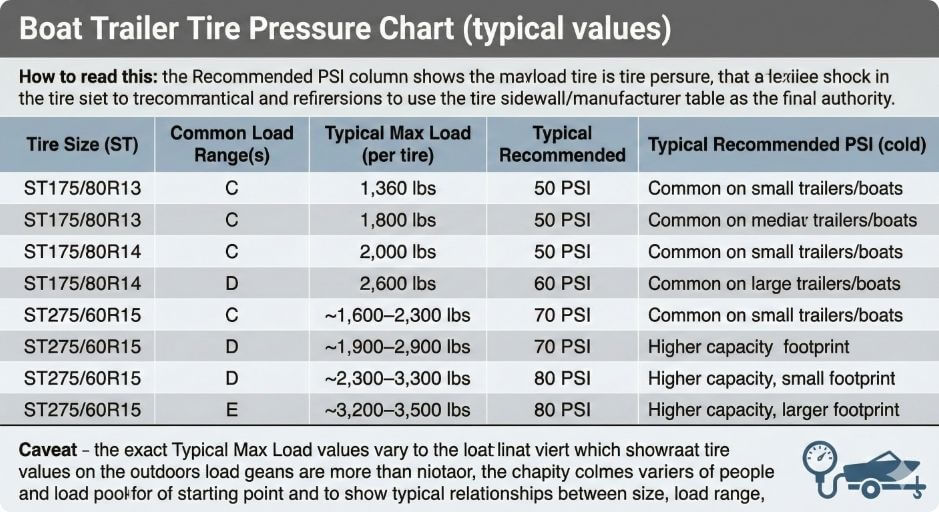
Boat Trailer Tire Pressure Chart (typical values)
How to read this: the Recommended PSI column shows a commonly used inflation pressure associated with that Load Range for the size shown. Typical Max Load is the approximate load capacity per tire at that PSI. These are typical example figures — use the tire sidewall/manufacturer table as the final authority.
| Tire Size (ST) | Common Load Range(s) | Typical Max Load (per tire) | Typical Recommended PSI (cold) | Notes |
| ST175/80R13 | C | 1,360 lbs | 50 PSI | Common on small trailers/boats |
| ST185/80R13 | C | 1,520 lbs | 50 PSI | Slightly higher capacity than ST175 |
| ST205/75R14 | C | 1,760 lbs | 50 PSI | Very common boat trailer tire |
| ST205/75R14 | D | 2,040 lbs | 65 PSI | D increases load capacity — higher PSI |
| ST215/75R14 | C | 1,870 lbs | 50 PSI | Slightly larger than 205/75R14 |
| ST225/75R15 | D | 2,540 lbs | 65 PSI | Common on medium trailers |
| ST225/75R15 | E | 2,830 lbs | 80 PSI | Higher load/towing applications |
| ST235/80R16 | E | ~3,080 lbs | 80 PSI | Typical for larger single-axle trailers |
| ST245/75R16 | E | ~3,270 lbs | 80 PSI | Used on heavier trailers/boats |
| ST255/70R15 | D/E | ~2,800–3,100 lbs | 65–80 PSI | Varies by brand — check manufacturer |
| ST275/60R15 | E | ~3,200–3,500 lbs | 80 PSI | Higher capacity, larger footprint |
Caveat: the exact Typical Max Load values vary by brand/manufacturer and by the tire’s load index. Use the tire’s sidewall and the manufacturer’s load/pressure table first. The table above is meant as a detailed starting point and to show typical relationships between size, load range, and PSI.
Determine — then Check & Adjust — Boat Trailer Tire Pressure (step-by-step)
Below is a single, seamless section you can drop into your blog that takes the reader from figuring out the correct PSI to physically checking and adjusting the tires. It’s practical, people-first, and written so a first-time trailer owner can follow it start-to-finish.
Overview (what this section does)
- Teach readers how to calculate the PSI they need based on actual load and tire ratings.
- Show how to check tire pressures correctly (cold), and how to adjust them safely.
- Include real arithmetic examples so readers can follow the exact math.
Tools you’ll need
- Accurate high-pressure tire gauge (0–100 PSI range).
- Portable air compressor able to reach 80+ PSI (if needed).
- Valve cap remover and valve core tool (for slow inflations).
- Pen and small notebook or phone note for recorded pressures.
- Tire placard/owner manual and the tire sidewall info (keep a photo of sidewall specs).
Step A — Calculate the total trailer load (worked example)
- Add up all weights: boat + trailer + gear/fuel/extra. Do the arithmetic clearly.
- Boat = 2,200 lbs
- Trailer = 700 lbs
- Gear/fuel = 200 lbs
- Total = 2,200 + 700 + 200 = 3,100 lbs
- (Breakdown: 2,200 + 700 = 2,900; 2,900 + 200 = 3,100.)
- (Breakdown: 2,200 + 700 = 2,900; 2,900 + 200 = 3,100.)
- Boat = 2,200 lbs
- Decide axle configuration and compute load per tire:
- Single-axle (2 tires) → divide total by 2.
- 3,100 ÷ 2 = (3,000 ÷ 2) + (100 ÷ 2) = 1,500 + 50 = 1,550 lbs per tire.
- 3,100 ÷ 2 = (3,000 ÷ 2) + (100 ÷ 2) = 1,500 + 50 = 1,550 lbs per tire.
- Tandem-axle (4 tires) → divide total by 4.
- 3,100 ÷ 4 = (3,000 ÷ 4) + (100 ÷ 4) = 750 + 25 = 775 lbs per tire.
- Single-axle (2 tires) → divide total by 2.
If weight is uneven (heavy gear forward/back), adjust per-tire loads accordingly; tongue weight and axle placement matter.
Step B — Choose a tire capacity and target PSI
- Check the tire sidewall for size and load range (C, D, E) and the manufacturer’s load/pressure table for that exact tire model. The sidewall shows a load index and often a max PSI — but the manufacturer table maps load to PSI exactly.
- Apply a safety margin: aim for at least 10% headroom between required per-tire load and the tire’s rated capacity at the chosen PSI.
- Example (single-axle): required per-tire load = 1,550 lbs.
- 10% margin = 1,550 × 0.10 = 155 lbs (because 1,550 × 0.1 = 155).
- Required capacity ≥ 1,550 + 155 = 1,705 lbs.
- 10% margin = 1,550 × 0.10 = 155 lbs (because 1,550 × 0.1 = 155).
- Choose a tire whose rated capacity at the manufacturer-specified PSI meets or exceeds 1,705 lbs.
- Example (single-axle): required per-tire load = 1,550 lbs.
- Typical rule-of-thumb mapping (use manufacturer table when possible):
- Load Range C → commonly ~50 PSI (capacities vary by size).
- Load Range D → commonly ~65 PSI.
- Load Range E → commonly ~80 PSI.
- Important: these are starting points — you must confirm with the tire manufacturer’s exact capacity chart for that tire size and load index.
- Load Range C → commonly ~50 PSI (capacities vary by size).
Step C — Check and adjust pressure (practical execution)
When to check: tires must be cold — meaning parked for at least 3 hours or driven less than 1 mile since stopping. Manufacturer ratings are cold-inflation figures.
Procedure
- Park on level ground and set the parking brake.
- Remove valve caps; wipe valve stems if dirty.
- Record the cold PSI of each tire with your gauge. Write it down.
- Compare measured PSI to your target PSI (from Step B) and to the tire sidewall max. Never exceed the sidewall maximum.
- Inflate in short bursts if under target:
- Add air, then recheck. High-pressure trailers require small increments (5–10 PSI) to avoid overshoot.
- Add air, then recheck. High-pressure trailers require small increments (5–10 PSI) to avoid overshoot.
- If overinflated, release air slowly with the valve core tool or the gauge’s bleed function then recheck.
- Re-check all four (or two) tires after adjusting — pressure should be consistent across tires.
- Replace valve caps and stow tools.
- Inflate the spare to the same target (or spare’s sidewall spec).
Practical tips
- Use a gauge you trust — cheap gauges often read low at high PSI.
- If you use a compressor at a gas station, double check with your own gauge (station gauges are sometimes inaccurate).
- Metal valve stems are preferable on trailers — inspect for corrosion.
- Do not lower PSI to “soften the ride” — trailer tires generate dangerous heat if underinflated.
Step D — Pre-trip checks and frequency
- Before every trip: check cold PSI (or check the morning of the trip).
- Regular maintenance: monthly checks if stationary, and after long trips or heavy hauls.
- After high-speed towing: recheck pressure and inspect for heat damage or sidewall deformation.
- Keep a small, accurate tire gauge in your tow vehicle and a portable compressor in your gear for emergencies.
Common Boat Trailer Tire Pressure Mistakes to Avoid
Most trailer tire problems come from a few small mistakes. They’re easy to make, especially if you’re new to towing a boat.
Using Car Tire PSI Standards
Car and truck tires usually run at much lower pressure than trailer tires.
Using those same numbers on a boat trailer can leave the tires underinflated, even if they look fine.
Trailer tires are built differently and need more air to carry weight safely.
Ignoring the Tire Sidewall PSI
The correct pressure is printed right on the tire, but it’s often overlooked.
Some people rely on old stickers or guess based on feel. That guesswork can shorten tire life or cause failures. The sidewall number exists for a reason.
Underinflating to “Soften the Ride”
Letting air out to make the ride smoother is a common mistake.
While it might feel gentler at low speeds, softer tires bend more and build heat. Over time, that heat can damage the tire from the inside.
The ride may feel stiff at proper pressure, but that stiffness is normal for trailer tires.
Forgetting to Check the Spare Tire
Spare tires are easy to ignore because they’re not on the road every day.
The problem is that spares often lose air slowly over time. When you finally need it, it may be flat or unsafe to use.
A quick check now saves stress later.
Assuming Tire Pressure Stays the Same All Year
Air pressure changes with temperature.
Cold weather lowers pressure. Hot weather raises it. If you only check once and forget about it, the pressure won’t stay where you left it.
Seasonal checks help catch problems before they show up on the highway.
Adjusting Tire Pressure for Towing Conditions
Towing conditions change, but your tire pressure usually shouldn’t change much. What matters most is knowing when pressure needs attention and when it should be left alone.
Long-Distance Highway Towing
Highway driving puts steady stress on trailer tires for long periods.
Before long trips, make sure the tires are inflated to the recommended pressure while cold. Once you’re on the road, don’t let air out just because the pressure rises slightly. That increase is normal.
Stopping to bleed air can leave the tires underinflated when they cool down.
Hot Weather and Heat Buildup
Hot pavement and summer air raise tire pressure faster than cooler conditions.
This doesn’t mean you should start with lower pressure. Tires are designed to handle normal heat increases. Lowering pressure ahead of time actually makes heat buildup worse, not better.
The downside is the tires may feel firm, but that firmness helps them stay safe.
Fully Loaded vs. Empty Trailer
A loaded trailer puts more weight on the tires than an empty one.
Trailer tires are meant to handle their rated load at the listed pressure. Running less pressure when empty isn’t necessary and can cause uneven wear.
Keeping the pressure consistent avoids confusion and mistakes.
Launch Ramps and Steep Inclines
Boat ramps can be steep, slick, and uneven.
Some people think lowering pressure helps with grip, but trailer tires aren’t built for that. Softer tires flex more and can slip or strain under weight.
Good traction comes from proper pressure and careful driving, not softer tires.
Why You Shouldn’t Lower Pressure for Comfort
It’s tempting to let air out to smooth out bumps.
While it might feel gentler, lower pressure increases tire flex and heat. That wear adds up over time and raises the chance of tire damage.
Trailer tires aren’t meant to ride comfortably — they’re meant to carry weight safely.
Boat Trailer Tire Pressure and Seasonal Storage
When a trailer sits for weeks or months, tire pressure changes even if the trailer never moves. Storage is when many tire problems quietly start.
How Tire Pressure Changes During Storage
Tires slowly lose air over time. Cold weather speeds this up, while warm weather can hide it.
A tire that was fine in the fall can be underinflated by spring, even if it looks okay at a glance.
Best Practices for Winter Storage
Before storing your trailer for winter:
- Inflate the tires to the recommended pressure
- Park on solid, level ground
- Check pressure once or twice during the season if possible
Cold temperatures lower PSI, so expect some pressure loss. The small effort of checking can prevent damage that’s hard to see later.
Best Practices for Long-Term Parking
If your trailer will sit for several months:
- Avoid soft ground like dirt or grass
- Move the trailer slightly every few weeks if you can
- Check pressure before moving it again
The drawback is a bit of extra effort, but it helps avoid tire shape problems.
Preventing Flat Spots and Sidewall Damage
Tires can develop flat spots when they carry weight without moving.
To reduce this:
- Keep tires properly inflated
- Use blocks or pads under the tires
- Remove some weight from the trailer if possible
Flat spots don’t always disappear once you start towing, especially on older tires.
Protecting Tires from Sun and Moisture
Sunlight and moisture slowly break down rubber.
- Use tire covers to block UV rays
- Keep tires out of standing water
- Store in a shaded or covered area if possible
Covers aren’t perfect, but they slow down cracking and drying, which helps tires last longer.
How Tire Pressure Affects Trailer Safety & Tire Life
- Connection between PSI and:
- Blowouts
- Tread separation
- Bearing and suspension stress
- Blowouts
- Signs your trailer tires may be improperly inflated
- When to replace tires regardless of tread depth
Expert Tips for Safe Boat Trailer Towing
Towing a boat safely takes a little planning. These tips come from basic safe‑towing practices that boaters rely on every trip.
Pre‑Trip Inspection Checklist
Before you hit the road, walk around your trailer and give it a quick once‑over. Spend five to ten minutes checking key things — it’s worth it every time.
- Look for obvious damage or loose parts
- Check tire pressure and condition
- Make sure lights and brakes work
- Confirm the hitch and safety chains are secure
A simple round‑the‑trailer check often finds small problems before they become big ones on the highway.
Match Tire Load Rating to Axle Weight
Every trailer tire has a load rating — the amount of weight it’s built to carry safely.
Using tires that aren’t rated for the weight your trailer will carry can lead to blowouts or fast wear. If your trailer is heavy when loaded, make sure each tire’s load rating meets or exceeds that weight. Checking this keeps your tires from being overloaded on the road.
Why Cheap Tires Often Cost More Long‑Term
It’s tempting to buy the least expensive tires, but low‑quality tires wear out faster and can fail unexpectedly.
Cheap tires:
- May not have strong enough sidewalls
- Can deteriorate sooner in sun or heat
- Might wear unevenly or crack
Spending a bit more for good trailer‑rated tires usually means fewer replacements and fewer surprises on the road.
When to Consult a Professional
Some problems are best checked by a tire or trailer expert.
Consider professional help if:
- You’re unsure about the tire load ratings
- Tires show cracks, bulges, or other damage
- Alignment or suspension issues seem present
- The trailer pulls or sways at highway speeds
A pro can spot issues you might miss and help you get set up safely before a long trip.
Frequently Asked Questions (FAQ)
Should I inflate boat trailer tires to max PSI?
Yes, trailer tires are designed to carry their rated load at the pressure listed on the sidewall. Inflating to max PSI ensures the tire can safely handle your boat’s weight. Do not overinflate beyond the sidewall number — that can make the ride harsh and increase wear.
Is higher tire pressure safer for towing?
Only if it matches the tire’s rated PSI. Too low is dangerous because it can overheat and fail. Too high isn’t necessarily safer — it can reduce traction and make tires more prone to damage. Stick to the tire’s recommended PSI.
Can I use passenger car tires on a boat trailer?
No. Car tires aren’t built for trailer loads. Trailer tires (ST tires) are designed for vertical weight and heavy towing. Using car tires can cause rapid wear, overheating, and even blowouts.
How much PSI do tandem-axle trailers need?
Tandem-axle trailers usually have the same PSI requirements for each tire as single-axle trailers — it’s based on the tire’s sidewall rating, not the number of axles. Always check each tire’s load rating and inflate accordingly.
Conclusion
Proper boat trailer tire pressure isn’t just a number on the side of the tire — it’s key to towing safely. Correct PSI keeps your trailer stable, prevents blowouts, and helps your tires last longer.
Make it a habit to check your tire pressure before every trip and at least once a month when the trailer is in storage. A few minutes of attention now can prevent costly repairs or dangerous situations later.
By keeping your trailer tires properly inflated, you’re not only protecting your investment but also giving yourself peace of mind on the road. Safe tires mean safer trips, smoother towing, and longer-lasting equipment.
