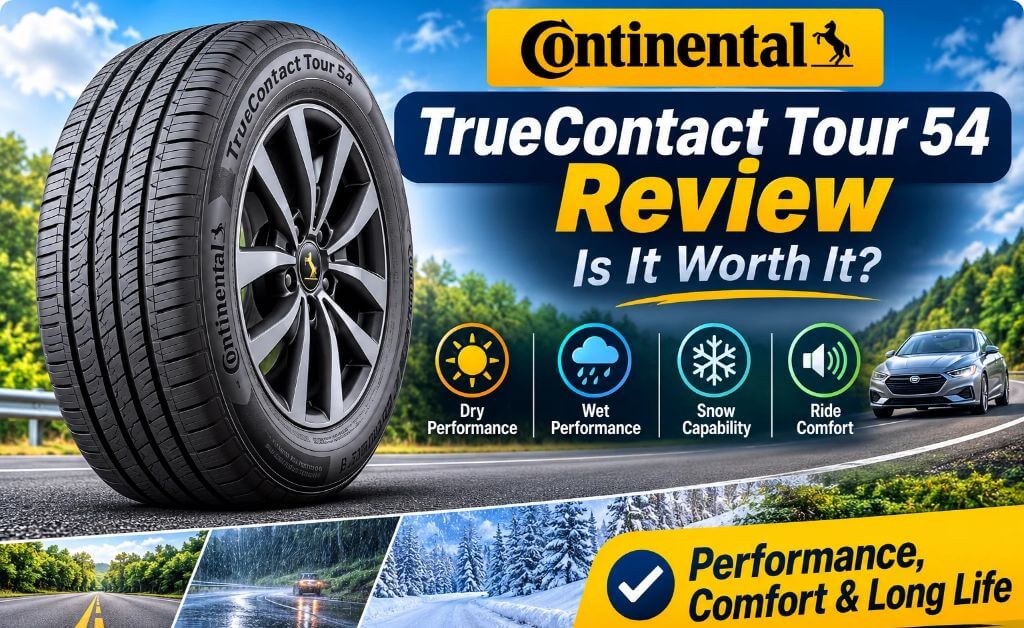
Continental TrueContact Tour 54 Review: Is It Worth It?
The Continental TrueContact Tour 54 is an all-season touring tire designed for passenger cars and crossovers. It focuses on wet-road traction, everyday comfort, fuel efficiency, and extended tread life. With an 840 UTQG treadwear rating and a limited mileage warranty of up to 80,000 miles on qualifying T- and H-rated versions, it is an appealing option for drivers who want a dependable tire for daily commuting and highway driving.
Independent testing provides encouraging evidence of its performance. In a 2026 comparison of five premium all-season tires, the TrueContact Tour 54 finished first overall in the 215/55R17 size. It delivered the shortest wet braking distance, the fastest wet handling time, and the best dry handling time in that test.
However, it does not lead every performance category. Its straight-line aquaplaning resistance was mid-field, while its snow results were less impressive than those of some winter-focused alternatives.
In this Continental TrueContact Tour 54 review, we examine its independent test results, specifications, technology, ride comfort, tread life, warranty, and fitment options to help you decide whether it is the right tire for your vehicle.
Quick Verdict: Is the Continental TrueContact Tour 54 a Good Tire?
Yes. The Continental TrueContact Tour 54 is a strong all-season touring tire, particularly for drivers who prioritize wet braking, predictable handling, and everyday comfort.
Its strongest evidence comes from a 2026 independent comparison in which it finished first among five tires. It also demonstrated competitive performance in earlier comparative testing.
| Category | Our assessment |
|---|---|
| Dry performance | Strong handling |
| Wet performance | Excellent |
| Aquaplaning resistance | Competitive, not class-leading |
| Snow performance | Suitable for occasional light snow |
| Ride comfort | Very good |
| Road noise | Competitive |
| Treadwear rating | 840 |
| Mileage warranty | Up to 80,000 miles |
| Best use | Daily commuting and highway driving |
Best for: Drivers who want confident wet-road performance, predictable handling, comfortable touring characteristics, and a long mileage warranty.
Not ideal for: Drivers who frequently encounter deep standing water, heavy snowfall, or icy roads and need specialized traction for those conditions.

Continental TrueContact Tour 54: Key Specifications
Continental introduced the TrueContact Tour 54 in August 2024 for passenger cars and crossovers. It replaced the original TrueContact Tour and PureContact LS in the manufacturer’s touring lineup.
The tire is available in selected fitments for 15- to 20-inch wheels. Specifications such as load index, speed rating, maximum load, and inflation pressure vary by size.
| Specification | Details |
|---|---|
| Tire category | All-season touring |
| Intended vehicles | Passenger cars and crossovers |
| Wheel diameter range | 15–20 inches |
| Treadwear rating | 840 |
| Traction grade | A |
| Temperature grade | A or B, depending on fitment |
| Speed ratings | T, H, and V |
| Load range | SL and XL, depending on size |
| Representative tread depth | 11/32 inch |
| Mileage warranty | Up to 80,000 miles |
| Main technologies | EcoPlus, Tuned Performance Indicators, Alignment Verification System |
Example Size-Specific Specifications
| Tire size | Load/speed rating | UTQG | Maximum pressure |
|---|---|---|---|
| 195/65R15 | 91H | 840 A A | 51 psi |
| 195/65R15 | 91T | 840 A B | 44 psi |
| 215/55R17 | 94H | 840 A A | 51 psi |
| 215/55R17 | 94V | 840 A A | 51 psi |
The two 215/55R17 versions illustrate why buyers should check the complete tire designation. Both have a load index of 94 and a listed maximum load of 1,477 pounds, but their speed ratings and warranty coverage differ.
The maximum inflation pressure listed for a tire is not the recommended everyday vehicle pressure. Always use the cold tire pressure specified on the driver’s door-jamb placard or in the owner’s manual.
For more help understanding these markings, see our guides on how to read tire size and the tire size chart.
Key Features and Technology Explained
The TrueContact Tour 54 combines several technologies intended to balance fuel efficiency, wet-road performance, tread life, and everyday driving comfort.
EcoPlus Technology
EcoPlus Technology focuses on reducing rolling resistance while supporting wet braking and tread longevity.
Rolling resistance is the energy a tire loses as it flexes and deforms while rotating. Reducing that resistance can lower the energy needed to keep a vehicle moving, potentially supporting fuel efficiency in gasoline vehicles and optimized range in electric vehicles.
Continental identifies three main benefits:
- Reduced energy consumption and optimized range.
- Improved wet braking.
- Extended tread life.
The tire uses an efficiency-focused rubber compound, including Tg-F polymers in Continental’s technical product information, to support reduced rolling resistance.
These are manufacturer design objectives, not guaranteed savings for every vehicle. Actual fuel economy and EV range depend on tire size, inflation pressure, vehicle weight, road conditions, temperature, and driving habits.
Tuned Performance Indicators: D, W and S
The tire features molded tread indicators that help drivers recognize changes in its performance characteristics as the tread wears.
The markings represent:
- D: Dry performance.
- W: Wet performance.
- S: Snow performance.
The letters gradually disappear as the tread wears, providing a visual indication that the tire is no longer optimized for particular conditions.
They are useful maintenance reminders, but they do not replace regular tread-depth measurements, inspections, or safe replacement practices.
Alignment Verification System
The Alignment Verification System uses rectangular indicators on both sides of the outer tread.
When these markings wear evenly, they suggest a consistent tread-wear pattern. Uneven wear between the indicators signals that the driver should check the vehicle’s wheel alignment.
This feature provides a visual warning rather than an electronic alignment measurement. Incorrect pressure, suspension problems, and improper rotation can also cause uneven tread wear.
EV Compatibility
Continental identifies the TrueContact Tour 54 with an EV Compatible sidewall designation.
Its efficiency-focused design is intended to support optimized energy use, while its touring characteristics aim to provide everyday comfort.
However, EV compatibility does not mean every size fits every electric vehicle. Owners must verify the approved tire dimensions, load index, speed rating, and required load capacity before purchasing.
How We Evaluated the Continental TrueContact Tour 54
This review is based on Continental’s official product specifications, warranty documentation, and three published independent comparative tire tests.
YourAutoVision did not conduct a firsthand road test or independently measure the braking distances discussed below.
We evaluated the tire using three types of evidence:
- Manufacturer information: Specifications, product technologies, treadwear rating, and warranty coverage.
- Independent testing: Published braking, handling, aquaplaning, snow, comfort, noise, and rolling-resistance results.
- Practical buying considerations: Vehicle fitment, maintenance requirements, warranty eligibility, and the limitations of available long-term wear evidence.
The three comparisons discussed below used the 215/55R17 fitment. Their findings provide useful evidence for that particular size, but they do not guarantee identical performance across every available fitment.
Independent Test Results: How the TrueContact Tour 54 Performs
2026 High-Mileage All-Season Test
The strongest recent evidence comes from a high-mileage all-season tire comparison published on August 26, 2026.
Five premium all-season touring tires were tested in the 215/55R17 size on a Toyota Camry.
The Continental finished first overall.
The test used the following scoring weights:
| Performance category | Weight |
|---|---|
| Dry performance | 35% |
| Wet performance | 40% |
| Snow performance | 10% |
| Comfort | 10% |
| Value | 5% |
The results show why the tire performed particularly well overall: wet performance received the highest weighting, and the Continental led several important wet and dry disciplines.
| Test discipline | Continental result | Position |
|---|---|---|
| Dry braking | 40.2 m | 3rd of 5 |
| Dry handling | 44.04 sec | 1st of 5 |
| Wet braking | 48.1 m | 1st of 5 |
| Wet handling | 50.32 sec | 1st of 5 |
| Straight aquaplaning | 63.48 km/h | 3rd of 5 |
| Snow braking | 16.6 m | 3rd of 5 |
| Snow traction | 4.54 sec | 3rd of 5 |
| Subjective comfort | 10/10 | Joint 1st |
| Internal noise | 63.9 dB | Joint 3rd |
| Rolling resistance | 8.18 kg/t | 1st of 5 |
The Continental’s wet results were particularly impressive. It recorded the shortest wet braking distance from 96 km/h to a stop and the fastest wet handling time in the group.
Its dry handling result was also the best, although dry braking placed third.
The tire recorded the lowest rolling resistance in the comparison. This supports its efficiency-focused design, but it should not be interpreted as a guaranteed fuel-saving percentage or additional EV driving range.
An important qualification applies to the snow measurements: those figures were supplied through a separate benchmarking program rather than measured personally by the author of the main test. They are useful comparative evidence but have a different data source from the dry and wet results.
Overall, the 2026 comparison provides strong evidence that the TrueContact Tour 54 is a capable wet- and dry-road touring tire, with more moderate results in aquaplaning and snow.
2025 Touring All-Season Comparison
An earlier comparison evaluated the Continental TrueContact Tour 54 in the 215/55R17 94V SL size on a 2025 Toyota Camry.
The tire received an overall assessment of 7.27 out of 10.
The evaluation highlighted several strengths:
- Sharp and direct steering.
- Controllable winter driving.
- A composed, comfortable road ride.
- Generally low noise levels.
- Competitive wet braking performance.
The testers also noted that quicker recovery on wet surfaces would improve its behavior during demanding maneuvers.
The report evaluated products across different touring categories and did not establish a single overall finishing order for all tires. Its individual evaluations are therefore more useful than assigning the Continental an unsupported universal ranking.
2024 Touring Tire Comparison
A further comparison published in 2024 included 11 tire patterns across different touring categories, including standard touring, grand touring, and all-weather products.
The TrueContact Tour 54 was one of the standard touring all-season entries.
The testers described its road behavior as confident and composed. It handled most road imperfections positively, although the ride felt slightly firm for a touring tire.
Pattern noise was relatively quiet on most surfaces but became more noticeable on coarse pavement. Steering response was direct and predictable.
The test also examined winter traction and showed that the tire could provide usable cold-weather performance, although it was not among the strongest severe-winter-focused products.
Because different tire categories were included, the individual measurements and qualitative findings provide more useful context than treating the complete group as a direct ranking of identical products.
Taken together, these three comparisons support the TrueContact Tour 54 as a strong touring tire, especially for everyday wet- and dry-road driving.
Continental TrueContact Tour 54 Performance Review
Dry-Road Performance and Handling
The TrueContact Tour 54 delivers competitive dry-road performance, particularly in handling and steering response.
In the 2026 comparison, it completed the dry handling course in 44.04 seconds, the fastest time among five tires. Its dry braking distance of 40.2 meters placed third.
This distinction matters because braking and handling evaluate different characteristics. A tire can provide excellent cornering control without producing the shortest stopping distance.
The earlier comparisons also showed competitive dry-road behavior, although the Continental did not consistently lead every measurement.
Dry-performance verdict: Strong, predictable handling with competitive braking, making it suitable for everyday driving rather than an especially sporty application.
Wet-Road Performance and Braking
Wet-road capability is the TrueContact Tour 54’s clearest strength.
In the 2026 comparison, it stopped from 96 km/h in 48.1 meters, the shortest distance in the group. Its wet handling time of 50.32 seconds was also the fastest.
The earlier comparative evaluations supported its strong wet braking and usable lateral traction, although the 2024 and 2025 assessments showed that recovery and grip behavior can vary across test conditions.
These findings make it an appealing choice for commuters and highway drivers who regularly encounter rain.
However, good wet braking does not remove the need for appropriate speeds, adequate tread depth, and correct tire inflation.
Wet-performance verdict: Excellent comparative wet braking and handling performance.
Hydroplaning Resistance
Hydroplaning occurs when a tire cannot displace standing water quickly enough to maintain consistent contact with the road.
In the 2026 straight-line aquaplaning test, the TrueContact Tour 54 reached a float speed of 63.48 km/h, placing third among five tires.
The Michelin Defender 2 recorded the best result at 66.65 km/h.
This illustrates an important distinction: excellent wet braking does not automatically mean the strongest aquaplaning resistance.
The measurement came from a controlled straight-line test, not every possible road situation involving deep water, cornering, or sudden lane changes.
Drivers who regularly encounter standing water should maintain appropriate speeds and consider this limitation when choosing tires.
Aquaplaning verdict: Competitive but not class-leading straight-line aquaplaning resistance.
Snow and Winter Performance
The TrueContact Tour 54 is designed for year-round driving, including light-snow conditions. However, it is not a substitute for a dedicated winter tire in regions with severe snowfall and icy roads.
In the 2026 comparison, it placed third in snow braking and snow traction among five tires. Those particular measurements came from the separately supplied benchmarking data described earlier.
The 2024 and 2025 comparisons provided additional evidence of usable winter traction, but results varied with the competing tires and test conditions.
For drivers who occasionally encounter light snow, the tire offers a reasonable all-season option. However, drivers who regularly face deep snow, ice, or prolonged severe winter conditions should consider an appropriately rated all-weather tire or a dedicated winter tire.
Continental describes the TrueContact Tour 54 for dry, wet, and light-snow conditions. Buyers who require severe-snow certification should verify the Three-Peak Mountain Snowflake marking on the exact tire sidewall rather than assuming that every all-season tire carries it.
Snow-performance verdict: Suitable for moderate winter conditions and occasional light snow, but not the right choice for frequent severe winter driving.
Ride Comfort and Road Noise
Highway Ride Comfort
The TrueContact Tour 54 provides a controlled and generally comfortable ride.
In the 2026 test, it shared the highest subjective comfort score of 10 out of 10.
Earlier road assessments described its ride as slightly firm but composed, with little excessive movement after encountering road imperfections.
This suggests a balanced touring character rather than an exceptionally soft, luxury-oriented driving experience.
Road Noise
The tire delivers competitive road-noise performance.
In the 2026 comparison, it recorded 63.9 dB of internal noise, tying for third place. The noise measurements across the test group were close, so the difference was unlikely to establish a meaningful everyday advantage by itself.
The earlier comparison also described its noise as generally low on most surfaces, although tread noise became more noticeable on coarse pavement and at highway speeds.
Actual cabin noise depends on the vehicle’s sound insulation, suspension condition, road surface, inflation pressure, and tread wear.
Comfort and noise verdict: A comfortable, relatively quiet touring tire with good everyday refinement, although not necessarily the quietest tire in every situation.
Tread Life and Long-Term Durability
Continental assigns the TrueContact Tour 54 a UTQG treadwear rating of 840.
This is a comparative rating under the Uniform Tire Quality Grading system, not a prediction that the tire will last a particular number of miles.
The tire also carries a limited treadwear mileage warranty that varies by speed rating:
| Speed rating | Mileage warranty |
|---|---|
| T | 80,000 miles |
| H | 80,000 miles |
| V | 70,000 miles |
There is not enough long-term independent wear evidence to establish a reliable average real-world lifespan.
The 2026 comparison’s cost-per-warranted-mile calculation also used manufacturer warranty mileage rather than directly measuring how far each tire lasted. It should not be treated as a long-term treadwear test.
Actual longevity depends on tire pressure, wheel alignment, rotation, vehicle type, driving habits, road conditions, and climate.
Tread-life verdict: The 840 rating and mileage warranty provide encouraging long-life credentials, but neither guarantees a specific real-world service life.
Continental TrueContact Tour 54 Warranty Explained
Continental offers the following limited treadwear warranty:
- T-rated versions: 80,000 miles.
- H-rated versions: 80,000 miles.
- V-rated versions: 70,000 miles.
The warranty applies to eligible replacement tires and comes with specific requirements.
Important Warranty Conditions
Tire rotation: Continental requires rotation every 6,000–8,000 miles, or sooner if uneven wear develops.
Wearout threshold: The mileage warranty defines wearout as even tread wear down to the 2/32-inch treadwear indicators.
Original equipment exclusion: The mileage warranty does not apply to tires originally installed on new vehicles.
Staggered fitments: Rear-axle tires on staggered or split-fitment vehicles receive 50% of the standard mileage warranty because they cannot be rotated front to rear.
Maximum service period: Tires that have been in service for more than 72 months are excluded from mileage warranty coverage.
Documentation: Owners need the original purchase receipt and an up-to-date rotation schedule for a qualifying claim.
The warranty uses a pro-rata replacement system. For example, if an 80,000-mile tire wears out evenly after 60,000 miles, the owner has received 75% of the warranted mileage. The replacement cost is adjusted accordingly, and the owner remains responsible for applicable taxes, mounting, balancing, shipping, and service charges.
The Total Confidence Plan also includes separate replacement-tire benefits, such as a 60-day satisfaction trial and road-hazard coverage, subject to their own terms and exclusions.
Warranty verdict: The TrueContact Tour 54 offers competitive treadwear coverage, especially on qualifying T- and H-rated versions. However, the mileage figures are conditional warranty limits, not guaranteed lifespans.
Available Tire Sizes and Fitment Considerations
The TrueContact Tour 54 is listed in selected passenger-car and crossover fitments for 15- to 20-inch wheels.
Representative sizes include:
- 195/65R15
- 205/55R16
- 215/55R17
- 215/65R17
- 225/60R16
- 225/40R18
- 235/55R18
- 235/40R19
- 245/40R20
The actual availability of each size and its load/speed configuration should be checked against the current product listing.
Before purchasing, verify:
- Correct tire dimensions.
- Required load index and speed rating.
- Standard Load or Extra Load specification.
- Approved wheel width.
- Vehicle-specific pressure recommendations.
- Warranty coverage for the selected speed rating.
The 215/55R17 94H and 94V versions are a useful example: they share the same load index but receive different mileage warranty coverage.
The tire’s maximum sidewall pressure should not be used as the normal inflation setting. Follow your vehicle manufacturer’s door-jamb placard or owner’s manual.
Use our Tire Size Calculator to compare tire dimensions when researching possible replacement sizes. However, a dimensional comparison alone does not approve vehicle fitment.
Continental TrueContact Tour 54: Pros and Cons
Pros
- Excellent wet braking and handling in the 2026 comparison.
- Strong dry-road handling.
- Competitive light-snow capability.
- Comfortable everyday ride.
- Lowest rolling resistance in the 2026 test.
- Up to 80,000-mile limited treadwear warranty on qualifying T- and H-rated versions.
Cons
- Straight-line aquaplaning resistance was mid-field.
- V-rated versions receive a shorter 70,000-mile warranty.
- Not a replacement for a dedicated severe-winter tire.
- Long-term real-world tread life remains insufficiently established.
Continental TrueContact Tour 54 vs. Michelin Defender 2
The Michelin Defender 2 is a relevant alternative for drivers considering a premium all-season touring tire.
Both tires were included in the same 2026 comparison in the 215/55R17 size on a Toyota Camry.
| Test measurement | Continental | Michelin |
|---|---|---|
| Overall position | 1st of 5 | 5th of 5 |
| Dry braking | 40.2 m | 40.4 m |
| Dry handling | 44.04 sec | 44.66 sec |
| Wet braking | 48.1 m | 51.6 m |
| Wet handling | 50.32 sec | 52.17 sec |
| Straight aquaplaning | 63.48 km/h | 66.65 km/h |
| Snow braking | 16.6 m | 17.7 m |
| Snow traction | 4.54 sec | 4.66 sec |
Lower braking distances and handling times are better. A higher aquaplaning float speed indicates better resistance in that specific test.
The results favor the Continental in most measured disciplines, especially wet braking and handling. The Michelin’s clear advantage was straight-line aquaplaning resistance.
The two tires also have different fitment and warranty configurations. Michelin advertises an 80,000-mile treadwear warranty for eligible Defender 2 sizes, while Continental offers 80,000 miles on T- and H-rated versions and 70,000 miles on V-rated versions. Always compare the exact vehicle-approved configurations rather than warranty figures alone.
Comparison verdict: The Continental is the stronger choice based on the available shared test, particularly for wet-road performance. The Michelin remains worth considering for drivers who place greater importance on its aquaplaning result or available fitment options.
Who Should Buy the Continental TrueContact Tour 54?
The TrueContact Tour 54 is particularly suitable for:
- Daily commuters who regularly drive on wet and dry pavement.
- Sedan and crossover owners seeking an all-season touring tire.
- Drivers who prioritize wet braking and predictable handling.
- Buyers who want a long mileage warranty.
- Drivers who occasionally encounter light snow.
- Compatible EV owners seeking an efficiency-focused touring tire.
Who Should Consider an Alternative?
Consider another tire if you:
- Frequently drive through deep snow or icy conditions.
- Need a tire specifically designed for severe winter performance.
- Prioritize maximum straight-line aquaplaning resistance.
- Require a load or speed rating unavailable in the compatible fitments.
- Prefer a more performance-oriented tire for aggressive driving.
Final Verdict: Is the Continental TrueContact Tour 54 Worth Buying?
Yes. The Continental TrueContact Tour 54 is a compelling all-season touring tire for drivers who prioritize wet-road confidence, predictable dry handling, everyday comfort, and long-term ownership value.
Its strongest evidence comes from the 2026 independent comparison, where it finished first among five tires. Its excellent wet braking, wet handling, and dry handling results make it particularly appealing for commuting and highway driving.
It also offers an 840 UTQG treadwear rating, efficiency-focused technology, and up to 80,000 miles of limited treadwear warranty coverage on qualifying T- and H-rated versions.
However, its aquaplaning and winter limitations matter. Drivers who regularly encounter severe snow, ice, or deep standing water should consider alternatives better suited to those conditions.
Our final recommendation: The Continental TrueContact Tour 54 is a very good all-season touring tire for drivers who spend most of their time on paved roads in dry, wet, and occasional light-snow conditions. It is not the right universal tire for every climate, but its independent performance evidence makes it a strong candidate for everyday driving.
Frequently Asked Questions
Is the Continental TrueContact Tour 54 a good tire?
Yes. It offers excellent wet braking and handling, strong dry-road handling, and competitive everyday comfort. Its main limitations are straight-line aquaplaning resistance and severe-winter capability.
How long do Continental TrueContact Tour 54 tires last?
There is insufficient long-term independent wear evidence to establish a reliable average lifespan. Actual mileage depends on maintenance, driving habits, vehicle type, and road conditions.
Does the TrueContact Tour 54 have an 80,000-mile warranty?
Yes, qualifying T- and H-rated versions receive an 80,000-mile limited treadwear warranty. V-rated versions receive 70,000 miles. Conditions apply.
Is the TrueContact Tour 54 good in rain?
Yes. The 2026 comparison recorded the shortest wet braking distance and fastest wet handling time among five tested tires.
Is the TrueContact Tour 54 good in snow?
It provides usable traction in occasional light snow, but it is not a substitute for a dedicated winter tire in regions with frequent heavy snow or ice.
Is the Continental TrueContact Tour 54 quiet?
It offers competitive noise performance. The 2026 comparison measured 63.9 dB of internal noise, although differences between the tested tires were small.
Is the TrueContact Tour 54 suitable for electric vehicles?
Continental identifies it as EV Compatible. Owners must still verify the correct tire size, load capacity, and speed rating for their particular vehicle.
Does the TrueContact Tour 54 have a 3PMSF rating?
Do not assume that an all-season tire has severe-snow certification. Check the Three-Peak Mountain Snowflake marking on the exact tire sidewall if this certification is required.
What is the UTQG rating of the Continental TrueContact Tour 54?
Continental lists a treadwear rating of 840 and a traction grade of A. The temperature grade can vary by fitment, so check the exact size specification.
Continental TrueContact Tour 54 vs. Michelin Defender 2: Which is better?
The Continental delivered stronger wet braking and handling in their shared 2026 comparison, while the Michelin provided better straight-line aquaplaning resistance. The better choice depends on vehicle compatibility, driving conditions, and warranty requirements.
