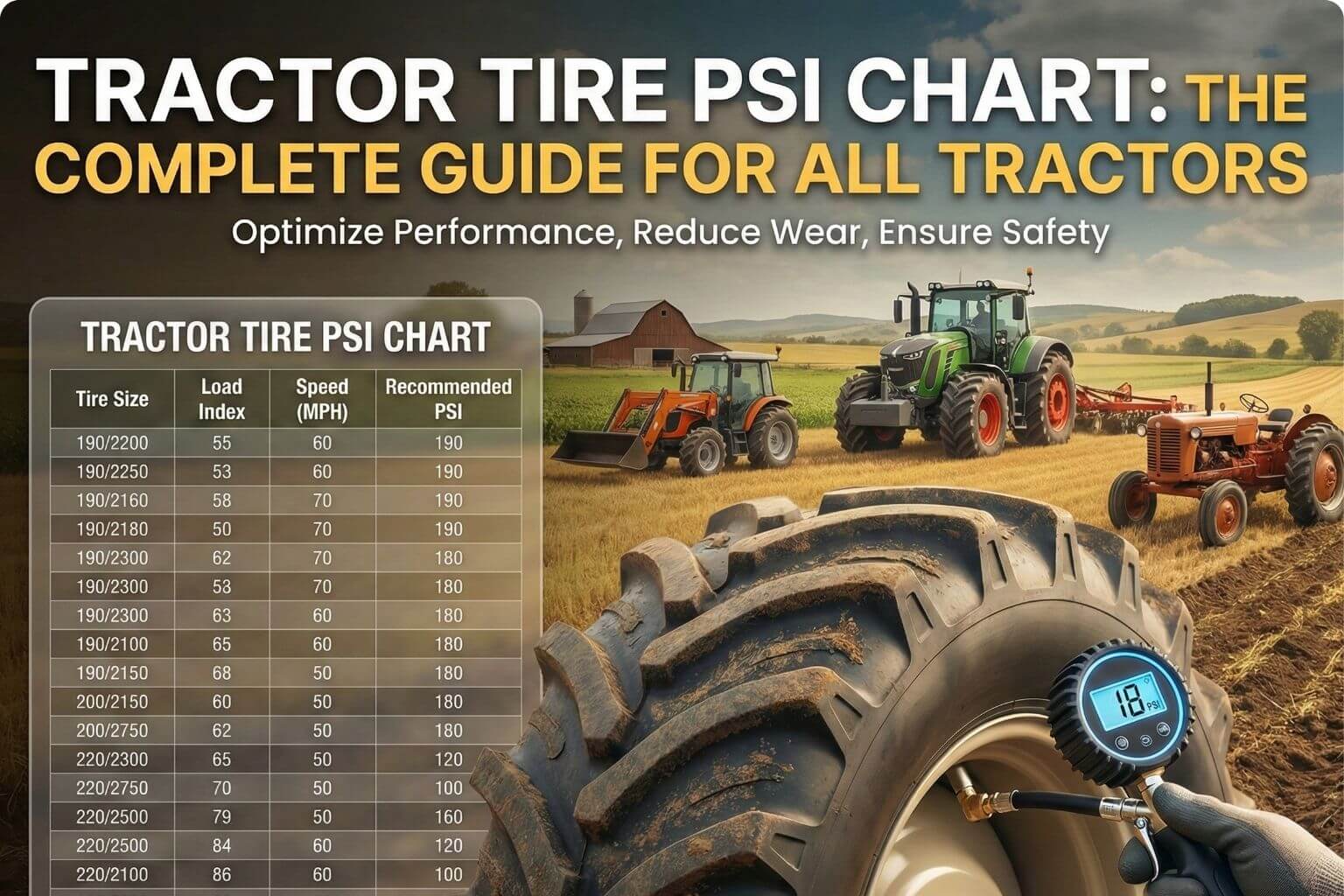
Tractor Tire PSI Chart – The Complete Guide
Maintaining the correct tractor tire PSI (pounds per square inch) is one of the simplest—and most overlooked—ways farmers and tractor owners can improve traction, fuel efficiency, ride comfort, and soil health. Yet many tractor users never receive clear PSI instructions, and manuals often provide vague ranges instead of practical, real-world numbers.
This comprehensive guide delivers multiple tractor tire PSI charts, broken down by tractor type, tire type, tire size, and job type, along with step-by-step instructions, expert tips, troubleshooting, and real-world insights based on agricultural best practices.
Whether you operate a compact tractor, a utility tractor, or a heavy-duty row-crop machine, this guide gives you the exact information you need to inflate your tires correctly—and avoid costly mistakes.
Why Tractor Tire PSI Matters
Keeping your tractor tires at the right PSI is one of the easiest ways to get better performance, save money, and protect your soil. Many tractor owners overlook tire pressure, but it affects almost everything your tractor does. Here’s why it matters.
Better Performance
1. Improved Traction
When your tires have the right amount of air, they can grip the ground properly. This is especially important when you’re:
- Plowing
- Pulling heavy equipment
- Lifting with a front loader
Correct PSI helps the tires “bite” into the soil so the tractor doesn’t slip or struggle.
2. Smoother Steering and Control
Proper tire pressure makes the tractor easier to steer.
If the tires are too soft, the tractor may feel slow to respond.
If they’re too hard, the ride can feel rough and shaky.
The right PSI keeps the tractor stable and easier to handle.
Better Fuel Efficiency
1. Underinflated Tires Waste Fuel
When tires don’t have enough air, they flatten out more and create extra drag.
This makes the tractor work harder than it should, which burns more fuel.
2. Overinflated Tires Don’t Grip Well
If your tires have too much air, they don’t press into the ground enough.
This reduces traction, meaning the tractor may spin or slip.
When that happens, the engine works harder and uses more fuel.
Healthier Soil
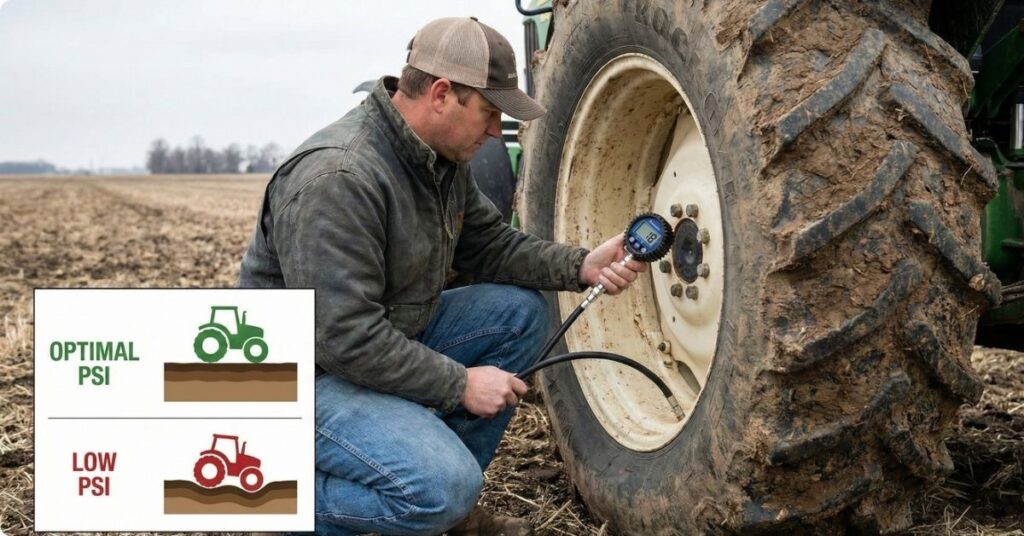
1. Proper PSI Reduces Soil Compaction
Heavy tractors can press soil down too tightly if the tires are overinflated.
Correct PSI spreads the weight more evenly and helps protect the soil structure.
2. Better Soil Means Better Crops
Loose, healthy soil allows plant roots to grow deeper and absorb more nutrients.
This can improve plant growth and overall field productivity.
Longer Tire Life (and Cost Savings)
1. Incorrect PSI Causes Uneven Wear
Too much air can wear out the center of the tire.
Too little air can wear out the edges.
Both situations shorten the life of the tire.
2. Proper PSI Saves Money Over Time
By keeping the tires at the right pressure, you can:
- Extend the life of the tires
- Avoid early replacements
- Reduce repair costs
This makes proper PSI one of the simplest ways to save money on tractor maintenance.
Factors That Affect Correct Tractor Tire PSI
The right tire pressure isn’t the same for every tractor or situation. Several factors affect what PSI you should use. Knowing these will help you keep your tires, tractor, and fields in the best condition.
Tire Type
Tractor tires come in two main types: radial and bias.
- Radial tires
- The layers run straight across the tire.
- They flex more and give a smoother ride.
- They usually handle lower PSI better and provide more traction on soft soil.
- The layers run straight across the tire.
- Bias tires
- The layers crisscross at an angle.
- They are stiffer and hold their shape under heavy loads.
- They need slightly higher PSI to perform well and last longer.
- The layers crisscross at an angle.
Tip: Check your tire sidewall to see if it’s radial or bias.
Tractor Type
Different tractors need different PSI because of size, weight, and work type.
| Tractor Type | Notes on PSI |
| Compact tractors | Smaller, lighter. Usually lower PSI. |
| Utility tractors | Medium size, used for multiple tasks. Moderate PSI. |
| Agricultural / row-crop tractors | Larger, heavier. PSI depends on tires and soil type. |
| Heavy-duty tractors | Big, heavy-duty farm tractors. Usually higher PSI for road transport and heavy loads. |
Tire Size & Load Capacity
- Tire size is printed on the sidewall (example: 14.9-28).
- First number = width (in inches)
- Second number = rim diameter (in inches)
- First number = width (in inches)
- Load capacity tells you how much weight the tire can safely carry.
- Larger tires can usually run at lower PSI because they spread weight better.
- Smaller tires may need slightly higher PSI for the same load.
Terrain & Job Type
Where and how you use the tractor affects the ideal PSI:
- Hard soil vs. soft soil
- Soft soil = lower PSI for better traction and less soil compaction
- Hard soil = slightly higher PSI for stability
- Soft soil = lower PSI for better traction and less soil compaction
- Fieldwork vs. road transport
- Fieldwork = lower PSI to reduce soil damage and improve grip
- Road transport = higher PSI to prevent tire wear and overheating
- Fieldwork = lower PSI to reduce soil damage and improve grip
- Front loader vs. hauling
- Loader work = medium to higher PSI to support weight
- Hauling heavy loads = higher PSI for tire stability
- Loader work = medium to higher PSI to support weight
Ballast Weight
Ballast adds extra weight to improve traction, but it affects tire pressure.
- Liquid ballast: Water or liquid in the tires
- Wheel weights: Heavy metal weights added to rims
- Effect on PSI: More ballast usually means you need slightly higher PSI to support the extra weight safely.
Seasonal Temperature
Tire pressure changes with temperature:
- Cold weather = air contracts, PSI drops
- Hot weather = air expands, PSI rises
Tip: Check and adjust PSI when seasons change, or if you notice tires look underinflated or overinflated.
Complete Tractor Tire PSI Chart
Most people searching for this topic simply want quick, accurate PSI numbers. This section gives you easy-to-read charts that show the right tire pressure for different tractor types, tire sizes, and jobs. You can use these tables to check your tires and adjust them with confidence.
Standard Tractor Tire PSI Range
Here are the general PSI ranges you’ll see on most tractors. These numbers give you a good starting point if you don’t have the exact specs for your tire.
| Tractor Type | Typical Front Tire PSI | Typical Rear Tire PSI |
| Compact Tractors | 16–22 PSI | 12–20 PSI |
| Utility Tractors | 20–28 PSI | 18–26 PSI |
| Row-Crop Tractors | 28–35 PSI | 20–30 PSI |
| Heavy-Duty Tractors | 30–40 PSI | 25–35 PSI |
Tip: Rear tires are usually bigger and run at a slightly lower PSI to help the tractor grip the ground better.
Detailed PSI Chart by Tire Size
This chart gives you more specific PSI ranges based on common tractor tire sizes. The numbers below work for most brands, but always check your owner’s manual if you are unsure.
| Tire Size | Tire Type | Front PSI | Rear PSI | Fieldwork PSI | Transport/Towing PSI |
| 9.5-16 | Bias | 18–22 | 16–20 | 12–16 | 18–22 |
| 11.2-24 | Radial | 18–24 | 16–22 | 12–16 | 20–24 |
| 12.4-28 | Bias | 20–26 | 18–24 | 14–18 | 22–26 |
| 14.9-28 | Radial | 22–28 | 20–26 | 16–20 | 24–28 |
| 16.9-30 | Radial | 24–30 | 22–28 | 18–22 | 26–30 |
| 18.4-34 | Radial | 26–32 | 24–30 | 18–22 | 28–32 |
How to use this chart:
- Fieldwork PSI is for plowing, tilling, or working on soft soil.
- Transport PSI is for driving on roads or towing heavy loads.
- If you’re switching between jobs, you may need to adjust the pressure.
PSI Chart by Tractor Type
If you don’t want to look up your tire size, you can use these simple charts based on the type of tractor you own.
Compact Tractors
| Use | Front PSI | Rear PSI |
| Light fieldwork | 14–18 | 12–16 |
| Loader use | 18–22 | 16–20 |
| Road/transport | 20–24 | 18–22 |
Utility Tractors
| Use | Front PSI | Rear PSI |
| Fieldwork | 18–24 | 16–22 |
| Heavy loader work | 24–28 | 22–26 |
| Road/transport | 26–30 | 24–28 |
Row-Crop Tractors
| Use | Front PSI | Rear PSI |
| Fieldwork | 22–28 | 18–24 |
| Pulling heavy implements | 26–32 | 22–28 |
| Road/transport | 28–34 | 24–30 |
Heavy-Duty Tractors (Large Farm Tractors)
| Use | Front PSI | Rear PSI |
| Fieldwork | 24–30 | 20–26 |
| Deep tilling / heavy loads | 30–36 | 26–32 |
| Road/transport | 32–40 | 30–36 |
Task-Specific PSI Recommendations
If you only want PSI numbers based on the job you’re doing, use the quick guide below.
| Task | Ideal PSI Range | Notes |
| Plowing | Low to medium (12–20 PSI) | Lower PSI increases traction and reduces soil damage. |
| Loader work | Medium to high (20–28 PSI) | Higher PSI helps support the weight of the loader. |
| Mowing | Medium (18–24 PSI) | Gives a smoother ride and steady ground contact. |
| Towing heavy loads | High (26–32 PSI) | Higher PSI keeps tires stable under heavy weight. |
| Road transport | High (26–36 PSI) | Higher PSI prevents overheating when driving fast on hard surfaces. |
How to Check Tractor Tire PSI (Step-by-Step)
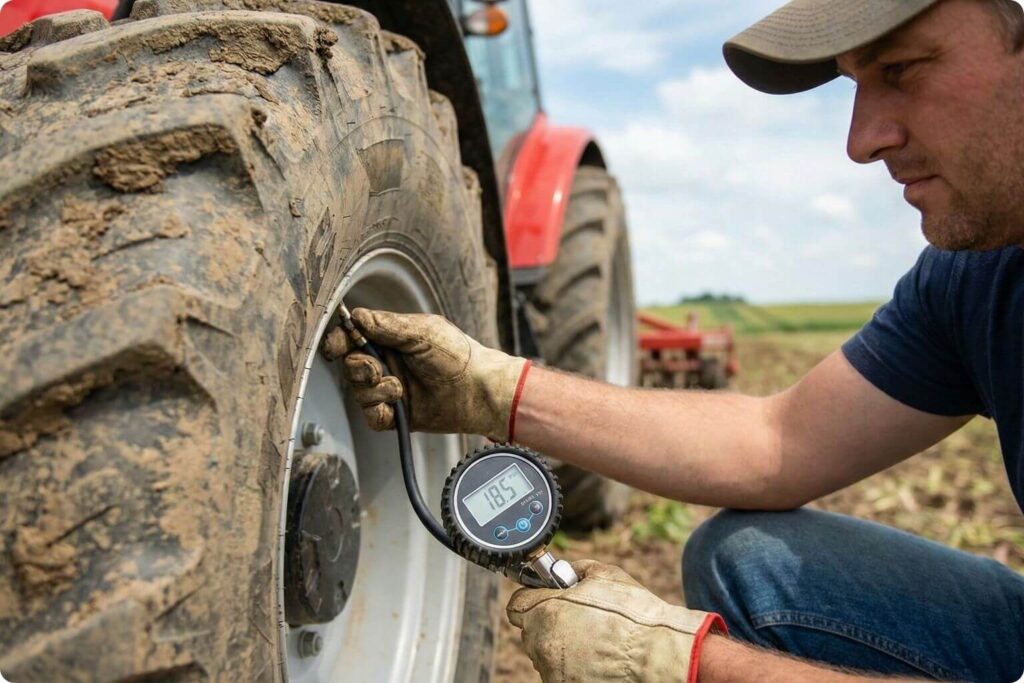
Checking your tractor’s tire pressure might seem tricky, but it’s easy if you follow these steps. Keeping the PSI correct will improve performance, save fuel, and protect your tires and soil.
Tools You’ll Need
Before you start, gather these simple tools:
- Tire pressure gauge – Make sure it’s suitable for tractor tires (not just a car gauge).
- Air compressor – For adding air when the PSI is too low.
- Valve stem cleaner – To remove dirt and debris from the tire valve before checking.
Step-by-Step Instructions
- Park on level ground
- Always check tire pressure when the tractor is on a flat, stable surface.
- Always check tire pressure when the tractor is on a flat, stable surface.
- Clean the valve stem
- Dirt or mud can give a false reading. Wipe the valve clean before testing.
- Dirt or mud can give a false reading. Wipe the valve clean before testing.
- Read the PSI
- Attach your gauge to the valve and take a reading.
- Write it down or remember the number.
- Attach your gauge to the valve and take a reading.
- Compare with the chart
- Check the PSI against the recommended numbers from the tractor tire chart you have.
- Check the PSI against the recommended numbers from the tractor tire chart you have.
- Inflate or deflate as needed
- Add air if the PSI is too low.
- Let air out if the PSI is too high.
- Small adjustments are best—don’t overcorrect.
- Add air if the PSI is too low.
- Check all tires
- Make sure you check both front and rear tires, because PSI often differs between them.
- Make sure you check both front and rear tires, because PSI often differs between them.
- Recheck after operation
- After using your tractor for a day or completing heavy work, check PSI again. Tires can settle or change pressure slightly after use.
Safety Warnings
- Don’t overinflate: Tractor tires are big and can be dangerous if overfilled. Overinflated tires can explode.
- Check your manual: Always follow the PSI range listed in your tractor’s owner manual.
- Call a professional if unsure: If you’re unsure about tire pressure or notice damage, it’s safer to get help from a trained mechanic.
How to Adjust Tractor Tire Pressure Correctly
Once you’ve checked your tractor’s tire PSI, you may need to adjust it. Doing it correctly ensures better performance, safer operation, and longer tire life.
Inflating Tires
- Attach the air compressor to the tire’s valve stem.
- Add air slowly—a little at a time.
- Check the PSI with a gauge frequently while inflating.
- Stop at the recommended PSI from your tractor tire chart.
- Replace the valve cap securely after inflating.
Tip: Avoid inflating too quickly. Big tractor tires can be dangerous if overfilled.
Deflating Tires
- Remove the valve cap carefully.
- Release a small amount of air using the gauge or the valve stem.
- Check the PSI after each release until it matches the recommended number.
- Replace the valve cap after adjusting.
Tip: Never release air too fast. Over-deflating can make the tire unstable and unsafe.
Matching PSI to Implements
The right PSI can change depending on the job or the tool attached to your tractor:
- Plowing or soft soil work → Slightly lower PSI for better traction and less soil compaction.
- Loader work → Medium to higher PSI to support the extra weight.
- Towing or hauling heavy loads → Higher PSI for tire stability and safety.
- Transport on roads → Higher PSI to prevent tire wear and overheating.
Tip: If you switch between jobs, check your tire chart and adjust the PSI as needed. Even small changes can improve performance and safety.
Common Symptoms of Incorrect Tractor Tire PSI
Tires that aren’t at the right PSI can cause problems for your tractor, your crops, and your wallet. Here’s how to spot if your tires need adjustment.
Signs of Underinflation
When your tires have too little air, you may notice:
- Squishy sidewalls – The tire looks soft and may bulge out at the sides.
- Poor traction – The tractor slips or spins more easily, especially on soft soil.
- Excess soil compaction – The weight isn’t spread evenly, pressing down the soil too much.
- Higher fuel use – The engine works harder to pull the tractor, using more fuel.
Tip: If you see or feel these issues, check the PSI and inflate the tires as needed.
Signs of Overinflation
When your tires have too much air, you may notice:
- Rough ride – The tractor feels bouncy or uncomfortable on the road or field.
- Reduced contact patch – The tire touches less of the ground, which reduces grip.
- Faster wear in the center – The middle of the tire tread wears down quicker than the edges.
- Less pulling power – The tractor struggles to pull equipment or loads efficiently.
Tip: If the tires feel hard or the center tread looks worn, you may need to reduce the PSI.
Diagnosing via Tread Wear Patterns
You can often tell if PSI is wrong just by looking at the tire tread:
- Center wear – Usually a sign of overinflation.
- Shoulder wear – Usually a sign of underinflation.
- Irregular wear – Could mean PSI is inconsistent, tires are mismatched, or alignment issues exist.
Tip: Check tires regularly for uneven wear. Catching problems early can save money and improve performance.
Expert Tips for Maintaining Correct Tractor Tire PSI
Keeping your tires at the right PSI is easy if you follow these simple habits:
- Check and adjust weekly – Especially if you use your tractor every day.
- Use a digital gauge – Gives a more accurate reading than old-fashioned gauges.
- Adjust for soil conditions – Lower PSI for wet or soft soil, higher PSI for dry or hard soil.
- Seasonal adjustments – Tires lose pressure in winter and gain it in summer; check regularly.
- Follow manufacturer guidelines – Brands like Michelin, Firestone Ag, and Titan/Goodyear provide recommended PSI for each tire.
Tip: Regular checks save fuel, improve traction, and extend tire life.
Frequently Asked Questions (FAQ)
1. What PSI should my tractor tires be?
The correct PSI depends on your tractor type, tire size, and the work you’re doing. Check your tractor tire chart or manufacturer guidelines for exact numbers.
2. Why are front and rear tractor tires different PSI?
Rear tires carry more weight and provide traction, so they usually run at a slightly lower PSI than front tires. Front tires handle steering and balance.
3. Is lower PSI better for plowing?
Yes. Lower PSI increases tire grip and reduces soil compaction, making plowing more effective.
4. How often should I check my tractor tire pressure?
Check at least once a week, or before any heavy work. Seasonal changes or frequent use can affect tire PSI.
5. Does ballast fluid change PSI?
Yes. Adding liquid ballast increases tire weight, which usually means you need slightly higher PSI to support the extra load safely.
6. Can overinflated tires damage my tractor?
Yes. Overinflated tires reduce ground contact, cause uneven wear, and can make the ride rough and unstable.
7. How do I know if my tires are underinflated?
Look for squishy sidewalls, poor traction, or faster wear on the edges of the tread.
8. Does temperature affect tire PSI?
Yes. Cold weather lowers PSI, and hot weather increases it. Always check and adjust when seasons change.
9. Should I adjust PSI for different tasks?
Yes. Lower PSI is better for soft soil or plowing, while higher PSI is needed for hauling, loader work, or road transport.
10. Can I use a regular car gauge to check tractor tires?
It’s better to use a tractor-grade or digital gauge. Regular car gauges may not handle the higher pressures of tractor tires accurately.
Conclusion
Correct tractor tire PSI is a vital—yet often ignored—factor in performance, fuel efficiency, tire life, and soil preservation. Using the charts in this guide, you can confidently set the right PSI for your tractor type, job, tire size, and operating conditions.
Whether you’re plowing, mowing, transporting, or doing loader work, the right PSI ensures:
- Maximum traction
- Minimum soil compaction
- Longer tire life
- Better fuel economy
- Safer handling
