Trailer Tire Size Chart: Complete Guide
Choosing the correct trailer tire size is one of the most important steps in keeping your trailer safe, stable, and road-ready. If you’re searching for a trailer tire size chart, you’re likely trying to match the right tire to your trailer’s weight, axle rating, and wheel size—without risking blowouts, uneven wear, or towing instability. Unfortunately, trailer tire sizing can be confusing, especially with older size markings, different load ranges, and multiple rim diameters to choose from.
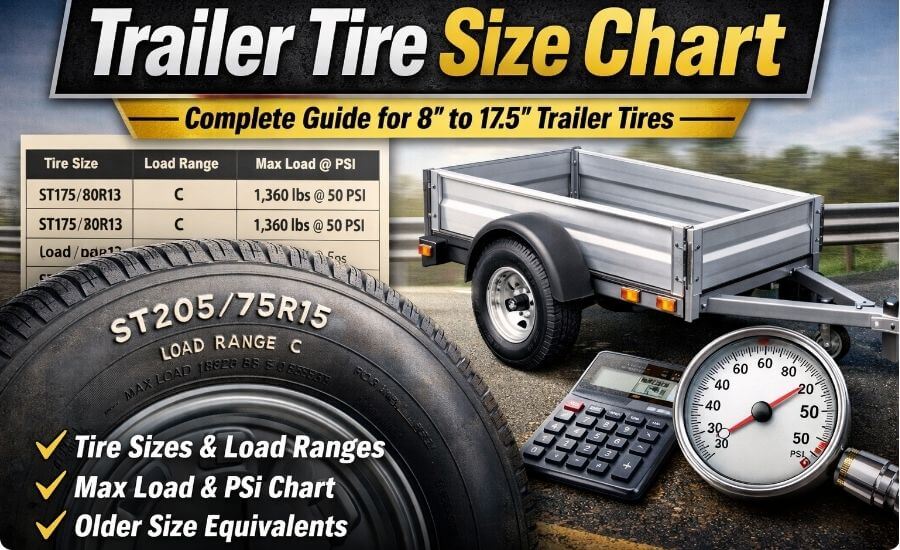
This guide breaks everything down in a clear, practical way. Below, you’ll find a complete trailer tire size chart covering 8-inch through 17.5-inch trailer tires, including older size equivalents, estimated tire width, rim width, load range, and overall diameter. We’ll also explain how to read trailer tire sidewall markings, calculate the correct load capacity for your trailer, and avoid common sizing mistakes that lead to premature tire failure.
Whether you’re replacing worn-out tires on a utility trailer, upgrading tires on an RV or cargo trailer, or verifying the correct size before a long haul, this article gives you the exact information you need to choose the right trailer tire with confidence.
Quick definitions: ST, load range, and why trailer tires are special
- ST = Special Trailer (or “Trailer” tires). ST tires are built for trailers — their construction, sidewall stiffness, and load characteristics differ from passenger (P) and light truck (LT) tires. That’s why most manufacturers and trailer builders expect ST tires on trailer axles. Venture Trailers+1
- Load range / ply rating. Load Range (B, C, D, E, etc.) maps to the tire’s ply rating or capacity; higher load ranges let the tire carry more weight at a specified maximum PSI. For trailers you must match or exceed the per-tire load needed for your axle(s).
- GVWR / GAWR. The trailer’s GVWR (Gross Vehicle Weight Rating) and each axle’s GAWR (Gross Axle Weight Rating) are the starting point for choosing tires — pick tires whose maximum load at the required PSI is ≥ the required per-tire load. NHTSA guidance permits tires whose load rating equals or exceeds the axle rating.
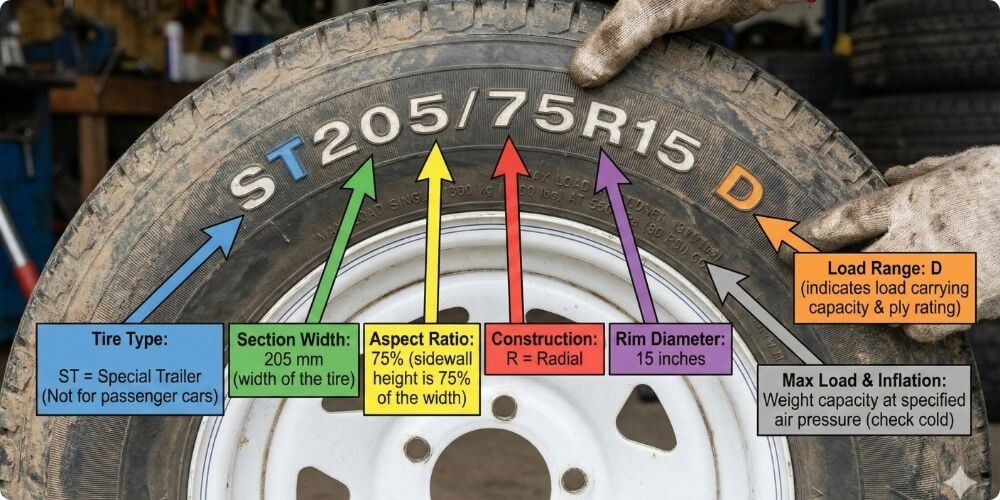
How to read a trailer tire sidewall (example: ST205/75R15 D)
A real sidewall might read: ST205/75R15 D 8PR DOT XXXX
- ST — Special Trailer (use on trailers).
- 205 — section width in millimetres (nominal). In ST205 the section width is ~205 mm (≈8.07″).
- 75 — aspect ratio: sidewall height is 75% of the section width.
- R — radial construction (D would indicate bias/diagonal). (Radial vs bias-ply affects heat, ride, and sidewall flexibility.)
- 15 — rim diameter in inches. Match tire rim diameter exactly.
- Load Range / PR / Max PSI — shown separately (e.g., D → max PSI may be 65, and load capacity listed). Always use the cold inflation pressure specified by the manufacturer for the load you carry.
Trailer Tire Size Chart (8″–17.5″) — Load Capacity, PSI & Older Size Reference
Legend:
Est. Width = estimated section width (inches).
Rim Width = recommended rim inner width (inches).
Load Range = typical available load ranges for that size.
Max Load (lbs) @ Max PSI = maximum load per tire at the listed cold inflation pressure (manufacturer max).
Manufacturer Example / Spec Link = link to a reputable manufacturer or product page readers can verify.
| Rim | Older / Common Marking | Modern Tire Size (typical) | Est. Width (in) | Rim Width (in) | Typical Load Range(s) | Overall Dia (in) | Max Load (lbs) @ Max PSI | Manufacturer Example / Spec Link | Notes |
| 8″ | 4.80-8 | 4.80-8 | 4.6″ | 3.0–3.75″ | B / C | ~16.1″ | ~775–990 lb @ 50–60 PSI | Carlisle / Towmaster product pages (bias 8″ sizes) | Common small utility trailers, lawn carts. Verify bias vs radial. |
| 8″ | 5.70-8 | 5.70-8 | 5.6″ | 3.0–3.75″ | B / C / D | ~18.1″ | ~990–1,540 lb @ 50–80 PSI (varies by load range) | Retailer spec pages for 5.70-8 | Heavier small trailers / older designs. |
| 8″ | 16.5×6.5-8 | 165/65-8 (approx) | 6.6″ | 4.5–5.375″ | C | ~16.5″ | see manufacturer | Carlisle / aftermarket listings | Older numeric marking mapping to metric when available. |
| 8″ | 18.5×8.5-8 | 215/60-8 (approx) | 8.9″ | 6.0–7.0″ | C / D | ~18.3″ | see manufacturer | Retail spec pages | Wide bias trailer tire option. |
| 9″ | 4.00-9 | 4.00-9 | 4.8″ | 3.0–3.75″ | B / C | ~17.4″ | ~800–1,000 lb @ 50–60 PSI | Carlisle / retailer listings | Older small trailer sizes. |
| 9″ | 6.00-9 / 6.90-9 | 6.00-9 / 6.90-9 | 6.5–7.1″ | 4.0–4.5″ | C | ~21.0–22.0″ | ~1,200–1,700 lb @ 50–65 PSI | Carlisle / retail pages | Often used on older utility/equipment trailers. |
| 10″ | 20.5×8-10 | 205/65-10 (approx) | 8.0–8.4″ | 5.0–6.0″ | C / D | ~20.4″ | ~1,360–1,760 lb @ 50–65 PSI | Carlisle / retailer listings | Common small boat trailer sizes in some markets. |
| 12″ | 4.80-12 | 4.80-12 | 4.6″ | 3.0–3.75″ | B / C | ~20–22″ | ~785–990 lb @ 50–60 PSI | Carlisle Sport Trail / Carlstar pages | Light-duty trailer use. |
| 12″ | 5.30-12 | 5.30-12 | 5.3″ | 3.75–5.0″ | B / C | ~21.9″ | ~855–1,050 lb @ 55–80 PSI | Carlisle Sport Trail (Carlstar) | Common for utility trailers and small enclosed trailers. |
| 13″ | B78-13 (older) | ST175/80R13 | 6.6″ | 4.5–5.5″ | C | ~24.1″ | 1,360 lb @ 50 PSI (C) | Maxxis M8008 ST spec / other ST spec sheets | Very common on smaller boat/RV jack tires & light trailers. |
| 13″ | — | ST185/80R13 | 7.3″ | 4.5–5.5″ | C | ~24.8″ | 1,480 lb @ 50 PSI (C) | Maxxis / Goodyear product pages | Slightly wider option; check fender clearance. |
| 14″ | — | ST205/75R14 | 8.0″ | 5.0–6.0″ | C / D | ~24.8–25.2″ | 1,760 lb @ 50 PSI (C); 2,040 lb @ 65 PSI (D) | Maxxis M8008 ST / manufacturer pages | Used on some light utility and specialty trailers. |
| 15″ | — | ST205/75R15 | 8.0–8.1″ | 5.0–6.0″ | C / D / E | ~26.9–27.3″ | 1,820 lb @ 50 PSI (C); 2,150 lb @ 65 PSI (D) | Maxxis M8008 ST / Goodyear Endurance spec pages | One of the most common trailer tire sizes. |
| 15″ | — | ST225/75R15 | 8.8–9.9″ | 6.0″ | D / E | ~28.0″ | 2,540 lb @ 65 PSI (D); 2,830 lb @ 80 PSI (E) | Maxxis / Goodyear spec pages | Good for heavier utility, cargo, and smaller RV trailers. |
| 16″ | — | ST235/80R16 | 9.2–9.8″ | 6.5″ | E / higher ply | ~30.8–31.4″ | 3,420 lb @ 80 PSI (E) | Maxxis / Goodyear Endurance pages | Common for heavier boat, RV, and commercial trailers. |
| 17.5″ | — | 205/75R17.5 (commercial variants) | 8.0–8.5″ | 6.0–6.75″ | Higher ply / commercial | ~27.5–29.0″ (varies) | ~2,700–4,000+ lb @ 80–110 PSI (varies widely by spec) | Commercial trailer tire pages (Goodyear, Michelin, commercial catalogs) | 17.5″ is more common in light commercial and RV coach axles — confirm load index and wheel rating. |
- Values are representative / typical. Actual section width, diameter, load capacity, and max PSI vary by brand, construction (bias vs radial), and load range. Treat the table as a verified starting point, not a replacement for the tire maker’s spec sheet.
- Load capacity is shown per tire at the listed max cold PSI. Example: an ST225/75R15 in Load Range D might be rated ~2,540 lbs at 65 PSI — the same tire in Load Range E will have a higher capacity at a higher max PSI. Always use the load capacity that corresponds to the tire’s exact load range & max PSI.
- Matching tires on an axle: Never mix different sizes, load ranges, or constructions (bias vs radial) on the same axle. Do not pair an ST tire with a passenger tire on the same axle.
- Older numeric markings: Many older trailers list sizes like 16.5×6.5-8. We mapped commonly-encountered older numbers to modern metric equivalents where possible; sometimes there is no exact metric equivalent — verify wheel sizing and bead seat diameter.
- Clearance, brakes, and wheels: Upsizing tires changes rolling diameter and can impact clearance, brake performance, and suspension gearing. Check fender/leaf clearance and re-confirm wheel load rating.
- Cold inflation: Max PSI should be measured cold (before towing). Heat during towing raises pressure; never inflate to an on-road hot PSI target. Always follow manufacturer guidance.
Step-by-step: How to pick the right trailer tire size (practical)
Step 1 — Find GVWR & axle GAWR (the starting point)
Locate the trailer data plate (near the coupler or frame) — it lists GVWR and GAWR. If you can’t find it, consult the trailer builder or axle stamp. Use the GAWR of the axle to calculate required per-tire capacity. NHTSA confirms you may fit tires with equal/greater load rating than the axle requires.
Example: Trailer GVWR = 3,500 lb, tandem axle (two axles) each rated 3,500 lb? Usually you’ll divide axle rating by the number of tires per axle (single axle with two tires = per-tire requirement = GAWR ÷ 2).
Step 2 — Calculate minimum per-tire load
Formula:
Required per-tire capacity = GAWR ÷ tires per axle
Add a safety margin (recommended 10–20%) to avoid running tires at their limit and to account for uneven load distribution.
Example: GAWR 3,500 lb on a single axle with 2 tires → minimum per-tire capacity = 1,750 lb. Choose a tire whose max load at the intended operating PSI ≥ 1,750 lb (pick next higher standard rating to be safe).
Step 3 — Select size or load range that meets per-tire requirement
Use manufacturer load/inflation charts (they show load at specific PSI for each size & load range). For the popular ST205/75R15, manufacturers list different capacities depending on load range (C/D/E), so read the specific product spec sheet.
Step 4 — Check rim fitment, clearance & brakes
- Confirm the rim width is compatible with the selected tire size (manufacturer listed “approved rim width”). Goodyear and Carlisle list approved rim widths for their trailer tires — use those numbers.
- Ensure fender and suspension clearance if upsizing.
- If the trailer has surge or electric brakes, check that the tire size change does not affect brake performance or drum compatibility.
Step 5 — Decide on construction: radial vs bias
- Radial (R) — better heat dissipation, longer tread life, improved highway stability for highway-driven trailers (RVs, car haulers).
- Bias (D) — sometimes preferred for specific load or off-road uses; older trailers may ship originally with bias ply. Choose per your towing speed and load profile. Manufacturer specs indicate construction and recommended use.
Upsizing: when it’s OK — and when it’s dangerous
When it may be OK:
- You keep the same load rating or increase it (e.g., switch to same-size with higher Load Range).
- There’s adequate fender/wheel well clearance and rims are compatible.
- Speed and brake considerations are evaluated.
When it’s risky:
- Increasing overall diameter enough to contact fenders or change gear ratio significantly.
- Using tires with insufficient rim bead seating or lower load rating.
- Mixing different sizes or load ranges on the same axle.
Always consult axle, wheel, and trailer manufacturers before upsizing.
Maintenance & inflation rules tied to tire size
- Inflation varies by load, not solely by size. For trailers you typically inflate to the manufacturer’s cold PSI for the load you have (often near the maximum PSI listed on the sidewall for ST tires), not “passenger car” pressures. Use the load/ inflation table from the tire maker to find the correct cold PSI for your per-tire load.
- Always run balanced & matched tires on the same axle. Mixing different sizes or load ranges on a single axle leads to uneven load sharing.
- Check DOT date codes before buying used tires; age and UV damage are as important as tread.
- Heat is the enemy — underinflation + heavy load + high speed = heat build-up and possible failure.
Conclusion — make the safe, informed choice
Trailer tire sizing may look like a list of numbers, but those characters and letters tell a critical safety story: what the tire can carry, how it will behave at highway speeds, and how it should be inflated. Start with your trailer’s GVWR/GAWR, choose tires whose rated load ≥ required per-tire load, match wheel/rim widths, and follow manufacturer load/inflation tables. When in doubt, favor higher load range and consult the tire maker’s specs or a professional installer.
Frequently Asked Questions (FAQs)
What does “ST” mean on trailer tires?
“ST” stands for Special Trailer. ST tires are designed specifically for trailers, with stiffer sidewalls and construction that handle heavy vertical loads and towing forces better than passenger (P) or light truck (LT) tires. For most trailers, ST tires are the recommended and safest option.
How do I know what size trailer tire I need?
Start by checking the tire size printed on the existing tire sidewall or the trailer data plate, then confirm the trailer’s GVWR and axle rating. Use a trailer tire size chart to verify the correct size, load range, rim width, and overall diameter before purchasing replacement tires.
What is load range on a trailer tire, and why is it important?
Load range (B, C, D, E, etc.) indicates how much weight a trailer tire can safely carry at a specific PSI. Choosing the correct load range is critical—tires with too low a load range can overheat and fail, while higher load ranges provide greater safety margins for heavier trailers.
Can I use a larger trailer tire than what came from the factory?
Sometimes, but not always. You must check fender clearance, suspension travel, wheel width, brake clearance, and wheel load rating before upsizing. Increasing tire size without verifying clearance or load compatibility can cause rubbing, handling issues, or component damage.
Can I replace trailer tires with passenger or light truck tires?
In most cases, no. Passenger (P) and light truck (LT) tires are not designed for sustained trailer loads and sidewall stress. ST trailer tires are built specifically for towing and should be used unless the trailer manufacturer explicitly approves an alternative.
How much weight can a trailer tire carry?
A trailer tire’s maximum load depends on its size, load range, and inflation pressure. The exact capacity is listed on the tire sidewall and in the manufacturer’s load/inflation chart. Always calculate the required load per tire using your axle rating and choose a tire that meets or exceeds that value.
What PSI should trailer tires be inflated to?
Trailer tires should be inflated to the manufacturer’s recommended cold PSI for the load being carried—often the maximum PSI listed on the sidewall for ST tires. Never set pressure based on hot readings taken after towing, as heat naturally increases PSI.
How often should trailer tires be replaced?
Most manufacturers recommend replacing trailer tires every 5–7 years, even if tread depth looks good. Age, UV exposure, and internal rubber degradation can cause failures long before the tread wears out. Always check the DOT date code on the tire.
Can I mix different trailer tire sizes or load ranges on the same trailer?
No. Never mix different sizes, load ranges, or constructions (bias vs radial) on the same axle. Mismatched tires can cause uneven load distribution, poor handling, and premature tire or axle failure.
Do wider trailer tires increase load capacity?
Not necessarily. Load capacity is determined by the tire’s construction and load range, not just width. A wider tire may offer stability benefits, but you must always rely on the manufacturer’s stated load rating—not appearance—when selecting trailer tires.
