Tire Speed Rating Chart: Complete Guide to Tire Speed Ratings
Last updated on August 16th, 2026
A tire’s speed rating tells you the tire’s rated speed capability under specified conditions. It is represented by a letter or speed symbol in the tire’s size and service description, such as T, H, V, W, or Y.
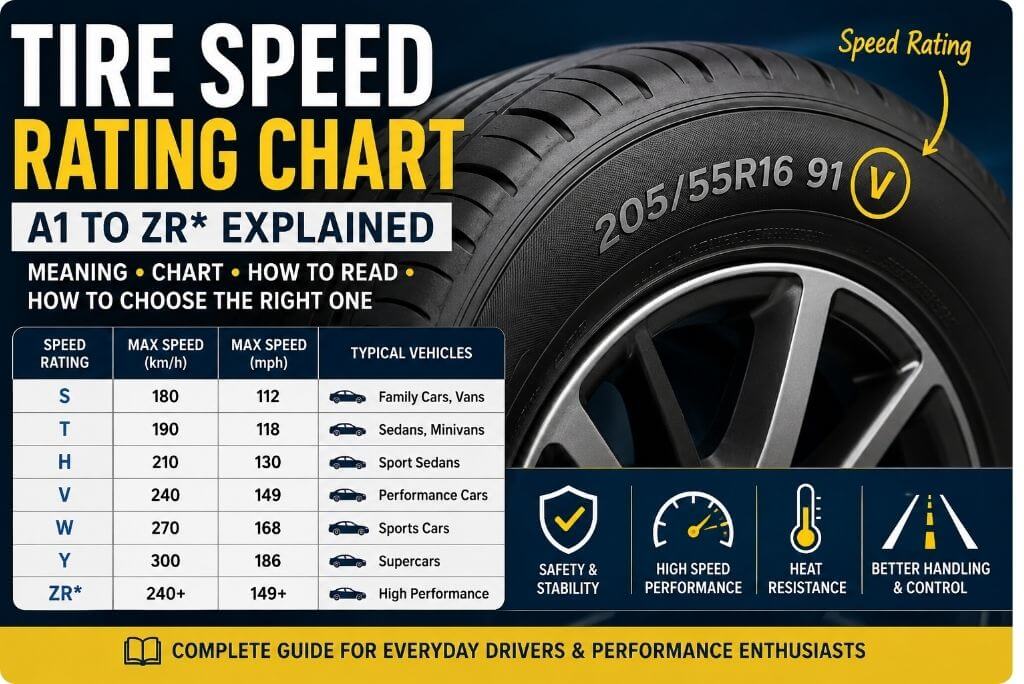
This Tire Speed Rating Chart shows the complete range from A1 to Y, with rated speeds in both mph and km/h. You’ll also learn how to read the speed rating on a tire sidewall, what common ratings such as S, T, H, V, W, and Y mean, and how Z, ZR, and (Y) differ.
A higher speed rating is not automatically the right choice for every vehicle. Always check your vehicle manufacturer’s recommended tire size, load requirements, and speed rating before replacing your tires.
Quick Tire Speed Rating Chart
For most U.S. passenger cars, SUVs, and crossovers, the ratings you’re most likely to encounter are S, T, H, V, W, and Y.
| Speed Rating | Rated Speed (mph) | Rated Speed (km/h) |
| S | 112 | 180 |
| T | 118 | 190 |
| H | 130 | 210 |
| V | 149 | 240 |
| W | 168 | 270 |
| Y | 186 | 300 |
| (Y) | Above 186 | Above 300 |
These figures are speed-category values used under standardized test conditions. They should not be interpreted as recommended driving speeds or as a guarantee that a vehicle can safely be operated at those speeds. NHTSA specifically cautions that speed ratings do not mean a vehicle can safely be driven at the tire’s rated speed, particularly when road, weather, tire, or vehicle conditions are unfavorable.
What Is a Tire Speed Rating?
A tire speed rating identifies the tire’s rated speed capability when carrying its rated load under specified conditions.
It is usually represented by a letter in the tire’s service description. For example, the V in 205/55R16 91V is the speed symbol.
A V-rated tire has a rated speed of 149 mph (240 km/h) under the applicable test conditions.
That does not mean 149 mph is a safe or recommended speed for driving. Actual tire performance can be affected by inflation pressure, load, temperature, tire condition, vehicle condition, road conditions, and how long the tire is operated at speed.
The speed rating should therefore be treated as a tire specification, not a driving recommendation.
It also should never be considered by itself. The correct replacement tire must meet the vehicle’s requirements for size, load-carrying capacity, speed rating, and other applicable specifications. USTMA recommends consulting the tire placard, owner’s manual, and vehicle or tire manufacturer when replacing tires.
How to Read a Tire Speed Rating on the Sidewall
The easiest way to understand a speed rating is to break down the complete tire marking.
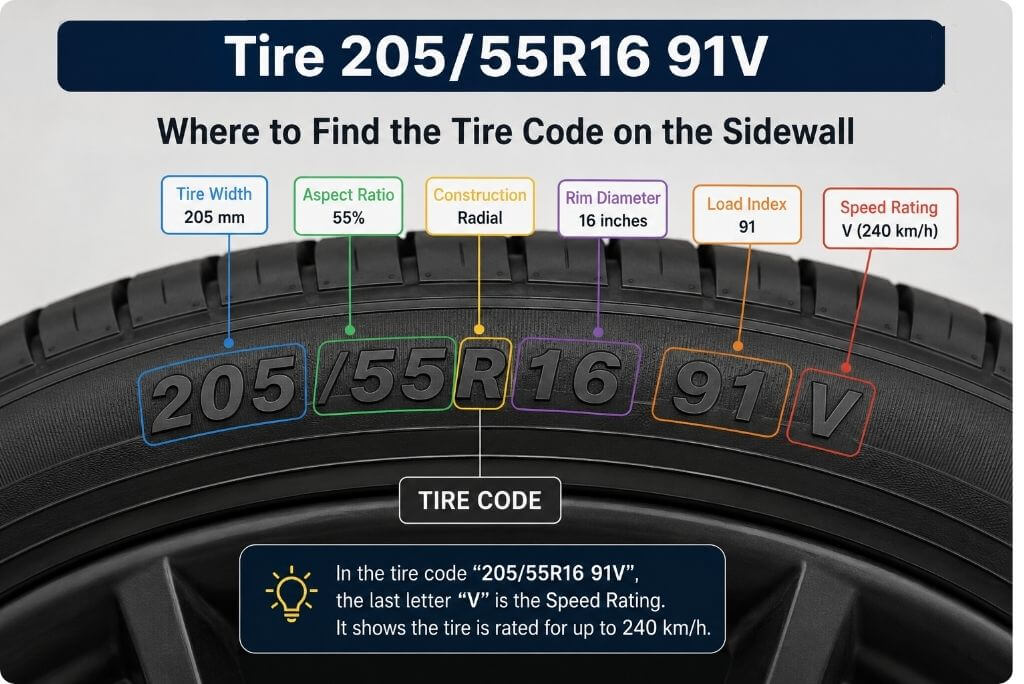
Consider this example:
205/55R16 91V
| Marking | Meaning |
| 205 | Section width in millimeters |
| 55 | Aspect ratio |
| R | Radial construction |
| 16 | Wheel diameter in inches |
| 91 | Load index |
| V | Speed symbol |
The V is the speed rating portion of this service description.
The 91 is not the speed rating. It is the load index and corresponds to a maximum load capacity of 615 kg (1,356 lb) per tire.
What About P, LT, XL, and Other Markings?
The beginning of a tire size can contain additional information about the tire’s application or construction.
For example:
- P — P-metric passenger tire
- LT — Light Truck tire
- XL — Extra Load designation used on applicable tires
These markings are separate from the speed symbol.
For example:
P225/65R17 102H
Here:
- P identifies the tire as P-metric
- 225/65R17 is the tire size
- 102 is the load index
- H is the speed symbol
Always interpret the complete tire marking, rather than assuming the last letter is the only specification that matters.
Where Can You Find the Tire Speed Rating?
You can find the tire’s speed symbol on the sidewall, usually as part of the tire’s complete service description.
However, when you’re buying replacement tires, don’t use the existing tire alone as your only reference.
The vehicle manufacturer’s recommended tire specification is normally listed on the tire information placard, commonly found on or around the driver’s-side door area, and may also be listed in the owner’s manual. USTMA recommends using these sources to determine the proper replacement tire.
This distinction is important:
The tire sidewall tells you what tire is currently fitted. The vehicle placard and owner’s manual tell you what the vehicle manufacturer recommends.
If the vehicle’s original tires have already been changed, the sidewall marking may not represent the manufacturer’s original specification.
When replacing tires, use the vehicle manufacturer’s specification as your starting point.
Complete Tire Speed Rating Chart
The following chart includes the commonly referenced speed symbols from the low-speed categories through the high-speed categories. Some of the lower ratings are associated with specialized, agricultural, industrial, temporary-spare, commercial, or other applications and are uncommon on modern U.S. passenger vehicles.
| Speed Symbol | Rated Speed (mph) | Rated Speed (km/h) |
| A1 | 3 | 5 |
| A2 | 6 | 10 |
| A3 | 9 | 15 |
| A4 | 12 | 20 |
| A5 | 16 | 25 |
| A6 | 19 | 30 |
| A7 | 22 | 35 |
| A8 | 25 | 40 |
| B | 31 | 50 |
| C | 37 | 60 |
| D | 40 | 65 |
| E | 43 | 70 |
| F | 50 | 80 |
| G | 56 | 90 |
| J | 62 | 100 |
| K | 68 | 110 |
| L | 75 | 120 |
| M | 81 | 130 |
| N | 87 | 140 |
| P | 93 | 150 |
| Q | 99 | 160 |
| R | 106 | 170 |
| S | 112 | 180 |
| T | 118 | 190 |
| U | 124 | 200 |
| H | 130 | 210 |
| V | 149 | 240 |
| W | 168 | 270 |
| Y | 186 | 300 |
Important Note About the Chart
The “general note” column is intentionally broad.
There is no universal rule that a particular speed symbol belongs to one specific type of vehicle. For example, it is misleading to say that Y-rated tires are only for supercars or that H-rated tires are always for luxury sedans.
Actual fitment is determined by the vehicle manufacturer and the tire’s complete specification.
The speed values above are standardized category values; they are not recommendations for how fast you should drive. Michelin and NHTSA publish comparable speed-rating information and likewise distinguish the rating from actual safe driving conditions.
What Do Z, ZR, and (Y) Mean on a Tire?
The letters Z, ZR, and (Y) can be confusing because they do not work exactly like fixed speed symbols such as H, V, W, or Y. The safest way to interpret them is to look at the tire’s complete size and service description.
What Does Z Mean?
A Z in the tire size designation indicates a high-speed tire designation. For tires with a maximum speed capability above 149 mph (240 km/h), the tire manufacturer may include a Z in the size designation. However, Z does not represent one single fixed speed value like V, W, or Y. If no specific speed symbol is provided in the service description, consult the tire manufacturer for the tire’s actual speed capability.
What Does ZR Mean?
ZR is a high-speed radial designation that can appear within the tire size. The Z identifies the high-speed designation, while R identifies radial construction. ZR should not be treated as a separate fixed speed rating such as W or Y.
For example:
| Tire Marking | What It Means |
| P275/40ZR17 | Above 149 mph (240 km/h); consult the tire manufacturer |
| P275/40ZR17 93W | 168 mph (270 km/h) |
| P275/40ZR17 93Y | 186 mph (300 km/h) |
| P275/40ZR17 (93Y) | Above 186 mph (300 km/h); consult the tire manufacturer |
These examples come directly from USTMA’s tire service guidance.
This means ZR alone does not tell you whether the tire is rated at 168 mph, 186 mph, or above 186 mph. When a specific speed symbol such as W or Y follows the load index, that symbol provides the applicable standardized speed rating.
What Does (Y) Mean?
(Y) indicates a tire speed capability above 186 mph (300 km/h) under the applicable test conditions. It is different from Y, which has a rated speed of 186 mph (300 km/h).
| Symbol | Rated Speed |
| Y | 186 mph (300 km/h) |
| (Y) | Above 186 mph (300 km/h) |
For example, a modern marking such as 245/40ZR19 98Y includes a ZR high-speed designation in the tire size, a 98 load index, and a Y speed symbol. In this example, Y—not ZR—is the specific standardized speed symbol indicating 186 mph (300 km/h).
A marking such as 245/40ZR19 (98Y) would indicate a capability above 186 mph (300 km/h). The actual tire capability should be confirmed with the tire manufacturer.
Important: These ratings describe tire capability under specified conditions. They are not recommendations to drive at those speeds, and they do not override vehicle limitations, road conditions, or legal speed limits. USTMA notes that actual tire speed and performance can be affected by inflation pressure, load, tire condition, wear, and driving conditions.
The Most Common Tire Speed Ratings Explained
Most U.S. drivers will encounter a smaller group of speed ratings more often than the full A1–Y range. The six ratings below—S, T, H, V, W, and Y—cover a broad range of passenger-car and performance applications.
A higher speed rating does not automatically mean a tire is better for every vehicle. The correct rating is the one that meets the vehicle manufacturer’s specification and suits the tire’s intended use.
S Tire Speed Rating — 112 mph (180 km/h)
An S-rated tire has a rated speed of 112 mph (180 km/h) under standardized test conditions. S-rated tires can be found on some passenger vehicles and other applications where this level of speed capability meets the vehicle’s requirements.
For a driver using the vehicle primarily for commuting, errands, and normal highway travel, the important point is not that the tire can reach 112 mph. It is that the tire has been engineered and tested for its rated speed category under specified conditions.
The vehicle manufacturer’s recommended tire specification still controls. If your vehicle calls for an S-rated tire, there is no general rule that says you need to upgrade simply because a higher-rated tire is available.
Read Our Complete Guide About Tire Speed Rating S
T Tire Speed Rating — 118 mph (190 km/h)
A T-rated tire has a rated speed of 118 mph (190 km/h). T is another common rating found on passenger vehicles and tires designed for everyday road use.
For normal commuting and highway driving, most drivers will never approach the tire’s rated speed. The practical importance of the T designation is that it identifies the tire’s tested speed category and helps ensure that the replacement tire is appropriate for the vehicle.
If your vehicle manufacturer specifies a T-rated tire, choose a replacement that meets that specification. Don’t select a lower rating simply because you never drive at high speeds.
H Tire Speed Rating — 130 mph (210 km/h)
An H-rated tire has a rated speed of 130 mph (210 km/h). H-rated tires are commonly found on passenger vehicles with greater performance requirements, including some sport-oriented sedans, coupes, crossovers, and SUVs. These are general examples, not fixed vehicle categories.
Compared with S and T ratings, H represents a higher tested speed category. Tires designed for higher speed capability may use construction and materials that provide greater resistance to heat buildup and support more responsive handling characteristics.
But H is not automatically better than T.
A higher rating can change the tire’s ride, handling feel, tread design, or other characteristics, and the best choice depends on the vehicle and the manufacturer’s specification. Always check the vehicle placard and owner’s manual before changing the speed rating.
V Tire Speed Rating — 149 mph (240 km/h)
A V-rated tire has a rated speed of 149 mph (240 km/h) under standardized test conditions. V-rated tires are commonly found on performance-oriented passenger vehicles and other applications where the vehicle manufacturer specifies this level of speed capability.
Compared with H-rated tires, V-rated tires are designed for a higher speed category. Tire construction, materials, and tread design can also be optimized to manage the heat and forces associated with higher-speed operation.
However, 149 mph is a tire rating, not a recommended driving speed.
USTMA and NHTSA both caution that speed ratings do not mean a vehicle can safely be driven at the tire’s maximum rated speed. Tire condition, inflation pressure, load, temperature, road conditions, and other factors can affect actual performance.
W Tire Speed Rating — 168 mph (270 km/h)
A W-rated tire has a rated speed of 168 mph (270 km/h). W is commonly associated with high-performance applications where the vehicle and tire combination requires a higher speed capability than a V-rated tire.
The important difference between V and W is their rated speed:
V = 149 mph (240 km/h)
W = 168 mph (270 km/h)
A W rating therefore provides a higher rated speed category than V. Tires in these categories may also use construction and tread characteristics designed to handle the heat and forces associated with higher-speed operation.
That does not mean a W-rated tire is automatically the better choice for a vehicle that specifies V. Tire selection should still follow the vehicle manufacturer’s requirements and consider factors such as ride, handling, weather performance, tread life, and cost.
Read Our Complete Guide About Tire Speed Rating W
Y Tire Speed Rating — 186 mph (300 km/h)
A Y-rated tire has a rated speed of 186 mph (300 km/h). Y-rated tires are commonly found in high-performance applications, but they should not be described as tires exclusively for supercars or exotic vehicles. Actual fitment depends on the vehicle manufacturer’s specification and the tire’s complete service description.
Y is one of the highest standardized speed symbols in the common passenger-tire chart:
Y = 186 mph (300 km/h)
Don’t confuse Y with (Y). The standard Y symbol represents 186 mph (300 km/h), while (Y) indicates a capability above 186 mph (300 km/h). USTMA lists these as separate speed symbols.
And, just as with V and W, the 186-mph figure is not a recommendation to drive at that speed. Speed ratings are based on standardized laboratory testing and do not account for every real-world condition a driver may encounter.
Quick Comparison: S vs. T vs. H vs. V vs. W vs. Y
| Speed Rating | Rated Speed | Practical Context |
| S | 112 mph (180 km/h) | Everyday passenger-vehicle applications |
| T | 118 mph (190 km/h) | Common passenger-vehicle applications |
| H | 130 mph (210 km/h) | Passenger and performance-oriented applications |
| V | 149 mph (240 km/h) | Performance-oriented applications |
| W | 168 mph (270 km/h) | High-performance applications |
| Y | 186 mph (300 km/h) | High/ultra-high-performance applications |
Important: These application descriptions are broad examples, not universal vehicle classifications. Your vehicle manufacturer’s specified tire size, load index, and speed rating should always take priority.
Speed Rating vs. Load Index
Speed rating and load index are two different tire specifications.
Consider:
205/55R16 91V
Here:
- 91 = load index
- V = speed symbol
The 91 load index corresponds to 615 kg (1,356 lb) per tire.
The V speed symbol corresponds to 149 mph (240 km/h).
| Specification | What It Tells You | Example |
| Load index | Maximum load capacity per tire | 91 = 615 kg / 1,356 lb |
| Speed symbol | Rated speed capability | V = 149 mph / 240 km/h |
The two specifications are related to tire performance, but they are not interchangeable.
A tire can have an appropriate speed rating but still have insufficient load capacity for the vehicle.
Likewise, a tire with sufficient load capacity may not meet the vehicle’s specified speed rating.
For the complete load-index values, see your tire load index chart.
How Does Tire Speed Rating Affect Handling, Ride Comfort, and Tread Life?
Speed rating can be related to tire construction, but it should not be used as a shortcut for predicting every aspect of tire performance.
Higher-speed tires may use construction designed to provide greater stability and resist deformation at higher speeds.
Depending on the tire’s overall design, this can contribute to a more responsive steering feel.
But speed rating is only one factor.
Handling
A higher speed category can be associated with construction intended for greater high-speed stability and control.
However, tread design, compound, sidewall construction, tire size, vehicle suspension, and alignment also affect handling.
Ride Comfort
Some performance-oriented tires may feel firmer than touring tires, but it would be incorrect to say that every higher-rated tire has a harsher ride.
Aspect ratio, sidewall design, inflation pressure, tread construction, suspension, and the tire’s intended use all matter.
Tread Life
Speed rating does not determine tread life.
Two V-rated tires can have completely different tread compounds, treadwear characteristics, warranties, and expected mileage.
A performance tire may prioritize grip and steering response, while a touring tire with the same speed rating may prioritize comfort and long tread life.
Therefore, don’t use the speed symbol as a substitute for evaluating treadwear information, warranty, construction, and independent testing.
Read Related Topic: Tire Tread Depth Chart
Can You Use a Higher or Lower Tire Speed Rating?
This is one of the most important questions when replacing tires.
Using a Higher Speed Rating
A higher-rated replacement tire can be appropriate if it also meets the vehicle’s other requirements.
For example, if the vehicle specifies an H-rated tire, a V-rated replacement may be acceptable when the complete tire specification and manufacturer guidance allow it.
But higher is not automatically better.
A higher speed rating may increase cost and can be associated with different handling, ride, or tread-life characteristics depending on the tire.
The correct approach is to match the tire to the vehicle rather than simply choosing the highest letter.
Using a Lower Speed Rating
A lower-rated replacement tire reduces the tire’s rated speed capability.
USTMA recommends replacement tires with the same size, load index, and speed rating designation recommended by the vehicle or tire manufacturer.
NHTSA safety material also states that if lower-speed-rated replacement tires are fitted, the vehicle’s speed capability is lowered to the capability of the replacement tire.
Therefore, don’t choose a lower rating simply because you normally drive below that speed.
If a lower-rated tire is being considered, check the owner’s manual and manufacturer guidance first.
How to Choose the Right Tire Speed Rating for Your Vehicle
Choosing a speed rating should start with the vehicle manufacturer’s specification, not the highest letter on the chart.
1. Check the Tire Placard
Look at the tire information placard and owner’s manual.
Identify:
- Tire size
- Load index
- Speed rating
- Inflation specification
- Any special construction requirement
2. Check the Complete Tire Marking
Don’t stop after finding the correct size.
For example:
205/55R16
does not tell you the load index or speed rating.
A complete service description might be:
205/55R16 91V
3. Match the Required Load Capacity
Make sure the replacement tire has the load-carrying capacity required for the vehicle.
USTMA advises against using a replacement tire that is smaller or has less load-carrying capacity than originally specified.
4. Match the Required Speed Rating
For normal replacement, use the vehicle manufacturer’s specified rating.
If an alternative rating is being considered, confirm that the vehicle or tire manufacturer permits it.
5. Consider Your Driving Conditions
Once the basic vehicle requirements are satisfied, compare:
- Wet traction
- Snow performance
- Ride comfort
- Road noise
- Tread life
- Steering response
- Price
- Warranty
The speed symbol is only one part of the buying decision.
6. Check Special Requirements
Some vehicles require specific tire construction or manufacturer-approved fitments.
Check for requirements such as:
- XL or reinforced construction
- Run-flat technology
- OE-specific markings
- P-metric or LT-metric specification
- Special load or speed requirements
If your vehicle manufacturer specifies a particular configuration, follow it.
Winter Tires, Cold Weather, and Speed Ratings
Winter tires introduce an important distinction between snow performance and speed rating.
A winter tire can have the same, higher, or lower speed rating than the tire used during warmer months, depending on the application.
Can a Winter Tire Have a Lower Speed Rating?
Yes, some winter tires have lower speed ratings than the vehicle’s warm-weather tires.
In certain manufacturer-approved situations, a lower-rated winter tire may be used, but the lower speed capability still applies.
USTMA recommends checking the owner’s manual and following applicable manufacturer guidance when selecting winter tires.
Does 3PMSF Mean a Certain Speed Rating?
No.
The 3PMSF (Three-Peak Mountain Snowflake) symbol relates to severe-snow-service qualification. It is not a speed rating. NHTSA identifies the Alpine/3PMSF symbol in connection with severe-snow requirements under FMVSS 139.
For example:
225/65R17 102H + 3PMSF
means:
- 225/65R17 = tire size
- 102 = load index
- H = 130 mph / 210 km/h speed rating
- 3PMSF = severe-snow-service designation
The 3PMSF symbol does not change the H speed rating.
Does Cold Weather Change the Speed Rating?
No. Cold weather does not change the speed symbol molded into the tire.
However, winter tires are designed differently from many all-season and summer tires, including compounds and tread designs intended to perform in colder conditions.
Therefore:
Winter traction and speed rating are separate tire characteristics.
Common Tire Speed Rating Mistakes
1. Treating the Rating as a Recommended Driving Speed
A V rating does not mean you should drive at 149 mph.
It is a tire capability classification based on specified test conditions.
2. Assuming Higher Is Always Better
A higher rating does not automatically mean:
- Better wet traction
- Better snow performance
- Longer tread life
- Better comfort
- Better fuel economy
- Better overall value
3. Choosing a Lower Rating Just Because You Drive Slowly
Your normal driving speed does not automatically make a lower-rated tire an equivalent replacement.
Follow the vehicle manufacturer’s specification or approved alternative.
4. Confusing Load Index With Speed Rating
In 91V, 91 is the load index and V is the speed symbol.
5. Treating H, V, W, or Y as Vehicle Categories
A speed symbol does not automatically identify the type of vehicle the tire belongs on.
Actual fitment is manufacturer-specific.
6. Confusing ZR With a Fixed Speed
ZR does not simply mean one fixed speed such as 149 mph.
The complete tire marking must be interpreted.
7. Confusing 3PMSF With Speed Rating
3PMSF indicates severe-snow-service qualification. It does not tell you whether a tire is H-, V-, W-, or Y-rated.
8. Looking Only at Tire Size
A correct size does not automatically mean the tire is the correct replacement.
Load index and speed rating also matter.
9. Assuming Speed Rating Determines Tread Life
It doesn’t.
Tread compound, design, driving, inflation, alignment, road conditions, and other factors influence tread life.
10. Mixing Different Ratings Without Checking
Do not casually mix different speed ratings.
Follow the vehicle and tire manufacturer’s recommendations, particularly when replacing fewer than four tires. USTMA recommends replacement tires have the same size, load index, and speed rating recommended by the vehicle manufacturer.
Tire Speed Rating FAQ
What is the highest tire speed rating?
Among the standard speed symbols, (Y) represents a rated speed capability above 186 mph (300 km/h).
The exact capability and application should be confirmed with the tire manufacturer.
Is a higher tire speed rating always better?
No.
A higher rating provides a higher rated speed capability, but it does not automatically mean better ride comfort, tread life, wet traction, snow performance, or overall value.
Can I use a higher speed rating than my vehicle requires?
A higher-rated tire may be appropriate when it meets the vehicle’s complete requirements and any applicable manufacturer guidance.
However, there is no reason to choose the highest rating simply because it is higher.
Can I use a lower tire speed rating?
A lower-rated tire has a lower rated speed capability and may affect vehicle performance.
For normal replacement, use the manufacturer’s specified rating unless an approved alternative applies. Some lower-rated winter tires may be permitted under specific circumstances.
What is the difference between Y and (Y)?
Y = 186 mph (300 km/h).
(Y) = above 186 mph (300 km/h).
The parentheses indicate the higher-than-Y capability.
Does 3PMSF indicate a tire’s speed rating?
No.
3PMSF relates to severe-snow-service qualification. The tire’s speed symbol is a separate specification.
Can I mix different tire speed ratings?
Avoid doing so unless the vehicle or tire manufacturer specifically permits the combination.
For the safest replacement strategy, follow the manufacturer’s recommended size, load index, and speed rating.
Final Tire Speed Rating Buying Checklist
Before buying replacement tires, check these items:
| What to Check | What You Need to Confirm |
| Tire size | Correct size for the vehicle |
| Load index | Adequate load capacity |
| Speed rating | Meets the manufacturer’s specification |
| Construction | P-metric, LT, XL, run-flat, etc., as required |
| Season | All-season, summer, or winter |
| 3PMSF | Required when severe-snow capability is needed |
| Vehicle placard | Manufacturer’s tire specification |
| Owner’s manual | Approved alternatives or restrictions |
| Driving needs | Comfort, wet grip, snow, handling, tread life |
| Tire manufacturer guidance | Any special application requirements |
The Simple Rule
If you remember only four things, check:
1. Correct tire size
2. Correct or adequate load index
3. Manufacturer-specified speed rating
4. Correct tire construction/application
Then compare the tire’s wet-weather performance, winter capability, comfort, tread life, warranty, and price.
Final Takeaway
A tire speed rating is important, but it is not a measure of overall tire quality and it is not a recommended driving speed.
The best way to choose a replacement tire is to start with the vehicle manufacturer’s specification, read the complete tire marking, and make sure the tire meets the required size, load capacity, speed rating, and construction.
A higher speed rating can be appropriate, but higher is not automatically better. A lower rating should not be treated as an equivalent substitute unless the vehicle or tire manufacturer permits it.
And when you see markings such as ZR, Y, or (Y), don’t rely on the letter alone. Read the complete tire service description and consult the tire manufacturer when the marking does not provide a fixed speed category.
Use the tire speed rating chart to understand the rating. Use your vehicle manufacturer’s specifications to decide what your vehicle needs.
Read Our Tire Speed Rating Comparison:
